
Tramlines are fixed surface-rail transport tracks embedded in urban roadways or dedicated rights-of-way designed for light rail vehicles and trams. They provide electric-powered mass transit, connecting urban districts with low-emission, high-capacity passenger transportation across global metropolitan regions.
- How Did Tramlines Develop Historically in Urban Transport Systems?
- What Are the Key Structural Components of Modern Tramlines?
- How Do Modern Tramlines Function and Operate in Urban Infrastructure?
- What Are Real-World Examples of Major Tramline Networks Globally?
- What Impact Do Tramlines Have on Urban Mobility and Environmental Sustainability?
Tramlines represent a fundamental category of municipal transportation infrastructure designed to facilitate fixed-guideway mass transit within densely populated metropolitan areas. In physical transport engineering, a tramline consists of two parallel steel rails set at a standardized gauge, most commonly standard gauge measuring 1,435 millimetres (4 feet 8.5 inches), mounted flush with surrounding road paving or laid upon separated ballast trackbeds. The primary purpose of tramline systems is to deliver high-frequency public transportation that bridges the capacity gap between municipal diesel or electric buses and heavy underground metropolitan rail systems.
The operational architecture of tramlines relies on light rail transit (LRT) principles, where light rail vehicles (LRVs) receive electric power from overhead line equipment (OLE) supplying 750 volts direct current (DC). Transit authorities, such as Transport for London (TfL) in the United Kingdom, utilize tramline networks to move large volumes of commuters through constrained urban corridors without contributing to local tailpipe emissions.
Tramline rights-of-way are divided into three operational categories: Category A fully segregated trackways isolated from all other traffic, Category B semi-segregated alignments separated by kerbs or markings but sharing road intersections, and Category C mixed-traffic street running where tram vehicles share lane space directly with motor vehicles. Transport planners implement these structural choices based on available road width, capital expenditure constraints, and targeted line speeds.
Classification and Structural Formats of Tramlines
Tramline engineering encompasses three distinct structural track configurations: grooved street rail systems, ballasted open trackways, and embedded concrete slab track panels. Grooved steel rails, such as the 59R2 rail profile, feature an integrated flangeway channel that houses the wheel flange of the tramcar, permitting road vehicles to drive directly across the track surface without damaging the steel profile or creating hazards for pneumatic rubber tires. Ballasted open trackways utilize conventional timber or prestressed concrete sleepers anchored in crushed granite ballast, deployed primarily on suburban segments where physical space allows full segregation from highway lanes. Concrete slab track systems utilize prefabricated reinforced concrete panels or poured-in-place concrete beds into which steel rails are permanently encapsulated with elastomeric polymer boots, providing vibration damping, stray current electrical isolation, and low-maintenance structural durability for up to 50 years.
Primary Urban Functions of Tramline Infrastructure
Urban tramlines serve three core socio-economic functions: high-density passenger distribution, urban streetscape revitalization, and transportation network decarbonization. By occupying a fixed linear footprint within street corridors, a single twin-track tramline delivers a carrying capacity of up to 12,000 passengers per hour per direction (PPHPD), which equals the passenger throughput of a six-lane highway filled with private automobiles. Municipal transport authorities integrate tramline corridors directly with secondary transport modes, including bus interchanges, heavy rail stations, and pedestrian active-travel paths. The presence of permanent rail infrastructure provides long-term commercial certainty to real estate developers, encouraging private capital investment in residential and commercial housing developments along tramline corridors.
How Did Tramlines Develop Historically in Urban Transport Systems?
Tramlines originated in 1807 with the Oystermouth Railway in Wales using horse-drawn carriages before expanding through steam, gas, and electric traction during the nineteenth century. Municipalities dismantled many first-generation networks by 1960 before modern light rail resurvivals began in 1980.
The historical evolution of tramlines spans over two centuries of industrial and civil engineering advancements. The earliest recorded public passenger tramline commenced service on 25 March 1807 along the Oystermouth Railway in Swansea Bay, Wales, utilizing iron edge-rails and horse-drawn carriages designed by entrepreneur Benjamin French. In 1860, American inventor George Francis Train introduced street tramways to England by constructing three short horse-drawn tramlines in London (Marble Arch, Victoria Street, and Bayswater Road) and one in Birkenhead, Merseyside. These early street lines relied on step-rail profiles protruding above the road pavement, which caused severe obstruction to horse-drawn carriages and led to street repairs and parliamentary regulatory oversight.
To standardize construction and operating rights, the Parliament of the United Kingdom enacted the Tramways Act 1870 on 9 August 1870. This legislation granted local municipal authorities statutory powers to construct trackways or license private operating companies, while mandating that operators maintain the road paving between the rails and for 18 inches on either side. Mechanical traction replaced horse power through two major technical waves: steam tram locomotives governed by the Use of Mechanical Power on Tramways Act 1879, and overhead electric traction pioneered by Frank J. Sprague in 1888.
By 1900, the London County Council (LCC) Tramways began electrifying hundreds of miles of street trackage across Greater London. To avoid overhead wires in central London areas like Westminster and Kingsway, engineers constructed conduit current-collection systems set beneath the street pavement between the running rails.
The First Generation of Horse, Steam, and Electric Tramlines (1807 to 1935)
First-generation tramline networks expanded rapidly across British and European municipalities between 1880 and 1925. Municipalities established four distinct traction types during this era: horse-drawn tramways, steam locomotive tramways, gas-powered internal combustion tramways, and overhead electric trolley systems. Horse tramways required an average ration of 10 horses per operating car, creating high operational costs and severe municipal sanitation challenges. Electric streetcars solved these limitations through centralized power generation stations feeding overhead copper trolley wires at 500 to 600 volts DC. By 1920, the United Kingdom contained over 2,600 route miles of electric tramlines, carrying over 4.8 billion passenger journeys annually across major cities, including London, Glasgow, Manchester, Birmingham, and Leeds.
Mid-Century Dismantling and the Second-Generation Light Rail Revival (1960 to Present)
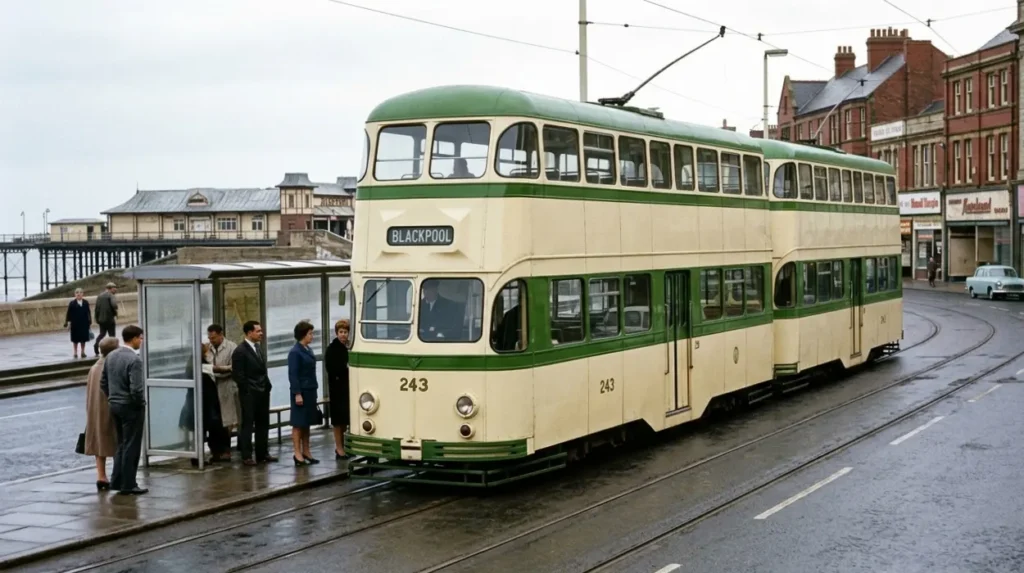
Between 1930 and 1960, municipal councils across Britain systematically closed and dismantled their first-generation tramline networks. Local government policies favored motor omnibuses and trolleybuses due to perceived lower roadway repair responsibilities, cheaper fuel, and flexible route maneuvering around traffic congestion. London closed its main street tramline system on 5 July 1952, leaving the Blackpool Tramway as the sole surviving first-generation electric street tramway in England by 1963.
Traffic congestion, urban air pollution, and rising motor vehicle usage prompted a light rail rebirth during the late twentieth century. Municipalities opened four notable second-generation tramline networks across the United Kingdom: Tyne and Wear Metro in 1980, Manchester Metrolink in 1992, Sheffield Supertram in 1994, and London Tramlink in May 2000.
What Are the Key Structural Components of Modern Tramlines?
Modern tramlines consist of steel grooved rails, concrete slab track foundations, overhead line electrification systems, power substations, and signal safety systems. These integrated engineered elements ensure structural stability, continuous electric power transmission, and safe vehicle movement across dense streetscapes.
The construction of modern tramline infrastructure requires specialized civil, structural, and electrical engineering systems designed to withstand heavy axle loadings, thermal expansion, and harsh weather conditions. The foundational element of a modern tramline is the trackbed structure, which must support static and dynamic loads exceeding 10 to 12 tonnes per vehicle axle. Civil engineers deploy two foundational track structure formats: ballasted trackbeds constructed with 300 millimetres of crushed igneous rock ballast over compacted subgrade, and unballasted concrete slab trackbeds constructed with steel-reinforced concrete slabs ranging from 250 to 350 millimetres in depth.
Steel rails used in tramline construction are manufactured according to strict European standard specifications, such as BS EN 14811 for grooved rails and BS EN 13674 for flat-bottom Vignoles rails. High-carbon steel alloys, including steel grades R260 and heat-treated R350HT, provide resistance against rail wear, corrugation, and wheel-rail interface degradation. Electrical power equipment forms the second core structural pillar, utilizing traction feeder substations spaced every 1.5 to 3.0 kilometres along the alignment to convert alternating current (AC) grid power from national distribution utilities into 750V DC traction current.
Trackbed Civil Engineering and Steel Rail Profiles
Tramline trackbeds incorporate four distinct engineering components: running rails, rail fasteners, elastomeric elastomeric surrounding boots, and sub-slab drainage channels. Grooved rail profiles, specifically 59R2 (RI59) and 60R2 (RI60) profiles, feature a wide rail foot, a vertical web, a rounded running head, and an adjacent guard lip that forms the flangeway channel. Rail anchors, such as Pandrol clips or Vossloh tension clamps, secure the rail to steel baseplates embedded directly into the concrete track slab. Elastomeric boot jackets made from synthetic rubber wrap around the foot and web of grooved rails prior to concrete pouring. These jackets provide two key engineering benefits: mechanical vibration damping that attenuates structure-borne noise in surrounding urban buildings, and electrical insulation that blocks stray traction currents from entering municipal utility pipelines and corroding buried metal infrastructure.
Electrification and Power Transmission Infrastructure
Tramline electrification architecture consists of three structural hardware sub-systems: traction power substations, overhead contact systems (OCS), and return current grounding circuits. Traction substations receive three-phase AC electrical supply at 11 kilovolts (kV) or 33 kV from regional electricity distribution network operators (DNOs). Internal transformer-rectifier units step down and convert the voltage into 750V DC output, which feeds direct positive current to overhead feeder cables.
The overhead contact system comprises hard-drawn grooved copper contact wire suspended 5.0 to 5.8 metres above the rail surface from cantilever arms mounted on steel traction poles or structural wall building rosettes. Light rail vehicles draw current through a roof-mounted single-arm pantograph fitted with carbon contact strips. The running steel rails serve as the negative return conductor, directing the electric current back to the substation to complete the electrical circuit.
How Do Modern Tramlines Function and Operate in Urban Infrastructure?
Tramlines function by delivering electric current from overhead catenary wires or ground-level power systems to vehicle traction motors, completing the circuit through running rails. Automated signalling and traffic light priority ensure rapid, safe, uninterrupted transit through complex city intersections.
The operational performance of a modern tramline network relies on real-time integration between vehicle propulsion technology, trackway guidance mechanisms, traffic signal automation, and centralized operations control centres (OCC). When a tramcar driver advances the master controller, onboard power electronics feed 750V DC current from the pantograph into variable-voltage variable-frequency (VVVF) inverter drives. These inverters convert the direct current into three-phase alternating current to power asynchronous AC induction traction motors mounted on the vehicle wheel bogies.
Vehicle guidance is achieved purely through mechanical wheel-rail contact without manual steering intervention. As the tramcar traverses curves, the conical profile of the steel wheel treads combined with wheel flanges reacting against the internal flangeway of grooved rails keeps the vehicle centered on the track alignment. At track junctions, motorized point switch mechanisms move flexible switch blades to direct tramcars onto diverging tramlines. These point mechanisms are actuated electronically via vehicle-to-infrastructure (V2I) induction loops buried in the trackbed or through inductive radio control commands transmitted directly from the driver cabin.
Electric Power Distribution and Return Current Mechanics
Traction mechanics on modern tramlines utilize regenerative braking energy management systems. When a tramcar decelerates, the onboard traction motors switch into generator mode, converting the kinetic energy of the moving vehicle back into electrical energy. This regenerated electric current flows upward through the pantograph into the overhead contact wire to power adjacent accelerating tramcars operating on the same feeder section.
In systems equipped with energy storage devices, such as supercapacitors or lithium-ion battery banks installed in substations or onboard vehicles, regenerated power is stored locally to peak-shave power grid demand. Where overhead catenary wires are prohibited due to historic urban heritage regulations, municipalities install ground-level power supply systems, such as Alstom APS (Alimentation par le Sol). Ground-level systems utilize a segmented neutral third rail placed between the running rails that energizes radio-controlled 8-metre conductive segments only when fully covered by an approaching tramcar.
Traffic Signal Priority and Intersection Integration
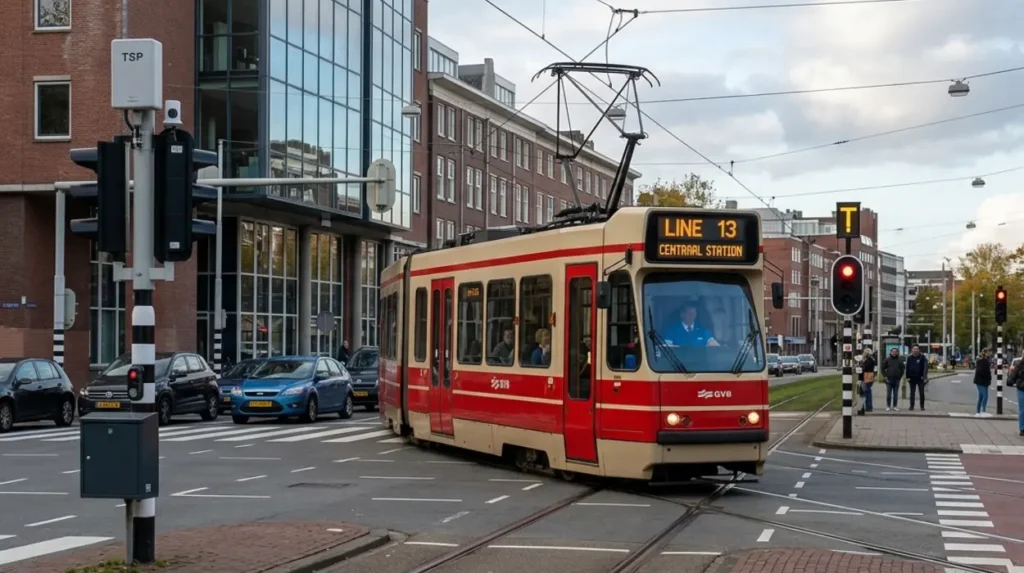
To maintain competitive journey times through congested urban street grids, tramline operators deploy Transit Signal Priority (TSP) technologies. TSP operates through three tracking technologies: buried electromagnetic inductive loops, radio frequency identification (RFID) transponders, and Global Positioning System (GPS) Automatic Vehicle Location (AVL) tracking. As a tramcar approaches a signalized road intersection, trackside detectors sense the vehicle presence 200 to 400 metres away and transmit an advance priority request to the municipal traffic signal controller.
The traffic controller executes one of two signal interventions: a Green Extension, which holds an existing green light open until the tramcar clears the junction, or an Early Green (Red Truncation), which shortens conflicting traffic light phases to provide an immediate green transit signal to the tramcar. The operational integration of transit signal priority increases average tramline commercial operating speeds from 14 kilometres per hour up to 26 kilometres per hour in congested city corridors.
What Are Real-World Examples of Major Tramline Networks Globally?
Major tramline networks operate worldwide, including London Tramlink in the United Kingdom, Melbourne Tram Network in Australia, Manchester Metrolink in England, and Strasbourg Tramway in France. These networks move millions of passengers daily across extensive urban track miles.
Metropolitan transit agencies worldwide operate diverse tramline systems tailored to regional urban layouts, geographic terrain, and passenger demand volumes. Four major international tramline networks demonstrate the scale and adaptability of modern light rail systems:
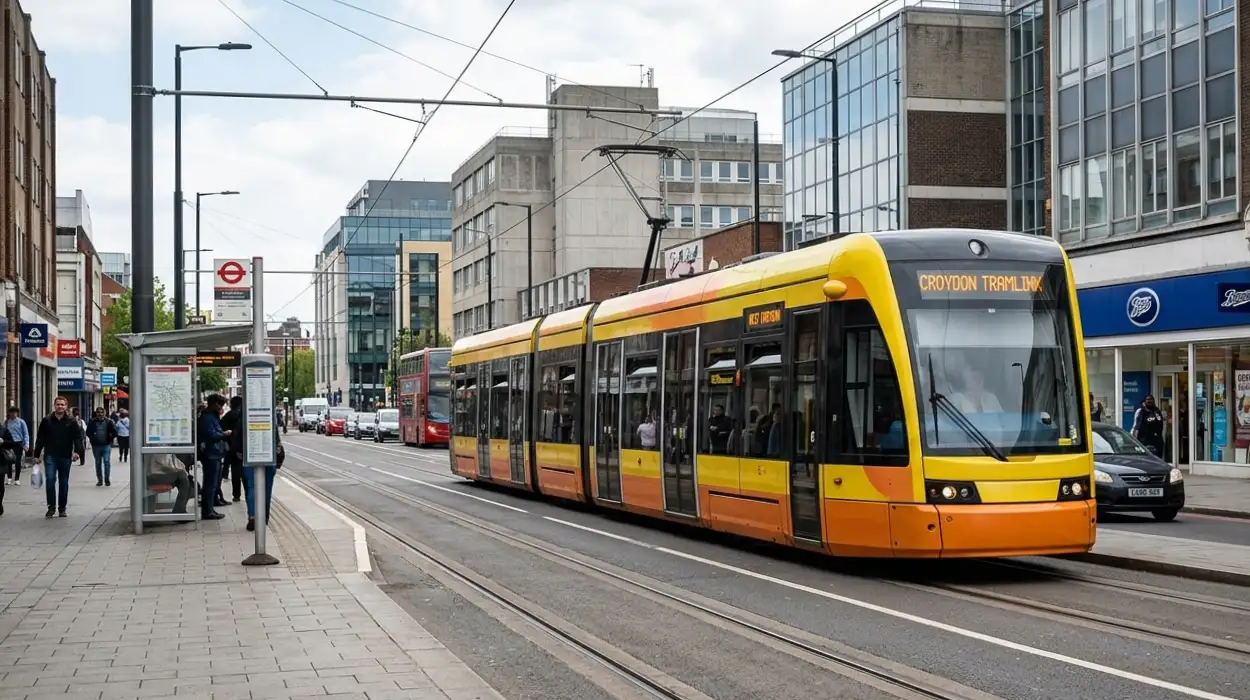
In South London, London Tramlink operates across 28 kilometres (17.4 miles) of track containing 39 passenger stops centered on the Croydon transport hub. Established under the Croydon Tramlink Act 1994 and opened to the public in May 2000, the network connects four key London boroughs: Croydon, Merton, Sutton, and Bromley. London Tramlink operates four color-coded services using a fleet of 24 low-floor light rail vehicles, including Bombardier CR4000 articulated tramcars and Stadler Variobahn units. The system combines three distinct track environments: re-used disused heavy rail corridors (such as the former Woodside and Kingswood Railway), dedicated off-street alignments, and street-running grooved trackways through central Croydon shopping districts.
British Tramline Systems and Capital Infrastructure
The United Kingdom contains six major second-generation operational light rail tramline networks: London Tramlink, Manchester Metrolink, Sheffield Supertram, West Midlands Metro, Nottingham Express Transit (NET), and Edinburgh Trams. Manchester Metrolink represents the largest light rail system in the UK, operating 103 kilometres (64 miles) of track and 99 stops across eight lines radiating from Manchester city centre. The system carried 44.3 million passenger journeys in the 2019/20 financial year, utilizing a standardized fleet of 147 Bombardier M5000 high-floor light rail vehicles operating at 12-minute headway frequencies.
In South Yorkshire, the Sheffield Supertram system operates 50 stops across 48 kilometres of track, featuring a Tram-Train route that operates on light rail street tracks and Network Rail heavy rail lines using dual-voltage vehicles. In the West Midlands, the West Midlands Metro connects Birmingham and Wolverhampton via a 22-kilometre corridor, featuring battery-powered catenary-free operating sections through central Birmingham historic squares.
International Tramline Networks and High-Capacity Transit Models
Internationally, Yarra Trams in Melbourne, Australia, operates the world’s largest urban tramline network, encompassing 250 kilometres (155 miles) of double track, 24 operating routes, and over 1,700 stops. The system moves over 200 million passengers annually using a mixed fleet of 500 tramcars ranging from historic W-class vehicles to modern three-section E-class Bombardier Flexity streetcars.
In France, the Strasbourg Tramway opened its initial line in November 1994 and grew into a 72-kilometre network serving 86 stations. Strasbourg pioneered modern accessible light rail vehicle design by commissioning Eurotram vehicles with 100% low-floor passenger access, continuous panoramic glass windows, and pedestrian-oriented urban street restructuring that replaced private automobile parking spaces with paved transit boulevards and green grass trackbeds.
What Impact Do Tramlines Have on Urban Mobility and Environmental Sustainability?
Tramlines eliminate direct tailpipe emissions, reduce traffic congestion by replacing thousands of single-occupancy motor vehicles, and stimulate economic regeneration along transit corridors. They deliver accessible, high-capacity transport that increases urban air quality and real estate values significantly.
Tramline infrastructure generates measurable ecological, economic, and social mobility impacts across dense urban areas. From an environmental engineering perspective, electric light rail transit produces zero local tailpipe emissions of harmful air pollutants, including nitrogen dioxide ($\text{NO}_2$), fine particulate matter ($\text{PM}_{2.5}$), and coarse particulate matter ($\text{PM}_{10}$). When powered by electrical grids supplied by renewable energy sources, such as offshore wind, solar photovoltaics, and hydroelectric power, tramlines achieve lifecycle carbon reduction rates of 75% to 90% compared to fossil-fuel-powered internal combustion buses and private diesel automobiles.
The passenger capacity efficiency of tramlines reduces road surface gridlock. A modern 40-metre bi-directional articulated light rail vehicle accommodates between 250 and 300 passengers, occupying approximately 95 square metres of street surface area. Transporting that same volume of 300 commuters in private cars assuming an average vehicle occupancy rate of 1.2 persons requires 250 motor vehicles, which occupy over 1,250 square metres of road space and create traffic congestion queues extending over 1.5 kilometres.
Decarbonization and Air Quality Improvement Data
Transportation sector decarbonization studies conducted by academic institutions, such as the University College London (UCL) Centre for Transport Studies, demonstrate that modal shifts from private motor vehicles to electric light rail produce measurable reductions in urban air toxicity. In transit corridors where municipal councils installed electric tramlines, surrounding ambient nitrogen dioxide concentrations decreased by 20% to 35% within 36 months of service commencement.
Furthermore, light rail vehicles operating on steel rails exhibit three-fold lower rolling resistance compared to rubber-tired electric buses running on asphalt pavement. This lower mechanical resistance reduces energy consumption per passenger-kilometre to approximately 0.05 kilowatt-hours (kWh) under standard operating loads, maximizing grid efficiency.
Urban Density, Economic Regeneration, and Accessibility Standards
Tramline corridors act as permanent catalysts for urban redevelopment, a planning phenomenon known as the “Transit-Oriented Development (TOD) rail effect.” Because rail tracks represent permanent municipal capital commitments that cannot be re-routed overnight like bus paths, private real estate developers concentrate capital projects along fixed tram routes. Financial impact analyses from UK light rail schemes demonstrate that commercial and residential properties located within an 800-metre walk radius of a tramline stop experience capital value premiums of 10% to 25% compared to non-served adjacent neighborhoods.
In terms of social accessibility, modern low-floor tramcars feature 100% step-free boarding directly from station platform edges raised 300 millimetres above the rail head. This level-boarding architecture eliminates barriers for mobility-impaired passengers, wheel-chair users, and families pushing strollers. This design minimizes platform dwell times to under 20 seconds per station stop, ensuring fast and accessible public transport across the city.
What are tramlines?
Tramlines are fixed steel rail tracks embedded in roads or dedicated corridors that enable electric-powered trams or light rail vehicles to transport passengers efficiently through urban areas.