Covent Garden is one of London’s most recognisable historic districts. Its present identity combines a seventeenth-century planned piazza, a centuries-old market tradition, major theatres, listed buildings, specialist shops, restaurants and street performance.
- What was Covent Garden before it became a London market?
- How did Inigo Jones transform Covent Garden in the 1630s?
- When did the Covent Garden fruit and vegetable market begin?
- Why did Covent Garden become associated with theatres and entertainment?
- How did Covent Garden develop during the eighteenth and nineteenth centuries?
- Why was Covent Garden Market relocated to Nine Elms in 1974?
- How was Covent Garden preserved after the wholesale market closed?
- What historic buildings and architectural features survive in Covent Garden today?
- How did Covent Garden become a modern entertainment and tourism hub?
- What is the long-term historical significance of Covent Garden?
- Frequently Asked Question
The district occupies an important position between the Strand, Soho, Holborn and London’s wider West End. Its history records several major phases of urban development: medieval religious landholding, Stuart-era town planning, commercial market expansion, eighteenth-century theatre culture, Victorian redevelopment, twentieth-century transport pressures and late twentieth-century heritage conservation.
The name Covent Garden derives from the former garden belonging to Westminster Abbey. Historic England records the area as a semi-rural convent garden and orchard in the fifteenth century. After the Dissolution of the Monasteries, the land entered royal ownership and was subsequently granted to the Russell family, whose descendants became the Earls and Dukes of Bedford.
The transformation from religious garden to urban quarter accelerated in the seventeenth century. Architect Inigo Jones created a formal residential development around an open piazza between 1631 and 1639. The design introduced a classical architectural language that influenced later London town planning.
A market appeared within the new development during the seventeenth century. By the eighteenth century, Covent Garden had become a major commercial and theatrical centre. By the nineteenth century, its market required a purpose-built structure. By the twentieth century, traffic congestion and wholesale distribution requirements forced the market to relocate.
The original market disappeared as a wholesale operation in 1974, but the historic buildings survived. The former market complex subsequently became a foundation for retail, dining, tourism and entertainment.
What was Covent Garden before it became a London market?
Before becoming a market, Covent Garden was a medieval Westminster Abbey garden and orchard that later became Crown land and a Bedford family estate. Its transformation began when Inigo Jones planned a classical residential piazza during the early seventeenth century.
The earliest historical identity of Covent Garden was agricultural rather than commercial. The land formed part of the possessions of Westminster Abbey, one of medieval England’s most important religious institutions. The garden served the convent community and included orchard land.
The term “Covent” derives from “convent,” while “garden” described the productive enclosed land. The name therefore reflects the site’s medieval ecclesiastical function.
The religious connection ended during the reign of Henry VIII. In 1536, following the English Reformation and the Dissolution of the Monasteries, the former convent garden passed into royal ownership. The Crown later granted the property to John Russell, the first Earl of Bedford. The Russell family retained ownership for almost four centuries.
This ownership pattern shaped the later development of Covent Garden. The Bedford estate treated land as a long-term economic asset. Residential construction created rental income, while later market activity produced additional revenue.
The area remained comparatively open in the early seventeenth century. London was expanding westward, and aristocratic landowners increasingly recognised the value of planned residential development.
The Bedford estate therefore commissioned Inigo Jones to transform the former garden into an organised urban quarter. This decision established the architectural framework that still defines much of the district.
How did Inigo Jones transform Covent Garden in the 1630s?
Inigo Jones transformed Covent Garden from open estate land into a planned classical residential quarter between 1631 and 1639. His piazza introduced Italian-inspired urban design, while St Paul’s Church established a monumental architectural focus on the western side.
Inigo Jones was an English architect and designer associated with the introduction of Italian Renaissance and classical architectural principles into English building. His Covent Garden scheme represented an important stage in the development of planned London terraces.
The development began around 1631. Jones created an open square surrounded by residential buildings. The design drew from continental European models and established a regular relationship between architecture, public space and movement.
The centrepiece was the Piazza. It functioned as an open urban space rather than a traditional medieval street. Residential buildings formed an organised enclosure around it.
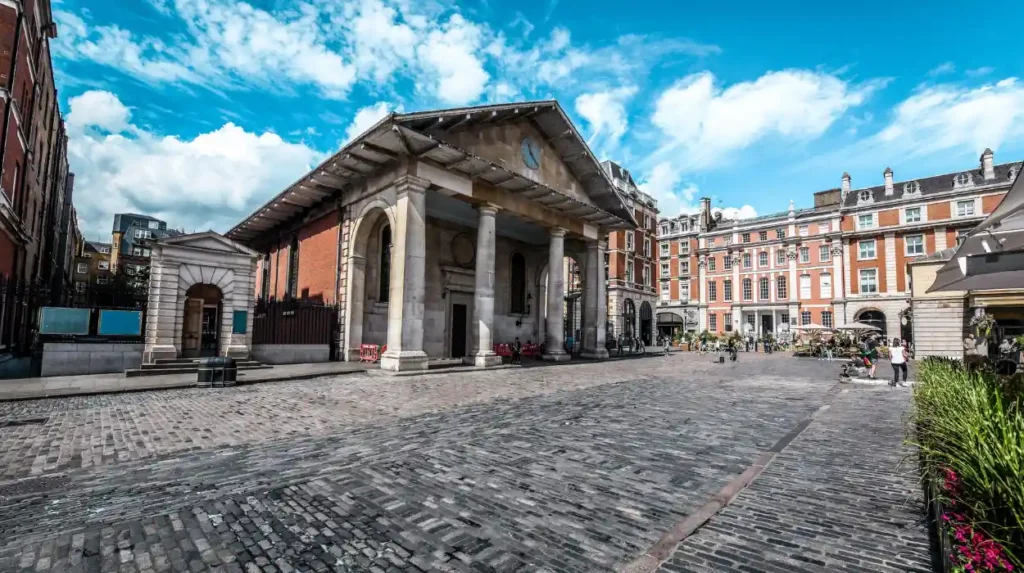
St Paul’s Church, Covent Garden, was built between 1631 and 1638 to Jones’s designs. Historic England lists the church at Grade I, recognising its exceptional architectural and historical importance. The building has a plain rectangular hall, a monumental east portico and a strong classical composition.
The church became an important landmark because it connected religious architecture with the new residential development. Its position also helped define the western edge of the Piazza.
Jones’s design influenced the development of later London terraces. Historic England identifies Covent Garden as an early example of the regular piazza terrace and notes its influence on the evolution of planned urban housing.
The original buildings did not all survive unchanged. Several were rebuilt or substantially altered. Historic England records the present Bedford Chambers development as a nineteenth-century rebuilding that retained elements of Jones’s original arcade concept.
The architectural significance therefore rests not only on surviving seventeenth-century fabric. It also rests on the persistence of the original street pattern, spatial arrangement and classical planning principles.
When did the Covent Garden fruit and vegetable market begin?
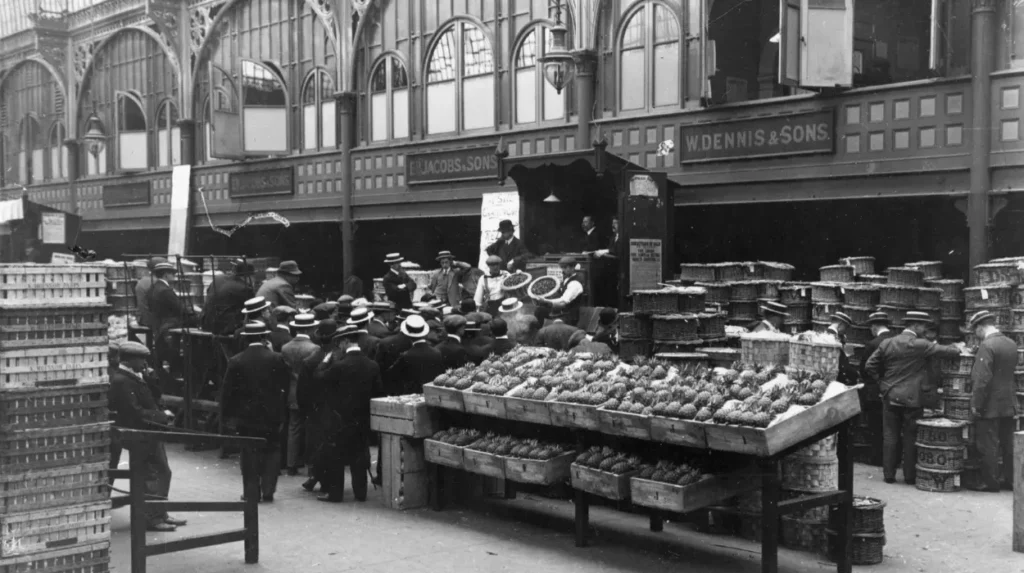
The first written reference to a “new market in Covent Garden” dates from 1654. The market expanded rapidly after the Restoration, received formal legal recognition in 1670, and became London’s principal fruit, vegetable and flower market.
Market activity developed after the creation of the Piazza. Traders used the open space to sell food, despite the original residential character of the development.
The first written reference to the “new market in Covent Garden” dates from 1654. By 1667, local authorities were already concerned about waste and disorder generated by market activity.
The market received formal legal recognition in May 1670. The fifth Earl of Bedford secured letters patent allowing a regulated market to operate within the Piazza. The grant allowed trading on every day except Sundays and Christmas Day.
The original rules restricted the market to fruit, flowers, roots and herbs. The market also remained confined to the Piazza. The Bedford family could charge traders for access and effectively controlled the commercial value of the market.
Market rents demonstrate the growing economic importance of the site. The annual value of the market lease rose from £5 in 1670 to £2,500 in 1798. This increase reflected the rising commercial importance of Covent Garden and the expansion of London’s population.
The Great Fire of London in 1666 destroyed large areas of the City of London east of Covent Garden. Covent Garden itself became increasingly important as a source of fresh produce for the growing capital. After the fire, the Piazza became heavily associated with fruit and vegetable trading.
The market also generated employment. Farmers, growers, wholesalers, porters, stallholders, carriers and retailers became part of its commercial network.
The market’s growth changed the character of the surrounding neighbourhood. Streets designed for residential occupation increasingly accommodated deliveries, trading, storage and pedestrian crowds.
Why did Covent Garden become associated with theatres and entertainment?
Covent Garden became a major entertainment centre because theatre development expanded around the market from the eighteenth century. The first theatre opened in 1732, establishing a cultural tradition that later developed through opera, ballet, music and street performance.
Theatre became an important part of Covent Garden after the Restoration of the monarchy in 1660. The Restoration ended the period when Parliament had closed public theatres during the Commonwealth.
The first theatre on the present Royal Opera House site opened in 1732. It was known as the Theatre Royal, Covent Garden. The building established a long-running theatrical association with the district.
The theatre site experienced repeated rebuilding. The first building was altered by architect Henry Holland in 1792 before being destroyed by fire in 1808. A second Theatre Royal opened in 1809 and was designed by Robert Smirke.
The second theatre became associated with major theatrical performances and later with Italian opera. In 1847 it was converted into the Royal Italian Opera House. Another fire destroyed the building in the mid-1850s.
Architect Edward Middleton Barry designed the third theatre, which opened in 1858. The present Royal Opera House therefore represents the third major theatre on the site.
The Royal Opera House is now Grade I listed. Historic England recognises its architectural quality, Victorian construction technology and nearly three centuries of theatrical and operatic continuity on the site.
The entertainment economy extended beyond the principal theatre. Covent Garden attracted actors, musicians, composers, publishers, booksellers, artists and other cultural workers.
Street entertainment also has a long history. The current Covent Garden estate records a 1662 reference in Samuel Pepys’s diary to a marionette performance featuring Punch on the Piazza. Modern street performance continues this longstanding association between public space and entertainment.
Covent Garden therefore developed through overlapping commercial and cultural economies. The market supplied food, while theatres and public entertainment attracted audiences. Shops, coffee houses and professional services grew around both activities.
How did Covent Garden develop during the eighteenth and nineteenth centuries?
During the eighteenth and nineteenth centuries, Covent Garden expanded as a market, theatre district and commercial neighbourhood. Population growth, urban congestion, changing property values and new transport requirements gradually transformed its buildings, streets and economic functions.
The eighteenth century brought rapid commercial expansion. Market trading became increasingly intensive, while theatre audiences added another large source of pedestrian activity.
The market also created social problems. A 1748 petition from local residents complained about noise, smells, obstructed streets, alcohol sales and disorder. Residents also linked these conditions to declining property values.
These complaints demonstrate an important feature of urban history. Commercial success produced pressure on residential environments. Covent Garden needed to accommodate food distribution while remaining a functioning neighbourhood.
Seven Dials developed north of Covent Garden during the 1690s. Thomas Neale, a Member of Parliament and property developer, established a radial street arrangement designed to maximise the number of rentable houses. The seven streets converged on a central point.
The surrounding district also acquired a reputation for poverty and crime. Historic England records that by around 1800, the wider neighbourhood, particularly St Giles, was associated with poverty, street crime and prostitution.
The nineteenth century brought a major architectural response to the market’s problems. John Russell, sixth Duke of Bedford, sought government approval for the improvement and regulation of Covent Garden Market.
A parliamentary measure in 1828 enabled the redevelopment of the market. Architect Charles Fowler designed a purpose-built market complex, replacing the informal stalls that had occupied the Piazza.
The new market opened in May 1830. Construction cost approximately £61,000, including £34,850 paid to contractor William Cubitt. The design introduced a formal arrangement of market ranges, colonnades and circulation spaces.
Fowler’s building represented a major advance in functional market architecture. Its design responded directly to commercial requirements while maintaining a strong classical appearance.
The market complex was subsequently expanded. Historic England records that open market spaces were roofed during 1874–75 and 1888–89 using iron columns, arches and roof structures.
These changes reflected Victorian advances in structural engineering. Iron construction allowed large covered market spaces while maintaining ventilation and daylight.
The Victorian period also strengthened Covent Garden’s theatre identity. Edward Middleton Barry’s Royal Opera House and Floral Hall formed an important cultural complex beside the market.
Floral Hall was constructed in 1858–59 as a glass-and-iron multipurpose space associated with the Royal Opera House. It later became connected to market activity before being incorporated into the modern Royal Opera House complex.
Why was Covent Garden Market relocated to Nine Elms in 1974?
Covent Garden Market moved to Nine Elms in November 1974 because the historic central London site could no longer accommodate modern wholesale operations, heavy traffic, vehicle access, storage requirements and efficient market distribution.
By the twentieth century, Covent Garden Market faced a fundamental logistical problem. The historic site had become surrounded by dense urban development.
Wholesale trading required increasingly large volumes of produce to enter and leave the district. Modern lorries required road space, while market businesses required storage, loading areas and efficient circulation.
Parliamentary evidence in 1970 recorded the scale of the problem. Approximately 1 million tons of fruit, vegetables and potatoes passed through the market annually, alongside flowers valued at about £12 million. Marketing activity affected more than 30 acres of the surrounding area.
The Covent Garden Market Act 1961 established the Covent Garden Market Authority as a statutory corporation. A statutory corporation is a public body created by legislation to exercise defined legal functions.
The 1961 legislation responded to planning and traffic problems and gave the authority powers to improve or replace the existing market.
Studies concluded that rebuilding the wholesale market in its historic location was impractical. The Covent Garden Market Act 1966 enabled the authority to proceed with relocation.
Nine Elms, south of the River Thames in the present London Borough of Wandsworth, became the new location. The site offered significantly more space for wholesale operations.
The market moved in November 1974. The institution continued under the name New Covent Garden Market. Parliamentary records identify the Nine Elms site as the market’s present location and record its establishment there from 1974.
The relocation separated two functions that had previously occupied the same place. Wholesale horticultural distribution moved to a modern logistics site, while the historic Covent Garden buildings became available for alternative urban uses.
The move therefore did not end the history of Covent Garden Market. It divided that history between the historic Piazza and the continuing wholesale market at Nine Elms.
How was Covent Garden preserved after the wholesale market closed?
After the wholesale market moved in 1974, Covent Garden underwent heritage-led redevelopment that retained historic buildings, streets and public spaces while introducing shops, restaurants, cultural venues and tourism uses within the former market district.
The closure of the original wholesale market created a major redevelopment challenge. The site contained historic architecture but also required new economic functions.
The preservation debate formed part of a wider twentieth-century shift in British attitudes toward historic urban environments. Demolition and large-scale redevelopment had removed many historic buildings in London during the post-war period.
Covent Garden became an important conservation campaign. The survival of the historic district depended on retaining buildings and the existing urban grain rather than replacing the entire area with modern development.
The Covent Garden Conservation Area was first designated in 1971. Westminster records show later extensions in 1974, 1978, 1987 and 2007. Conservation areas are designated places where special architectural or historic character receives additional planning protection.
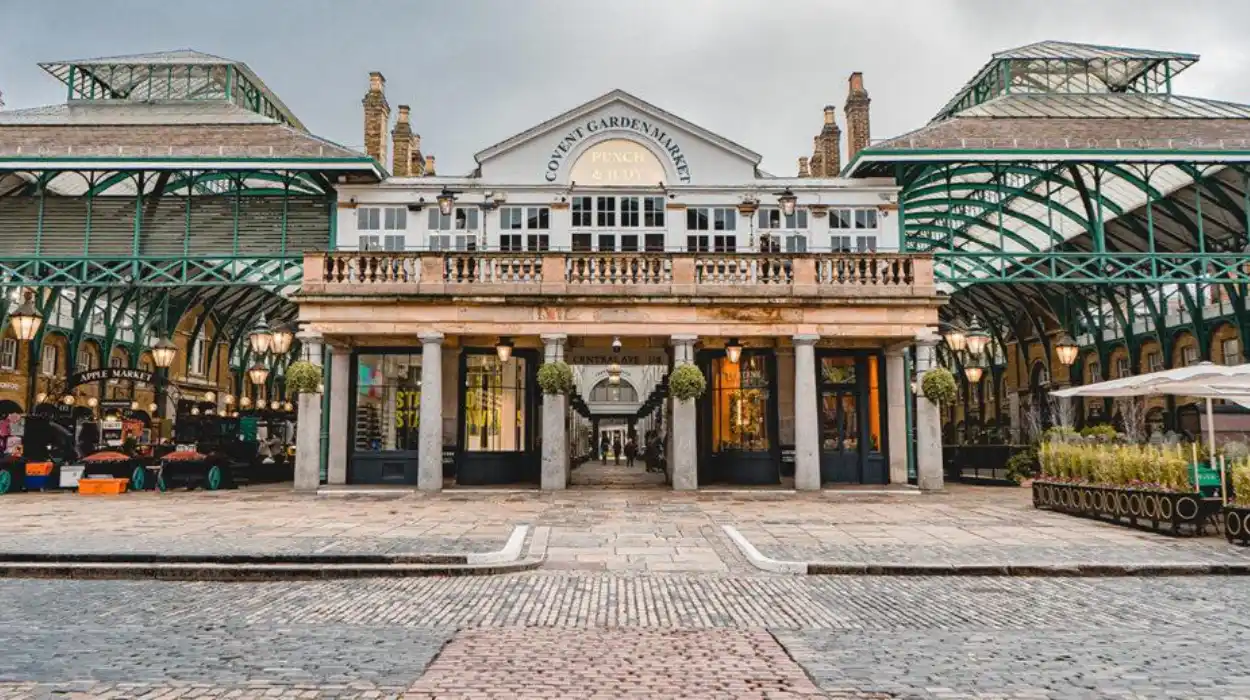
The market buildings were particularly important. Historic England lists Covent Garden Market Building as Grade II*. The Grade II* category identifies particularly important buildings of more than special interest.
The market complex retains its nineteenth-century colonnades, central avenue and covered market structures. Historic England records the later nineteenth-century roof additions and subsequent restoration by the Greater London Council.
The former market building was subsequently adapted for new commercial uses. The Apple Market occupies part of the historic complex today and hosts handmade crafts, jewellery, prints, watercolours and other goods. Mondays are dedicated to antiques and collectables.
The redevelopment demonstrated adaptive reuse. Adaptive reuse means giving an existing historic building a new function while retaining significant architectural fabric.
This approach preserved the physical evidence of the market era while changing the economic purpose of the district.
To experience this historic landmark in person today, consult our comprehensive [Best Places to Explore in Soho for Food, Music, and Cultural Experiences] for itineraries and visiting parameters.
What historic buildings and architectural features survive in Covent Garden today?
Covent Garden retains a dense collection of protected historic buildings, including the Market Building, St Paul’s Church, Royal Opera House, historic terraces and Seven Dials streets, creating a continuous architectural record from the seventeenth century to today.
The Market Building remains the most visible reminder of Covent Garden’s wholesale market history. Its Greco-Roman architectural language reflects Charles Fowler’s functional approach to nineteenth-century market design.
The building is arranged around market ranges and a central avenue. Its Doric colonnades, pediments, arcades and roof structures remain defining features of the Piazza. Historic England designated it Grade II* in 1958.
St Paul’s Church remains another essential part of the seventeenth-century landscape. Designed by Inigo Jones and constructed between 1631 and 1638, it represents the earliest surviving architectural phase of the planned Covent Garden development.
The Royal Opera House represents the district’s long theatrical continuity. The present building was constructed in 1857–58 to designs by Edward Middleton Barry. Historic England identifies it as Grade I listed.
The building also demonstrates architectural adaptation. A major west extension was constructed between 1979 and 1982, while a substantial southern extension was completed between 1996 and 2000. The later work incorporated modern facilities while referencing the historic Piazza.
Floral Hall provides another example of adaptive heritage. Originally constructed in 1858–59, the structure used glass and iron and functioned as a multipurpose hall beside the theatre. It was later dismantled and substantially re-erected during the Royal Opera House redevelopment.
Part of the original Floral Hall survives elsewhere. Its portico was relocated to Borough Market in Southwark around 2003 and is itself listed Grade II. The relocation demonstrates how historic architectural components can survive through careful reuse even when their original urban context changes.
Seven Dials also retains elements of its seventeenth-century planning concept. Thomas Neale’s radial layout remains legible in the street pattern, even though many buildings have been rebuilt.
These surviving structures create a layered architectural environment. Medieval landholding, Stuart planning, Georgian commerce, Victorian engineering, twentieth-century conservation and contemporary cultural development are all represented within a relatively compact area.
How did Covent Garden become a modern entertainment and tourism hub?
Covent Garden became a modern entertainment hub after wholesale trading ended, as heritage conservation enabled the historic market buildings and streets to support retail, restaurants, cultural venues, theatre audiences, crafts, tourism and regulated street performance.
The end of wholesale trading fundamentally changed Covent Garden’s economic model. Heavy market logistics disappeared from the Piazza, reducing the need for large-scale delivery operations.
The historic buildings then became valuable assets for retail and leisure. Their architectural character attracted businesses and visitors while maintaining the visual identity of the former market.
The Royal Opera House remained the district’s principal cultural institution. Its theatre, opera and ballet programmes continued the performance tradition established on the site in 1732.
Street performance became another important part of the modern identity. Contemporary Covent Garden provides designated performance spaces within the Market Building, including the North Hall and South Hall. Performance activity is regulated because the building is listed.
The West Piazza also supports public performances. The modern street-performance tradition connects directly with the documented history of public entertainment on the Piazza, including the 1662 marionette performance recorded by Samuel Pepys.
Retail activity has also retained a market connection. The Apple Market continues to operate inside the historic Market Building, although its products now primarily consist of handmade crafts and other specialist goods rather than wholesale fruit and vegetables.
Restaurants and cafés occupy buildings that previously served commercial, residential and market functions. This represents another form of adaptive reuse.
The modern district therefore does not reproduce the nineteenth-century market. Instead, it preserves selected architectural structures while assigning them contemporary economic functions.
This distinction is important for understanding heritage. Historic preservation does not require every building to retain its original use. It requires significant historic character and fabric to remain legible while buildings continue to function.
Covent Garden demonstrates this principle particularly clearly. The market building remains recognisable as a market structure even though its commercial purpose has changed.
The Royal Opera House similarly combines historic architectural character with modern theatre technology. Its twentieth-century extensions incorporated rehearsal rooms, studios, workshops, offices, foyers, stage facilities and other infrastructure required by a major contemporary performing-arts organisation.
What is the long-term historical significance of Covent Garden?
Covent Garden’s long-term significance comes from its continuous relationship between public space, commerce, architecture and entertainment. Its surviving buildings document London’s urban development from medieval landholding through planned housing, wholesale trade, theatre culture and heritage-led regeneration.
Covent Garden is significant because several different histories overlap within one district.
Its medieval history explains the name and original land use. The Dissolution of the Monasteries explains the transfer of the land from Westminster Abbey to the Crown.
The Bedford family explains the transformation from private estate to planned residential development. Inigo Jones explains the introduction of classical urban design.
The 1654 market reference and 1670 legal grant explain the institutional development of commercial trading. The market’s later expansion demonstrates the economic impact of London’s population growth.
The Royal Opera House explains the development of Theatreland and the continuing importance of Covent Garden as a cultural district. Its repeated rebuilding also records the risks of fire and the evolution of theatre architecture.
Charles Fowler’s 1830 market explains the nineteenth-century transition from informal stalls to purpose-built commercial infrastructure.
The 1961 legislation and 1974 relocation explain the twentieth-century shift from traditional central markets to modern logistics.
The 1971 conservation designation and later redevelopment explain how heritage protection influenced the district’s modern identity.
The history also demonstrates the importance of transport in shaping London. Wholesale markets required efficient movement of large quantities of goods. As road traffic increased, the historic central location became increasingly unsuitable for large-scale distribution.
The relocation to Nine Elms preserved the wholesale market institution while freeing the original Covent Garden buildings for a different economic role. The New Covent Garden Market continues the horticultural tradition at its modern site. The London wholesale market system still recognises Nine Elms as an important horticultural distribution centre.
The market’s institutional continuity remains substantial. The Covent Garden Market Authority continues to oversee the wholesale market under legislation originating with the Covent Garden Market Act 1961 and subsequent amendments.
The historical significance of Covent Garden therefore extends beyond tourism. It provides a useful case study in urban history, architectural conservation, commercial geography, theatre history and adaptive reuse.
For educators, the district offers a compact example of how London developed through successive economic systems. For historians, its buildings provide evidence of changing architectural ideals. For genealogical researchers, market records, parish histories and occupational histories provide routes into studying people who lived and worked in the neighbourhood.
For conservationists, Covent Garden demonstrates the value of protecting historic urban character while permitting economic change.
The district’s present identity is consequently the result of several centuries of adaptation rather than a single redevelopment project. The former convent garden became a planned piazza, the piazza became a market, the market became a major wholesale distribution centre, and the historic market district became a cultural and entertainment destination.
That sequence explains why Covent Garden remains one of London’s most historically layered urban environments.
Frequently Asked Question
What is the history of Covent Garden?
Covent Garden began as land belonging to Westminster Abbey and was known as a convent garden. After the Dissolution of the Monasteries, it became part of the Crown estate before passing to the Russell family. In the 1630s, architect Inigo Jones developed the area into a planned residential piazza.