Hyde Park is one of London’s most significant historic landscapes. Covering approximately 142 hectares, or 350 acres, it developed from monastic land into a Tudor hunting ground, a royal recreation space, a public park, a national event venue, and a protected heritage landscape. Its history reflects major changes in British monarchy, urban development, landscape design, public access, political expression, and heritage conservation.
- How did Hyde Park begin as royal land in Tudor England?
- Why did Hyde Park change from a hunting ground into a public space?
- How did royal landscape design create the Hyde Park seen today?
- How did Hyde Park become part of London’s expanding urban landscape?
- Why did Hyde Park become a major venue for national events?
- How did Hyde Park become associated with political protest and free speech?
- What historic features still show Hyde Park’s royal and public past?
- How is Hyde Park protected as a historic landscape today?
- Why does Hyde Park remain historically important to London today?
- Frequently Asked Question
Located in central London, Hyde Park sits beside Kensington Gardens and forms part of a wider historic network of Royal Parks. The park has remained important because each major period of British history left physical evidence within its landscape. Its boundaries, roads, lake, riding routes, memorials, entrances, and public spaces record nearly five centuries of continuous change.
Historic England registers Hyde Park as a Grade I Park and Garden, recognising its exceptional national historic importance. The park’s development also demonstrates how royal land gradually became public infrastructure while retaining its historic identity.
How did Hyde Park begin as royal land in Tudor England?
Hyde Park began as agricultural and monastic land before King Henry VIII acquired it in 1536, enclosed it as a royal hunting ground in 1540, and established the foundations of a landscape that later developed into one of London’s most important public parks.
Before becoming a royal park, the land belonged to Westminster Abbey. The area consisted primarily of agricultural land connected to the Abbey’s wider estates in and around London.
The transformation occurred during the reign of King Henry VIII. In 1536, Henry acquired the land through an exchange involving Westminster Abbey. This period coincided with the Tudor Crown’s wider restructuring of religious institutions and land ownership.
Henry VIII expanded royal control over land across London and used large enclosed landscapes for hunting, military activity, and recreation. Hyde Park became part of a wider royal geography that included areas associated with St James’s Park, Greenwich Park, and other Crown-controlled landscapes.
In 1540, Hyde Park was enclosed as a deer park. A deer park was a defined landscape used for maintaining and hunting deer under aristocratic or royal control. Enclosure separated the royal hunting ground from surrounding agricultural and urban land.
The park’s original purpose was therefore very different from its modern role. It was not created as a public garden, municipal park, or recreational space for London residents. It was a controlled royal landscape designed around the privileges of the Tudor monarchy.
Hunting held political and social importance in Tudor England. Royal hunting landscapes demonstrated land ownership, authority, wealth, and access to natural resources. Deer were valuable animals, and maintaining hunting grounds required extensive territory and management.
Hyde Park’s location also made it strategically useful. It stood west of the historic City of London and close to major royal residences and routes. Over time, London’s expansion surrounded the park, transforming what had once been a peripheral royal landscape into a major green space within the capital.
Historic England identifies Hyde Park’s early development as that of a sixteenth-century royal deer park that later became a public amenity. This transition from exclusive royal territory to public landscape remains the central process behind Hyde Park’s modern identity.
Why did Hyde Park change from a hunting ground into a public space?
Hyde Park changed because seventeenth-century monarchs gradually allowed public access, reducing its exclusive hunting function and establishing new uses for recreation, travel, social activity, and public gathering, beginning a permanent transition from royal territory toward shared urban space.
The Stuart period fundamentally changed Hyde Park’s relationship with Londoners.
King James I, who came to the English throne in 1603, permitted limited access to sections of the park. This access remained socially restricted and largely benefited courtiers and wealthy visitors connected to royal life.
The decisive change came in 1637 under King Charles I. Charles opened Hyde Park to the general public. The Royal Parks identifies Hyde Park as the first of London’s Royal Parks to receive this broader public access.
Public access changed how the landscape functioned. Hunting no longer defined every part of the park. Visitors increasingly used Hyde Park for walking, riding, driving carriages, and social interaction.
One important feature was the Tour, later known as the Ring. This route became a place where fashionable London society displayed horses and carriages. By the 1630s, it represented a broader transition from hunting and military activity toward organised leisure.
The Great Plague of London also demonstrated the park’s practical importance as open land. In 1665, Hyde Park provided refuge for people leaving infected areas of London. The event showed how large open spaces could serve wider urban needs during periods of crisis.
The Civil War and Commonwealth created another major interruption in Hyde Park’s history. In 1652, Parliamentarian authorities divided the park into five sections and sold the land to private purchasers. Historic England records that many mature trees were cut down during this period.
After the Restoration of the monarchy in 1660, Hyde Park returned to royal ownership. Contemporary descriptions recorded a severely altered landscape. The grounds were reopened, enclosed again, and restocked with deer.
These events demonstrate that Hyde Park’s survival was not automatic. Political change repeatedly affected ownership, access, trees, infrastructure, and land management.
The park nevertheless retained its importance because its large size and location made it increasingly valuable to London. As the capital expanded westward, Hyde Park became an important permanent open space surrounded by growing districts.
How did royal landscape design create the Hyde Park seen today?
Queen Caroline’s eighteenth-century redesign created many of Hyde Park’s defining features by separating Kensington Gardens, introducing the Serpentine, and applying new landscape principles that replaced rigid formal design with a more natural-looking and influential park environment.
The eighteenth century produced one of the most important transformations in Hyde Park’s physical history.
Queen Caroline, the wife of King George II, played a central role in reshaping the landscape during the 1720s and 1730s. Her changes connected Hyde Park to major developments in British landscape design.
One of her most significant decisions involved Kensington Gardens. Approximately 300 acres were separated from Hyde Park to form the enlarged landscape associated with Kensington Palace.
The separation was marked by a ha-ha. A ha-ha is a recessed landscape boundary consisting of a ditch and retaining wall. It creates a physical barrier while preserving an uninterrupted view across the landscape.
The ha-ha demonstrated changing ideas about gardens and parkland. Earlier formal landscapes often relied on highly visible walls, straight avenues, geometric arrangements, and rigid boundaries. The eighteenth-century approach increasingly valued wider views and landscapes designed to appear more natural.
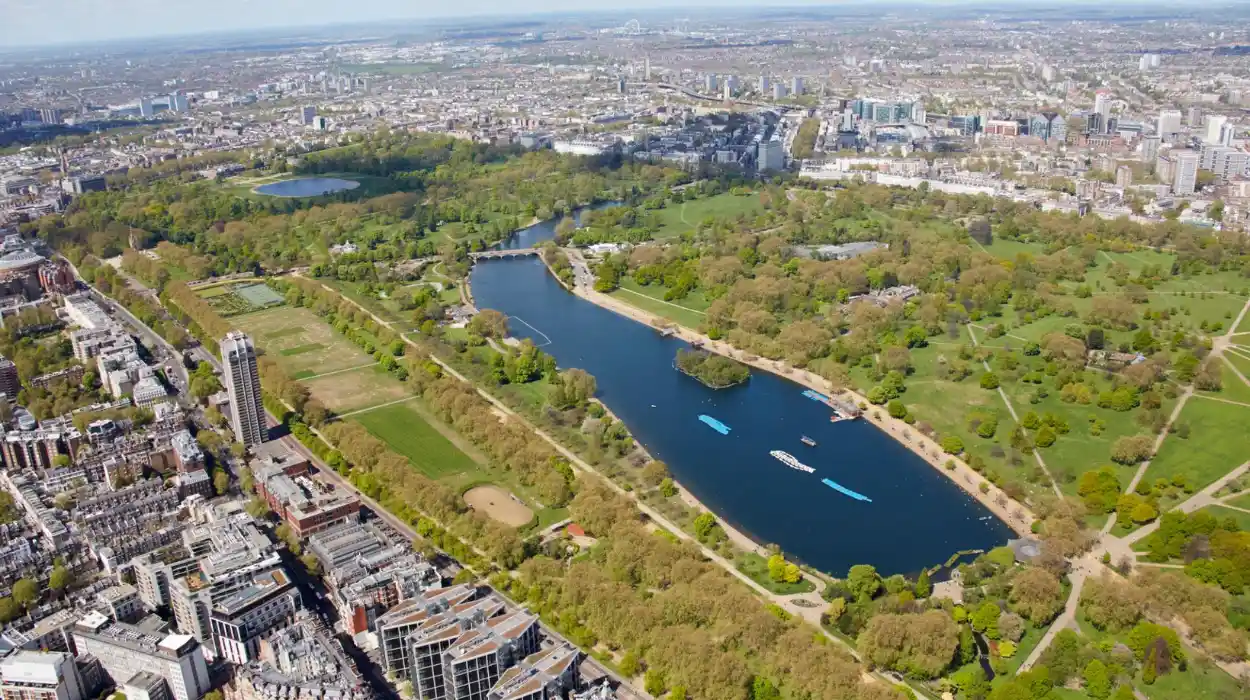
Queen Caroline also created the Serpentine by damming the Westbourne Stream. The lake became one of the most recognisable features in Hyde Park.
The Serpentine represented an important departure from earlier artificial water features. Many formal gardens used straight canals and geometrically arranged lakes. The Serpentine was designed with an irregular, natural-looking form.
This approach influenced landscape design beyond Hyde Park. Naturalistic water and irregular parkland became major features of eighteenth-century British landscape architecture.
The landscape established during Queen Caroline’s redesign remains central to the park’s modern appearance. Visitors still encounter the relationship between open grassland, water, trees, paths, and broad views that emerged from this period of royal intervention.
Hyde Park therefore became historically important not simply because of its size. Its landscape recorded changing ideas about how nature should be designed, controlled, and experienced within a major capital city.
How did Hyde Park become part of London’s expanding urban landscape?
Hyde Park became a central urban landscape as London expanded around its boundaries, creating new demands for roads, entrances, pedestrian access, riding routes, and formal infrastructure while preserving the park as a major protected open space within the growing metropolis.
London’s growth fundamentally changed Hyde Park.
During the Tudor period, the park stood within a landscape that contained agricultural land, royal estates, and less densely developed settlements. By the eighteenth and nineteenth centuries, urban expansion had brought major residential districts directly to its boundaries.
The growth of Bayswater, Mayfair, Paddington, Kensington, and other neighbouring areas increased pressure on the park.
Residents required better access. Roads connected surrounding districts. Pedestrians needed entrances and paths. Carriages required organised routes.
During the late eighteenth century, the Crown showed reduced interest in directly shaping Hyde Park. The landscape increasingly responded to the practical needs of its growing urban surroundings.
Lord Euston, who served as park ranger from 1794 to 1807, promoted improvements. Historic England records that he planted large numbers of trees and raised concerns about deteriorating infrastructure within the park.
The nineteenth century produced a much larger programme of redesign.
Architect Decimus Burton became a major figure in the transformation of Hyde Park from the 1820s. Burton worked within a wider programme supervised by the Office of Works and assisted by road engineer James McAdam.
Their work reorganised major sections of the park. The former brick wall along Park Lane was replaced by iron railings and planting. New entrances and lodges improved access and circulation.
The development of roads also changed how Londoners experienced Hyde Park. Carriage drives and pedestrian routes established clearer patterns of movement through the landscape.
Marble Arch became part of this nineteenth-century transformation. Originally designed as a ceremonial structure associated with Buckingham Palace, it was moved to the north-east corner of Hyde Park and became a prominent gateway near the western end of Oxford Street.
These improvements show how historic parks adapted to urban growth. Hyde Park retained its royal origins while acquiring infrastructure appropriate to a modern capital.
The result was a landscape with multiple functions. It remained historically royal while serving ordinary London residents. It retained open land while becoming integrated with roads and neighbourhoods. It preserved historic features while receiving new architectural infrastructure.
Why did Hyde Park become a major venue for national events?
Hyde Park became a national event space because its large central location allowed Britain to stage celebrations, exhibitions, demonstrations, and public gatherings there, turning the former royal hunting ground into a visible setting for national culture and political participation.
By the nineteenth century, Hyde Park had become much more than a recreational landscape.
Its size made large-scale events possible. Its central location made it accessible to London residents and visitors. Its public status allowed national celebrations and major gatherings to take place in a highly visible environment.
In 1814, the Prince Regent organised major celebrations in Hyde Park to mark the end of the Napoleonic Wars. Fireworks and public festivities demonstrated the park’s growing role as a national ceremonial space.
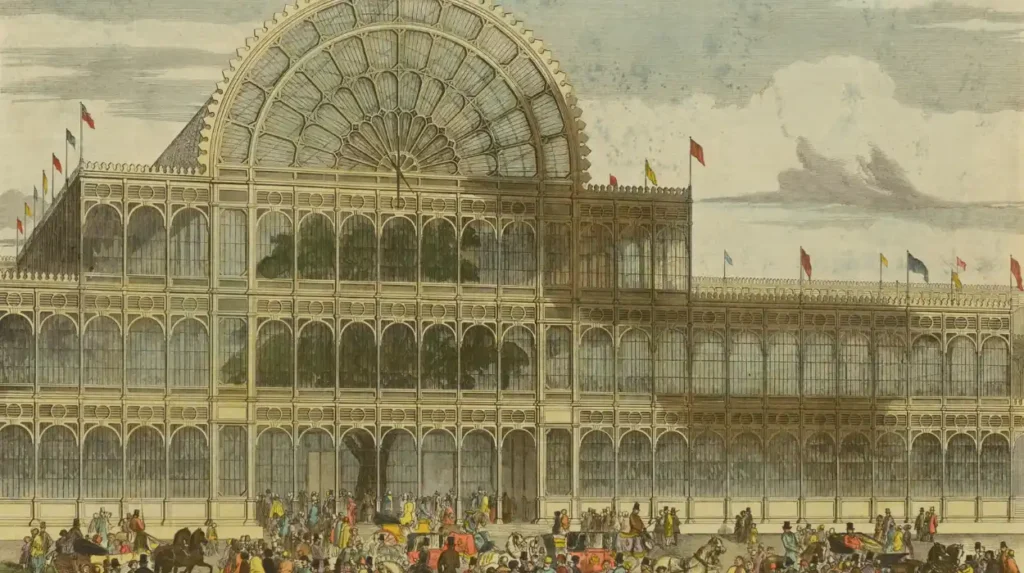
The most internationally significant nineteenth-century event was the Great Exhibition of 1851.
The Great Exhibition was organised to display developments in industry, manufacturing, technology, art, and design. It was housed in the Crystal Palace, a vast structure built within Hyde Park.
The exhibition attracted approximately six million visits during 1851. It brought international attention to Hyde Park and demonstrated the park’s capacity to host an event of unprecedented scale.
The Great Exhibition also connected Hyde Park with Victorian Britain’s industrial and imperial identity. The site became a physical stage for the presentation of international products, technological development, and cultural exchange.
The event changed the history of public exhibitions. It also reinforced Hyde Park’s role as a location where national ambitions could be presented to a mass audience.
Large public spaces became increasingly important during the nineteenth century because expanding cities required places capable of accommodating crowds.
Hyde Park met this requirement. Its historic landscape could temporarily contain structures and gatherings while remaining part of London’s permanent public geography.
The park therefore developed a dual identity. It was both a protected historic environment and a working public space capable of responding to major national events.
How did Hyde Park become associated with political protest and free speech?
Hyde Park became associated with political expression through a long tradition of public speaking and mass gatherings, particularly around Speaker’s Corner, where reformers, activists, and campaigners used the park’s public character to address large audiences and challenge established authority.
Hyde Park’s history includes an important connection with public speech and political assembly.
Speaker’s Corner, located near the north-east section of the park, developed from a wider historical tradition associated with public execution and final speeches.
Until 1783, the Tyburn Gallows stood near Hyde Park. People condemned to death were traditionally permitted to make final public statements.
After executions ended at Tyburn, public speaking remained associated with the surrounding area. Speaker’s Corner gradually developed into a recognised location for open debate and public address.
This tradition made Hyde Park different from purely ornamental gardens. The park became a place where public opinion could be expressed in physical space.
Prominent historical figures associated with speaking traditions in Hyde Park include William Morris, Karl Marx, and Vladimir Lenin, according to The Royal Parks’ historical account.
Political gatherings became increasingly significant during the nineteenth and early twentieth centuries.
In 1866, reformers marched on Hyde Park during campaigns connected to parliamentary reform. The park became a visible setting for demands concerning political representation.
The women’s suffrage movement also used Hyde Park extensively. The Royal Parks records that approximately 300,000 suffragettes gathered in the park in 1908 to demand voting rights for women.
Sylvia Pankhurst and other suffrage campaigners also participated in rallies associated with Speaker’s Corner and Hyde Park.
These gatherings demonstrate a major historical transformation. Land created for royal privilege became a location where citizens publicly challenged political systems and demanded expanded democratic rights.
The relationship between Hyde Park and public assembly remains one of its most important historical legacies.
Its landscape therefore records not only monarchy and aristocratic recreation but also political participation, organised protest, and freedom of expression.
What historic features still show Hyde Park’s royal and public past?
Hyde Park preserves visible evidence of its historical development through the Serpentine, Rotten Row, Speaker’s Corner, Marble Arch approaches, carriage routes, memorial landscapes, and surviving spatial relationships that connect Tudor royal land with modern public use.
Modern visitors can identify multiple physical remnants of Hyde Park’s historical development.
The Serpentine remains the clearest example of Queen Caroline’s eighteenth-century landscape intervention. Its irregular form records changing ideas about naturalistic design.
Rotten Row represents another important historical route. The name developed from the French expression Route du Roi, meaning King’s Road, according to The Royal Parks.
The route became associated with royal and fashionable riding. It remains one of London’s best-known historic equestrian routes.
Speaker’s Corner preserves Hyde Park’s connection with public debate and political expression. Its continuing use reflects the historical importance of open public speech within the park.
The park’s roads and entrances also record nineteenth-century urban improvements. Decimus Burton’s work reorganised access and circulation as London expanded around the landscape.
Marble Arch’s historical association with the north-east corner of Hyde Park demonstrates the relationship between ceremonial architecture and public movement through central London.
Trees also provide evidence of change and loss. Historic England records that Dutch elm disease destroyed the remaining old elms in Hyde Park from the 1950s onwards. Later planting programmes replaced lost trees but did not reproduce every historic planting pattern.
The twentieth century also brought substantial pressure from road development. Historic England records that Park Lane improvements in the 1960s removed approximately 8.5 hectares from the park and destroyed part of an earlier internal carriage road.
These changes demonstrate that historic preservation does not mean complete physical stability. Hyde Park has continuously changed while retaining its fundamental identity.
Archaeological and landscape research has documented this history. Historic England research records state that visible archaeological features across Hyde Park were surveyed in 1993 using detailed ground survey and aerial photographic analysis.
Such research provides evidence beyond written records. Paths, boundaries, landscape features, earthworks, and spatial relationships help historians understand how the park developed over time.
How is Hyde Park protected as a historic landscape today?
Hyde Park is protected through its Grade I heritage designation and public management framework, recognising its exceptional historic importance while supporting conservation, landscape maintenance, biodiversity, public recreation, education, events, and continued access for millions of Londoners and visitors.
Hyde Park is not simply an old public park. It is a nationally significant historic landscape.
Historic England lists Hyde Park at Grade I on the Register of Historic Parks and Gardens. Grade I is reserved for landscapes of exceptional historic interest.
The designation recognises the importance of the park’s long development from a Tudor deer park into a major public landscape.
Protection also involves practical management.
The Royal Parks charity manages Hyde Park as part of its responsibility for London’s Royal Parks and other important historic open spaces. The wider Royal Parks estate includes approximately 5,000 acres of historic parkland and green space across London.
Modern management requires a balance between preservation and public use.
Hyde Park remains an active urban landscape. People use it for walking, exercise, cycling, riding, cultural events, education, public gatherings, and recreation.
Conservation therefore involves more than protecting individual monuments. It includes managing trees, grassland, water, wildlife habitats, paths, structures, and historic views.
The park’s approximately 142-hectare area and roughly three-mile perimeter demonstrate the scale of this management challenge.
Historic preservation also requires recognition of change. Roads, pollution, intensive visitor use, weather, disease, and infrastructure create continuing pressures on historic landscapes.
Tree loss from Dutch elm disease provides one example. Road widening along Park Lane provides another. These changes altered the physical park while demonstrating the need for continued conservation planning.
Hyde Park’s protected status ensures that its historic significance remains part of decisions about its future.
Why does Hyde Park remain historically important to London today?
Hyde Park remains historically important because its landscape records nearly five centuries of change, connecting Tudor monarchy, Stuart public access, Georgian landscape design, Victorian national events, democratic protest, and modern heritage conservation within one continuously used central London space.
Hyde Park’s significance comes from continuity.
Few landscapes demonstrate so clearly how London changed while remaining connected to its earlier history.
The park began as land associated with Westminster Abbey. It became a Tudor royal hunting ground. Stuart monarchs opened it to wider public access. Georgian landscape design created the Serpentine and reshaped its relationship with Kensington Gardens.
Nineteenth-century architects and engineers adapted the park to an expanding metropolis. Victorian Britain used it for celebrations and the Great Exhibition.
Political reformers and suffrage campaigners transformed the park into a space for democratic expression. Twentieth-century infrastructure projects created new threats to its boundaries and historic landscape.
Today, Hyde Park remains both historic and functional.
Its importance also extends beyond London history. The park provides evidence for the history of British monarchy, landscape architecture, urban planning, public health, recreation, political protest, and heritage protection.
For history enthusiasts, Hyde Park provides a chronological record of changing Britain.
For cultural tourists, it connects major periods of London history within a single accessible landscape.
For educators and academic students, the park offers direct evidence of how land ownership, architecture, politics, and public space interact.
For heritage preservationists, Hyde Park demonstrates the complexity of conserving a living historic environment.
For genealogical researchers, the wider history of Westminster, royal institutions, urban expansion, employment, social gathering, and political movements provides important context for understanding the London communities that developed around the park.
To experience this historic royal landscape in person today, consult our comprehensive [Best Canal Walks in Little Venice for Relaxation, Cafés, and Waterside Photography] for itineraries and visiting parameters.
Hyde Park became one of London’s largest and most important historic Royal Parks through a long process rather than a single act of creation. Royal ownership established its foundations. Public access changed its purpose. Landscape design created its defining appearance. Urban growth made its open space increasingly valuable. National events expanded its public role. Political gatherings gave it democratic significance. Heritage protection secured its historic status.
The result is a landscape where different periods remain connected.
Henry VIII’s sixteenth-century enclosure established the royal park. Charles I’s seventeenth-century decision to open it created a new relationship with the public. Queen Caroline’s eighteenth-century interventions shaped the landscape that visitors still recognise. Decimus Burton’s nineteenth-century improvements integrated the park with an expanding London.
The Great Exhibition demonstrated Hyde Park’s international importance. Speaker’s Corner and suffrage demonstrations established its role in political expression. Modern conservation ensures that these layers of history remain visible.
Hyde Park therefore remains more than one of London’s largest central green spaces.
It is a documented record of how royal land became public heritage.
Its history explains why preserving historic parks matters. Buildings provide evidence of the past, but landscapes preserve different forms of evidence. Routes show movement. Trees show environmental change. Water features show design principles. Boundaries show ownership. Open spaces show how societies gathered.
Hyde Park contains all of these historical records within a landscape that continues to serve London every day.
That combination of royal origins, public access, landscape innovation, national events, political history, and protected heritage explains how Hyde Park became one of London’s most important historic Royal Parks today.
Frequently Asked Question
When did Hyde Park become a Royal Park?
Hyde Park became royal property in 1536 when King Henry VIII acquired the land from Westminster Abbey. In 1540, he enclosed it as a royal hunting ground.