
Kensington developed from a rural settlement on London’s western edge into one of Britain’s most important royal, architectural, educational and cultural districts. Its transformation was driven by monarchy, aristocratic landownership, Victorian planning and the institutions created after the Great Exhibition of 1851.
- How did Kensington begin as a rural settlement outside London?
- Why did William III and Mary II choose Kensington for a royal palace?
- How did successive monarchs shape Kensington Palace and its gardens?
- Why did Kensington decline as a royal court after George II?
- How did Queen Victoria make Kensington central to British royal history?
- How did Prince Albert and the Great Exhibition transform South Kensington?
- How did Kensington become home to Britain’s major museums?
- How did royal prestige influence Kensington’s residential development?
- What role did architecture play in Kensington’s cultural identity?
- How did Kensington become a centre for education and scientific research?
- How have modern royal residents continued Kensington’s historical importance?
- Why is heritage preservation essential to Kensington’s identity today?
- How does Kensington’s royal history still shape the district today?
- What makes Kensington one of London’s most important historical cultural districts?
- Frequently Asked Question
The history of Kensington explains why the district contains an unusual concentration of royal residences, museums, universities, diplomatic buildings, historic gardens and protected architecture. Royal patronage established Kensington Palace as a centre of court life. Queen Victoria’s childhood connected the area permanently to the history of the British monarchy. Prince Albert’s cultural vision then helped create South Kensington’s internationally important museum and education quarter.
Today, Kensington represents several connected historical landscapes. These include the royal landscape around Kensington Palace and Kensington Gardens, the Victorian cultural landscape of South Kensington, and the residential streets and squares created through centuries of metropolitan expansion.
The Royal Borough of Kensington and Chelsea covers approximately five square miles, and around 70% of the borough lies within conservation areas, demonstrating the exceptional importance of its surviving historic environment.
How did Kensington begin as a rural settlement outside London?
Kensington began as a small rural settlement west of the historic City of London and developed gradually through agriculture, aristocratic estates and suburban expansion. Its location between Westminster and western countryside later made it attractive to royalty, wealthy landowners and influential institutions.
Before Kensington became associated with palaces and museums, it was a village surrounded by fields, market gardens and private estates. Its historical development reflected London’s westward expansion.
The settlement existed long before Kensington became a fashionable district. For centuries, it remained physically separate from the densely developed City of London. The surrounding landscape contained agricultural land, country houses and estates belonging to wealthy families.
This position became increasingly valuable during the seventeenth century. London was growing rapidly, while wealthy residents sought cleaner air and larger properties outside the crowded urban centre.
Kensington offered an important geographical advantage. It was close enough to Westminster and the institutions of government for convenient access, while remaining outside the smoke, congestion and density of central London.
The district’s future therefore depended on a fundamental process of metropolitan change: rural land was gradually converted into aristocratic estates, residential developments, roads, gardens and public institutions.
Royal intervention accelerated this transformation dramatically.
Why did William III and Mary II choose Kensington for a royal palace?
William III and Mary II transformed Kensington after purchasing Nottingham House in 1689 because its suburban location offered healthier air and easier access to Westminster than distant royal residences. Their decision converted Kensington into a permanent landscape of royal influence and architectural investment.
The defining event in Kensington’s royal history occurred in 1689.
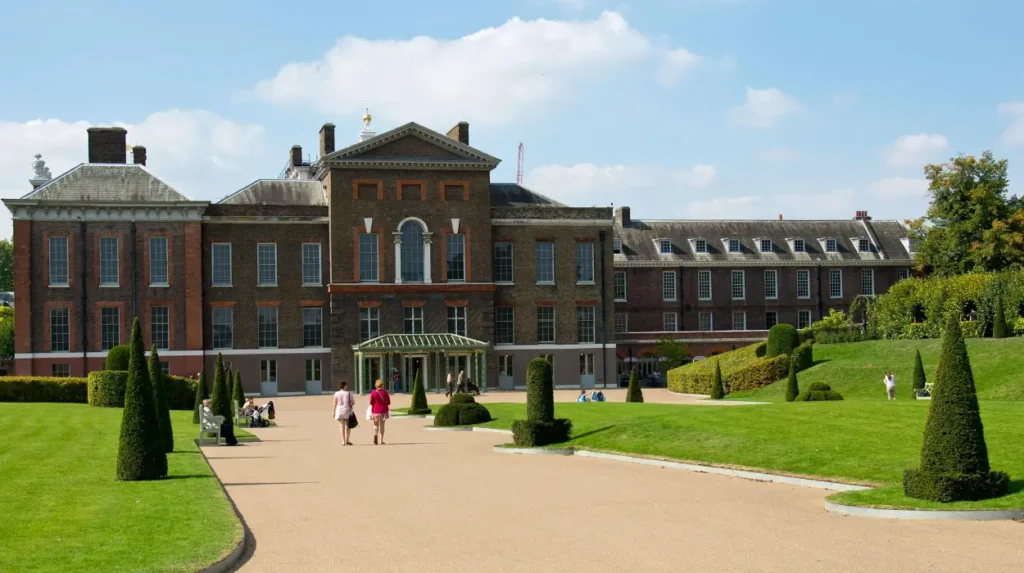
William III and Mary II acquired Nottingham House, a substantial mansion originally associated with Sir Heneage Finch, the first Earl of Nottingham. Historic England records that the original house dated from 1661 and that William III purchased it in 1689.
The royal couple required a residence that suited their political and personal circumstances.
Whitehall Palace stood at the centre of government, but William suffered from asthma and was concerned about London’s polluted atmosphere. Kensington offered a healthier suburban environment while maintaining practical access to Parliament and Westminster.
The monarchs commissioned Sir Christopher Wren, one of England’s most important architects, to transform Nottingham House into a royal palace.
The construction programme fundamentally changed the scale and status of the property.
Wren added major new architectural elements, including the Clock Court and the South Front. The palace also received a Long Gallery measuring approximately 96 feet. The transformation turned a private country house into an appropriate residence for the monarchy.
William and Mary moved into the completed palace on Christmas Eve 1689.
The decision had consequences beyond the palace walls. Once the monarchy established a permanent presence in Kensington, the surrounding district gained political and social importance.
Aristocrats, courtiers and wealthy families increasingly valued proximity to the royal household. Kensington’s development therefore became connected to the geography of power.
The palace established the foundation for more than three centuries of royal association.
How did Sir Christopher Wren change Kensington Palace?
Sir Christopher Wren adapted Nottingham House rather than replacing it entirely. This approach allowed the Crown to create a functioning palace quickly while expanding the original structure into a complex suitable for royal administration and court life.
The resulting building combined the earlier house with major late-seventeenth-century additions.
This architectural history remains visible in Kensington Palace’s protected status. The palace is listed at Grade I, the highest category of architectural protection in England, and Historic England identifies the principal phases of development as the original 1661 house, Wren’s work between 1689 and 1695, and later eighteenth-century alterations.
How did successive monarchs shape Kensington Palace and its gardens?
Successive monarchs transformed Kensington Palace into a Stuart and Georgian court centre through architectural additions, ceremonial rooms and redesigned gardens. Queen Anne, George I, George II and Queen Caroline each altered the estate, creating structures and landscapes that still define Kensington’s historic identity.
The royal importance of Kensington did not end with William III and Mary II.
Queen Anne inherited a palace already established as a royal residence. Her reign added one of Kensington’s most recognisable historic structures: the Orangery.
Completed in 1705, Queen Anne’s Orangery was designed through the involvement of Sir Christopher Wren and Nicholas Hawksmoor. It provided space for exotic plants and royal entertaining.
The building represented an important feature of elite eighteenth-century culture.
Orangeries demonstrated wealth, scientific interest and access to imported plants. They also functioned as architectural spaces for social gatherings.
The Hanoverian succession introduced further changes.
George I expanded and redecorated the palace. William Kent, an influential architect, designer and artist, created some of Kensington Palace’s most distinctive interiors.
Kent’s work included the famous King’s Staircase, decorated with life-size painted figures associated with the court of George I. These interiors preserved the visual culture of an eighteenth-century royal court within the modern historic landscape.
George II and Queen Caroline continued Kensington’s development.
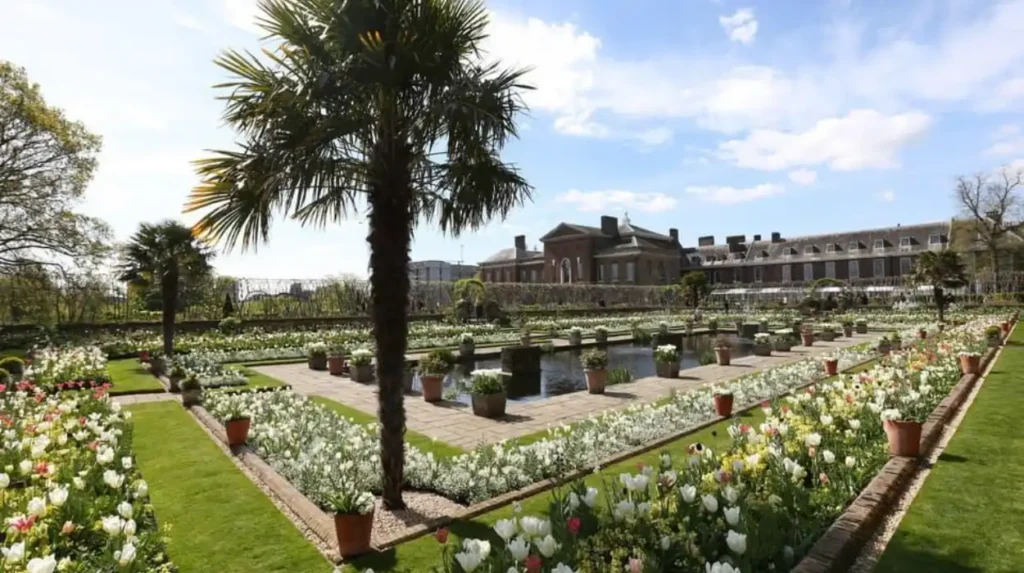
Queen Caroline exercised particular influence over the gardens and surrounding landscape. The royal estate became connected to wider improvements in Hyde Park and Kensington Gardens.
These changes demonstrated an important historical mechanism: royal landscapes influenced public landscapes.
Private royal requirements encouraged the redesign of land that later became part of London’s major park system.
What was Queen Caroline’s influence on Kensington’s landscape?
Queen Caroline helped shape the eighteenth-century landscape around Kensington by supporting major garden and park improvements. Her patronage connected royal residence, formal landscaping and public recreation within the developing western districts of London.
Her influence extended beyond palace decoration.
Landscape designers created new features and vistas associated with the royal parks. The development of Kensington Gardens and the adjoining Hyde Park established a physical relationship between monarchy and open space.
This relationship remains fundamental to modern Kensington.
The palace, gardens and parkland continue to form one connected historic environment rather than isolated attractions.
The royal landscape also established an enduring contrast within Kensington: densely built residential and institutional districts developed beside extensive protected green spaces.
Why did Kensington decline as a royal court after George II?
Kensington Palace lost its position as the principal centre of royal court life after George II died in 1760, but its royal identity survived. The palace became associated with junior royals, family residences and later Queen Victoria’s childhood, preserving its constitutional importance.
George II was the last reigning monarch to make Kensington Palace his principal residence.
After his death in 1760, the palace entered a different phase.
George III disliked Kensington and preferred other royal residences. No reigning monarch slept regularly at Kensington Palace for many decades after George II’s death.
The decline of court activity did not eliminate the palace’s royal function.
Instead, Kensington increasingly accommodated members of the wider royal family.
This transition was historically important because it changed the meaning of the palace.
Kensington was no longer primarily a centre of daily government and court ceremony. It became a royal residential complex connected to dynastic family life.
That function prepared the setting for one of the most significant events in British constitutional history: the childhood and accession of Queen Victoria.
How did Queen Victoria make Kensington central to British royal history?
Queen Victoria permanently strengthened Kensington’s royal significance because she spent her childhood at Kensington Palace and became Queen there on 20 June 1837. Her accession connected the district directly to the Victorian monarchy and Britain’s nineteenth-century constitutional transformation.
Princess Victoria was born in 1819 and spent much of her childhood at Kensington Palace.
Her upbringing occurred under the supervision of her mother, Victoria, Duchess of Kent, and within a restrictive household system often called the Kensington System.
This system attempted to control the young princess’s education, social relationships and access to political influence.
The historical importance of Kensington reached a defining moment on 20 June 1837.
William IV died, and the eighteen-year-old Victoria was informed at Kensington Palace that she had become Queen.
She held her first Privy Council meeting in the Red Saloon at the palace on the same day.
The Privy Council is a formal body of advisers to the British sovereign. Victoria’s first meeting therefore represented the transition from princess to constitutional monarch.
Shortly afterwards, Victoria moved to Buckingham Palace.
Kensington Palace nevertheless retained permanent significance as the place where one of Britain’s longest-reigning monarchs entered public life.
The palace also became a physical record of Victorian dynastic history.
Victoria later used Kensington to accommodate members of her extended family. Her daughter, Princess Louise, a sculptor and artist, remained closely associated with the palace and designed the statue of Queen Victoria on its western side, unveiled in 1893.
How did Prince Albert and the Great Exhibition transform South Kensington?
Prince Albert’s programme after the Great Exhibition of 1851 transformed South Kensington into a planned centre for art, science and education. Exhibition profits helped finance land acquisition and institutions that created the internationally important cultural district surrounding Exhibition Road.
The nineteenth century produced Kensington’s second great transformation.
The first was royal.
The second was institutional.
The Great Exhibition of 1851 took place in Hyde Park and demonstrated Britain’s industrial production, international trade, engineering and artistic manufacture.
Prince Albert, the husband of Queen Victoria, played a central role in promoting the exhibition.
The event generated a surplus of £186,000.
The Royal Commission for the Exhibition of 1851 used this money to purchase an estate in South Kensington. That estate later developed into a concentration of museums, colleges and cultural institutions.
This decision created one of the most important examples of cultural planning in British urban history.
The objective was not simply to construct individual buildings.
The intention was to create an interconnected district where art, science, design and education could develop together.
South Kensington became associated with what later became known as Albertopolis, a term connected to Prince Albert’s cultural vision.
The area included institutions that became internationally important, including the Victoria and Albert Museum, the Natural History Museum, the Science Museum, Imperial College London, the Royal College of Art, the Royal College of Music and the Royal Albert Hall.
The modern South Kensington cultural quarter receives more than 20 million visitors annually across 22 major institutions, according to Imperial College London’s description of the district.
Why was the Great Exhibition estate important to Britain’s cultural development?
The South Kensington estate created a long-term institutional infrastructure for national education and public culture. Museums preserved collections, colleges trained specialists and public buildings presented scientific and artistic knowledge to large audiences.
This model reflected Victorian concerns about industrial competition.
British political and cultural leaders believed that better education in art, science and design would strengthen manufacturing and national economic performance.
The Victoria and Albert Museum originated directly from this programme.
The institution was established in 1852 and moved to South Kensington in 1857 as the South Kensington Museum before becoming the Victoria and Albert Museum in 1899.
The museum’s mission linked public education with design and manufacturing.
This connection explains why Kensington’s cultural district developed differently from a conventional entertainment district.
Its institutions were designed as permanent educational infrastructure.
How did Kensington become home to Britain’s major museums?
Kensington became Britain’s leading museum district through Victorian state investment, royal patronage and educational planning. The Victoria and Albert Museum and Natural History Museum established South Kensington as a permanent centre where national collections, architecture and public learning developed together.
The Victoria and Albert Museum became one of the central institutions of South Kensington.
Its origins lay in the Great Exhibition and the Victorian effort to improve British design education.
The museum’s development was closely connected to Prince Albert’s programme for the district. Its buildings were intended to demonstrate architectural and decorative excellence as well as house collections.
The Natural History Museum represented another major stage.
The natural history collections of the British Museum had outgrown their original accommodation.
Sir Richard Owen, the scientist and superintendent associated with the collections, argued for a separate museum building.
The project developed during the nineteenth century, and architect Alfred Waterhouse created the final design after Francis Fowke’s death.
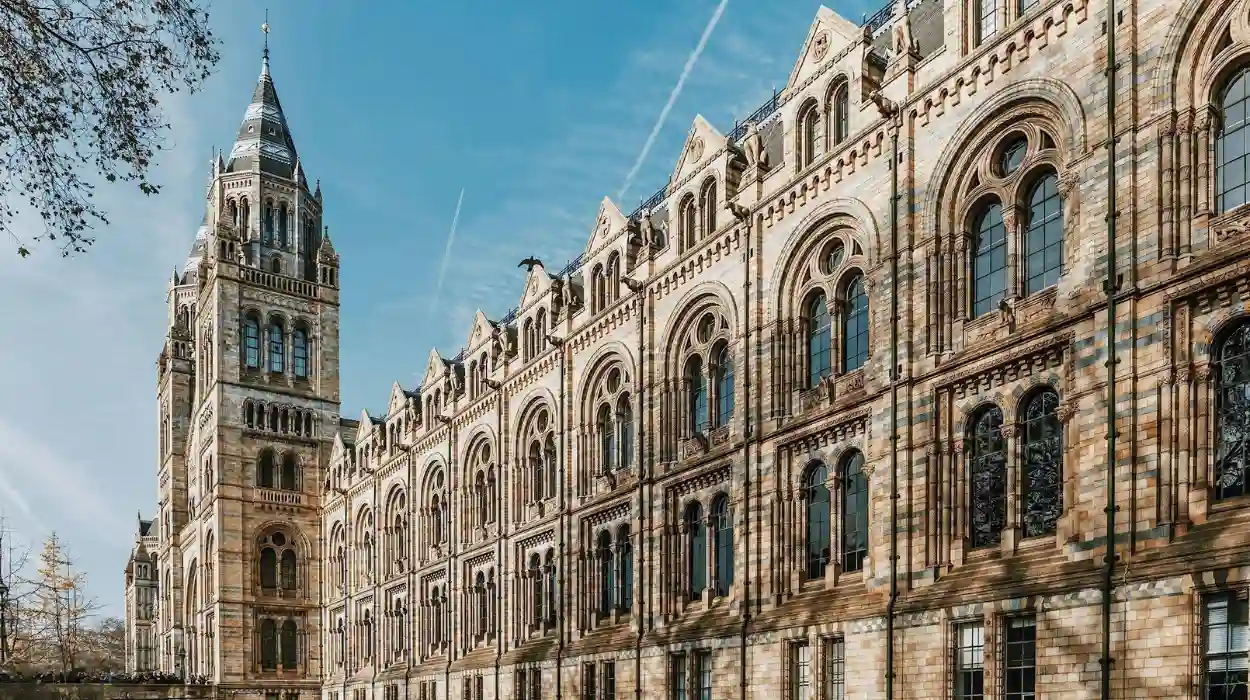
The Natural History Museum was constructed between 1873 and 1881 and became one of London’s most important Victorian public buildings.
Waterhouse used extensive terracotta, a material suited to London’s polluted Victorian atmosphere.
Historic England lists the building at Grade I and identifies its exceptional architectural and historical significance.
The museum district therefore preserved Victorian ideas in physical form.
Architecture became part of education.
The buildings themselves communicated scientific knowledge, artistic ambition and national confidence.
How did royal prestige influence Kensington’s residential development?
Royal prestige increased Kensington’s attractiveness to aristocrats and wealthy residents, encouraging the development of terraces, squares and private estates. Proximity to Kensington Palace, royal parks and central government helped establish the district as one of London’s most prestigious residential environments.
The palace influenced surrounding property development through status and geography.
Living near a royal residence offered social advantages.
Kensington also benefited from its access to Westminster and the West End.
During the eighteenth and nineteenth centuries, London’s wealthy population increasingly expanded westward. Landowners developed estates through planned streets, terraces and garden squares.
This process created the built environment now associated with historic Kensington.
Large houses accommodated affluent families and their household staff. Terraces created uniform architectural streetscapes. Squares provided controlled green spaces within residential development.
The area’s architectural identity therefore emerged through estate planning rather than uncontrolled urban growth.
This pattern contributed to Kensington’s long-term social geography.
Royal association increased prestige.
Prestige increased property values.
Property development financed new buildings and infrastructure.
The resulting built environment attracted further wealthy residents and institutions.
This cycle helped establish Kensington’s reputation as an elite London district.
What role did architecture play in Kensington’s cultural identity?
Architecture became central to Kensington’s cultural identity because royal, Victorian and later institutional buildings preserved successive periods of British history. Palaces, museums, terraces, churches and educational buildings created a concentrated architectural record spanning several centuries.
Kensington’s historical importance is visible through its architecture.
Kensington Palace represents seventeenth-century royal adaptation and eighteenth-century court decoration.
The Victoria and Albert Museum represents Victorian design education and public cultural policy.
The Natural History Museum represents Victorian scientific ambition and Romanesque architectural experimentation.
Together, these buildings demonstrate how institutions used architecture to express their purpose.
The Natural History Museum is particularly important because its design incorporates detailed sculptural decoration associated with the natural world.
Historic England identifies the building’s extensive terracotta detailing, carefully designed interiors and relationship with nearby cultural institutions as major reasons for its Grade I designation.
The concentration of important buildings also strengthened Kensington’s institutional identity.
Individual structures became part of an architectural network.
Museums stood near colleges.
Educational institutions stood near concert venues.
Royal buildings stood beside historic parks.
This physical proximity created an urban cultural ecosystem.
How did Kensington become a centre for education and scientific research?
Kensington developed into a major educational and scientific centre because the South Kensington estate deliberately brought museums and specialist institutions together. The Victorian programme connected public collections, higher education, research and professional training within one geographically concentrated district.
The cultural district was designed around education.
Museums provided public access to collections.
Colleges trained artists, scientists, engineers and musicians.
Research institutions expanded specialist knowledge.
Imperial College London’s main South Kensington campus traces its origins to the college founded there in 1907. The institution remains located within the historic cultural landscape created through the Great Exhibition estate.
The district therefore developed through institutional continuity.
Victorian planning created the original framework.
Twentieth-century universities and research organisations expanded it.
Modern institutions continue to operate within the same geographical concentration.
This continuity is historically significant.
Many major urban cultural districts develop through commercial activity or later regeneration.
South Kensington developed from a nineteenth-century programme that deliberately connected national collections with education.
That original structure remains visible today.
How have modern royal residents continued Kensington’s historical importance?
Modern members of the royal family have maintained Kensington Palace’s public significance by using it as a London residence while historic apartments remain accessible to visitors. Twentieth-century and contemporary royal occupants connected the palace’s Stuart and Victorian history with modern monarchy.
Kensington Palace continued its royal residential role after Queen Victoria.
During the nineteenth and twentieth centuries, it accommodated several members of the extended royal family.
Princess Margaret lived at Kensington Palace during the twentieth century.
Diana, Princess of Wales, also made the palace internationally recognisable as a modern royal residence.
The palace was home to Prince William and Prince Harry during their childhood after the marriage of the Prince and Princess of Wales in 1981.
The Second World War also affected the historic building.
In 1940, incendiary bombs dropped by the Luftwaffe damaged the State Apartments. The later restoration demonstrated the importance of preserving the palace as a national historic site.
Historic Royal Palaces completed major refurbishment work in 2012, and Queen Elizabeth II officially reopened the palace following the project.
The modern preservation model combines several functions.
Kensington Palace remains associated with the monarchy.
Historic spaces are interpreted for visitors.
Architectural fabric receives conservation protection.
The palace therefore operates simultaneously as a royal site, museum environment and heritage asset.
Why is heritage preservation essential to Kensington’s identity today?
Heritage preservation protects Kensington’s exceptional concentration of royal, architectural and cultural assets while allowing the district to remain a functioning part of London. Listed buildings, conservation areas and institutional stewardship preserve evidence of centuries of political, social and cultural development.
Kensington’s historical importance depends heavily on the survival of its physical environment.
The Royal Borough of Kensington and Chelsea reports that approximately 70% of its area lies within conservation areas.
Conservation areas are designated places where planning controls protect architectural and historic character.
Listed buildings receive additional legal recognition.
Kensington Palace is Grade I listed.
The Natural History Museum is also Grade I listed.
These designations recognise buildings of exceptional national significance.
Preservation involves more than protecting famous landmarks.
Historic streets, terraces, gardens and institutional buildings provide the wider context necessary to understand the district.
Without this surrounding environment, individual monuments would lose much of their historical meaning.
Kensington’s preservation system therefore protects relationships between buildings and landscapes.
The palace relates to Kensington Gardens.
The museums relate to Exhibition Road.
Educational institutions relate to the Great Exhibition estate.
Residential architecture relates to aristocratic landownership and metropolitan growth.
How does Kensington’s royal history still shape the district today?
Kensington’s modern identity remains directly shaped by royal decisions made from 1689 onward and Victorian institutions created after 1851. The palace, parks, museums and educational establishments continue to define its economy, architecture, tourism and international cultural reputation.
The modern district cannot be separated from its historical development.
William III and Mary II established the royal foundation.
Queen Anne and the Hanoverian monarchs expanded the palace and gardens.
Queen Victoria connected Kensington to the nineteenth-century monarchy.
Prince Albert’s Great Exhibition programme created South Kensington’s institutional framework.
These developments produced a rare concentration of historical functions within a relatively compact area.
Kensington contains royal heritage.
It contains national museums.
It contains major educational institutions.
It contains protected residential architecture.
It also contains historic parks and gardens.
These elements continue to attract visitors, researchers, students, conservation specialists and cultural organisations.
To experience this historic district and its major landmarks in person today, consult our comprehensive [Best Things to Do in Kensington, London] for itineraries and visiting parameters.
The long-term significance of Kensington lies in this continuity.
The district did not become culturally important through a single event.
Its identity developed through connected historical processes spanning more than three centuries.
Royal residence created prestige.
Prestige encouraged elite development.
Victorian planning established museums and colleges.
Heritage protection preserved the resulting environment.
Modern institutions continue to use and interpret these historic spaces.
What makes Kensington one of London’s most important historical cultural districts?
Kensington is historically important because it combines three major forces in British history: monarchy, Victorian cultural planning and long-term heritage preservation. Its surviving palace, museums, institutions and landscapes provide an unusually complete physical record of Britain’s political and cultural development.
Kensington’s transformation demonstrates how royal decisions can influence urban history for centuries.
The purchase of Nottingham House in 1689 changed a suburban property into a royal palace.
The palace attracted aristocratic attention and established Kensington as a prestigious location.
The reigns of Queen Anne, George I, George II and Queen Caroline shaped its buildings and landscape.
Queen Victoria’s childhood and accession added constitutional significance.
The Great Exhibition of 1851 then produced a second transformation.
Prince Albert and the Royal Commission used the exhibition’s legacy to acquire land in South Kensington and develop a permanent cultural and educational estate. The resulting district became home to institutions that continue to define London’s international reputation.
Kensington therefore represents a continuous historical sequence rather than separate landmarks.
Its royal history shaped its prestige.
Its Victorian institutions shaped its intellectual and cultural role.
Its conservation system protects the evidence of those developments.
For history enthusiasts, Kensington provides a concentrated record of British monarchy and urban development.
For cultural tourists, it connects internationally important museums with royal landscapes.
For educators and students, it demonstrates the relationship between architecture, public policy, science, art and national identity.
For heritage researchers and genealogical researchers, the district preserves evidence of the aristocratic families, royal households, architects, artists, scientists and institutions that shaped London’s western expansion.
The history of Kensington remains visible because the structures created by successive generations still perform meaningful roles.
Kensington Palace remains a royal and historic institution.
Kensington Gardens remain part of London’s major landscape heritage.
The museums continue to preserve and interpret national collections.
Educational institutions continue the Victorian ambition to connect knowledge with public life.
That continuity explains why Kensington remains one of London’s most prestigious cultural districts.
Its status was built over centuries.
Its royal history created the foundation.
Its institutions expanded the legacy.
Its protected historic environment ensures that this history remains visible in the modern city.
Frequently Asked Question
Why is Kensington important in British royal history?
Kensington is important because Kensington Palace became a royal residence in 1689 under William III and Mary II. It later became the childhood home and accession location of Queen Victoria.