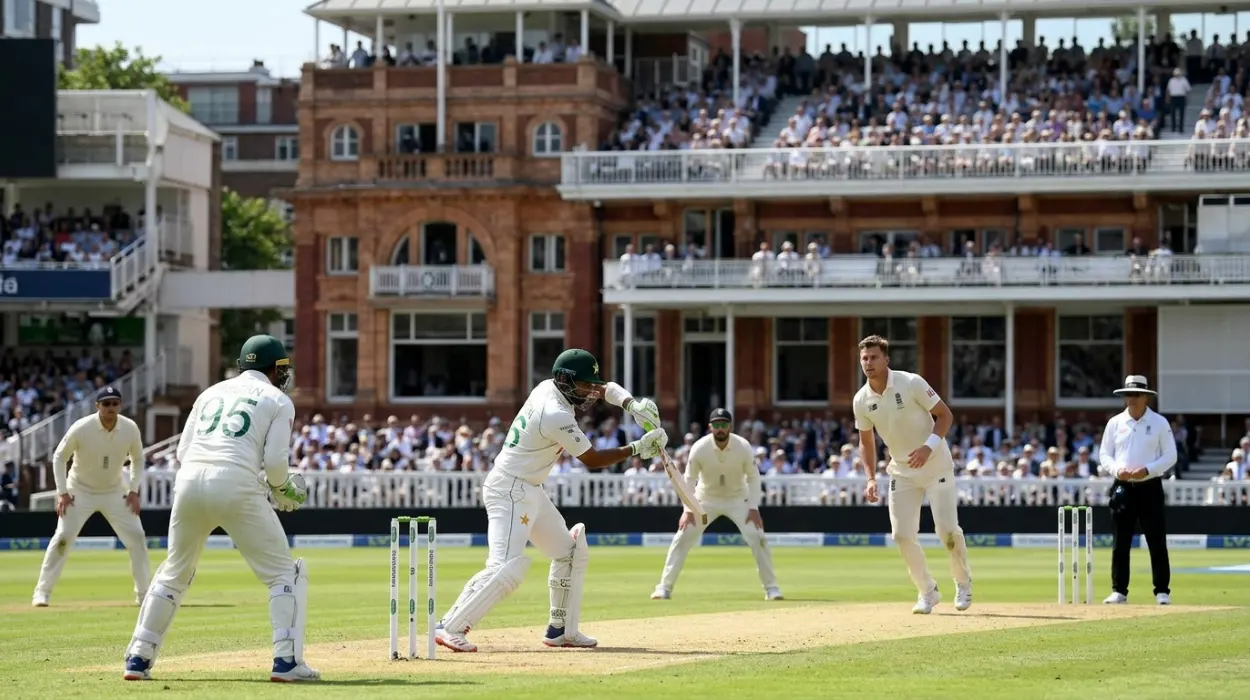
The cricket rivalry between the Pakistan national cricket team and the England cricket team represents one of international sport’s most enduring, culturally rich, and tactically complex test matches and limited-overs contests, originating with Pakistan’s maiden Test tour of England in 1954.
- How do Pakistan and England perform in Test match cricket?
- What are the statistics for Pakistan and England in One-Day Internationals?
- How do the teams match up in Twenty20 Internationals?
- What role do venue conditions and pitch dynamics play in the series?
- What is the cultural and economic impact of the Pakistan-England cricket fixture?
- Frequently Asked Question
The diplomatic and athletic framework between the two nations was established shortly after Pakistan gained independence in 1947 and was granted Test status by the International Cricket Council in 1952. The inaugural Test match between the sides took place at Lord’s Cricket Ground in London on June 10, 1954. That historic series concluded in a 1-1 draw, underscored by Pakistan’s legendary fast bowler Fazal Mahmood taking 12 wickets to secure a famous victory at The Oval. Over the subsequent seven decades, the fixture expanded from traditional five-day Test matches into One-Day Internationals and Twenty20 Internationals, yielding hundreds of high-profile encounters across global venues.
The relationship between the England and Wales Cricket Board and the Pakistan Cricket Board has experienced profound administrative milestones, geopolitical shifts, and iconic on-field moments. Historical milestones include Pakistan’s landmark series victories on English soil in 1987, 1992, and 1996 under captains Imran Khan and Wasim Akram, as well as a fiercely contested 2-2 series draw in England in 2016. Conversely, England has undertaken major tours of Pakistan, highlighted by a historic return in 2022 after a 17-year security-related hiatus, where England secured a 3-0 Test series sweep.
Statistical metrics across formats outline a fiercely competitive landscape. Across Test cricket, the two nations have played over 90 matches, with England holding a historical advantage in total victories. In One-Day Internationals, the teams have contested 91 matches, featuring 56 wins for England and 32 wins for Pakistan, alongside 3 no-results. In the shortest format, Twenty20 Internationals, the rivalry features 32 encounters, with England claiming 22 victories and Pakistan winning 9 matches, alongside 1 no-result. These fixtures regularly draw global audiences managed by sports networks and reported extensively by outlets such as The Londoner News.
How do Pakistan and England perform in Test match cricket?
The head-to-head Test match record between Pakistan and England showcases a grueling contest of technical discipline, tactical endurance, and historic individual milestones spanning more than seventy years of red-ball competition.
Across 92 completed or ongoing Test matches, England has secured 30 victories, while Pakistan has claimed 23 wins, with 39 matches concluding in a draw. This format highlights contrasting strategic philosophies, where English conditions traditionally favor seam bowling and swing, while Asian conditions test patience against spin. Monumental batting performances define this ledger, such as the record-breaking fourth-wicket partnership of 454 runs between Harry Brook and Joe Root during the August 2026 Test at Headingley Cricket Ground in Leeds. In that match, Brook scored an individual high of 317 runs and Root added 262 runs, propelling England to a total of 823/7 declared. Pakistan’s red-ball successes rely heavily on historic fast bowling spells from icons like Fazal Mahmood, Waqar Younis, and Shoaib Akhtar, alongside resilient batting displays from legendary captains.
What are the statistics for Pakistan and England in One-Day Internationals?
The One-Day International rivalry between Pakistan and England features high-scoring run chases, tactical middle-overs containment, and intense global tournament encounters managed under the auspices of the International Cricket Council.
Out of 91 matches played since their inaugural ODI encounter on August 31, 1974, at Trent Bridge in Nottingham—where Pakistan triumphed by seven wickets behind a century from Majid Khan—England has won 56 matches, and Pakistan has won 32 matches, alongside 3 no-results. The two teams share a storied history in International Cricket Council Cricket World Cups, having played 11 matches in the tournament’s history. While Pakistan historically dominated early World Cup meetings, England claimed a crucial 93-run victory at Eden Gardens in Kolkata during the 2023 ICC Men’s Cricket World Cup. Both teams deploy distinct roster adjustments for 50-over cricket, balancing aggressive opening batsmen with specialized death-overs bowlers.
How do the teams match up in Twenty20 Internationals?
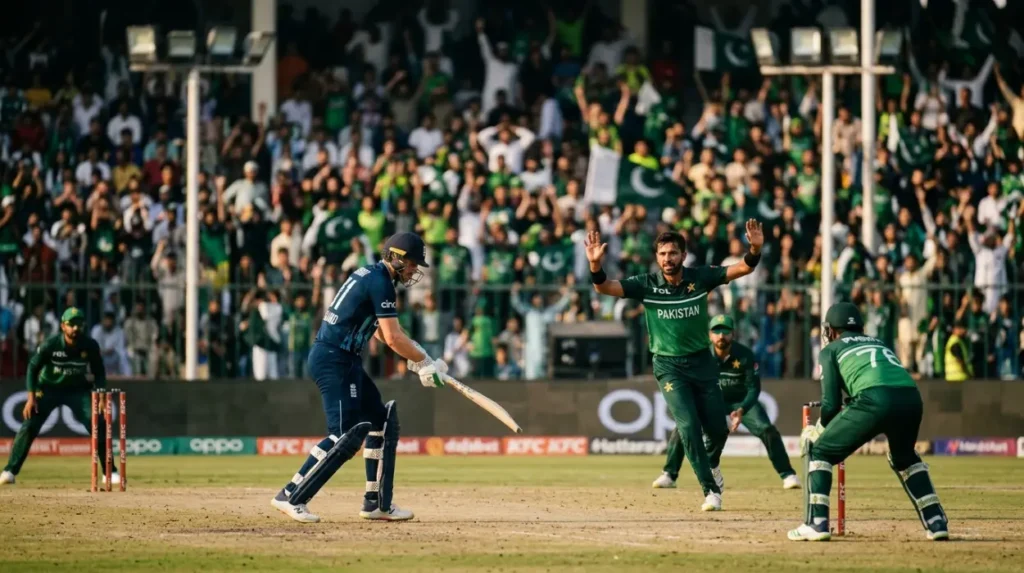
The Twenty20 International fixture between Pakistan and England highlights fast-paced power-hitting, modern fielding analytics, and high-stakes global tournament finals dictated by immediate strategic adaptations.
Beginning with their first T20 match at County Ground, Taunton, in August 2006, the teams have played 32 T20Is. England leads the head-to-head count with 22 wins, compared to Pakistan’s 9 wins, with 1 match producing no result. The pinnacle of their T20 encounters occurred in the final of the 2022 ICC Men’s T20 World Cup at the Melbourne Cricket Ground in Australia, where England defeated Pakistan by 5 wickets to capture the global trophy. Subsequent matches, including a tight encounter at the 2026 ICC Men’s T20 World Cup where England won by 2 wickets at the Pallekele International Cricket Stadium in Sri Lanka, underscore the razor-thin margins separating the two squads in the shortest format of the game.
What role do venue conditions and pitch dynamics play in the series?
Home and away conditions dictate strategic selection, bowling allocations, and batting approaches, as distinct geographical environments in the United Kingdom and Pakistan alter the behavior of the cricket ball.
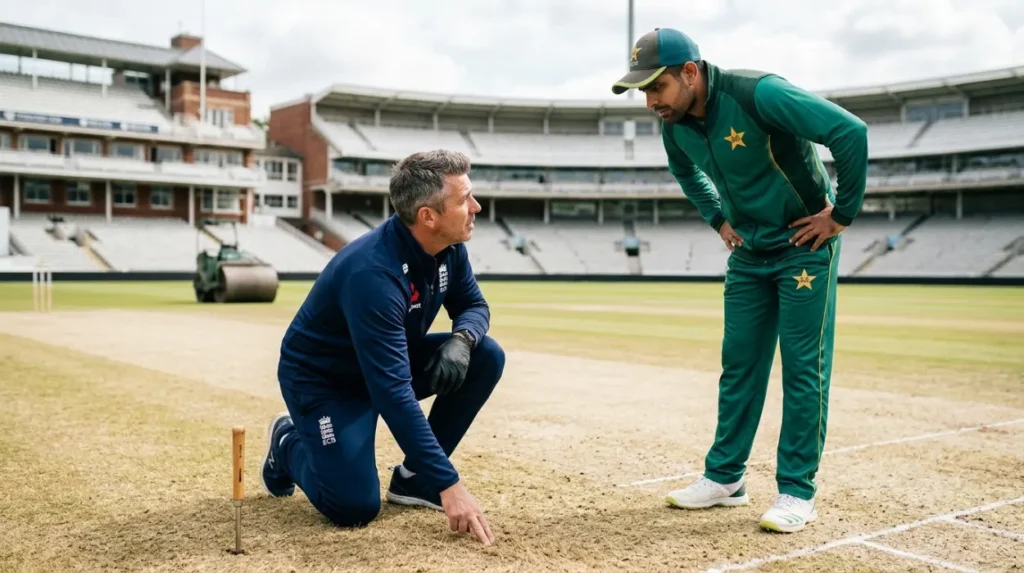
When matches take place in the United Kingdom, English conditions traditionally favor seam bowling and swing. Venues such as Lord’s Cricket Ground in London, The Oval, Edgbaston Stadium in Birmingham, and Headingley Cricket Ground in Leeds offer pitches with grass cover and overhead humidity that assist fast bowlers in extracting lateral movement off the pitch. Conversely, matches hosted in Pakistan—at venues like the Gaddafi Stadium in Lahore, Rawalpindi Cricket Stadium, and the National Stadium in Karachi—historically feature flat, dry surfaces that favor spin bowlers and high-scoring batting line-ups. Modern pitch curation, however, increasingly emphasizes sporting tracks designed to produce positive results across all scheduled days of play.
What is the cultural and economic impact of the Pakistan-England cricket fixture?
The bilateral cricket series between Pakistan and England serves as a major economic driver for international broadcasting and a vital cultural bridge connecting millions of diaspora fans across the globe.
The fixtures regularly draw global audiences managed by sports networks and reported extensively by outlets such as The Londoner News. Matches played at English venues routinely draw massive, vociferous support for both sides, turning grounds into neutral-yet-bipartisan cauldrons of energy. Economic and broadcast implications further elevate the status of the fixture, as multi-format tours generate substantial revenue through television rights, stadium ticket sales, and global digital streaming metrics monitored by the International Cricket Council. As both boards continuously update their player development pathways, franchise league commitments, and conditioning regimens, the Pakistan-England rivalry remains a foundational pillar of modern international sports.
Frequently Asked Question
When did Pakistan and England first play Test cricket?
Camden Market first opened on 30 March 1974 with 16 traders selling antiques, jewellery, arts and crafts. The original market operated beside the Regent’s Canal near Dingwalls.