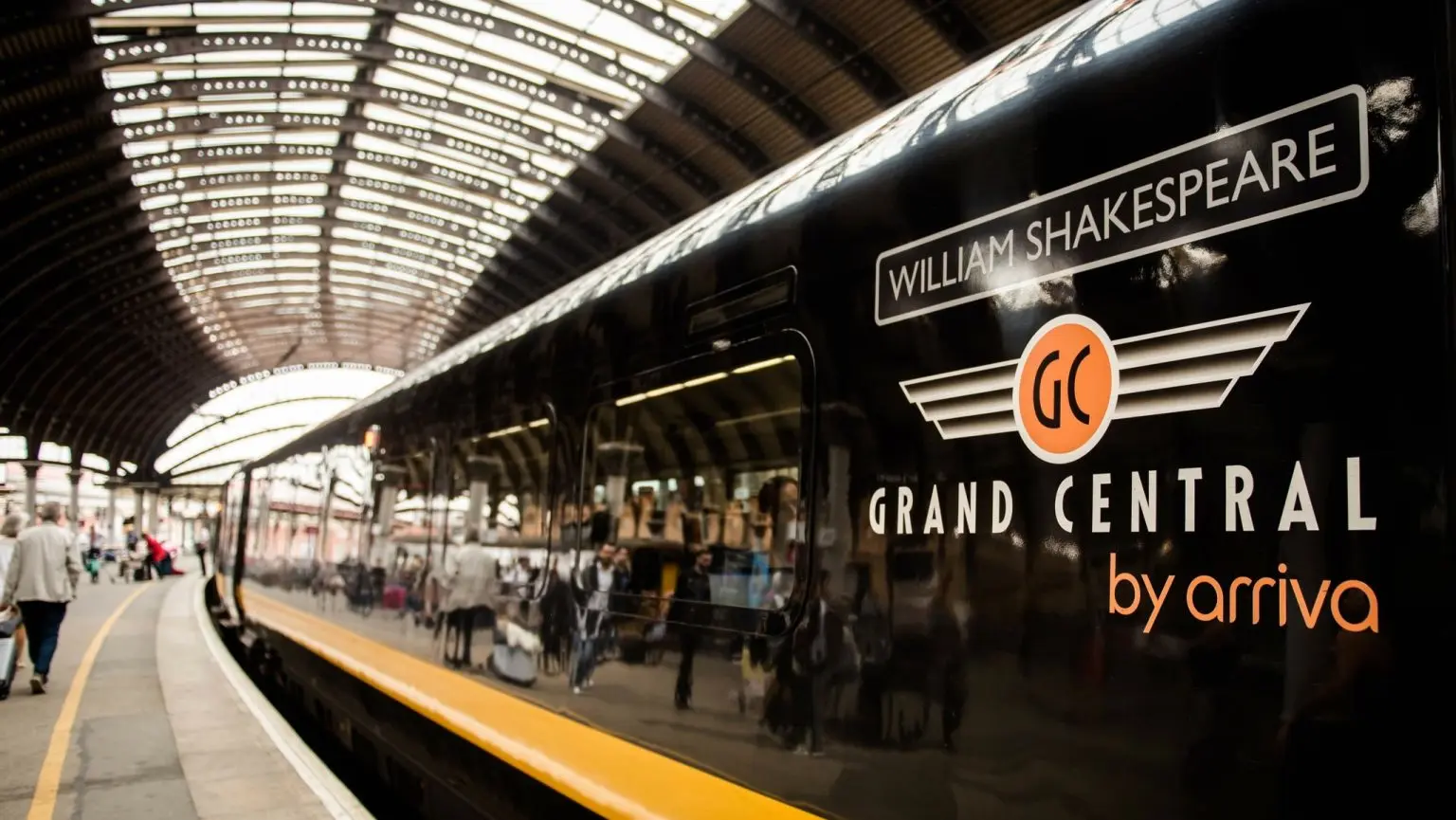
- Arriva’s open access rail subsidiary Grand Central formally applied on November 13 to the Office of Rail and Road (ORR) for track access rights to launch five daily return trains between Manchester Piccadilly and London St Pancras for an initial seven-year term beginning in May 2029.
- The proposed service is routed via the Midland Main Line to utilize spare off-peak network capacity, deliberately bypassing the heavily congested West Coast Main Line where the regulator rejected bids from Wrexham, Shropshire & Midlands Railway (WS&MR), FirstGroup’s Lumo, and Avanti West Coast in October following earlier rejections in July 2025.
- Intermediate stops will include Stockport, Macclesfield, Congleton, Stoke-on-Trent, Uttoxeter, Derby, Loughborough, Leicester, Wellingborough, and Luton Airport Parkway—providing Congleton and Uttoxeter with their first direct trains to London, restoring long-distance links to Wellingborough and Luton Airport Parkway, and enabling single-change international rail connections at St Pancras.
- Theme park operator Merlin Entertainments backed the proposal, noting that enhanced rail connectivity to Uttoxeter—the nearest station to Alton Towers—will help visitors reach the resort without relying on private cars.
- The application aligns with Arriva’s broader £300 million fleet investment—comprising nine five-car Hitachi tri-mode electric-diesel-battery trainsets ordered via Angel Trains in March 2025 with options for additional units—alongside a separate pending ORR bid submitted in December 2025 for a Newcastle–Brighton service via Birmingham.
London (The Londoner News) November 13, 2026 – Arriva’s open access train operator Grand Central has submitted a formal application to the Office of Rail and Road (ORR) to run five daily return passenger services between Manchester Piccadilly and London St Pancras. Filed on November 13 for an initial seven-year access period targeted to commence in May 2029, the proposal routes trains via the Midland Main Line to leverage spare off-peak capacity and avoid severe congestion on the West Coast Main Line. Calling at ten intermediate stations including Congleton, Uttoxeter, Derby, Leicester, and Luton Airport Parkway, the privately funded initiative aims to expand regional connectivity and international rail links at no cost to the taxpayer.
- What Are the Key Specifications of Grand Central’s Proposed Manchester–London Route?
- How Does Grand Central’s Midland Main Line Bid Compare with Recent UK Open Access Rail Applications?
- Background of the Particular Development After the News
- How This Development Can Affect Regional Passengers, Aviation and Tourism Hubs, and Rail Regulators
As reported by rail industry correspondents at Railway-News, Rail Business Daily, and Railnews, Grand Central formally lodged its track access application with the Office of Rail and Road (ORR) on November 13, 2026. Under the submitted timetable, the operator seeks seven-year access rights to operate five trains per day in each direction between Manchester Piccadilly and London St Pancras International, with passenger operations scheduled to launch in May 2029. Grand Central stated that its blueprint “demonstrates how open access operators can unlock new connections and improve passenger choice by making better use of the existing railway network,” confirming that the proposed schedule accounts for existing platform availability at both Manchester Piccadilly and London St Pancras while capitalising on spare off-peak capacity along the Midland Main Line.
By routing services via the East Midlands rather than the traditional West Coast Main Line (WCML), Arriva’s subsidiary seeks to avoid the severe infrastructure bottlenecks that recently derailed competing open access proposals. In October 2026, the Office of Rail and Road rejected applications submitted by Wrexham, Shropshire & Midlands Railway (WS&MR), FirstGroup’s Lumo, and Avanti West Coast to operate additional WCML passenger services, concluding that insufficient network capacity meant introducing extra trains would impair operational performance. Those rulings followed earlier regulatory rejections in July 2025 involving WS&MR, Lumo, and Virgin.
As detailed by regional journalists at Congleton Nub News, Macclesfield Nub News, and Luton Today, the proposed Grand Central timetable includes ten intermediate station calls: Stockport, Macclesfield, Congleton, Stoke-on-Trent, Uttoxeter, Derby, Loughborough, Leicester, Wellingborough, and Luton Airport Parkway. This routing would deliver the first direct rail services to London for both Congleton and Uttoxeter, while restoring direct long-distance connections to Wellingborough and Luton Airport Parkway. Furthermore, terminating at London St Pancras International will allow passengers from the North West, Staffordshire, and the East Midlands to connect onto international Eurostar services with a single platform transfer.
The proposal has garnered commercial backing from theme park operator Merlin Entertainments, which operates the nearby Alton Towers resort in Staffordshire. As reported by Rail Business Daily, Merlin Entertainments noted that Uttoxeter serves as the closest railway station to Alton Towers, stating that “making rail travel more convenient, alongside improved links from the station to the resort, will help more visitors reach us without relying on a car.” Industry reports further noted Merlin Entertainments’ position that “the proposal aligns with the Government’s ambition to improve public transport connectivity to major visitor attractions, while delivering benefits for passengers and local communities at no additional cost to the taxpayer. We look forward to supporting Arriva and Grand Central in making the case to the Office of Rail and Road and the Department for Transport, and demonstrating the positive impact this new service could have for the visitor economy.”
Explaining the strategic vision behind the application, Grand Central Director Chris Brandon emphasised the operator’s two-decade track record of serving underserved communities. As reported by Congleton Nub News and Luton Today, Chris Brandon stated that “for nearly 20 years, Grand Central has demonstrated the difference direct rail connections can make to communities like Sunderland, Hartlepool and Bradford. We want to bring those same benefits to more places, giving passengers greater choice and opening up new opportunities to travel sustainably on public transport.” Chris Brandon further added: “This is an exciting and innovative proposal that would make better use of existing railway capacity to connect communities that have lacked direct long-distance rail links. By bringing new investment and competition to the network, at no additional cost to the taxpayer, we can deliver real benefits for passengers and the places we serve. We look forward to working with the ORR and Network Rail as they consider our application.”
The Manchester–London bid forms part of a broader fleet modernisation and network expansion strategy led by parent company Arriva. In March 2025, Arriva placed a £300 million order through leasing company Angel Trains for nine five-car Hitachi electric-diesel-battery tri-mode trainsets—to be manufactured at Newton Aycliffe in County Durham—to replace Grand Central’s entire existing fleet, retaining contractual options to procure additional units should new open access routes win regulatory approval. While Arriva withdrew an earlier application for a London King’s Cross to Cleethorpes service in October 2026, a separate December 2025 proposal to operate five daily return trains between Newcastle and Brighton via Birmingham and Gatwick Airport using Class 180 diesel multiple units remains under active consideration by the ORR.
What Are the Key Specifications of Grand Central’s Proposed Manchester–London Route?
Regulatory filings submitted on November 13, 2026, and coverage from Railway-News and Rail Business Daily outline the operational parameters of the proposed open access service:
- Termini and Frequency: Five trains per day in each direction between Manchester Piccadilly and London St Pancras International.
- Contract Duration and Launch Target: An initial seven-year track access agreement, with passenger operations targeted to commence in May 2029.
- Routing Strategy: Uses spare off-peak capacity on the Midland Main Line to bypass capacity constraints on the West Coast Main Line.
- Intermediate Stations (10): Stockport, Macclesfield, Congleton, Stoke-on-Trent, Uttoxeter, Derby, Loughborough, Leicester, Wellingborough, and Luton Airport Parkway.
- New and Restored Connectivity: Introduces first-ever direct London trains for Congleton and Uttoxeter, restores long-distance calls at Wellingborough and Luton Airport Parkway, and provides single-change international rail connections at St Pancras.
- Rolling Stock Backing: Supported by Arriva’s March 2025 £300 million order for nine five-car Hitachi tri-mode trainsets via Angel Trains, with options to expand the order upon route approval.
How Does Grand Central’s Midland Main Line Bid Compare with Recent UK Open Access Rail Applications?
A comparison of recent open access track access submissions illustrates why Grand Central selected the Midland Main Line over the West Coast corridor:
| Operator / Applicant | Proposed Corridor & Route | Regulatory Status (As of Nov 2026) | Key Capacity & Strategic Factor |
| Grand Central (Arriva) | Manchester Piccadilly – London St Pancras (via Midland Main Line) | Submitted Nov 13, 2026 (Target start May 2029) | Uses spare off-peak Midland Main Line capacity; avoids WCML bottlenecks. |
| Grand Central (Arriva) | Newcastle – Brighton (via Birmingham & Gatwick Airport) | Under ORR consideration (Submitted Dec 2025) | Proposes five daily return services using Class 180 DMUs, restoring a link lost in 2008. |
| Grand Central (Arriva) | London King’s Cross – Cleethorpes | Withdrawn in October 2026 | Removed from regulatory pipeline following strategic portfolio review. |
| WS&MR, Lumo & Avanti West Coast | West Coast Main Line (WCML) expansion bids | Rejected by ORR in October 2026 (following July 2025 rejections) | Denied due to insufficient WCML capacity and detrimental performance impact. |
Background of the Particular Development After the News
Open access rail operators in Great Britain operate independently of government-contracted passenger rail franchises, assuming full commercial revenue risk while paying Network Rail track access charges to run long-distance services on under-served routes. Established in 2007, Arriva-owned Grand Central built its business model connecting towns and cities in Yorkshire and the North East—including Sunderland, Hartlepool, and Bradford—directly with London King’s Cross.
In recent years, multiple transport groups—including FirstGroup’s Lumo, Virgin, and Wrexham, Shropshire & Midlands Railway—have sought to replicate open access success on the lucrative London–North West corridor. However, intense congestion on the West Coast Main Line between London Euston and Manchester led the Office of Rail and Road to reject competing WCML bids in both July 2025 and October 2026 to protect timetable reliability. By devising a route via Stoke-on-Trent, Derby, and the Midland Main Line into London St Pancras, Arriva and Grand Central aim to circumvent WCML infrastructure limits while tapping into underserved regional markets and airport corridors.
How This Development Can Affect Regional Passengers, Aviation and Tourism Hubs, and Rail Regulators
The submission of Grand Central’s Manchester–London open access bid is projected to influence several key stakeholder groups across the British transport and leisure sectors:
1. Expanded Direct Travel Choices and Lower Fares for Underserved Communities
For passengers in towns such as Congleton, Uttoxeter, and Wellingborough, regulatory approval would eliminate mandatory station transfers for journeys to London, while introducing direct head-to-head fare competition on established flows between Manchester, Stockport, Stoke-on-Trent, Derby, Leicester, and the capital.
2. Seamless Airport and Leisure Connectivity for Luton Airport and Alton Towers Visitors
For international travellers and domestic tourists, direct long-distance calls at Luton Airport Parkway and Uttoxeter—combined with single-change Eurostar access at St Pancras—will encourage modal shift away from private cars toward integrated rail-to-air and rail-to-resort journeys.
3. Complex Timetable and Infrastructure Trade-Offs for Network Rail and the ORR
For the Office of Rail and Road and Network Rail planners, evaluating the application will require balancing the economic benefits of privately funded competition against junction capacity constraints across Staffordshire, the East Midlands, and the southern approach into London St Pancras ahead of the proposed May 2029 launch.