Richmond occupies a distinctive place in London’s history because its royal identity developed from several connected features: a Thames-side location, a royal manor, a Tudor palace, extensive hunting grounds, and a landscape that remained close to the capital while retaining a rural character.
- Why did Richmond become a royal location in the first place?
- How did Henry VII transform Sheen into Richmond?
- How important was Richmond Palace to the Tudor monarchy?
- Why is Elizabeth I central to Richmond’s royal history?
- How did Charles I change Richmond’s royal landscape?
- What happened to Richmond during the English Civil War and Restoration?
- Why did Richmond’s riverside become fashionable in the eighteenth century?
- How did Richmond Bridge change the town?
- How did the railway turn Richmond into a modern London suburb?
- Which royal remains can still be seen in Richmond today?
- How did Richmond’s royal identity survive after the monarchy stopped using the palace?
- Why does Richmond remain important to London’s history?
- What is Richmond’s lasting legacy as a royal riverside escape?
- Frequently Asked Question
The district’s royal history stretches from the medieval Manor of Sheen to the Tudor court, Stuart hunting grounds, Georgian riverside development, Victorian transport expansion, and modern heritage conservation. These phases explain why Richmond became associated with royal retreat, recreation, landscape, and residence.
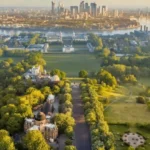
Richmond’s historical importance is not based on a single surviving palace. The principal royal buildings disappeared or were substantially altered, but their physical and institutional legacy remains visible through Richmond Green, the Old Palace, Richmond Park, the Thames waterfront, Richmond Bridge, historic houses, and protected landscapes.
The Royal Parks describes Richmond Park as having changed little over roughly 800 years. The park’s royal associations begin with the medieval Manor of Sheen, while its transformation into an enclosed hunting park occurred under Charles I in the seventeenth century.
Understanding this history requires separating Richmond’s royal palace from Richmond Park. They developed through related royal interests but followed different historical trajectories. The palace established Richmond as a royal residence, while the park preserved its function as a large landscape for hunting, recreation, and later public access.
Why did Richmond become a royal location in the first place?
Richmond became royal because the medieval Manor of Sheen provided a strategically useful riverside estate near London, combining agricultural land, hunting opportunities, river transport, and access to the capital while maintaining separation from its crowded urban centre.
The earliest royal association belongs to the Manor of Sheen, which formed part of the Crown’s wider estates. The site stood on the south-western approach to London beside the River Thames. Its landscape included farmland, woodland, pasture, and open areas suitable for hunting.
King Edward I, who reigned from 1272 to 1307, established an important royal connection with the manor. The area remained associated with successive monarchs and gradually developed into a royal residential environment.
The Thames was fundamental to this development. Before modern road and railway networks, rivers provided efficient movement for people, goods, and royal households. The Thames also connected Richmond with other royal sites upstream and downstream.
The landscape offered another advantage. Medieval kings used hunting as both recreation and a demonstration of royal authority. Hunting grounds required managed territory, game animals, woodland, and controlled access. Richmond’s surrounding countryside provided these conditions.
The location also allowed the monarchy to remain within practical reach of London. Richmond was sufficiently close for political and administrative purposes while providing a less urban environment.
This combination of proximity and landscape became the defining feature of Richmond’s royal identity.
How did Henry VII transform Sheen into Richmond?
Henry VII transformed the royal estate by rebuilding the palace after a major fire, adopting the name Richmond from his earldom, and establishing a Tudor royal residence that became associated with royal ceremony, government, hunting, and the monarch’s private life.
Henry VII became England’s first Tudor monarch after defeating Richard III at the Battle of Bosworth in 1485. His reign lasted from 1485 until 1509 and established the Tudor dynasty.
The palace at Sheen had suffered damage from fire before Henry VII’s major rebuilding programme. The king developed the residence into an important royal palace and renamed the surrounding royal estate Richmond.
The name derived from Henry’s former title as Earl of Richmond. The title connected his new royal identity with the Tudor family’s Welsh and Lancastrian associations.
Richmond Palace became one of Henry VII’s preferred residences. The king died there on 21 April 1509. Historic Royal Palaces identifies Richmond Palace as the location of his death at the age of 52.
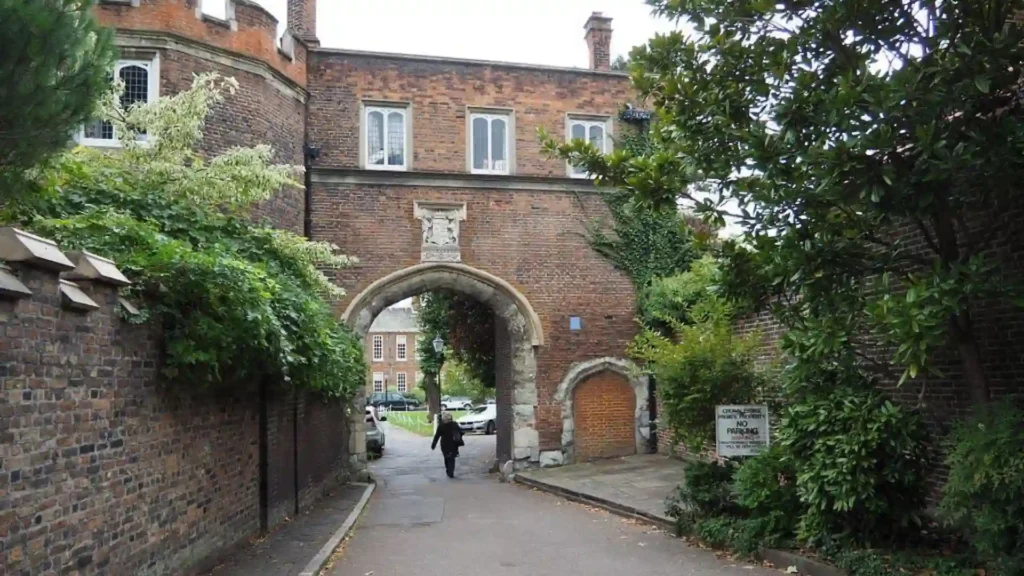
The palace also established the physical relationship between Richmond Green and royal authority. The surviving Old Palace complex incorporates remains of Henry VII’s palace of 1501. Historic England lists the Gate House and Old Palace as Grade I heritage assets.
The surviving gateway is particularly important because it provides tangible evidence of the Tudor palace. Henry VII’s arms remain associated with the historic entrance, connecting the present streetscape with the royal complex established more than five centuries ago.
How important was Richmond Palace to the Tudor monarchy?
Richmond Palace became one of the Tudor monarchy’s significant residences because it supported royal administration, court life, hunting, family residence, and ceremonial activity while providing access to the Thames and extensive countryside surrounding the royal estate.
Henry VIII inherited Richmond Palace in 1509 after his father’s death. The young king continued to use royal residences across England, including Richmond, Hampton Court, Greenwich, and Windsor.
Richmond was particularly valuable for its combination of palace accommodation and open countryside. Hunting remained an important royal activity, and the estate provided access to managed landscapes outside the dense urban environment.
Henry VIII’s reign also transformed the physical and political character of England. The English Reformation, the break with papal authority, and the growth of royal administrative power created an increasingly complex court system.
Richmond Palace participated in this wider royal network. It was not simply a country retreat. Royal residences functioned as centres where monarchs received officials, diplomats, courtiers, household servants, and political visitors.
The palace also became associated with the Tudor royal family. Mary I was born at Greenwich, while Elizabeth I developed a particularly strong connection with Richmond later in her life.
The importance of Richmond therefore extended beyond architecture. The palace formed part of the geographic system through which Tudor monarchs exercised authority.
Why is Elizabeth I central to Richmond’s royal history?
Elizabeth I is central to Richmond’s history because she maintained a strong association with Richmond Palace, spent her final days there, and died at the palace on 24 March 1603, ending the Tudor dynasty after nearly 120 years of Tudor rule.
Elizabeth I ruled England from 1558 until 1603. Her reign established Richmond Palace as an important location during the final decades of Tudor monarchy.
Her relationship with Richmond reflected the practical advantages already established by earlier monarchs. The palace provided a royal residence near London, while the surrounding landscape offered recreation and hunting.
Elizabeth died at Richmond Palace in the early hours of 24 March 1603. She was 69 years old. Historic Royal Palaces records Richmond Palace as the location of her death and identifies the illness affecting her final days as a severe throat infection.
Her death created a major constitutional transition. Elizabeth had no surviving children, so the Tudor dynasty ended with her reign. James VI of Scotland succeeded her as James I of England.
Richmond therefore occupies an important position in the chronology of English monarchy. The palace witnessed the death of Henry VII in 1509 and Elizabeth I in 1603, linking the beginning and end of the Tudor dynasty through the same royal residence.
This association gives Richmond an importance that extends beyond local history. The district forms part of the national narrative of Tudor government, succession, monarchy, and royal residence.
How did Charles I change Richmond’s royal landscape?
Charles I changed Richmond by converting its surrounding countryside into an enclosed royal hunting park after bringing his court to Richmond in 1625, creating the landscape that became Richmond Park and permanently strengthening the area’s royal identity.
Charles I became king in 1625. During the same year, he brought his court to Richmond Palace while plague affected London. The move demonstrated Richmond’s continuing value as a comparatively rural royal refuge close to the capital.
The king’s interest in hunting accelerated the transformation of the surrounding landscape. The area became known as the New Park.
In 1637, Charles I enclosed the park with a brick wall approximately eight miles long. The enclosure controlled the movement of deer and restricted access across the royal hunting ground.
The park contained red and fallow deer. Royal Parks records that Charles I introduced the deer population in 1637 and that their descendants continue to form an important part of Richmond Park’s landscape.
The enclosure also created conflict over access. Local residents depended on the countryside for movement and access to resources. The royal authorities installed ladder stiles in sections of the boundary, allowing pedestrians to cross the enclosure.
The park therefore represented both royal privilege and a negotiated relationship with local communities.
Its creation was one of the most consequential events in Richmond’s history because the landscape survived the decline of the palace itself.

What happened to Richmond during the English Civil War and Restoration?
Richmond’s royal landscape changed during the Civil War when Parliament controlled Crown property, but the New Park survived as protected open land and returned to royal ownership after the Restoration of Charles II in 1660.
The English Civil War created a fundamental change in the political status of royal property. Charles I was executed in 1649, and the monarchy was abolished during the Commonwealth period.
Richmond Palace and its associated lands were affected by the redistribution of Crown property. Historic England records that Parliament sold Richmond Palace while the New Park was given to the City of London.
The park’s survival was significant. It was protected from complete destruction and remained a park during the Commonwealth period. This prevented the landscape from being entirely converted to other uses.
The monarchy returned in 1660 when Charles II became king. Richmond Park was restored to the Crown, allowing the royal hunting tradition to continue.
The palace did not regain its former importance. Its decline was gradual rather than sudden. Later royal priorities shifted towards other residences, and parts of the old palace complex disappeared.
Richmond therefore entered the post-Restoration period with a stronger surviving landscape legacy than palace legacy.
This distinction shaped the district’s later development.
Why did Richmond’s riverside become fashionable in the eighteenth century?
Richmond’s riverside became increasingly fashionable during the eighteenth century because improved roads, the Thames, royal associations, landscaped estates, elegant houses, and leisure culture made the area attractive to wealthy residents and visitors seeking proximity to London.
The eighteenth century changed Richmond from a predominantly royal locality into a fashionable riverside settlement.
The decline of the palace as a major royal residence did not eliminate Richmond’s prestige. Instead, royal associations became part of the area’s wider cultural identity.
Richmond Hill became particularly important. Its elevated position created extensive views over the Thames Valley. Wealthy residents built substantial houses around the hill and along the riverside.
Richmond’s association with royal history strengthened the value of this landscape. The presence of Richmond Park provided an enormous open space next to a growing settlement.
The development of riverside villas also extended across neighbouring districts. Richmond Council’s historical research identifies important eighteenth-century houses and estates along the Thames, including Richmond House, Marble Hill House, and Strawberry Hill.
Richmond Wells also contributed to the area’s eighteenth-century reputation. The development of fashionable amenities reinforced the transformation from royal estate to leisure-oriented riverside community.
The process demonstrates an important historical shift. Royal patronage established Richmond’s prestige, while private wealth and transport gradually converted that prestige into a permanent residential and visitor economy.
How did Richmond Bridge change the town?
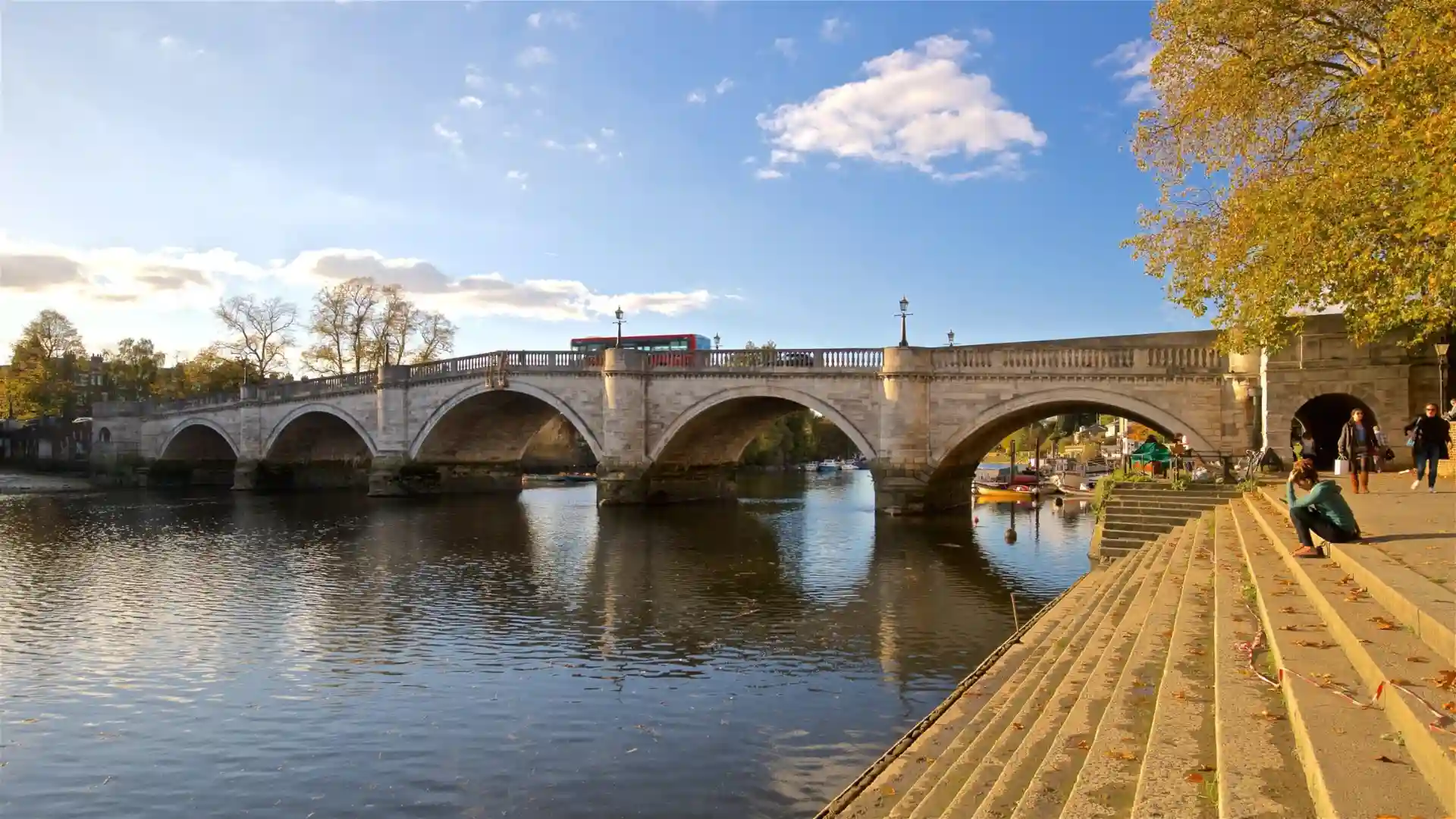
Richmond Bridge transformed movement across the Thames when it opened in 1777, replacing the ferry and connecting Richmond more directly with Twickenham while supporting commercial activity, residential development, and the growth of the riverside as a destination.
Before Richmond Bridge, river crossing depended on a ferry. The bridge opened in 1777 as a toll bridge and replaced that earlier system.
James Paine designed Richmond Bridge. The structure was built from Portland stone and became an important piece of eighteenth-century infrastructure. Richmond Council records its opening and its connection with Twickenham.
The bridge improved road connectivity on both sides of the Thames. Better movement supported the growth of housing and commercial activity.
Its construction also strengthened Richmond’s role within the wider Thames Valley. Visitors and residents gained a permanent crossing rather than relying on ferry operations.
The bridge remains one of Richmond’s most important historic structures. Its survival provides direct physical evidence of the eighteenth-century transition from royal landscape to connected urban settlement.
The bridge also helped integrate Richmond into the transport network that later expanded through roads, railways, and trams.
How did the railway turn Richmond into a modern London suburb?
The railway accelerated Richmond’s transformation into a modern suburban district by reducing travel time to central London, encouraging residential construction, increasing population, and changing the local economy from an elite riverside settlement into a connected metropolitan community.
Railway development reached Richmond during the nineteenth century. Richmond Council’s historical research records railway arrival in 1846, while other council heritage documentation identifies 1848 in connection with subsequent population and transport development.
The railway changed the geography of daily life.
Before rail transport, long-distance movement depended heavily on roads, river services, horses, and walking. Railway connections allowed residents to live farther from central London while maintaining access to employment and commerce.
Population growth followed. Richmond Council records that the population increased from approximately 3,000 in 1801 to around 21,000 by 1901.
The growth produced new streets, shops, houses, and civic infrastructure. Large estates were subdivided as demand for housing increased.
This process affected the surrounding riverside landscape. Some large villas disappeared as their land became more valuable for residential development.
The railway therefore reduced Richmond’s dependence on its royal identity. The district became part of metropolitan London while retaining the physical landscape inherited from its royal past.
Which royal remains can still be seen in Richmond today?
Richmond’s surviving royal heritage includes the Old Palace and Gate House, Richmond Green, Richmond Park, historic royal landscape boundaries, surviving palace archaeology, and views associated with the Thames and Richmond Hill, allowing visitors to trace the district’s royal development.
The Old Palace provides the clearest architectural evidence of Richmond Palace. Historic England confirms that the building incorporates remains of Henry VII’s 1501 palace and retains the original palace gateway.
Richmond Green also preserves the spatial character of the former royal settlement. Its open grassland sits beside the Old Palace and historic houses, maintaining the relationship between palace, settlement, and landscape.
Richmond Park provides an even larger survival. Historic England describes it as a royal deer park with pre-fifteenth-century origins, enclosed by Charles I, improved by later monarchs, and opened as a public space during the nineteenth century.
The park now has formal conservation significance. Royal Parks identifies Richmond Park as a National Nature Reserve, a Site of Special Scientific Interest, and a European Special Area of Conservation.
Its biodiversity is also historically significant. Royal Parks records 144 bird species, 29 butterfly species, and 11 bat species in the park.
The deer remain one of the strongest physical links with the seventeenth-century royal hunting landscape. The park currently supports more than 630 red and fallow deer.
To experience this historic royal landscape in person today, consult our comprehensive [Best Things to Do in Greenwich Beyond Maritime Museums and Royal Observatory Visits] for itineraries and visiting parameters.
How did Richmond’s royal identity survive after the monarchy stopped using the palace?
Richmond retained its royal identity because the palace landscape, Richmond Park, historic buildings, riverside views, royal associations, and surviving architectural fragments continued to shape local heritage even after the palace ceased to function as a major royal residence.
Royal identity can survive without a functioning royal palace. Richmond demonstrates this process clearly.
The physical palace declined, but its surrounding geography remained. Richmond Green continued to define the historic centre. Richmond Park preserved the hunting landscape. The Thames retained its importance as a riverside feature.
The district also preserved historic buildings associated with the former palace estate. Historic England’s statutory listings protect the Old Palace and Gate House, while Old Palace Place and other buildings preserve architectural evidence from later periods.
The preservation of Richmond Park was particularly important. Its survival ensured that the landscape created for royal hunting remained a defining feature of the district centuries after the Stuart monarchy.
Victorian public access further changed the meaning of the royal landscape. A space originally associated with royal hunting became a public recreational environment.
This transition created a modern form of heritage continuity. The same landscape can document royal power, political conflict, land management, public access, biodiversity, and conservation.
Why does Richmond remain important to London’s history?
Richmond remains important because its history connects medieval royal landholding, Tudor monarchy, Stuart hunting culture, Georgian riverside development, Victorian suburban expansion, transport history, landscape conservation, and modern public heritage within one continuous London district.
Richmond’s significance rests on the survival of this complete historical sequence.
The medieval period established the royal manor. Henry VII created a major Tudor palace and gave the estate its Richmond identity. Henry VIII continued the royal association. Elizabeth I died at Richmond Palace in 1603.
Charles I then transformed the surrounding countryside into Richmond Park. The park survived the political upheaval of the Civil War and returned to Crown ownership after the Restoration.
The eighteenth century brought fashionable riverside development and Richmond Bridge. The nineteenth century introduced railway connectivity and rapid population growth.
The twentieth and twenty-first centuries added another layer: systematic heritage protection and environmental conservation.
Richmond Park now demonstrates how historical land management can produce modern ecological value. Its ancient trees, grasslands, wetlands, deer herds, archaeological remains, and historic boundaries preserve evidence from different periods.
The Royal Parks states that the landscape has changed little in roughly 800 years, making it an unusually strong surviving example of London’s historic royal countryside.
For historians, Richmond provides evidence of changing royal priorities. For architectural researchers, it preserves fragments of a major Tudor palace. For environmental historians, the park records centuries of grazing and landscape management. For genealogical researchers, the expanding nineteenth-century town provides evidence of changing settlement and population.
What is Richmond’s lasting legacy as a royal riverside escape?
Richmond’s lasting legacy is the preservation of a royal landscape within modern London, where palace remains, Richmond Park, the Thames, historic streets, and protected buildings demonstrate how royal residence evolved into public heritage and conservation.
Richmond did not remain a royal retreat because the monarchy continuously occupied its palace. Its importance developed through historical continuity.
The royal estate established the location. Tudor monarchs gave Richmond national significance. Stuart rulers expanded its hunting landscape. Georgian society transformed the riverside into a fashionable settlement. Victorian transport integrated it into metropolitan London.
Modern conservation preserved the strongest physical evidence.
The Old Palace remains a protected Grade I building. Richmond Park remains a protected historic landscape and National Nature Reserve. Richmond Bridge continues to span the Thames as an eighteenth-century transport monument. Richmond Green preserves the spatial relationship between the former palace and the town.
These survivals explain Richmond’s unusual historical character. The district combines royal history, landscape history, transport history, architectural conservation, and environmental heritage without requiring reconstruction of the vanished palace.
Richmond therefore represents a long transition from royal estate to public historic landscape. Its history demonstrates how political institutions, royal land management, transport infrastructure, private development, and conservation can reshape the same place across centuries.
The most important surviving connection is the landscape itself. The Thames, Richmond Green, Richmond Park, Richmond Hill, and the remaining palace structures continue to preserve the geography that made the area valuable to successive generations.
Richmond’s royal history consequently remains embedded in the modern town. Its surviving heritage is not limited to monuments. It exists in the relationship between buildings, open land, roads, river crossings, park boundaries, archaeological remains, and views.
That continuity explains why Richmond remains one of London’s most historically significant riverside districts and why its royal past continues to influence the way its landscape is understood, protected, and visited today.
Frequently Asked Question
Why did Richmond become a royal retreat?
Richmond became a royal retreat because of its location beside the River Thames, its proximity to London, its countryside, and its suitability for hunting. The medieval Manor of Sheen developed into an important royal estate before Henry VII rebuilt the palace.