Key Points
- London Markets End Mixed: The FTSE 100 edged up 7.96 points (0.1%) to 10,694.50 following Chancellor John Healey’s autumn Budget statement, while the FTSE 250 declined 0.3% to 24,639.26 and the AIM All-Share added 0.3% to 760.92.
- Fiscal Stability Prioritised: Chancellor John Healey delivered a Budget grounded in “fiscal discipline” aimed at providing “breathing space” for households, maintaining existing fiscal rules without imposing broad-based tax hikes that would unsettle gilt markets.
- Banking and Gambling Taxes Adjusted: Lenders face a temporary 15-month increase in the banking surcharge from 3% to 6%, while machine gaming duty increased to 25% from 20%—a outcome well below worst-case market fears.
- Sharp Sector Movements: Bank shares held firm and betting operators rallied, but major housebuilders slumped between 6.6% and 7.3% on softer-than-expected first-time buyer scheme funding, while drugs giant GSK dropped 4.8% on weak vaccine division revenue.
- Focus Turns to Central Banks: Gilts stabilized with 10-year yields nudging down to 5.33%, as global investor attention shifted to monetary policy decisions from the US Federal Reserve, European Central Bank, and Bank of Japan.
LONDON (The Londoner News) October 28, 2026 – London equity markets delivered a calm reaction on Wednesday as investors digested Chancellor of the Exchequer John Healey’s inaugural Budget statement before turning their attention toward upcoming monetary policy decisions from major global central banks. The FTSE 100 closed slightly higher at 10,694.50 after the Chancellor unveiled a fiscal package emphasizing deficit reduction and fiscal discipline designed specifically to avoid unsettling government bond markets. With UK 10-year gilt yields easing slightly to 5.33% and sterling holding steady against the dollar at $1.3310, analysts described the market’s reception as a tolerant “steady as she goes” verdict, even as sector-specific tax measures triggered sharp declines among housebuilders and pharmaceutical majors.
- Key Points
- How Did Financial Markets and Analysts Evaluate Chancellor John Healey’s First Budget?
- How Did Specific FTSE 100 Sectors Respond to the Budget Tax Adjustments?
- What Economic Forecasts Were Issued by the Office for Budget Responsibility?
- How Are Global Markets Positioning Ahead of the US Federal Reserve Rate Decision?
- Background of the UK Fiscal Framework and Central Bank Policy Pressures
- Prediction: How Market Reaction to the Budget Will Affect Institutional Investors and Homeowners
How Did Financial Markets and Analysts Evaluate Chancellor John Healey’s First Budget?
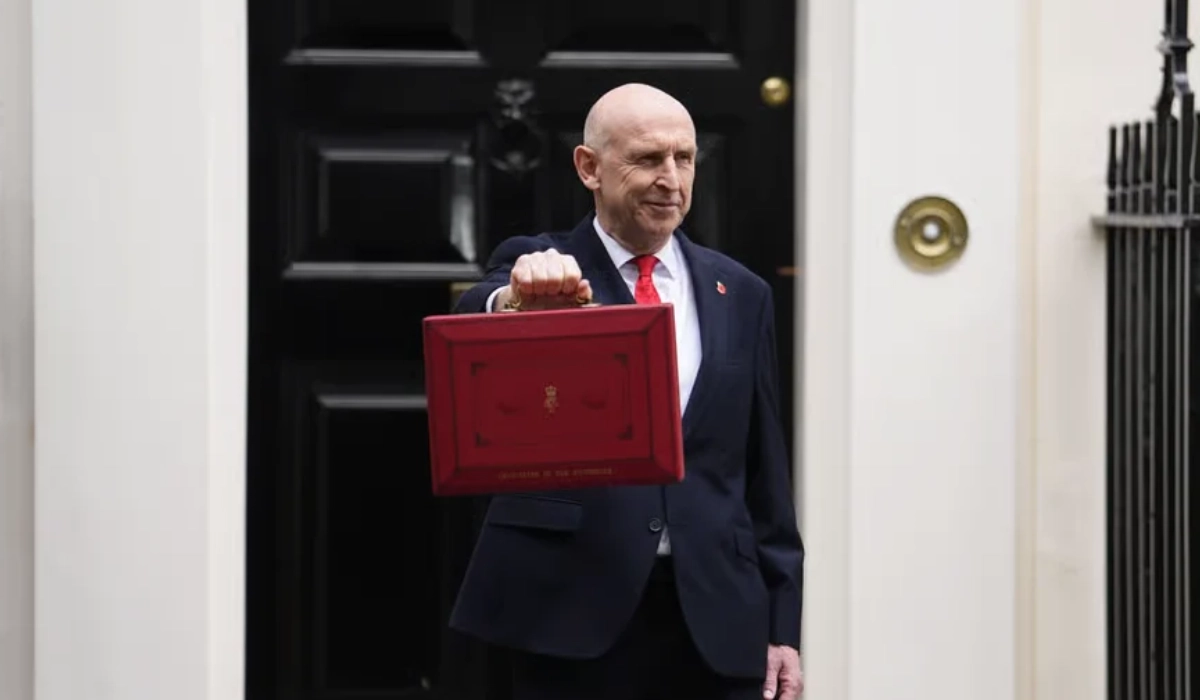
The Chancellor delivered his first Budget statement outlining the Labour administration’s economic priorities, stating that the measures were designed “for the working people of Britain” and built upon an uncompromising foundation of “fiscal discipline.”
As reported by Alliance News, Chancellor John Healey stated:
“Fiscal discipline is my first commitment.”
Healey stressed that the government’s tax and spending framework will give “breathing space” to households while generating “innovation and growth in every postcode,” including targeted tax measures on banking profits and betting operators to subsidize household energy bill assistance.
Market commentators widely interpreted the fiscal package as a calculated effort to preserve sovereign debt stability and prevent volatility in the UK gilt market.
As reported by Alliance News, Tom Stevenson, investment director at Fidelity International, noted:
“For investors, the message was one of stability, with few major surprises to unsettle financial markets.”
Reflecting on the government’s approach to bond markets, Kallum Pickering, chief economist at Peel Hunt, characterized the outcome as a “mostly inconsequential” Budget that financial markets could readily “tolerate.”
As reported by Alliance News, Kallum Pickering observed:
“For all Prime Minister Andy Burnham’s talk that the UK should not be in hock to the bond market, his government’s first Budget, delivered by Chancellor John Healey, was plainly designed with the market in mind. Fiscal rules were left untouched, higher debt-interest costs more than accounted for the reduction in near-term headroom, and there were no broad-based tax rises to spook anyone.”
Sharing a similar sentiment on the government’s risk-averse approach, Sanjay Raja, chief UK economist at Deutsche Bank, remarked:
“The Chancellor’s mantra heading into the autumn Budget was to ‘do no harm’, and we think the Chancellor successfully met this objective.”
An economic commentary from Dutch bank ING highlighted that while the Budget keeps public sector borrowing on a downward trajectory without complicating matters for the Bank of England, several structural headwinds remain. ING noted that many of the UK’s longer-term challenges remain unfunded and unaddressed, while noting the fiscal trajectory leaves open the option for an early general election in 2027.
On sovereign debt markets, UK 10-year gilt yields nudged lower to 5.33% from 5.34% late Tuesday. As reported by Alliance News, Kathleen Brooks, research director at XTB, assigned the bond market’s verdict a “decent B+”, summarizing the fiscal statement as “steady as she goes.” On currency desks, sterling was little moved, trading at $1.3310 against the US dollar compared to $1.3307, while edging marginally lower against the euro to €1.1941 from €1.1943.
How Did Specific FTSE 100 Sectors Respond to the Budget Tax Adjustments?
While benchmark indices remained relatively flat, individual equity sectors experienced notable divergence based on specific policy details announced by the Treasury.
Banking Sector
UK banking stocks traded higher despite the announcement of a temporary 3% increase in the bank surcharge, raising the rate from 3% to 6% for a 15-month duration. Markets had feared a potential return to the 8% levy that existed prior to 2023.
As reported by Alliance News, Benjamin Toms, banking analyst at RBC Capital Markets, estimated that the surcharge will present a net headwind to FY27 bank profitability of up to 4%, adding:
“The market will be sceptical that these changes will be temporary based on experiences elsewhere in Europe such as Spain.”
Despite the tax headwind, major domestic lenders closed in positive territory:
- Lloyds Banking Group: Rose 1.7%
- Barclays: Gained 1.6%
- NatWest: Advanced 2.0%
- Standard Chartered: Surged 2.4% after lifting full-year performance guidance alongside third-quarter earnings.
Gambling and Gaming Operators
Shares in betting operators mounted a relief rally after the government announced a 5% increase in machine gaming duty to 25%, avoiding earlier media speculation that rates could double to 40%. Entain rose 3.6%, while Rank Group jumped 12%. Analysts at JPMorgan noted that the 25% duty structure represented “a relief versus worst-case fears.”
Housebuilders and Developers
Conversely, UK housebuilders suffered steep selling pressure despite official confirmation of a government support scheme for first-time buyers. Equity analysts attributed the sell-off to market disappointment over the total funding allocation and implementation timeline, which could lead home buyers to delay purchases.
- Barratt Redrow: Slumped 6.6% (down 22.2p to 315.7p)
- Taylor Wimpey: Fell 7.3%
- Persimmon: Dropped 6.9%
Pharmaceutical and Energy Stocks
Outside of Budget measures, pharmaceutical giant GSK dropped 4.8% (down 92.0p to 1,831.5p). Although third-quarter top-line revenue and earnings surpassed consensus estimates, investors were unsettled by weaker-than-expected sales contributions from its vaccines division. On the FTSE 250, energy services firm Hunting plummeted 9.5% after cutting its full-year EBITDA guidance for the second time in two months due to ongoing Middle East conflicts impacting second-half operations.
As reported by Alliance News, Jim Johnson, chief executive officer of Hunting, stated:
“Whilst the long-term fundamentals of our end-markets remain robust, which includes ongoing strong trading results within our Subsea-focused businesses, the protracted and deepening nature of the conflict in the Middle East has impacted our overall results in Q3 and into Q4, with a deterioration in the short-term trading outlook seen in recent weeks.”
What Economic Forecasts Were Issued by the Office for Budget Responsibility?
The macroeconomic backdrop framing Chancellor Healey’s policy choices was detailed in updated projections published alongside the Budget by the Office for Budget Responsibility (OBR).
The official economic watchdog revised its growth and inflation metrics:
- GDP Growth: UK economic growth for 2026 was upgraded slightly to 1.2% from 1.1%, but the OBR slashed its 2027 GDP forecast from 1.5% to 1.0%.
- Inflation Outlook: CPI inflation is now forecast to reach 3.1% in 2026 and 3.4% in 2027, before slowing to the Bank of England’s 2% target in 2028—approximately one year later than projected in March.
- Fiscal Headroom: Fiscal buffer against the government’s primary Budget rule was estimated at roughly £15 billion for 2029-30 (down from £23.6 billion projected in March 2026), before rebuilding to £22 billion in 2030-31.
How Are Global Markets Positioning Ahead of the US Federal Reserve Rate Decision?
With UK domestic fiscal policy settled, global market attention swiftly shifted toward central bank rate decisions scheduled across major international jurisdictions.
In European equity trading, Paris’s CAC 40 closed unchanged, while Frankfurt’s DAX 40 gained 0.4%. On Wall Street, US indices traded mixed as the 10-year US Treasury yield stretched to 5.03% and the 30-year yield widened to 5.33%. Commodity markets saw Brent crude rise to $116.37 per barrel, while spot gold eased to $4,039.18 per ounce.
Investors are primarily focused on the upcoming interest rate announcement from the US Federal Reserve, where consensus expects rates to remain on hold despite persistent headline inflation metrics.
As reported by Alliance News, David Morrison, senior analyst at Trade Nation, commented:
“As far as investors are concerned, the consensus expectation is that interest rates will be left unchanged, even though all major US inflation measures show that prices are far from stable, and are well above the Fed’s 2% target. Yet the CME’s FedWatch Tool suggests that the US central bank will tighten monetary policy before year-end and could raise rates further in the first quarter of 2027 as well.”
The European Central Bank is scheduled to convene its own monetary policy meeting on Thursday, followed by the Bank of Japan on Friday, with both institutions widely expected to maintain existing benchmark interest rates.
Background of the UK Fiscal Framework and Central Bank Policy Pressures
The autumn Budget represents a delicate balancing act for UK Treasury officials following years of elevated interest rates, persistent inflation pressures, and volatile gilt yields. Following public debt spikes and bond market volatility in recent years, the Labour administration under Prime Minister Andy Burnham and Chancellor John Healey has prioritized strict adherence to fiscal rules to reassure international institutional investors.
Simultaneously, major global central banks—including the Federal Reserve, the Bank of England, and the European Central Bank—are navigating sticky inflation dynamics driven by elevated energy prices and resilient wage growth. The Federal Reserve’s target rate framework continues to dictate global capital flows, with 10-year Treasury yields hovering near 5% creating tighter financial conditions across international capital markets.
Prediction: How Market Reaction to the Budget Will Affect Institutional Investors and Homeowners
The market’s calm initial reception to Chancellor Healey’s Budget will influence borrowing costs, corporate investments, and asset allocations across the UK economy.
1. Stability in Mortgage Rates and Sovereign Borrowing
Because the Budget avoided unexpected borrowing commitments or sudden tax shocks, sovereign gilt yields remain stable around 5.33%. This stability will prevent a sudden spike in wholesale swap rates, allowing commercial lenders to keep fixed-rate mortgage pricing relatively steady for UK homeowners in the coming quarters.
2. Selective Re-allocation in Equity Portfolios
Institutional equity investors are likely to re-allocate capital back into UK banking and leisure stocks as worst-case tax fears subside. However, housebuilders will face persistent headwinds and lower valuation multiples until clarity emerges regarding the exact funding levels and rollout speed of the first-time buyer support initiative.
3. Heightened Sensitivity to US Monetary Policy Decisions
With domestic fiscal risk temporarily sidelined, UK asset valuations will remain highly sensitive to international interest rate decisions. Should the US Federal Reserve signal further monetary tightening or delay rate cuts due to persistent inflation above 2%, global bond yields could rise further, placing renewed upward pressure on borrowing costs across the UK and European economies.