
Key Points
- Significant Transformation: After a decade of planning and a £25 million investment, Grosvenor Square in Mayfair, London, has reopened following its most significant redesign in 300 years.
- Climate Resilience: The project aims to combat urban issues such as biodiversity loss, rising temperatures, and flooding, with soil restoration allowing the square to absorb up to 1.4 million litres of stormwater.
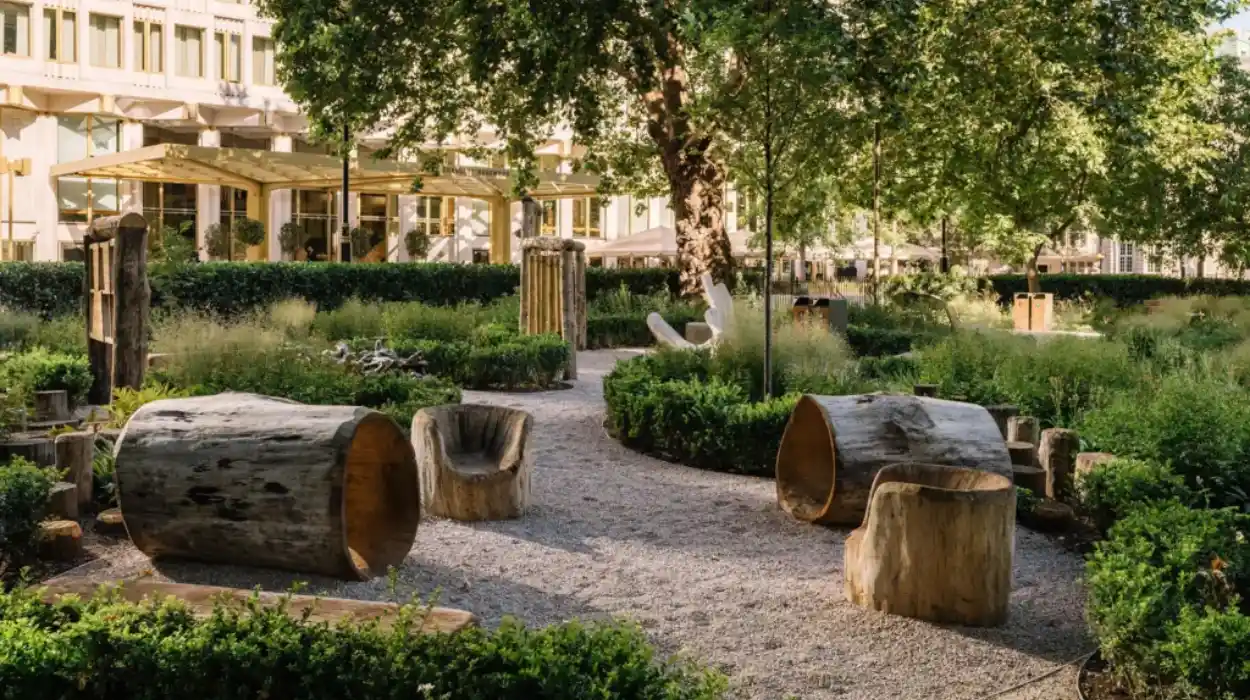
- Greening the Square: The planted area has increased from less than 1% to nearly 50%, featuring 70,000 new plants across 63 species, 80,000 bulbs, 44 new trees, and two new wetland areas.
- Public Amenities: The revitalised space includes 300 additional seats, public toilets, drinking fountains, improved lighting, and a new cafe kiosk.
- Educational Hub: The Wheatsheaf Building serves as a new visitor and learning centre operated by the London Wildlife Trust, providing free educational programmes on biodiversity and climate change.
- Design Heritage: Originated by Tonkin Liu and delivered by BDP, the project represents the fourth major redesign in the square’s history and stands as one of the final projects of the late Professor Nigel Dunnett.
London (The Londoner News) July 18, 2026 – One of central London’s most historic and prestigious public spaces has undergone a monumental transformation, reopening its gates today as a climate-resilient sanctuary for both residents and local wildlife. Following a year-long closure and a decade of meticulous planning, the £25 million project has radically reimagined Grosvenor Square, evolving it from a traditional, manicured lawn into a biodiverse urban garden capable of withstanding the pressures of a changing climate.
Why was Grosvenor Square redesigned?
The decision to overhaul the square, which has served as a fixture of Mayfair for 300 years, was driven by a need to address modern environmental challenges. As reported by Building Design journalist Tom Lowe, the scheme focuses heavily on increasing the site’s biodiversity and providing a robust defence against urban flooding and the “heat island” effect.
The square’s new landscape is specifically engineered to improve resilience to extreme weather. According to details shared by Grosvenor, soil has been decompacted and restored across 15,000 square metres—a surface area equivalent to two football pitches—enabling the garden to absorb up to 1.4 million litres of stormwater, thereby alleviating pressure on London’s drainage network.
Who was responsible for the transformation?
The redesign project is the fourth in the square’s three-century history. The design was originated by London-based architecture practice Tonkin Liu and delivered by the prominent design practice BDP.
A critical component of the project was its planting strategy, which was led by the late Professor Nigel Dunnett, a globally recognised expert in urban horticulture and planting design at the University of Sheffield. As noted by the London Wildlife Trust, Professor Dunnett passed away in April 2026, making this square one of his final completed works. His vision focused on creating a “low-input but high-impact” landscape that remains visually appealing throughout all seasons, rather than just the summer months.
What can visitors expect to see in the new Grosvenor Square?
The transformation is stark. Where previously less than 1% of the square was planted, almost half is now dedicated to nature. This includes:
- Over 70,000 new plants across 63 different species.
- 80,000 new bulbs and 44 new trees.
- Two newly created wetland areas designed to attract birds, dragonflies, and other pollinators.
Beyond the ecological benefits, the site has been upgraded to improve the visitor experience. As reported by Emily Whitehouse of NewStartMag, the redesign follows a consultation process involving over 7,000 Londoners and includes approximately 300 extra seats, wider entrances, public toilets, and new water fountains.
A central feature of the new-look square is the Wheatsheaf Building. This new visitor and learning hub, funded by the Westminster Foundation and managed by the London Wildlife Trust, will host a year-round programme of educational events, including school visits, guided walks, and family workshops, aimed at connecting urban dwellers with nature.
Explore more Central London News:
Enness Secures £10m+ Bridging Loan for Luxury Acquisition, Central London 2026
Australian Student Fletcher Beasley Dies in Victoria Embankment Fall, London 2026
What do local leaders and organisers say about the project?
The project has received significant support from both private stakeholders and public officials. Hugh Grosvenor, highlighting the project’s significance, stated, as reported by Building Design, that the reopening is a
“very special moment for Grosvenor and for this part of London.”
He further added:
“The square has been at the heart of Mayfair for three hundred years, and our responsibility has been to respect that history while ensuring it is ready to serve London for the next century.”
The Mayor of London, Sadiq Khan, expressed his support for the initiative as a model for future urban development. As captured by NewStartMag, Khan said:
“It’s amazing to see Grosvenor Square revitalised with dozens of new plant species and wildlife, providing a space where both Londoners and visitors can reconnect with nature. This extraordinary urban garden showcases how investment in our public spaces can help to build a greener, fairer and better city for everyone.”
How is the square adapting to the future?
The project seeks to balance the square’s Georgian heritage with modern necessities. The design restores the original central oval-shaped green while integrating the “sparkling flowering lawns” and woodland plantings championed by the late Professor Dunnett.
Jamie Whitty-Lewis, chief executive of Grosvenor Property UK, emphasised the cooling effect of the new landscape, noting in earlier comments to the BBC that the planting strategy was essential for the West End to adapt to climate change: “We are feeling the summers getting warmer and the winters getting wetter. The planting here has a cooling effect, so you’ll feel right now it’s actually quite cool here under the shade of the trees.”
As the square enters this new chapter, it serves not only as a public garden but as a living laboratory for urban resilience. With wildlife already returning to the site—ducks, butterflies, and dragonflies having been spotted ahead of the official opening—the project organisers believe they have successfully demonstrated that historic spaces can be reimagined to meet the environmental and social demands of the 21st century.