Key Points
- Budget Cuts on an Enormous Scale: The East London NHS Foundation Trust (ELFT) is going to implement efficiency savings worth £24.9 million, which amounts to cutting the budget by 331 jobs.
- Geographical Coverage: The cuts in employment and restructuring affect areas such as Tower Hamlets, Hackney, Newham, Luton, and Bedfordshire.
- Industrial Action: The industrial action ballot initiated by the Unite union branch will be held on 25 August, thanks to the new e-balloting law.
- Redundancy Controversy: There was intense lobbying against the redundancy of Unite branch secretary and staffside chair Mark Dunne, whose last day at work was on 31 July.
- Political Involvement: The Labour Member of Parliament for Poplar and Limehouse, Apsana Begum, expressed her official concern regarding patient access to the chief executive of the Trust.
- General Systemic Issues: It should be mentioned that there are reserves worth more than £150 million and a balanced budget for 2025/26, but not the decisions of the national government and the NHS England and North East London Integrated Care Board.
London (The Londoner News) August 6, 2026 – Health workers and trade union representatives across East London have mobilised into a fierce resistance against sweeping institutional cutbacks, mounting an organised campaign that combines grassroots workplace walkabouts, public demonstrations, and an upcoming industrial action ballot.
The conflict centres on the East London NHS Foundation Trust (ELFT) and its newly introduced financial programme. As documented by Jane L, an ELFT worker and Unite representative writing for Workers’ Liberty, the Trust aims to implement £24.9 million in “efficiency savings” which will result in the deletion of 331 equivalent posts. These measures stem directly from the “Going Further, Going Together” financial sustainability initiative initiated by management in 2024.
Why are health workers and unions balloting for industrial action?
The aggressive nature of the proposed restructuring has triggered immediate pushback from organised labour. According to Jane L of Workers’ Liberty, the Unite branch plans to launch a ballot for industrial action on 25 August, making use of updated legal frameworks that permit electronic union balloting. Weekly coordination meetings among ELFT union reps have paved the way for active site walkabouts in locations such as Mile End, Newham, and Hackney.
Jane L of Workers’ Liberty reported that these walkabouts exposed a critical information gap, noting that “the walkabouts we’ve conducted revealed there is a lack of awareness at some sites about the proposed cuts”. Nevertheless, this organising push has already stimulated a notable surge in overall Unite union membership.
Explore more East London News:
East London Waste Facility Fires Up 52% in 2026
NHS Trust Plans £25m Cuts in East London 2026
How has the redundancy of Mark Dunne impacted the dispute?
A major focal point of the brewing industrial dispute is the controversial redundancy of Unite branch secretary and staffside chair Mark Dunne. While management attributed the termination to a formal “service redesign” within the finance department, union members view the move as explicit victimisation aimed at silencing a prominent internal critic.
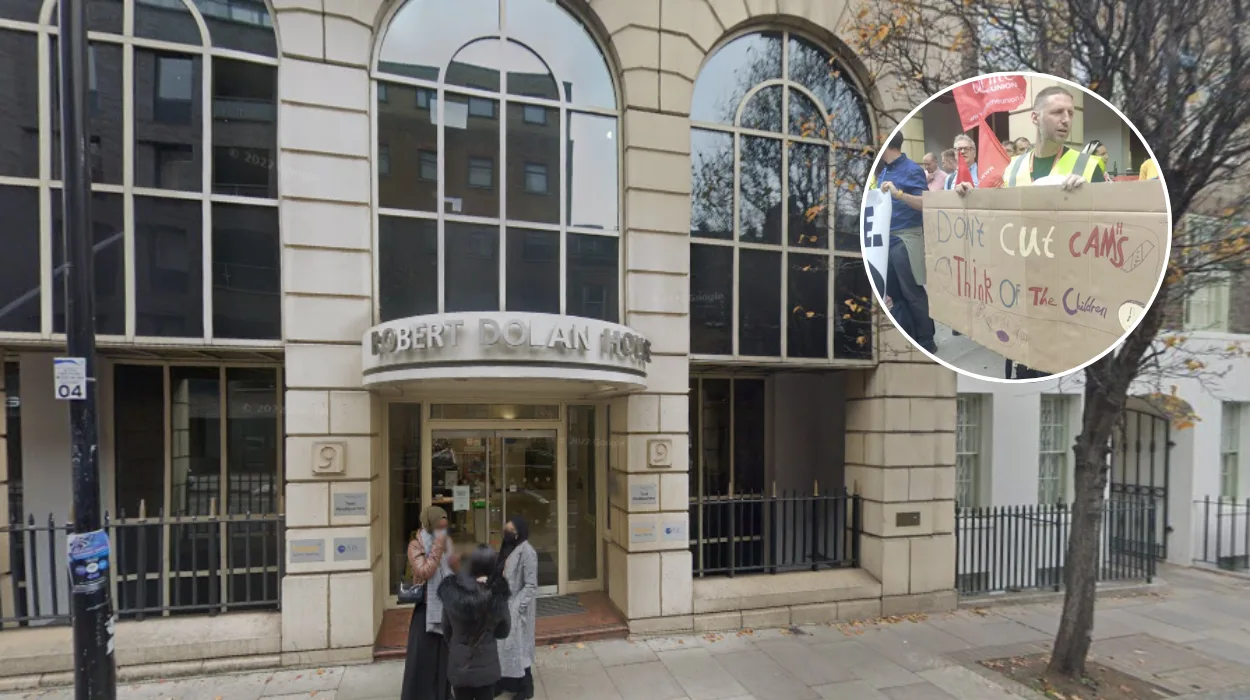
Reporting on the cascading local fallout, Jane L of Workers’ Liberty stated that demonstrations were held directly outside ELFT headquarters to protest both the cuts and Dunne’s dismissal. Despite ongoing local rallies, protests, and petitions, union efforts failed to reverse the decision, and Dunne’s final day at work took place on 31 July.
Adding parliamentary weight to the controversy, Labour MP for Poplar and Limehouse, Apsana Begum, intervened via correspondence with the Trust’s chief executive. As reported by Jane L of Workers’ Liberty, Apsana Begum stated in her letter: “I simply cannot envisage that cuts of that scale could be implemented without creating a substantial variation in how services are accessed by patients”. Furthermore, The Guardian highlighted the grave outlook of the restructuring, reporting that the changes would involve the redesign of at least 10 key services, including child and adolescent mental health care, talking therapies, addiction support, and community minority programmes.
Are the financial cuts a local necessity or a political choice?
Union campaigners argue that the sweeping reductions are entirely avoidable. Jane L of Workers’ Liberty emphasised that ELFT is currently maintaining a balanced budget for the 2025/26 fiscal cycle. Although the Trust previously registered a £12.7 million adjusted deficit for 2024/25, it maintains over £150 million in reserve funds. Having already absorbed £70 million worth of cuts over the preceding two years, workers argue that current reductions are driven by top-down political directives rather than local insolvency.
According to Jane L of Workers’ Liberty, financial pressures are cascading down from NHS England and national government policy, with the North East London Integrated Care Board explicitly targeting efficiency savings via a 50% reduction in running costs, which are subsequently passed on to individual trusts.
With demonstrations scheduled across multiple sites and an industrial action ballot commencing on 25 August, staff maintain that their campaign is not merely about protecting internal working conditions, but safeguarding vulnerable patients who depend on under-resourced mental health services.