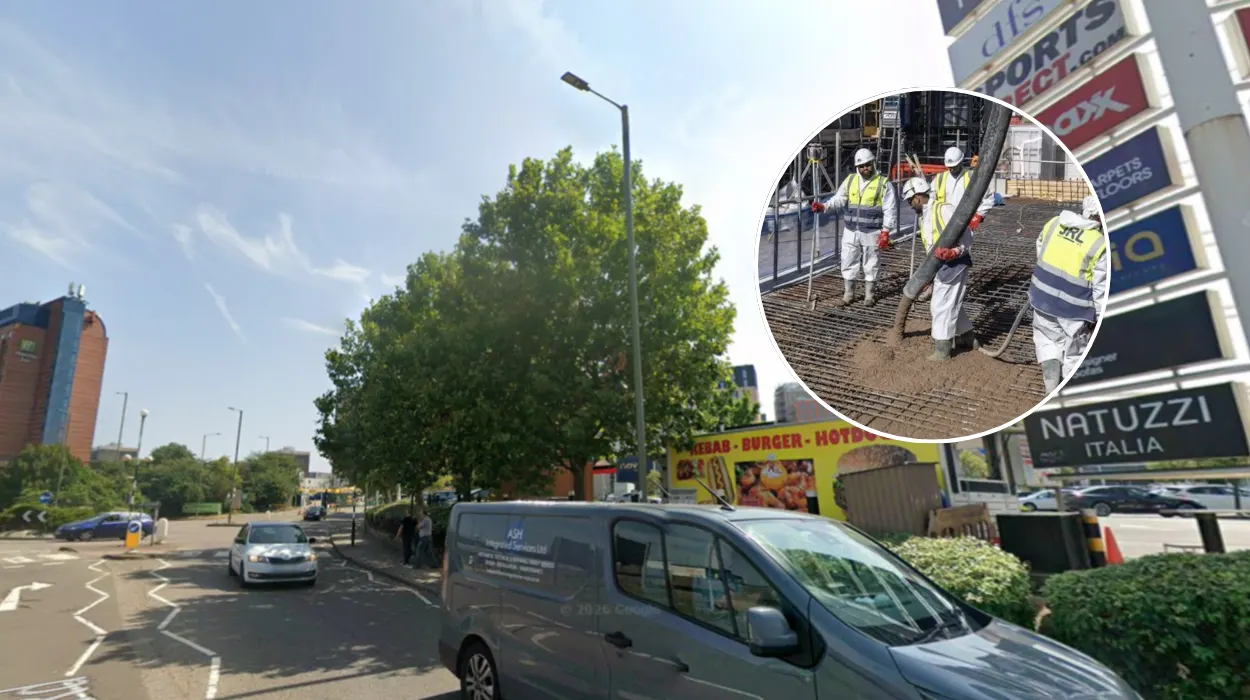
Key Points:
- UK Industry Milestone: Brent Cross Town has achieved a national premier by becoming the first residential development in the United Kingdom to successfully utilize calcined clay concrete in its permanent structural works.
- Supply and Execution: The innovative lower-carbon material was supplied by industry specialist Capital Concrete and successfully deployed by principal contractor Midgard.
- Project Scope: The material was integrated into a permanent suspended slab for Brent Cross Town’s third build-to-rent residential building, which is slated to comprise over 200 homes upon its operational completion in 2028.
- Environmental Impact: The specialized mix design substituted 30% of standard traditional cement with calcined clay, driving a net 10% reduction in embodied carbon compared to the equivalent standard concrete formulations previously specified at the site.
- Circular Economy Integration: The material utilized LKAB Minerals’ calcined clay, manufactured purposefully from recycled brick materials derived as by-products of the industrial brick manufacturing sector.
- Regulatory Compliance: Calcined clay concrete formulations have held formal structural approval under British Standards since 2019, paving the legal and technical pathway for structural specifications across the wider UK civil engineering landscape.
- Wider Urban Context: Brent Cross Town is a massive 180-acre joint-venture regeneration scheme delivered in North London by Related Argent and Barnet Council, currently transitioning into its expansive second residential delivery phase.
London (The Londoner News) June 18, 2026 – In a pioneering development for the United Kingdom’s sustainable construction sector, the Brent Cross Town regeneration project in North London has made history by becoming the nation’s first residential masterplan to successfully integrate calcined clay concrete into permanent structural works. The milestone material delivery, which was officially manufactured and supplied by Capital Concrete, marks a massive operational shift in standard structural engineering methodologies by demonstrating that low-carbon, clay-infused cement alternatives can seamlessly replace traditional carbon-intensive binders in high-density residential high-rises. As civil engineering frameworks face mounting structural mandates to decrease structural footprints, the success of this London pour offers a commercial template for low-carbon infrastructure scaling throughout the British Isles.
- Key Points:
- What is Calcined Clay Concrete and How Does It Reduce Carbon Footprints?
- Where is the Sustainable Material Sourced and How Does It Support the Circular Economy?
- Is Calcined Clay Concrete Fully Approved Under Existing British Standards?
- How Do Capital Concrete Officials View This Structural Milestone?
- What Role Does This Material Play in the Broader Brent Cross Town Masterplan?
- Why Do Developers Consider This a Significant Step Forward for UK Construction?
- What Does This Innovation Mean for the Future of British Infrastructure?
The material execution was managed on-site by principal contracting firm Midgard, which utilized the specialty mix to pour a permanent suspended slab within the footprint of Brent Cross Town’s third major build-to-rent residential asset. This specific block is scheduled to become fully operational by 2028, adding a volume of more than 200 individual homes to the expanding development. By introducing the alternative binder mix directly into a primary structural element like a suspended slab—a component that demands absolute mechanical integrity and long-term durability—the project partners have effectively proven that sustainable cement substitutes can meet the rigorous load-bearing metrics of the modern structural industry without compromising on long-term building safety.
What is Calcined Clay Concrete and How Does It Reduce Carbon Footprints?
To understand the environmental weight of the Brent Cross Town project, it is vital to examine the specific mineral science of the concrete mix supplied by Capital Concrete. In standard construction, traditional Portland cement acts as the chemical glue that binds aggregate materials together. However, traditional cement manufacturing is incredibly energy-intensive and chemically unstable, releasing vast amounts of carbon dioxide during the thermal breakdown of limestone. To mitigate these environmental damages, material engineers have continuously searched for reliable supplementary cementitious materials (SCMs).
In this specific deployment, the engineering teams successfully replaced 30% of the traditional cement content inside the concrete mix with a specialty calcined clay binder. This specific alteration yielded an immediate 10% reduction in overall embodied carbon when measured directly against the standard, equivalent concrete mixes that had been used across earlier building blocks at the North London development. By removing a substantial slice of the carbon-heavy cement component and substituting a thermally treated clay equivalent, the development has set a realistic precedent for low-carbon material integration that does not sacrifice structural performance.
Where is the Sustainable Material Sourced and How Does It Support the Circular Economy?
The supply chain dynamics underpinning this historic material trial highlight a strong focus on industrial circularity. The concrete matrix supplied by Capital Concrete incorporated a calcined clay product manufactured by LKAB Minerals. Rather than relying on newly mined virgin clay reserves, this particular material stream was manufactured by utilizing recycled brick material. This source material represents a prominent structural by-product generated during commercial brick manufacturing processes, capturing what would otherwise be considered industrial waste and feeding it directly back into primary infrastructure systems.
By converting a manufacturing by-product into a high-performance structural component, the collaboration between the supplier, the mineral processor, and the developer directly reinforces the core tenets of a circular economy. This structural methodology prevents the depletion of natural raw minerals while simultaneously reducing the volume of solid waste redirected to landfills. The structural application further validates the utility of industrial symbiosis—where the waste outputs of one manufacturing sub-sector are repurposed to become the low-carbon inputs of another.
Is Calcined Clay Concrete Fully Approved Under Existing British Standards?
While the application at Brent Cross Town represents a national premier for a major residential development, the underlying chemical technology has undergone comprehensive regulatory scrutiny over the past several years. Calcined clay concrete formulations have been fully approved for standard engineering use under official British Standards since 2019. This established regulatory certification ensures that structural engineers, local building authorities, and commercial insurance firms can confidently specify calcined clay formulations across a vast array of demanding structural concrete applications.
The existence of these regulatory approvals since 2019 meant that the engineering teams at Midgard and Capital Concrete were operating within a fully compliant, legally sound structural framework. The transition from laboratory testing to real-world deployment on a massive residential scheme demonstrates that the main barrier to widespread lower-carbon concrete adoption is often not a lack of regulatory clearance, but rather a historical industry hesitation to deviate from traditional, tried-and-tested Portland cement mixes.
Explore more North London News:
Harry Enfield Partially Deaf From Hampstead Heath Wild Swimming: London 2026
Arsenal Fans Mark Historic Premier League Triumph With Tattoos, Kentish Town 2026
How Do Capital Concrete Officials View This Structural Milestone?
The corporate leadership at Capital Concrete has framed this operational achievement as part of a wider commitment to rewriting material specifications for a green built environment. As reported in the official industry statement published by Agg-Net, Jack Sindhu, the technical director at Capital Concrete, expressed a strong corporate focus on driving sustainable infrastructure forward through intensive research and commercial field testing.
As reported by Agg-Net, Jack Sindhu stated that: “As a business, we’re continually exploring and developing material solutions that support customer requirements for a more sustainable built environment. Using lower‑carbon concrete technologies like calcined clay allows us to deliver high-performance materials to projects/customers, which actively contributes to a more responsible and future-focussed construction industry.”
Sindhu further emphasised the collaborative framework that allowed this material deployment to transition smoothly from supply plants to active construction shuttering. As reported by Agg-Net, Jack Sindhu noted that: “We’re proud to be involved in this exciting project and to be collaborating with LKAB Minerals to help advance lower-carbon concrete technologies using calcined clay. This allows us to deliver high-performance materials for our customers which actively contributes to a more responsible and future-focussed construction industry.”
What Role Does This Material Play in the Broader Brent Cross Town Masterplan?
The integration of calcined clay concrete is not an isolated experiment but a key component of a vast urban transformation. Brent Cross Town represents a massive 180-acre new urban district being brought forward through a joint venture partnership between developer Related Argent and Barnet Council. The grand scale of the development means that even minor percentage reductions in material-level carbon can accumulate into massive municipal carbon savings over the lifetime of the site’s multi-year buildout.
The district is scaling rapidly to address London’s ongoing housing demands. More than 2,000 people have already taken up residence within the community following the formal completion of the initial phase of residential buildings last year. The project is now pushing aggressively into its second major delivery phase, an expansive construction push that encompasses the delivery of 1,600 new homes. This phase includes a diverse mix of residential formats, including 300 modern co-living studios, 150 dedicated retirement living homes, and a substantial student hub consisting of more than 660 student apartments.
Why Do Developers Consider This a Significant Step Forward for UK Construction?
For the developers guiding the 180-acre regeneration zone, the success of the calcined clay slab provides commercial validation that ambitious environmental targets can align perfectly with rigid construction timelines and high structural standards. The material choice supports wider corporate policies designed to establish Brent Cross Town as a net-zero carbon development by 2030, a goal that requires stripping carbon out of both operational energy use and embedded building materials.
As reported by Agg-Net, Tim Hoyland, the environment manager at Related Argent, highlighted the deep macro-economic and industrial benefits of adopting alternative binder technologies. As reported by Agg-Net, Tim Hoyland stated that: “The successful application of calcined clay concrete in permanent works at Brent Cross Town is a significant step forward for sustainable construction in the UK. This material is a practical alternative to traditional cement replacement, allowing the industry to significantly reduce carbon emissions and support job creation and the circular economy.”
What Does This Innovation Mean for the Future of British Infrastructure?
The successful deployment of calcined clay concrete by Capital Concrete, Midgard, and Related Argent serves as a critical proof of concept for the wider British building industry. Historically, the UK construction sector has relied on other industrial industrial by-products, such as Ground Granulated Blast-furnace Slag (GGBS) from the steel sector or Pulverized Fuel Ash (PFA) from coal-fired power stations, to replace traditional cement. However, as the UK systematically transitions away from coal power and restructures its domestic steel production, the structural availability of these traditional SCMs is projected to drop significantly over the coming decade.
Calcined clay presents a highly abundant, resilient, and domestically sourceable alternative. Because clay is widely available across the geography of the United Kingdom and can be augmented by recycling brick waste as demonstrated at Brent Cross Town, it secures a stable, long-term supply chain for low-carbon construction. The successful completion of the permanent suspended slab proves to skeptical structural engineers that this material is a viable option for heavy structural work, paving the way for wider industrial adoption across both public infrastructure and private commercial portfolios nationwide.