
Key Points
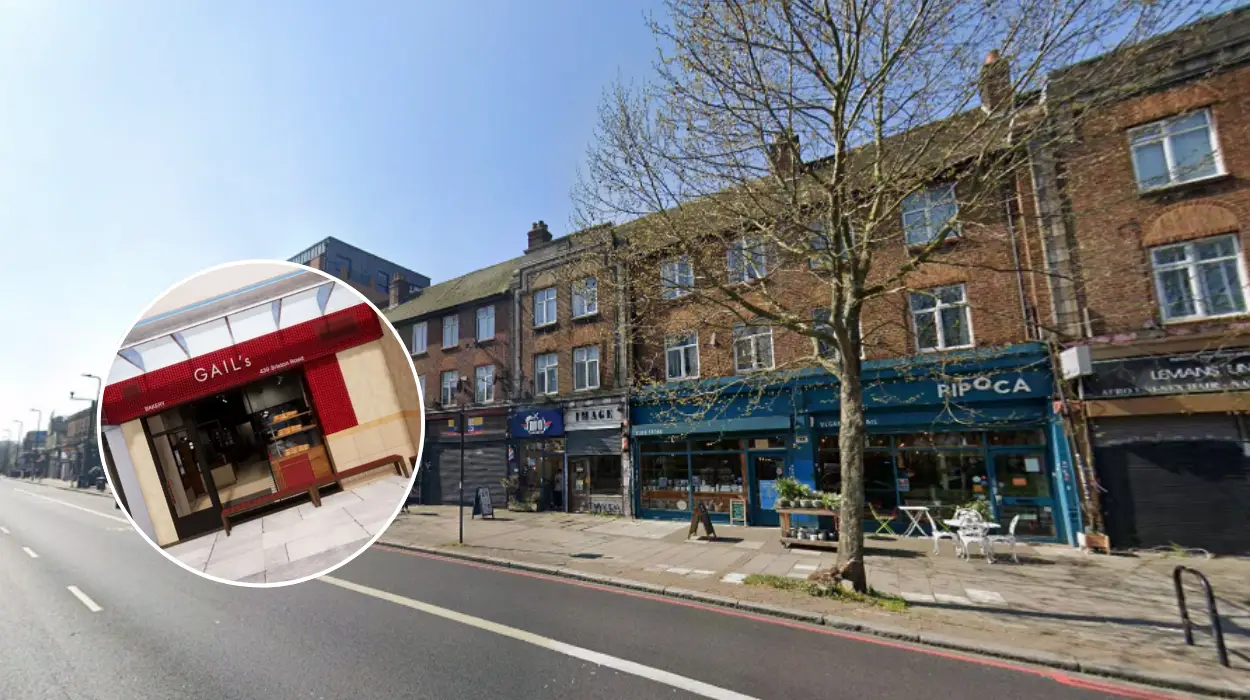
- Brixton Expansion Plans: The high-end bakery chain Gail’s has submitted formal planning applications to open a new branch at 439 Brixton Road, situated directly adjacent to the busy Brixton Underground station.
- Site Transition: The unit earmarked for development was formerly occupied by the fast-food noodle chain Chopstix and currently sits vacant.
- Proposed Alterations: Documentation reveals Gail’s is seeking municipal permission to completely remove the existing shopfront, install new corporate branding, and display internally illuminated static fascia signs.
- Public Consultation Window: Submitted on 13 May 2026, the local planning application remains open for community feedback and formal public objections until Friday, 19 June 2026.
- Gentrification Backlash: The announcement has sparked significant public debate online and offline, with critics accusing the chain of exacerbating local gentrification and threatening the survival of Brixton’s remaining independent businesses.
- Broader Corporate Tensions: The controversy follows a series of recent disputes involving Transport for London (TfL) tenants, including the forced closure of a 36-year-old Brixton news stand due to soaring rent demands.
London (The Londoner News) June 12, 2026 — The premium bakery and coffee shop chain Gail’s has unveiled plans to establish its latest outlet next to Brixton Underground station, igniting an immediate wave of debate regarding corporate expansion, local identity, and urban gentrification in South London.
- Key Points
- What Do the Official Planning Applications Disclose About the New Store?
- Why Has the Planned Opening Generated Intense Local Backlash?
- How Has the Brixton Public Responded to the Announcement?
- How Are Independent High-Street Traders Impacted by Corporate Openings?
- What Is the Academic and Political Context Behind the Brand’s Reputation?
- How Do the Company and Its Supporters Defend the Expansion?
- What Are the Next Steps for the Brixton Road Development?
The company submitted a comprehensive planning application to Lambeth Council seeking permission to overhaul the commercial property at 439 Brixton Road.
The high-street unit, which previously housed the quick-service noodle chain Chopstix, is slated for a total aesthetic transformation including structural changes to its frontage and the installation of prominent brand signage.
As local residents and small business owners digest the implications of an upmarket food retailer moving onto Brixton’s core thoroughfare, the municipal consultation process is rapidly drawing to a close, with the deadline for public representations set for 19 June 2026.
What Do the Official Planning Applications Disclose About the New Store?
According to official municipal registers compiled by the London Borough of Lambeth’s planning division, the development involves multiple concurrent applications under references 26/01369/FUL and 26/01463/ADV. The documentation indicates that Gail’s Ltd, working alongside its designated agent Planning Potential Ltd, intends to thoroughly modernise the vacant site.
The structural proposals outline the full replacement of the existing shopfront. This includes the complete recladding of the external shopfront surround and the installation of an entirely new shopfront frame configured with dual entry doors.
Furthermore, the advertising consent application requests the legal right to feature one internally illuminated static fascia sign alongside two pieces of non-illuminated fascia lettering across the front elevation. Following the conclusion of the public consultation period next week, local authority planning officers will compile an official recommendation report evaluating the project against prevailing national and borough-level planning frameworks. The final decision will either be determined via delegated authority by a senior planning officer or referred directly to Lambeth Council’s elected Planning Applications Committee for a public vote.
Why Has the Planned Opening Generated Intense Local Backlash?
The arrival of the upmarket brand has served as a lightning rod for long-standing anxieties concerning economic displacement within the neighborhood. As reported by Ruby Gregory, Senior Local Democracy Reporter for MyLondon, Gail’s has become heavily synonymous across the capital with the forces of aggressive gentrification, particularly following a major commercial push highlighted in late 2025 when the executive team announced a rapid expansion program targeting 40 new national locations.
With individual signature pastries such as cinnamon buns retailing at approximately £4.00 and artisanal sourdough loaves commanding starting prices of £4.90, segments of the local community argue the brand caters almost exclusively to affluent incoming demographics rather than the historical, working-class populations of Brixton.
In a public analysis published by the South West Londoner, data compiled from Rightmove and the UK House Price Index revealed that residential property prices in neighborhoods featuring an established Gail’s branch sit an average of 95 per cent higher than the baseline UK national average. This profound statistical correlation has led socioeconomic researchers to formally coin the phrase the “Gail’s effect”—a real estate phenomenon where the brand acts as a visual and economic indicator of advanced middle-class displacement.
How Has the Brixton Public Responded to the Announcement?
Public sentiment across South London has fragmented sharply along economic and cultural lines since the details of the 439 Brixton Road application emerged. Local tracking by journalism titles indicates an immediate explosion of civic commentary across digital platforms.
Writing for MyLondon, Ruby Gregory noted that an single online informational post uploaded by the hyper-local digital community hub bestofbrixtonldn on the social media platform Instagram quickly amassed over 1,200 likes and generated 572 distinct public comments within a highly condensed timeframe. The public testimony showcased a deep-seated frustration with the changing commercial landscape of the high street.
To provide clear insight into the exact nature of local opposition, the specific arguments raised by neighborhood residents highlight concerns over corporate visual monotony and economic exclusion:
- High-Street Monoculture: Commenting directly on the public development thread, local resident and social media user divagez argued against the necessity of the project, stating: “The High Street doesn’t need another overpriced bakery. It needs variety, affordability and businesses that actually serve the whole community.”
- Loss of Cultural Identity: Expressing a wider sense of cultural exhaustion regarding London’s evolving retail landscape, another local commentator using the handle somaticswithsuhad observed: “It is everywhere… how are all high streets gonna look the same? Every year London looks more generic, costs more to live in, and loses a bit more of its character. Gail’s? Really?”
- Redundancy of Outlets: A significant portion of online objectors additionally highlighted geographical redundancy, pointing out that an established Gail’s branch already operates on Railton Road in nearby Herne Hill, located just over a 20-minute walk from the newly proposed Brixton Road site.
How Are Independent High-Street Traders Impacted by Corporate Openings?
The impending arrival of a heavily capitalized corporate chain comes at a time when grassroots independent commerce across Lambeth faces severe financial headwinds. Local independent operators have expressed growing alarm that small-scale enterprises are being structurally squeezed out of central transit hubs by major corporate entities capable of absorbing massive overheads.
The structural precarity of independent station traders was recently underscored by the high-profile displacement of Pritesh Patel, the independent owner of Brixton News. Patel was forced to permanently dissolve his station news stand after 36 consecutive years of continuous operation inside Brixton Underground station following an unsustainable rent review implemented by the landlord, Transport for London (TfL).
Speaking directly on the financial realities of competing for physical space in the immediate vicinity of the new Gail’s site, Pritesh Patel stated that TfL management informed him he would be required to pay an annual rent of £85,000 to maintain his small leasehold—a figure that represented more than double his historical operating rate.
A highly similar commercial dispute is currently unfolding at the nearby Oval Underground station, where the independent, family-operated Old Roots Café has been formally notified by TfL that its long-term commercial lease will not be extended. The café, which has provided hot beverages and community space within the station infrastructure for two decades, faces total eviction by the summer of next year.
In an interview detailing the wider systemic threat facing independent station traders, Metin Balci of the Old Roots Café stated:
“TfL are limiting small businesses that are trying to run in their stations. We’re all being replaced by Gail’s, Pret and Greggs, but there’s no way we can compete with them. If this continues there will be no independent businesses left in stations.”
What Is the Academic and Political Context Behind the Brand’s Reputation?
The intense cultural weaponisation of a commercial bakery chain has drawn scrutiny from urban sociologists and political analysts alike, who note that the brand has evolved into a potent political symbol far exceeding its baseline identity as a food vendor. During recent UK general election cycles, the Liberal Democrats explicitly utilized the presence of local branches to execute a targeted geographic strategy codenamed “Operation Cinnamon Bun,” which accurately identified affluent, historically Conservative constituencies that were highly susceptible to political swinging.
Analyzing the intense civic hostility directed toward the chain, Professor Paul Watt, an academic specialist in urban renewal and author of Social Housing and Urban Renewal: A Cross-National Perspective, provided an expert breakdown to journalists regarding the sociological mechanisms at play. Professor Paul Watt explained that when an urban area becomes structurally acceptable to the traditional middle class, it triggers a secondary wave of institutional investment where financiers, major banks, and big institutional capital begin aggressively saturated the local market.
In a formal statement analyzing the symbolic weight of the company on the modern high street, Professor Paul Watt stated:
“It’s trying to think about what Gail’s signifies? It is as though a Gail’s now is not a sign of success, but it is of something quite distasteful. I suspect it is connected to the notion that Gail’s symbolises the corporate retail arm of gentrification.”
The company has previously encountered targeted civic resistance and direct activist campaigns across various London neighborhoods. As documented by the South West Londoner, grass-roots organizers in Walthamstow Village launched a formal community petition titled “Prevent Gail’s from establishing a store on our high street,” which rapidly secured more than 1,800 verified signatures from local residents. Gail Penfold, a 62-year-old full-time carer and prominent community champion within the Walthamstow area, publicly criticized the corporate model, stating that the neighborhood was fundamentally “not the right area for a Gail’s,” adding that the locality “is full of quirky shops and independent businesses. We are a welcoming borough, but they don’t give back to the community.”
Furthermore, distinct branches situated in Archway, Tooting, and Crystal Palace have drawn public condemnation from local trade associations for deliberately acquiring commercial plots in ultra-close proximity to highly successful, pre-existing independent bakeries. In February, an escalation of community tensions resulted in the physical targeting of the Archway storefront, which sustained property damage and graffitied slogans that generated national news headlines.
Explore more South London News:
Conan Doyle Sherlock Holmes Home Flat Conversion Plans: Croydon 2026
Greenwich Docklands International Festival Unveils Free 2026 London Lineup
How Do the Company and Its Supporters Defend the Expansion?
In the face of ongoing neighborhood friction, representatives and supporters of the artisan chain maintain that the business model is built upon high-quality craftsmanship, sustainable sourcing, and genuine neighborhood integration. The corporate history of the organization traces back to the 1990s, when founder Gail Mejia initially unified premier urban artisanal bakers to supply top-tier restaurants through a wholesale enterprise known as The Bread Factory. The consumer-facing retail brand subsequently launched its debut bakery on Hampstead High Street in 2005.
Defending the operational philosophy of the business against accusations of detached corporate behavior, corporate literature published via official channels by GAIL’s Bread states:
“We bake by hand with natural ingredients, and whilst we are ordinary people, we want to make extraordinary things. We want to play our part to bring humanity back into the food world, and back to local communities… Though we’ve grown over the years, our philosophy has remained the same: to make good food that people love, and create bakeries that people want to keep coming back to.”
The company also regularly highlights its corporate social responsibility framework, noting that surplus day-end food items are systematically sorted and donated to approximately 95 distinct regional charities operating within their immediate commercial neighborhoods to combat urban food waste.
Furthermore, corporate executives argue against the validity of using their brand as a generic shorthand for neighborhood destruction. In a comprehensive corporate defense provided to The Times, Tom Molnar, the co-founder of Gail’s, explicitly challenged the validity of the public backlash. Tom Molnar stated that the organization purposefully seeks to “build small sites so they are a part of a diverse high street,” before issuing a direct appeal to the shopping public: “I’d encourage people to look at what we’re trying to do, rather than taglines.”
The sentiment that the bakery represents a positive, high-quality asset to a modern high street is shared by consumers in other regions of the United Kingdom where the intense London-centric gentrification debates carry less cultural weight. Reflecting on the opening of an outlet outside of the capital, Taku Sibanda, a 24-year-old catering worker employed at a hot dog concession in the city of Bath, reported that the brand’s arrival 100 metres from his workplace had caused no friction. Taku Sibanda stated:
“My boss never complained they were taking his business, I have no issue with it being in Bath. It’s tasty, it’s got good food, it’s a nice addition to the high street.”
What Are the Next Steps for the Brixton Road Development?
The ultimate determination of whether Gail’s will successfully establish its foothold on Brixton Road rests with the planning department of Lambeth Council. The statutory public consultation period remains fully active, allowing any local stakeholder, business operator, or private resident to submit a formal letter of support or objection via the council’s online planning portal.
When contacted for an official statement regarding the mounting community opposition and the specific allegations of corporate gentrification surrounding the 439 Brixton Road site, senior representatives responding on behalf of the Local Democracy Reporting Service (LDRS) stated that the corporate chain did not wish to offer a formal comment on the pending Brixton application at this juncture.
Should the structural plans receive formal approval from local planners or council committee members later this summer, building contractors will proceed to dismantle the former Chopstix facade to pave the way for the brand’s latest high-footfall South London location.