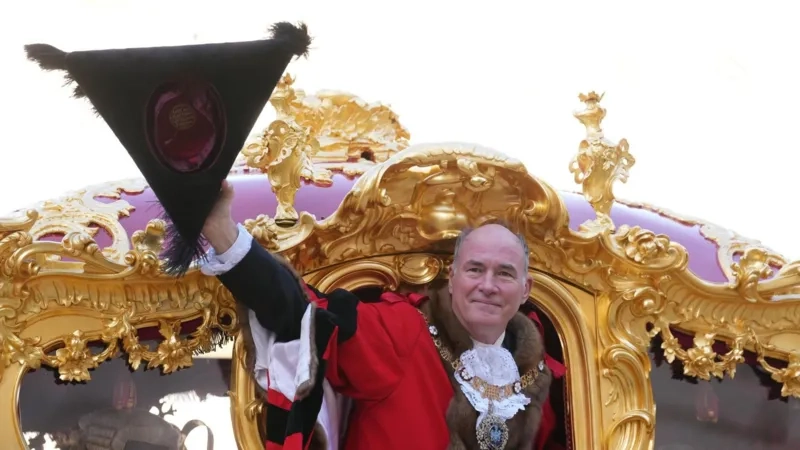
- Thousands of spectators lined the streets of the City of London on Saturday, November 14, 2026, to watch the annual Lord Mayor’s Show, a civic tradition dating back more than 800 years.
- The procession marks the formal installation of Alderman Bronek Masojada of the Billingsgate ward as the 698th Lord Mayor of London, succeeding Dame Susan Langley, who was the first person to hold the title of Lady Mayor.
- Featuring approximately 6,500 participants, 250 horses, and more than 50 decorated floats—including a replica of Tower Bridge with rising bascules—the 2.86-mile (4.6km) parade travelled from Mansion House to the Royal Courts of Justice and back.
- Ahead of the street parade, Bronek Masojada travelled along the River Thames aboard the ceremonial barge Jubilant, accompanied by a flotilla of livery company boats before coming ashore at HMS President, echoing the historic journey to Westminster to swear loyalty to the Crown.
- Deputy Nighat Qureishi, chair of the Lord Mayor and Sheriffs’ Committee, highlighted the City of London Corporation’s dual role in global finance and social initiatives such as homelessness and suicide prevention, while Aldersgate Ward Beadle Martyn Craddock praised the unrehearsed event for uniting Londoners and international visitors.
London (The Londoner News) November 14, 2026 – Executive Summary: Thousands of spectators gathered across the City of London on Saturday, November 14, 2026, to witness the centuries-old Lord Mayor’s Show celebrating the appointment of Alderman Bronek Masojada as the 698th Lord Mayor of London. Dating back more than 800 years, the unrehearsed 2.86-mile procession featured approximately 6,500 people, 250 horses, and over 50 floats. Preceded by a ceremonial flotilla along the River Thames aboard the barge Jubilant and Friday’s Silent Ceremony, the event highlighted both the Square Mile’s financial heritage and its civic and charitable work.
As reported by BBC News and The Standard, the City of London was transformed on Saturday morning, November 14, 2026, as one of Britain’s oldest civic traditions—the annual Lord Mayor’s Show—took place across the Square Mile. Tracing its origins back more than 800 years to the early 13th century, the event celebrates the formal appointment of the incoming Lord Mayor of London, with Alderman Bronek Masojada of the Billingsgate ward assuming the historic office this year.
Bronek Masojada formally took office during the traditional Silent Ceremony held on Friday, November 13. He succeeds Dame Susan Langley, who made history as the first individual to hold the title of Lady Mayor, and serves as London’s 698th Lord Mayor.
Saturday’s procession comprised roughly 6,500 participants, 250 horses, and more than 50 floats—among them a detailed replica of Tower Bridge equipped with working, rising bascules (movable sections of roadway). Covering a 2.86-mile (4.6km) route, the parade departed from Mansion House at 11am, travelled past St Paul’s Cathedral to the Royal Courts of Justice, and returned to the City. Organisers had anticipated more than 350,000 spectators would line the traffic-free pavements along the route, with millions more tuning in via live television and online broadcasts.
Prior to joining the street procession, Bronek Masojada participated in a ceremonial river pageant along the River Thames. Travelling aboard the Royal Shallop Jubilant, accompanied by a flotilla of livery company boats, the new Lord Mayor came ashore at HMS President. This river journey directly echoes the route early Lord Mayors took upriver to Westminster to pledge loyalty to the Crown under a 13th-century charter granted by King John.
Commenting on the significance and scale of the occasion, Deputy Nighat Qureishi, chair of the Lord Mayor and Sheriffs’ Committee, noted that the parade remains one of the longest-running public shows in the world that is completely unrehearsed. As reported by BBC News, Deputy Nighat Qureishi stated: “It’s a very unique position that the City of London Corporation does and it’s all just to highlight all the different things that we actually get involved with.”
Deputy Nighat Qureishi further explained the breadth of the Corporation’s civic responsibilities: “One of the things is being at the financial centre of the world, but also that dovetails into all the community and all the social work that the City of London Corporation engages with, whether it’s with homelessness, whether it’s with suicide prevention, whether it’s to look after the parks, the Royal Parks in Kenley or otherwise.”
Behind the scenes, ceremonial officials played a key role in organising the day’s proceedings. Martyn Craddock, the Ward Beadle for the Aldersgate Ward, assisted in bringing the event together. Speaking to reporters during the festivities, as covered by BBC News, Martyn Craddock stated: “It’s a beautiful historic, traditional event that’s been going on for so long.”
Reflecting on the atmosphere across the capital, Martyn Craddock added: “It is here to celebrate the new Lord Mayor but it brings Londoners together. It brings lots of people from all around the country and the world together to come and see the best of what London’s got on offer in beautiful surroundings, on the most glorious sunny – but cold – day.”
Dressed in full historical regalia, Martyn Craddock also detailed the origins and distinct features of his ceremonial attire: “The role of beadle has been around since the 13th century and the outfits were all distinct for the ward within the City of London.” He continued: “Every ward has a different type of braiding, sometimes they have a different colour. Very few of us have green, but the outfit is provided by the City of London for each of the ward beadles. We have this beautiful three-cornered hat and each of us have the mace of our wards. It’s absolutely beautiful, but it weighs an absolute tonne.”
What Are the Key Figures and Facts from the 2026 Lord Mayor’s Show?
Official event schedules and reporting by BBC News, The Standard, and the City of London Corporation outline the scale of Saturday’s celebration:
- Incoming Officeholder: Alderman Bronek Masojada (representing the Billingsgate ward), installed as the 698th Lord Mayor of London following Friday’s Silent Ceremony.
- Predecessor: Dame Susan Langley, the first person to hold the title of Lady Mayor of London.
- Historical Origins: Dates back more than 800 years to the early 13th century.
- Parade Scale: Approximately 6,500 participants, 250 horses, and more than 50 floats, including a working replica of Tower Bridge with rising bascules.
- Route and Distance: A 2.86-mile (4.6km) street circuit starting at Mansion House and travelling to the Royal Courts of Justice and back, preceded by a Thames river pageant aboard the barge Jubilant to HMS President.
- Spectator Attendance: Organisers expected more than 350,000 people to line the streets of the Square Mile.
How Do the Key Ceremonial Stages of the Lord Mayor’s Installation Compare?
A structured breakdown illustrates how the traditional installation of the Lord Mayor combines solemn civic ritual with public celebration:
| Ceremonial Stage | Timing & Location | Core Ritual & Purpose | Key Participants |
| The Silent Ceremony | Friday, November 13, 2026 (Guildhall) | Formal transfer of civic insignia and office without speeches. | Outgoing Lady Mayor Dame Susan Langley and incoming Lord Mayor Bronek Masojada. |
| The River Pageant | Saturday morning, November 14, 2026 (River Thames to HMS President) | Waterborne procession echoing the medieval trip to Westminster. | Bronek Masojada aboard the Royal Shallop Jubilant and livery company boats. |
| The Lord Mayor’s Show | Saturday, November 14, 2026 (11am, Mansion House to Royal Courts of Justice) | 2.86-mile public parade celebrating civic heritage and charity. | 6,500 performers, 250 horses, 50+ floats, ward beadles, and 350,000+ spectators. |
Background of the Particular Development After the News
The Lord Mayor’s Show is one of the oldest continuous civic processions in the world, originating in 1215 when King John granted a Royal Charter permitting the citizens of London to elect their own mayor. Under the terms of that charter, each newly elected mayor was required to travel out of the City of London to Westminster to swear loyalty to the Sovereign. Over eight centuries, that mandatory journey evolved into an elaborate public spectacle showcasing the City’s ancient livery companies, military units, charities, and commercial institutions.
Unlike the ceremonial Mayor of London—an elected regional executive role created in 2000 covering Greater London—the Lord Mayor of the City of London serves a one-year term as head of the City of London Corporation and acts as an international ambassador for the United Kingdom’s financial and professional services sector. Alongside global trade promotion, the office oversees substantial philanthropic initiatives through the Lord Mayor’s Appeal and supports local community and environmental programmes across London.
How This Development Can Affect London’s Financial Sector, Civic Charities, and Tourism
The installation of Bronek Masojada as the 698th Lord Mayor and the staging of the 2026 Lord Mayor’s Show are projected to influence key stakeholders across the capital:
1. International Trade Advocacy for the UK Financial and Professional Services Sector
For banking, insurance, and legal institutions based in the Square Mile, Alderman Bronek Masojada’s background in insurance and financial leadership positions the new Lord Mayor to lead overseas trade delegations aimed at strengthening London’s global competitiveness throughout his 2026–2027 mayoral term.
2. Heightened Visibility and Fundraising Momentum for Civic and Social Charities
For community organisations supported by the City of London Corporation—including initiatives tackling homelessness, suicide prevention, and the upkeep of open spaces such as Kenley Common and the Royal Parks—the prominent platform of the Lord Mayor’s Show raises public awareness and donor engagement ahead of winter charitable campaigns.
3. Boosted Hospitality Footfall and Heritage Tourism Across Central London
For local businesses, transport operators, and cultural institutions in central London, the influx of more than 350,000 spectators and international visitors reinforces the City’s appeal as a weekend cultural destination, generating substantial footfall for museums, guided walking tours, and hospitality venues.