Key Points
- Severe Heatwave Grips the UK: The United Kingdom is experiencing an unprecedented June heatwave, with temperatures projected to smash the historical 1976 record and potentially hit 38°C to 40°C.
- UN Chief Intervenes: United Nations Secretary-General António Guterres delivered a major keynote speech at London Climate Action Week, proclaiming, “London isn’t just calling. It’s cooking.”
- Tale of Two Crises: Guterres linked the climate crisis and the global energy crisis, citing their shared destructive origin as a global dependency on fossil fuels.
- New Clean Energy Blueprint: The UN unveiled a major policy framework targeting rapid reductions in greenhouse gases, specifically focusing on methane emissions from agriculture, waste, and fossil fuels, alongside escalating financial support for developing countries.
- The AI Energy Threat: The UN chief highlighted that while Artificial Intelligence offers immense potential for climate solutions, it remains exceptionally “hungry for land, water, and power.”
- Geopolitical Confounding: The address noted that the ongoing Middle East conflict involving Israel, Iran, and the United States has unleashed a massive global energy and development shock, outstripping past historic energy crises.
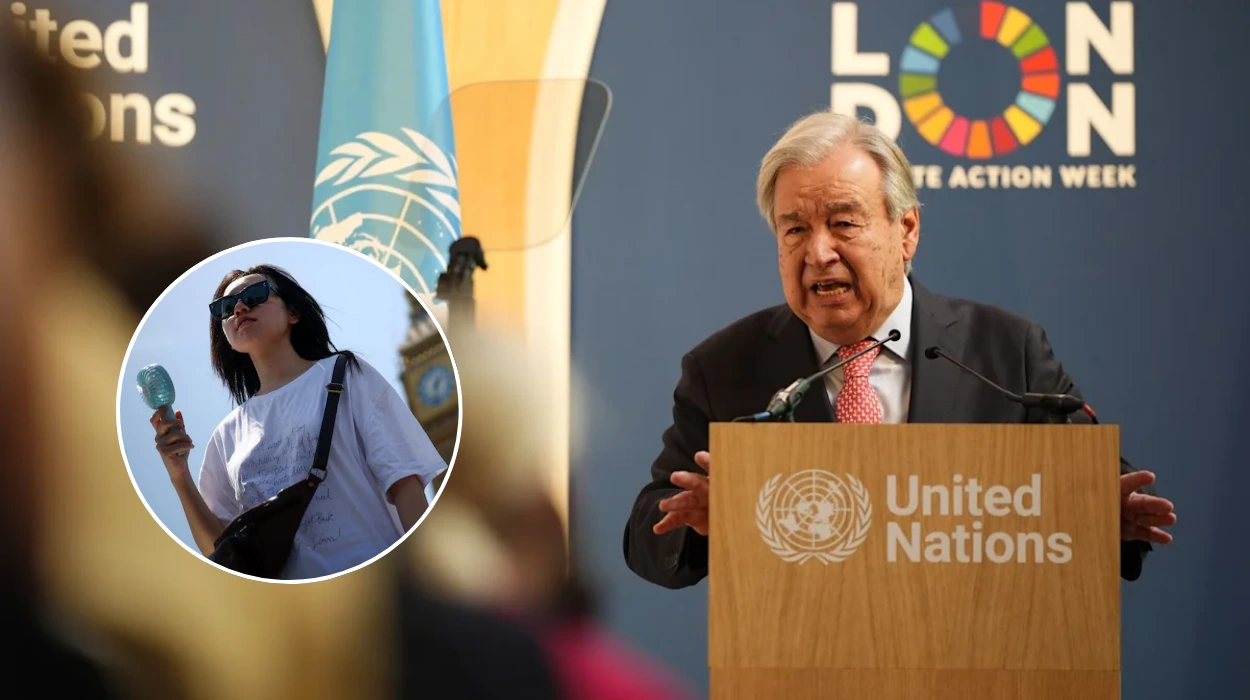
London (The Londoner News) June 23, 2026 – In an impassioned intervention amidst an unprecedented heatwave sweeping across Western Europe, United Nations Secretary-General António Guterres warned international delegates that the climate crisis has reached an acute, localized flashpoint, declaring that “London isn’t just calling. It’s cooking.” Delivering a sweeping keynote address at London Climate Action Week on Tuesday, the UN chief introduced a comprehensive blueprint designed to break global reliance on fossil fuels, accelerate renewable energy transitions, and curb secondary emissions drivers like Artificial Intelligence and methane. The high-level speech coincided with a severe domestic meteorological event as the British Met Office expanded extreme heat warnings, forecasting that temperatures could shatter the 1976 national June record by climbing to an extraordinary 38°C or higher.
- Key Points
- How Is the Current Heatwave Affecting London and the Wider European Continent?
- What Did António Guterres Mean by a ‘Tale of Two Crises’?
- What Is Inside the New UN Clean Energy Transition Blueprint?
- Why Is the UN Chief Warning About the Environmental Cost of AI?
- How Are Geopolitical Shocks in the Middle East Affecting the Energy Transition?
- Why Does the United Nations Believe a Renewable Future Is Economically Inevitable?
- What Obligations Face World Leaders Ahead of the COP31 Climate Summit?
How Is the Current Heatwave Affecting London and the Wider European Continent?
The meteorological reality blanketing the United Kingdom provided a stark, oppressive backdrop to the diplomatic proceedings in the capital. As reported by Daniel Johnson of UN News, a deadly heatwave continues to grip Europe, forcing the UN Secretary-General to issue an immediate, emotional appeal for aggressive global action to halt irreversible planetary damage.
The heatwave has moved beyond a seasonal anomaly into a public health and infrastructure crisis. According to data reported by Hannah Devlin, the Science Correspondent for The Guardian, the Met Office expanded its extreme heat warning across vast swaths of England and Wales on Sunday, predicting record-breaking June highs. Met Office forecasters revealed a 25 percent probability that temperatures could breach the 40°C threshold during the week.
In the text compiled by Devlin, Tom Crabtree, a Met Office deputy chief forecaster, stated that:
“The forecast heatwave is developing into an impactful severe weather event, with record-breaking June temperatures and very high humidity. The combination of heat and humidity will be oppressive and bring impacts across society from public health and infrastructure, to power and water supplies.”
Furthermore, as noted by Met Office meteorologist Becky Mitchell within the same Guardian dispatch, the UK is facing the unprecedented prospect of three consecutive June days featuring temperatures at or above 37°C. Mitchell noted that urban centers are bracing for “tropical nights,” where overnight temperatures fail to drop below 20°C, depriving the human body and regional infrastructure of vital cooling windows.
The regional impact has been felt immediately across transport and civil sectors. In coverage provided by ITV News London, reporters observed that local rail services have been systematically reduced across London due to the risk of tracks buckling under the intense heat. Civil agencies have warned that reduced rail capacities will push commuters onto expanding road networks, exponentially raising the risk of widespread vehicular overheating and severe traffic gridlock.
What Did António Guterres Mean by a ‘Tale of Two Crises’?
Addressing the audience at London Climate Action Week, Guterres deployed classic literary imagery to contextualize the current geopolitical and environmental matrix. As reported by the political and environmental reporting team at ITV News, the UN chief explicitly invoked Charles Dickens to depict a fractured global landscape.
According to the transcript published by ITV News, Guterres stated that:
“Crisis brings clarity and here in London – the city of Dickens – it is clear that our world is facing a ‘tale of two crises’. A climate crisis is pushing us deeper towards higher temperatures and closer to catastrophic tipping points and an energy crisis exposing the folly of a world hooked on hydrocarbons.”
The UN leader argued that these dual systemic strains are fundamentally linked. As transcribed by the live tracking team at The Guardian, Guterres clarified the underlying structural connection, stating that, “On the surface, these crises may seem separate, but they share the same destructive origin: fossil fuels.”
The Secretary-General warned that global climate disruption is “accelerating before our eyes.” He pointed out that the arrival of the El Niño warming pattern through the summer months creates a compounded ecological threat, warning that the phenomenon risks “blowing the house down” by multiplying the baseline impacts of human-driven warming.
What Is Inside the New UN Clean Energy Transition Blueprint?
To counter these interlocking emergencies, the United Nations used the London forum to unveil an expansive global framework focused on total energy independence and deep decarbonisation. As detailed by James Murray and the editorial staff at BusinessGreen News, the newly launched UN blueprint calls for rapid, legally binding commitments to slash aggregate greenhouse gas emissions.
How Does the UN Plan to Tackle Methane Emissions?
A central pillar of the newly introduced blueprint is an aggressive, targeted campaign against methane—a potent greenhouse gas that traps up to 80 times more atmospheric heat over a 20-year timeline than carbon dioxide. As reported by BusinessGreen News, Guterres’s framework establishes explicit, stringent operational recommendations for the three sectors overwhelmingly responsible for global methane discharge:
- The Waste Sector: Mandating strict landfill gas capture systems and comprehensive organic waste diversion.
- The Agricultural Sector: Implementing systemic shifts in livestock management and rice cultivation techniques.
- The Fossil Fuel Supply Chain: Forcing the immediate elimination of routine venting and flaring practices within oil and gas infrastructure.
What Structural Financial Reforms Is the UN Demanding?
Beyond sectoral emission mandates, the UN blueprint outlines severe fiscal measures designed to penalize fossil fuel extraction while subsidizing green alternatives. According to the legislative breakdown published by BusinessGreen News, the blueprint demands a complete, synchronized global end to all state-level fossil fuel subsidies.
Concurrently, Guterres advocated for the implementation of a sweeping international windfall tax levied directly against the excessive profits of global coal, oil, and gas corporations. The capital generated from this corporate climate levy would be directed into dedicated funds to underwrite renewable energy infrastructure projects across developing nations and reinforce local climate resilience programs in vulnerable global communities.
Why Is the UN Chief Warning About the Environmental Cost of AI?
A striking element of Guterres’s address was a direct, critical critique of the technological sector, specifically focusing on the escalating resource footprint of contemporary computational infrastructure. While many international bodies look to advanced computing to model climate changes, the UN chief presented a dual-edged assessment of artificial intelligence.
As reported by BusinessGreen News, Guterres highlighted the inherent contradiction of using energy-intensive systems to solve atmospheric crises, stating that:
“Artificial intelligence can accelerate climate solutions – it can help cure disease, transform education, and enable humanity to tackle challenges when sought beyond our reach. We must harness that potential, but AI is also hungry for land, water, and power.”
The blueprint subsequently demands that major multinational technology firms “clean up AI” by providing full operational transparency regarding the energy and water consumption of massive data centers, alongside mandating that these computational hubs operate exclusively on dedicated, newly constructed renewable power grids.
How Are Geopolitical Shocks in the Middle East Affecting the Energy Transition?
The Secretary-General’s address did not occur in a geopolitical vacuum; it explicitly accounted for the severe military and diplomatic conflicts actively reshaping the global economy. As reported by Daniel Johnson of UN News, Guterres noted that the world’s current energy security crisis is deeply aggravated by ongoing maritime disruptions in the Strait of Hormuz and the volatile war involving Israel, Iran, and the United States.
Guterres categorized the economic fallout of the current Middle Eastern war as an unprecedented historic disruption. According to the UN News transcript, Guterres observed that the conflict has unleashed “the mother of all energy shocks,” establishing an economic crisis that comfortably surpasses the scale of both the 1970s oil embargoes and the shockwaves generated by the Russian invasion of Ukraine.
The Secretary-General emphasized that while wealthy, industrialized nations face severe inflation and supply constraints, the true devastation of this geopolitical alignment falls entirely upon emerging economies. As recorded by Johnson, Guterres informed the London delegation that:
“It is a debt shock, a food shock, a development shock. The good news is – unlike every past energy crisis – we now have a clear way out, a clean way out.”
Explore more Local London News:
Southwark Council Court Case Over Emergency Housing List: South London 2026
Nicky Campbell Daughter Lilla Injured in E-Bike Hit and Run: Peckham 2026
Why Does the United Nations Believe a Renewable Future Is Economically Inevitable?
Despite the bleak convergence of record-shattering heatwaves and international warfare, Guterres maintained that the structural economics of clean energy have achieved permanent, irreversible momentum. The Secretary-General provided concrete financial data to demonstrate that the global transition to green energy is no longer an open ideological debate, but an established economic trajectory.
According to the data tracking provided by UN News, Guterres highlighted dramatic market shifts that occurred since 2010:
- Solar Energy Costs: Have plunged by nearly 90 percent globally.
- Onshore Wind Costs: Have dropped by more than 70 percent.
- Battery Storage Costs: Have experienced an extraordinary 95 percent collapse.
The UN chief pointed out that current international clean energy investments now outpace fossil fuel expenditures by a factor of nearly two to one. He noted that the deployment of renewable infrastructure has already successfully averted an amount of greenhouse gas emissions that exceeds the combined annual output of the United States, the European Union, and Japan.
Framing renewable power as the ultimate guarantor of national sovereignty, Guterres noted the geopolitical immunity of green energy assets. As reported by Daniel Johnson, the UN chief concluded that:
“There are no embargoes on sunlight and no blockades on the wind.”
What Obligations Face World Leaders Ahead of the COP31 Climate Summit?
Looking toward future diplomatic interventions, Guterres signaled that the upcoming political schedule must transition away from rhetorical consensus toward mandatory national enforcement. As reported by BusinessGreen News, the Secretary-General confirmed he will officially convene a high-level summit of world leaders in September to lock down definitive state commitments ahead of the UN COP31 Climate Summit scheduled to take place in Antalya, Türkiye, later this year.
The UN chief made it clear that the international community will no longer accept vague, distant net-zero targets that lack near-term legislative backing. According to transcripts published by BusinessGreen News, Guterres insisted that:
“That summit must be more than another moment for speeches. Countries should arrive with concrete government-led transition plans that include strong commitments to phase out fossil fuels, the financial reforms and the government funding needed to ensure all countries can build a renewable energy future.”
Concluding his address to the sweltering assembly in London, Guterres presented a sharp, binary choice to the assembled ministers and corporate executives. He warned that national governments can either choose to double down on volatile fossil fuels and remain perpetually exposed to the next inevitable geopolitical energy shock, or they can opt for permanent energy and economic sovereignty by planning an immediate, managed transition to renewables. “The right choice,” the Secretary-General concluded, “is obvious.”