Key Points
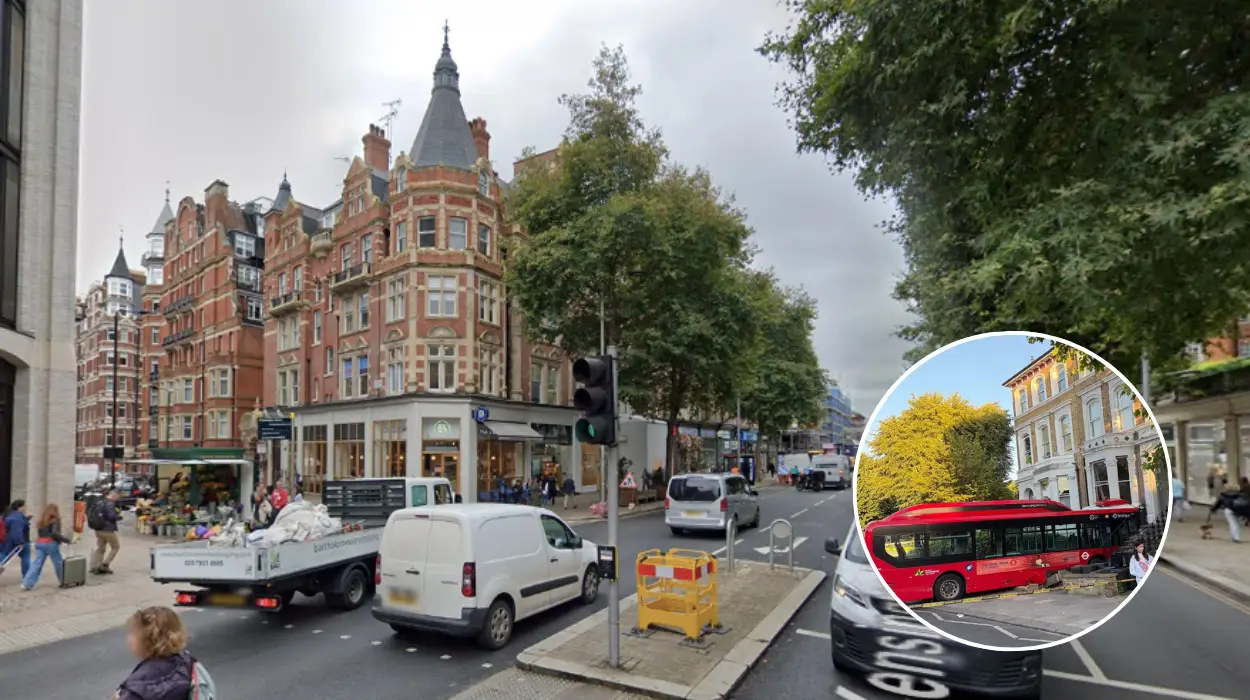
- A single-decker Transport for London (TfL) bus operated by First Bus ploughed into the frontage of a terraced residential home on St Quintin Avenue in North Kensington, West London.
- The vehicle mounted the kerb, striking street furniture, damaging the building’s stairs, and completely dislodging a sash window from its frame.
- Two parked cars were also significantly damaged during the collision, which occurred during the evening hours.
- Emergency services, including the Metropolitan Police, London Fire Brigade (LFB), and London Ambulance Service (LAS), rushed to the scene following emergency calls.
- Miraculously, no injuries were reported, and the London Ambulance Service confirmed that no passengers, pedestrians, or residents required treatment at the scene.
- No arrests have been made, and the Metropolitan Police have officially stated that no criminal offences have been identified in connection with the crash.
- Dangerous structure engineers from the Kensington and Chelsea Council were deployed to the site immediately to assess the structural stability of the property.
- Transport for London and the operator, First Bus, have confirmed that a full investigation is currently underway to determine the precise cause of the accident.
North Kensington (The Londoner News) July 3, 2026 – A single-decker Transport for London bus has collided directly with a terraced residential home on St Quintin Avenue in North Kensington, West London, causing substantial damage to the frontage of the property and two nearby cars. The incident, which triggered a significant response from the capital’s emergency services, occurred at approximately 19:15 BST on Thursday evening. Despite the severe impact on the building’s structural elements—including the complete dislodgement of a front sash window from its frame and damage to the entrance stairs—authorities have confirmed that no one was injured. Both Transport for London (TfL) and the operating company, First Bus, have launched a comprehensive investigation to ascertain exactly how the multi-tonne commuter vehicle came to mount the kerb and slam into a family residence.
What happened during the St Quintin Avenue bus crash?
As reported by Samuel Turner, a breaking news reporter for London Now, the collision took place on Thursday evening when the single-decker bus veered off the main road and encroached heavily on the property’s frontage near the roundabout by Highlever Road. Visual evidence and video clips circulating on social media showed the vehicle wedged tightly against the terraced house, having cleared the pavement entirely.
According to an official statement provided to the media by a Metropolitan Police spokesperson, “On Thursday, 2 July at 19:02hrs police were called to reports of a collision between a bus and a residential building on St Quintin Avenue, Notting Hill. Officers attended alongside the London Ambulance Service and London Fire Brigade.” The police further confirmed that anyone with information that may assist their ongoing enquiries is being asked to call 101, quoting the log number CAD 7570/2July.
The impact caused immediate alarm among local residents on the quiet residential street, which serves as a major thoroughfare for local bus routes. In separate coverage by Poppy Huggett, a senior reporter for London Now, it was revealed that the structural damage was widespread across the immediate impact zone. The vehicle did not simply strike the exterior wall; it also crushed street furniture and collided with two stationary cars parked along the street. The westbound section of St Quintin Avenue remained completely closed to traffic between Highlever Road and North Pole Road overnight and well into the following morning to allow recovery teams and engineers to work securely.
How did emergency services respond to the scene?
The response from London’s primary emergency services was immediate and highly coordinated, involving multiple units to ensure the safety of the public and the occupants of the building. As reported by the BBC News editorial team, the London Ambulance Service was alerted to the incident at around 19:14 BST.
A spokesperson for the London Ambulance Service stated that
“We were called at 7.14pm yesterday to reports of a road traffic collision in St Quintin Avenue, W10. We sent a paramedic in a fast response car to the scene. Fortunately, no one needed treatment.”
The rapid assessment by medical personnel confirmed that neither the bus driver, any potential passengers on board, nor anyone inside the residential dwelling suffered physical trauma during the collision.
Simultaneously, the London Fire Brigade deployed a massive asset allocation to manage potential structural collapses or fuel leaks. As reported by senior reporter Poppy Huggett of London Now, a spokesperson for the London Fire Brigade detailed the scale of their operation:
“Firefighters were called to a road traffic collision on Quintin Avenue in Notting Hill yesterday. Crews made the scene safe after a bus collided with street furniture and a terraced house. Two cars were also damaged in the collision.”
The LFB spokesperson further clarified that the brigade was officially called at 19:12 BST, and the incident was successfully brought to a conclusion for the firefighters by 20:03 BST. The operation required the deployment of two fire engines from the local North Kensington and Hammersmith fire stations, alongside two specialist fire rescue units brought in from Chelsea and Croydon fire stations to handle the delicate stabilization of the scene.
What is the extent of the damage to the North Kensington home?
The structural integrity of the affected terraced house became an immediate priority for local authorities as soon as the vehicle was stabilized. As reported by the BBC News team, the bus encroached significantly onto the property’s small front garden and porch area, completely shattering the structural framing of a ground-floor sash window and dislodging it entirely from the brickwork.
Local government officials quickly intervened to manage the potential risk to neighboring properties. As recorded in the original BBC News report, Johnny Thalassites, a representative from the Kensington and Chelsea Council, confirmed that council officers were dispatched to the site without delay. Thalassites stated that
“council officers were on site alongside dangerous structure engineers to assess the damage.”
The deployment of dangerous structure engineers is standard protocol in the United Kingdom when a vehicle impact compromises the load-bearing elements of a building. These specialists are tasked with examining whether the internal walls, upper floors, or adjacent terraced structures face an imminent threat of collapse. In his public statement via BBC News, Johnny Thalassites added,
“We’d expect an investigation to be underway to establish the cause, but we’re just glad nobody appears to be seriously hurt.”
Explore more West London News:
Uxbridge Road Major Regeneration Plan Approved: Hammersmith and Fulham 2026
How West London Beavers Stopped Railway Station Flooding: Ealing 2026
What are Transport for London and First Bus doing to investigate?
With the immediate physical dangers mitigated, the focus of both municipal authorities and corporate entities has firmly shifted toward accountability and preventative analysis. As reported by BBC News, Transport for London, the statutory body responsible for the capital’s transport system, is treating the incident with high severity. TfL confirmed that it is actively working in lockstep with the independent bus operator, First Bus, which is contractually responsible for running the specific route involved in the crash.
The investigation will scrutinise multiple operational variables. Forensic mechanical examiners are expected to check the single-decker bus for any sudden mechanical failures, such as braking system anomalies, steering malfunctions, or electronic throttle issues. Concurrently, operational logs will be reviewed to evaluate the driver’s duty hours, potential fatigue, or sudden medical episodes that could have led to a loss of vehicle control.
As reported by London Now reporters, local transit infrastructure faced immediate disruption following the incident, with bus routes 7 and 70 being placed under strict diversions well into the next working day. This area of West London is known for dense traffic, and the closure of a vital artery like St Quintin Avenue required TfL to re-route dozens of service runs while forensic teams completed their on-site assessments.
Is there any evidence of criminal activity or negligence?
Whenever a large commercial vehicle collides with a stationary residential structure, the possibility of criminal negligence or driving offences is heavily scrutinised by traffic law enforcement units. However, in this specific instance, the Metropolitan Police have moved rapidly to clarify that they do not believe any criminal intent or unlawful driving behavior was a factor in the accident.
As reported by Samuel Turner of London Now, the Metropolitan Police explicitly confirmed that “no injuries were reported, no arrests have been made, and no criminal offences have been identified.” This statement indicates that early breathalyser tests, preliminary driver interviews, and basic digital tachograph data from the bus did not show immediate evidence of driving under the influence or reckless operation.
Nonetheless, a non-criminal, statutory investigation remains active. The police are continuing to appeal to the public for dashcam footage or eyewitness testimony. Neighbors and passing motorists who may have witnessed the moments leading up to the vehicle mounting the pavement are urged to submit evidence via the standard police communication channels to help piece together the precise chronological timeline of this highly unusual West London transit accident.