
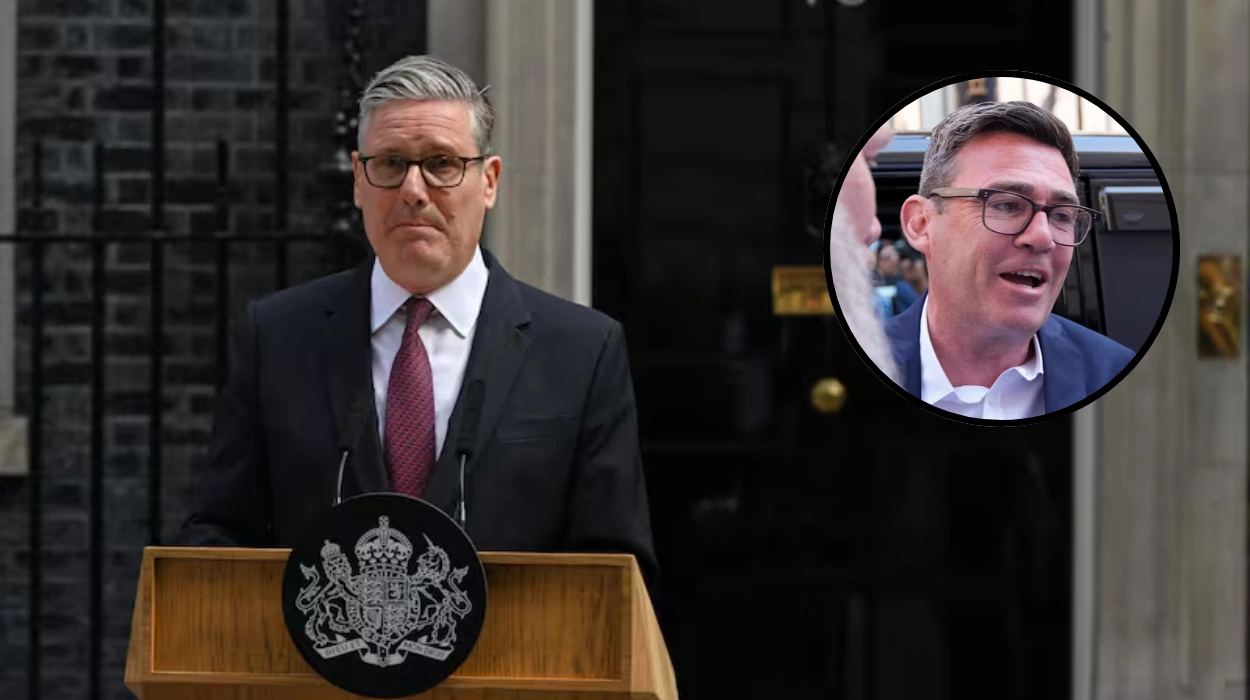
Key Points
- Starmer Resigns Amid Severe Pressure: United Kingdom Prime Minister Keir Starmer announced his resignation on Monday, 22 June 2026, following a severe leadership crisis within the Labour Party driven by internal policy revolts and crumbling poll ratings.
- Andy Burnham Set to Become Next Prime Minister: Former Mayor of Greater Manchester, Andy Burnham, won a rapid return to Parliament via a by-election in Makerfield and is currently the sole, unopposed candidate to lead the Labour Party and the country.
- Constrained by Existing Manifesto: Burnham is legally and politically anchored to the centre-left platform that brought Labour to power in 2024, limiting his capacity to execute immediate policy overhauls.
- The “Manchesterism” Strategy: The incoming leader advocates a unique “business-friendly socialist” doctrine aimed at decentralising London-centric governance, shifting power up to 200 miles north of 10 Downing Street.
- Economic Policy Restraint: To avoid terrifying international financial markets, Burnham has committed to maintaining the current administration’s strict spending and borrowing caps, promising no new taxes on workers.
- Defence Spending Conundrum: The incoming administration inherits an intense debate regarding the UK’s commitment to raising military expenditure to 3.5% of GDP by 2035, a dispute that previously triggered major frontbench resignations.
London (The Londoner News) June 27, 2026 – The United Kingdom stands on the precipice of a dramatic transformation in executive tone and political style, as the stolid and increasingly unpopular Prime Minister Keir Starmer prepares to hand over power to his popular, affable, and charismatic likely successor, Andy Burnham. However, fresh political analysis indicates that despite Burnham’s public efforts to distance himself from his predecessor’s micro-managed governance, he will find himself structurally shackled to the economic, fiscal, and legislative policies set in motion by Starmer. Burnham, who was sworn into Parliament as the Member for Makerfield on Monday afternoon mere hours after Starmer dramatically announced his resignation on 22 June 2026, faces the immense challenge of operating within the exact policy platform that ended 14 years of Conservative rule in 2024. If no rival enters the leadership contest by the close of nominations, Burnham is scheduled to assume office on 17 July 2026, making him Britain’s seventh prime minister within a single chaotic decade.
- Why Did Keir Starmer Resign as Prime Minister?
- How Did Andy Burnham Engineer His House of Commons Return?
- What Is Andy Burnham’s Plan to Fix the UK Economy?
- Can Andy Burnham Overcome the Budget and Defence Crisis?
- How Will the New PM Navigate Foreign Policy and the US Relationship?
- What Is the Long-Term Strategy for Burnham’s Premiership?
Why Did Keir Starmer Resign as Prime Minister?
The downfall of Keir Starmer followed months of mounting internal anger and catastrophic polling figures that left Labour lawmakers terrified of an impending electoral wipeout by right-wing insurgencies. As documented across multiple media platforms, the immediate catalyst for the transition was a fast-moving frontbench rebellion regarding fiscal policy, international relations, and diplomatic errors.
According to reports compiled by the political unit at Wikipedia, the internal structural integrity of Starmer’s government fractured rapidly following a dismal performance in the May 2026 local elections. This loss triggered a wave of high-profile departures, starting on 14 May 2026 when Health Secretary Wes Streeting resigned from the cabinet in open protest against Starmer’s leadership direction. The situation worsened on 11 June 2026 when Defence Secretary John Healey and Armed Forces Minister Al Carns abruptly resigned over bitter, unresolved disputes concerning the government’s military spending timeline.
Beyond the cabinet room, Starmer’s domestic standing was severely undermined by repeated political blunders. As detailed by international correspondents Lauren Frayer and Michel Martin of NPR News, the Prime Minister faced intense criticism for his controversial decision to appoint Peter Mandelson—a figure heavily tarnished by historical links to the disgraced financier Jeffrey Epstein—as the United Kingdom’s Ambassador to the United States. This strategic misstep alienating liberal voters, who drifted in large numbers toward the Green Party, while leaving the Labour flank completely exposed to Nigel Farage’s anti-immigration party, Reform UK, which has consistently dominated nationwide opinion polls.
The cumulative weight of these crises ultimately forced Starmer’s hand over a tense weekend at the prime ministerial country estate, Chequers. As reported by political editors at The Guardian, more than half a dozen cabinet ministers privately informed Starmer that his authority had evaporated, prompting his inner circle to begin drafting a valedictory address. In an emotional broadcast watched closely by ministerial allies inside Downing Street, Starmer’s voice cracked as he announced he would stand down to allow an orderly transition, stating:
“When I leave the biggest job in the country, I shall spend more time on the most important job, being the best husband I can to my fantastic wife, Vic… and being the best dad I can to my beautiful children.”
How Did Andy Burnham Engineer His House of Commons Return?
The path for Burnham’s extraordinary ascent to the apex of British power required a coordinated legislative maneuver that unfolded over several weeks in May and June 2026. Having spent a decade away from Westminster building a formidable regional power base as the Metro Mayor of Greater Manchester, Burnham had been actively seeking a mechanism to re-enter parliament, having previously been blocked by Labour’s National Executive Committee from contesting an earlier by-election in Gorton and Denton.
As outlined by Wikipedia’s record of the leadership crisis, the breakthrough occurred on 14 May 2026, when Josh Simons, the sitting Labour MP for the safe northwestern constituency of Makerfield, agreed to resign his seat. This self-sacrifice allowed Burnham to contest a rapid by-election. On Thursday, 18 June 2026, Burnham secured a resounding victory in Makerfield, capturing nearly 55 per cent of the 45,510 votes cast and beating the second-place Reform UK candidate by a margin exceeding 9,000 votes.
His victory speech served as a direct manifesto for national leadership. As recorded by reporters tracking the count, Burnham declared to cheering supporters:
“Everyone knows that politics isn’t working. Everyone can feel that the country isn’t where it should be. Tonight could, just could, be the turning point.”
On Monday, 22 June 2026, as captured by photojournalist Yui Mok of the Press Association (PA), Burnham arrived at Portcullis House in Westminster surrounded by supportive lawmakers from the Parliamentary Labour Party. Within hours of his official swearing-in, Starmer’s formal resignation transformed Burnham from a newly returned backbencher into the presumptive prime minister.
Explore More London Politics News
Keir Starmer Resigns: Andy Burnham Eyes Downing Street in London 2026
Keir Starmer Defends Leadership at London Housing Project, London 2026
What Is Andy Burnham’s Plan to Fix the UK Economy?
The core challenge awaiting the incoming prime minister is the stagnation that crippled his predecessor’s tenure. As noted by financial writers at Jermyn, Starmer’s terminal flaw was an total inability to deliver promised economic growth, modernise fractured public services, or alleviate a stubborn cost-of-living crisis impacting millions of British households.
Upon launching his leadership bid via social media, Burnham immediately sought to reframe the national economic debate while projecting a sense of continuity to volatile international institutions. Writing on the platform X, Burnham stated:
“The country expects stability, seriousness and a continued focus on the issues that matter most and that is what it will get.”
As a politician widely recognized as sitting on the “soft left” of the Labour Party, Burnham’s ideological positioning naturally invites scrutiny from the financial sector. To prevent market volatility, Burnham has explicitly pledged that his incoming administration will revive the sluggish UK economy without exceeding the strict spending and borrowing limits established under the existing Starmer-Rachel Reeves framework.
This hyper-cautious approach is deliberately designed to avoid a repetition of the bond market collapse seen in autumn 2022. As detailed by analysts at The Associated Press, those markets remain deeply traumatised by the memory of former Prime Minister Liz Truss, whose unfunded tax cuts triggered a severe financial panic and ended her premiership after a record-breaking, chaotic 49 days.
Academic observers warn that Burnham will have to walk a fine fiscal tightrope to survive his opening months in office. Explaining this delicate balance, Mark Goodwin, a politics lecturer at Coventry University, observed:
“If you are a Labour prime minister from the soft left of the party, the markets don’t need that much invitation to panic. They will start from a position of scepticism. So he’d have to be very, very careful… He will face a challenge to convince people that this is something different, without the markets reading that as ‘This is too different.'”
To stimulate growth within these rigid fiscal parameters, Burnham intends to deploy an economic model he pioneered in the North West, colloquially termed “Manchesterism.” As reported by The Associated Press, this framework represents a highly pragmatic, business-friendly socialist approach. Rather than relying heavily on state borrowing, “Manchesterism” focuses on leveraging private sector investment to fund massive regional infrastructure projects, while simultaneously decentralising central government departments to grant local communities direct authority over housing, utilities, transport systems, and regional education.
Can Andy Burnham Overcome the Budget and Defence Crisis?
While Burnham’s macroeconomic rhetoric emphasizes stability, senior policy analysts point out that the incoming Prime Minister faces immediate, conflicting budgetary pressures that may force him to break his initial fiscal promises.
As highlighted by Jill Rutter, a senior fellow at the independent Institute for Government think tank, Burnham is inheriting a complex web of unfunded domestic crises alongside rigid international defense commitments. The most explosive problem is military spending. The outgoing Starmer administration had committed the United Kingdom to a strict NATO-aligned target of raising defence spending to 3.5 per cent of Gross Domestic Product (GDP) by the year 2035. However, as Rutter noted, the structural reality of this pledge remains deeply contested following the high-profile resignation of John Healey, who abandoned his post as Defence Secretary precisely because Starmer was failing to allocate the immediate cash required to achieve that target.
According to Rutter’s policy assessment, Burnham faces a multi-layered dilemma: he must find a way to fund these expanded military programs, decide whether to completely scrap existing domestic spending priorities, and determine how to fulfill public sector wage demands without violating his own fiscal rules. While Burnham has sought to reassure the electorate by adopting Starmer’s explicit pledge not to raise income tax or national insurance contributions on working people, he has simultaneously floated proposals to reduce the tax burden on businesses. Specifically, Burnham has signaled a desire to reverse a recent increase in employer national insurance contributions—a tax businesses pay to fund public healthcare, pensions, and welfare. Consequently, independent economists remain highly skeptical of how Burnham can cut business taxes, maintain low worker taxation, and expand public services all at the same time.
How Will the New PM Navigate Foreign Policy and the US Relationship?
While Burnham’s decade as Mayor of Greater Manchester provided him with unmatched domestic and regional credentials, his complete lack of traditional foreign policy experience represents a major strategic vulnerability as he enters Downing Street. This deficit arrives at a highly sensitive geopolitical moment, particularly regarding the UK’s bilateral relationship with the United States.
As reported by 1News, the critical “Special Relationship” between London and Washington has suffered significant strain in recent months. The diplomatic relationship soured substantially following public criticisms from US President Donald Trump, who openly attacked Starmer’s administration over its refusal to join specific military operations concerning the ongoing war involving Iran. Upon hearing rumors of the leadership transition in London, President Trump posted a blunt assessment on his Truth Social network, stating:
“Keir Starmer will resign as Prime Minister of The United Kingdom. He failed badly on two very important subjects- IMMIGRATION AND ENERGY (OPEN NORTH SEA OIL!). I wish him well!”
Burnham’s challenges on the international stage are further complicated by his historical policy positions on European integration. In past public statements, Burnham openly expressed a long-term desire to see the United Kingdom rejoin the European Union within his lifetime. However, showing the pragmatic calculations required to win national power, Burnham significantly backed away from this stance during his recent by-election campaign in Makerfield—a working-class constituency that voted decisively by a margin of two-to-one in favor of Brexit during the 2016 referendum.
According to political analysts, Burnham recognizes his international limitations and plans to adjust his governance model accordingly. In an assessment of Burnham’s prospective cabinet structure, The Associated Press noted that the incoming leader does not intend to replicate Starmer’s centralized, hands-on management of foreign affairs. Instead, Burnham is expected to delegate the bulk of international diplomacy by appointing an experienced, authoritative political figure to serve as Foreign Secretary, allowing the Prime Minister to focus his energy on domestic reconstruction.
What Is the Long-Term Strategy for Burnham’s Premiership?
Faced with severe financial constraints, a binding manifesto, and an unstable global landscape, Burnham’s immediate strategy appears to be focused on political survival and narrative management rather than rapid legislative radicalism.
As analysed by Matthew Flinders, a professor of politics at the University of Sheffield, Burnham’s primary task during his first hundred days will be mastering a skill that entirely eluded Keir Starmer: the art of clear public communication. Professor Flinders observed:
“An early priority for Burnham will be something Starmer struggled with: crafting a clear and convincing narrative that people understand about the direction he wants to take the country.”
This focus on public narrative plays directly into Burnham’s established communication strengths. Throughout his mayoral tenure, Burnham successfully cultivated a highly popular political persona as an approachable, northern “everyman”—frequently rejecting traditional political suits in favor of casual T-shirts, playing amateur football, and famously participating in public charity DJ battles spinning 1990s indie tracks.
However, academic experts warn that this popular appeal can evaporate quickly under the intense pressure of national government. Warning of the dangers ahead, Professor Flinders added:
“At the moment, Andy Burnham is being almost hailed and held up as a folk hero that will save British politics. The tide is changing and the big issue for Andy Burnham is that when the world suddenly moves against him and he becomes a folk devil, will he sustain the pressure?”
To mitigate this risk, Burnham’s long-term strategy involves playing a patient, deliberative political game. According to further analysis provided by Professor Flinders, the incoming Prime Minister intends to use the remaining three years of the current parliamentary term to demonstrate basic administrative competence, stabilize public services, and build up his core team. If he can maintain public support and survive until the next mandatory general election, Burnham then intends to seek an explicit, independent public mandate. This would allow him to introduce a bolder, more radical manifesto of his own design—including long-held constitutional ambitions such as replacing the unelected House of Lords with a fully elected regional senate and implementing proportional representation for British parliamentary elections. Professor Flinders concluded:
“My sense is that he will take some time, sensibly, to build up his team, his narrative, his story and his connections in order to then try to secure a public mandate and the next general election to then approach the more radical phase that he wants to deliver, which is exactly what Margaret Thatcher did in the ’80s.”