Key Points:
- Mass Arrests in Nine Elms: Metropolitan Police officers arrested at least 48 demonstrators outside the United States Embassy in south-west London for expressing support for Palestine Action, a proscribed organisation.
- Proscription Under Terrorism Act: Expressing support for Palestine Action became an explicit offence under the Terrorism Act following the group’s official proscription by the UK government in June 2025.
- Organised by Defend Our Juries: The demonstration was coordinated by activist group Defend Our Juries just days prior to a pivotal Supreme Court appeal scheduled for 4 November 2026 challenging the terror designation.
- Section 35 Dispersal Order Active: Scotland Yard enforced a Section 35 dispersal order across the embassy grounds and surrounding districts from 8:00 am to 11:00 pm to manage public order and prevent public illegal support.
- Parallel Demonstrations and Costs: A parallel demonstration occurred outside the US consulate in Edinburgh, while police forces highlighted the significant financial burden of managing recurring public order events.
London (The Londoner News) October 31, 2026 – Police officers arrested dozens of demonstrators outside the United States Embassy in south-west London on Saturday, 31 October 2026, after more than 100 people gathered to demonstrate support for the proscribed direct-action group Palestine Action. According to official announcements released by Scotland Yard, Metropolitan Police officers detained 48 individuals by late afternoon, primarily under section 13 of the Terrorism Act, which criminalises expressing explicit support for a proscribed organisation. Organised by activist network Defend Our Juries, the rally in Nine Elms took place ahead of a scheduled Supreme Court hearing on 4 November 2026, where campaign groups will appeal the legality of the group’s terror designation.
- Key Points:
- How did law enforcement handle the protest outside the US Embassy in Nine Elms?
- What statements were made by individual participants detained at the demonstration?
- Why was the United States Embassy selected as the primary location for the demonstration?
- What is the financial and operational impact of proscription protests on policing resources?
- Background of Palestine Action’s Legal Battle and Proscription History
- Legal Precedents, Civil Liberties, and Police Resource Allocation
How did law enforcement handle the protest outside the US Embassy in Nine Elms?
As reported by home affairs correspondents for the Press Association (PA), more than 100 activists gathered outside the American diplomatic complex in Nine Elms on Saturday afternoon.
Many attendees held printed placards featuring statements such as “I oppose genocide, I support Palestine Action”, “We are protesters, not terrorists”, and “Heroes, not terrorists”, while several participants wore keffiyehs and carried Palestinian flags.
In an official public update posted on social media platform X shortly before 4:00 pm, the Metropolitan Police confirmed the scale of enforcement action across the embassy grounds:
“Officers have arrested 48 people, with the majority detained for expressing support for a proscribed organisation, with further arrests expected throughout the day.”
To maintain spatial control, Scotland Yard authorized a Section 35 dispersal order covering the embassy footprint and adjacent streets from 8:00 am until 11:00 pm. The legal measure empowered police officers to direct individuals to leave the perimeter immediately or face summary arrest. Police spokespersons stated that the order followed advance intelligence indicating that organized groups intended to gather specifically to declare support for a banned entity.
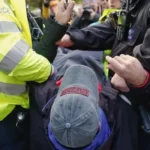
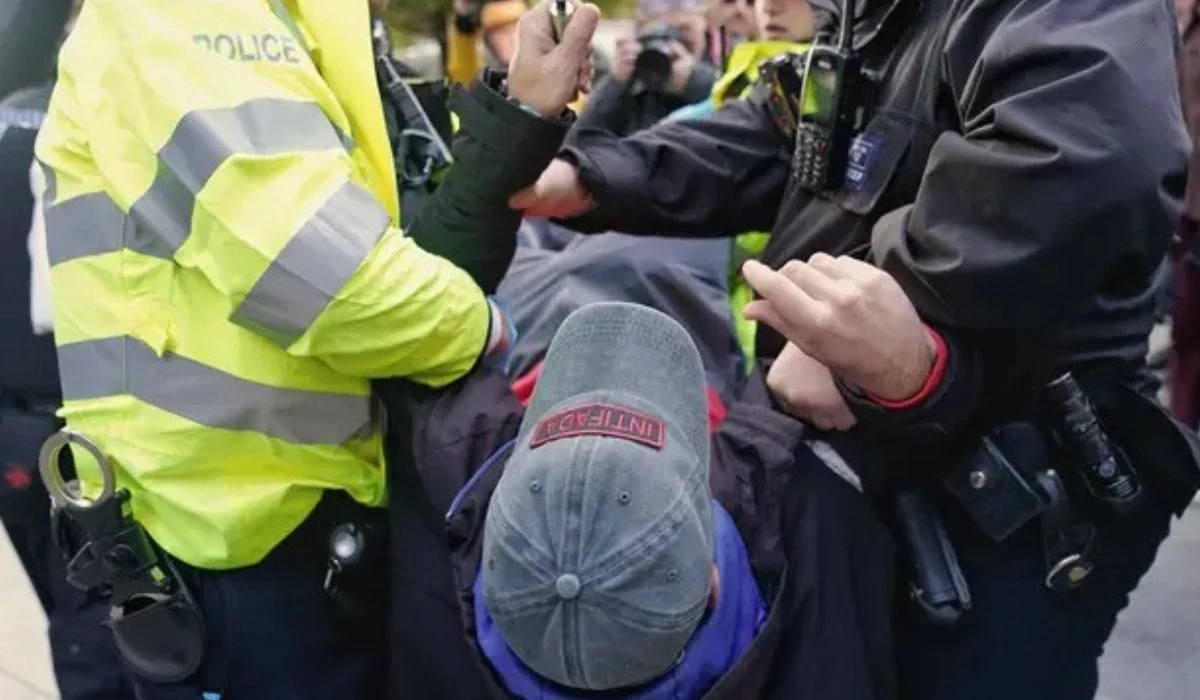
As reported by PA, police intervention began shortly after 12:30 pm, with officers systematically detaining individuals one by one. Observers noted that officers physically lifted and carried several protesters to transport vans parked along Ponton Road when individuals engaged in passive resistance by refusing to walk. Bystanders and fellow demonstrators applauded and chanted “free, free Palestine” as detainees were loaded into vehicles for transfer to central London police stations.
What statements were made by individual participants detained at the demonstration?
As reported by crime and justice reporters for the Press Association, several individuals attending the Nine Elms demonstration spoke publicly regarding their motivations prior to being taken into police custody.
Charles Allison, a 75-year-old retired lawyer who traveled to London from Cumbria, explained his decision to participate despite the immediate risk of prosecution under anti-terrorism legislation. Speaking to PA reporters, Charles Allison stated:
“I decided that I ought to try and do something, and this is the little bit that I’m doing. I fear for our civil liberties, which are being devalued and watered down, even by this new Labour Government. So I’m dejected, but enthused that there are so many wonderful people protesting.”
Elaborating on the legal strategy behind the timing of the demonstration, Charles Allison told PA:
“To show that there is no declining level of protest. I hope the Supreme Court justices, they won’t necessarily be influenced by it, but I hope that they will take a long-term view of what is happening in this country and decide that the proscription was unlawful, as I believe it was. I speak as an ex-lawyer, so it’s uncomfortable for me to break the law deliberately. But I felt that I could do no other.”
Moments after completing his interview just before 1:00 pm, two Metropolitan Police officers approached Charles Allison, informed him that he posed a threat under public order measures, and escorted him to a waiting transport vehicle.
Concurrently, 36-year-old attendee Lauren Wallace explained to PA that she brought her four-year-old daughter, Lilah, to witness the gathering and stand alongside her mother, who held a pro-Palestine Action sign at the front line. Lauren Wallace stated to reporters:
“My mum’s here today to hold a sign, and I’m unbelievably proud of her and respect her so much for doing it. And I think, in her words, she maybe has like a freedom to do it that me, with a young daughter and a job, probably don’t have.”
Reflecting on her family’s decision to participate in political assembly, Lauren Wallace added:
“So I came to support her and show solidarity with her, and also to, I guess, show my daughter the power of protest and how important it is to be political. And if anything, I hope Lilah’s way more political and radical than I am because I think that’s what the world kind of needs.”
Why was the United States Embassy selected as the primary location for the demonstration?
As reported by legal correspondents for LBC, organizers from Defend Our Juries deliberately selected the US Embassy as the primary protest site due to Washington’s active geopolitical involvement in the Middle East conflict.
In public press notices explaining the site selection, Defend Our Juries noted that the US government had “not shied away” from participation in regional affairs and arms provisions.
Furthermore, international security analysts noted that the protest followed administrative steps taken by the US State Department in August 2025, when American authorities formally implemented unilateral sanctions against Palestine Action after designating it as a foreign threat entity.
Simultaneously, secondary mobilizations occurred across northern borders. As reported by BBC Scotland, a parallel demonstration supporting Palestine Action took place outside the United States consulate located near Holyrood in Edinburgh, where Scottish police monitored similar gatherings.
What is the financial and operational impact of proscription protests on policing resources?
As reported by public safety reporters for The Daily Telegraph, senior officers at Scotland Yard expressed concern over the sustained drain on police resources caused by recurring public order operations linked to proscribed direct-action groups.
In official statements issued during Saturday’s enforcement drive, Metropolitan Police spokespersons highlighted the operational strain placed on municipal policing, noting that Palestine Action-related protests “take significant police resources away from the neighbourhoods and communities where they are most needed”.
According to formal financial figures released by the Metropolitan Police in response to Freedom of Information (FOI) requests, the force expended £1.3 million on six separate “Palestine-Israel public order events” across London during June and July alone. Senior officials noted that continuous weekend deployments force police forces to reallocate officers away from local neighborhood patrols, burglary investigations, and emergency call responses.
Background of Palestine Action’s Legal Battle and Proscription History
Palestine Action was founded as a UK-based direct-action network targeting defense supply chains, aerospace manufacturing plants, and corporate offices associated with military suppliers supplying hardware to foreign armed forces. Over several years, activists carried out high-profile blockades, paint sprayings, and structural break-ins at industrial facilities across Britain.
The legal status of the organization escalated into a major constitutional battle:
- June 2025 Proscription Order: Following legislative debates, then-Home Secretary Yvette Cooper signed an executive order under the Terrorism Act proscribing Palestine Action, rendering membership, fundraising, or public expressions of support illegal under UK law.
- February 2026 High Court Challenge: Group co-founder Huda Ammori filed a judicial review challenging the Home Secretary’s decision. Three High Court judges ruled in favor of Huda Ammori, declaring the proscription decision unlawful and an disproportionate intrusion into fundamental freedom of speech.
- June 2026 Court of Appeal Reversal: The UK government appealed the decision. Five judges sitting in the Court of Appeal unanimously reversed the High Court’s ruling, finding that the terror ban was a “justified and proportionate” interference with freedom of expression rights given the public safety risks.
- November 2026 Supreme Court Hearing: Defend Our Juries and legal representatives for Palestine Action secured permission to present their final appeal before the UK Supreme Court on 4 November 2026.
Legal Precedents, Civil Liberties, and Police Resource Allocation
The upcoming Supreme Court hearing on 4 November and the wave of arrests outside the US Embassy are predicted to produce significant constitutional, legal, and operational consequences for British civil society.
For the UK judiciary and civil rights advocates, the Supreme Court’s impending decision regarding Palestine Action’s proscription will establish a major legal precedent governing the intersection of counter-terrorism legislation, state security, and political protest rights under the European Convention on Human Rights (ECHR). If the Supreme Court upholds the Court of Appeal’s ruling, legal experts predict that public expressions of support for direct-action groups will remain strictly criminalized, leading to higher prosecution rates for non-violent demonstrators. Conversely, if the court rules that executive proscription was unlawful, it will re-establish broad protections for political advocacy while restricting how Home Secretaries apply anti-terrorism laws to domestic direct-action groups.
For the Metropolitan Police and UK taxpayers, continued weekend enforcement operations surrounding proscribed political groups are predicted to maintain financial strain on municipal budgets into 2027. If political protests continue to trigger mass arrests and complex legal prosecutions under the Terrorism Act, police authorities will likely lobby the Home Office for supplemental public order funding or push for expanded administrative powers to prevent mass assemblies outside foreign diplomatic missions altogether.