London’s skyline transforms dramatically at sunset. The city’s historic monuments, modern skyscrapers, royal parks, bridges, and riverfronts reflect centuries of architectural development against changing evening light. Sunset photography in London combines visual beauty with historical context, allowing visitors to capture landmarks that represent nearly two thousand years of urban evolution. From Roman foundations and medieval churches to Victorian engineering and contemporary skyscrapers, each viewpoint tells part of London’s story while offering remarkable photographic opportunities.
- Why are London’s sunset viewpoints among the world’s most iconic photography locations?
- Which historic landmarks create the most spectacular sunset photographs in London?
- Where are the best elevated locations to photograph London’s sunset skyline?
- How does the River Thames enhance sunset photography across London?
- How have London’s parks preserved historic sunset viewpoints?
- What historical and architectural periods are visible from London’s sunset viewpoints?
- When is the best time of year to capture London’s most memorable sunsets?
- How are London’s historic viewpoints protected for future generations?
Golden hour, typically beginning about one hour before sunset, softens architectural details and enhances colour across the city. The River Thames acts as a natural reflector, amplifying warm tones that illuminate famous landmarks including the Palace of Westminster, Tower Bridge, St Paul’s Cathedral, and Canary Wharf. Seasonal variations further influence photography, with long summer evenings providing extended shooting opportunities and crisp winter sunsets delivering dramatic contrasts.
Unlike temporary attractions, London’s sunset viewpoints remain enduring cultural assets protected through conservation policies, heritage legislation, and careful urban planning. Many viewpoints are safeguarded under strategic planning frameworks designed to preserve significant sightlines established centuries ago. Understanding the historical significance of these locations enriches every visit and helps photographers appreciate not only the scenery but also the city’s architectural legacy.
Why are London’s sunset viewpoints among the world’s most iconic photography locations?
London’s sunset viewpoints combine internationally recognised landmarks, protected historic sightlines, diverse architecture spanning nearly two millennia, and reflective waterways. These features create consistently dramatic evening compositions that attract professional photographers, cultural tourists, educators, and historians throughout every season of the year.
London possesses one of the world’s most recognisable urban skylines because its architectural development reflects successive historical periods rather than a single era. Roman settlement began around AD 47 with Londinium. Medieval expansion introduced defensive walls, churches, and marketplaces. The Great Fire of 1666 reshaped central London, leading to extensive rebuilding under architects including Sir Christopher Wren. Victorian industrialisation introduced railway bridges, embankments, and monumental civic buildings, while the twenty-first century added distinctive skyscrapers that coexist with protected heritage sites.
The city’s location along the River Thames significantly enhances sunset photography. The river curves through central London, creating numerous viewing corridors where evening sunlight reflects across the water before illuminating major landmarks. This natural alignment produces layered compositions unavailable in many inland cities.
Strategic planning has preserved many important viewing corridors. The London View Management Framework protects designated panoramas, river prospects, and landmark vistas, ensuring that structures such as St Paul’s Cathedral remain visible from historically significant locations despite ongoing development.
These preserved viewpoints serve both aesthetic and educational purposes. They demonstrate how urban planning balances economic growth with cultural heritage preservation, allowing photographers to document both London’s historical continuity and contemporary evolution.
Which historic landmarks create the most spectacular sunset photographs in London?
Historic landmarks dominate London’s finest sunset images because centuries of architectural craftsmanship, riverside positioning, elevated silhouettes, and protected conservation zones produce visually balanced compositions enhanced by warm evening light throughout every season of the year.
Several landmarks consistently define London’s sunset photography.
Tower Bridge
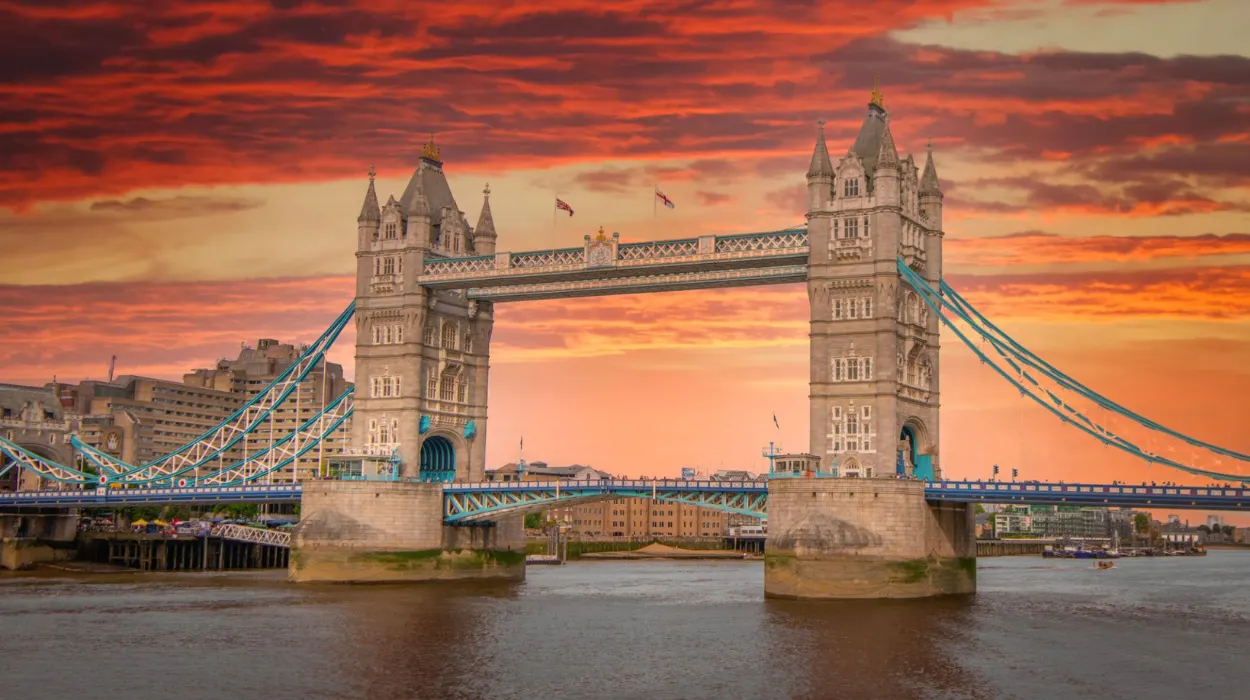
Completed in 1894, Tower Bridge represents Victorian engineering innovation. Its twin towers and bascule mechanism create symmetrical compositions that photograph exceptionally well during sunset. Reflections in the Thames strengthen visual balance while surrounding modern buildings illustrate London’s architectural progression.
Palace of Westminster
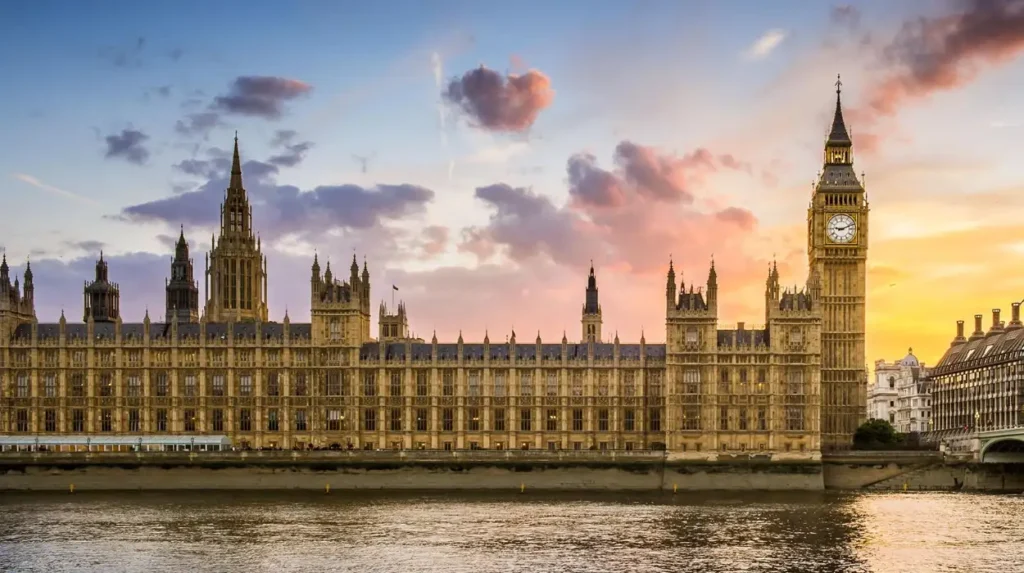
The Palace of Westminster occupies the historic site of England’s medieval royal palace. Following the devastating fire of 1834, architect Charles Barry and Augustus Pugin designed the present Gothic Revival complex. During sunset, intricate stonework absorbs warm golden light, while the silhouette of the Elizabeth Tower becomes especially distinctive.
St Paul’s Cathedral
Designed by Sir Christopher Wren after the Great Fire of London, St Paul’s Cathedral was completed in 1710. Its dome remains one of Europe’s most significant architectural achievements. Protected sightlines ensure the cathedral remains visible from numerous elevated locations, making it a central feature of many sunset panoramas.
Tower of London
Established by William the Conqueror shortly after the Norman Conquest of 1066, the Tower of London has served as a royal fortress, prison, treasury, and armoury. Evening light highlights its Norman stone walls while contrasting dramatically with nearby contemporary skyscrapers.
The Shard
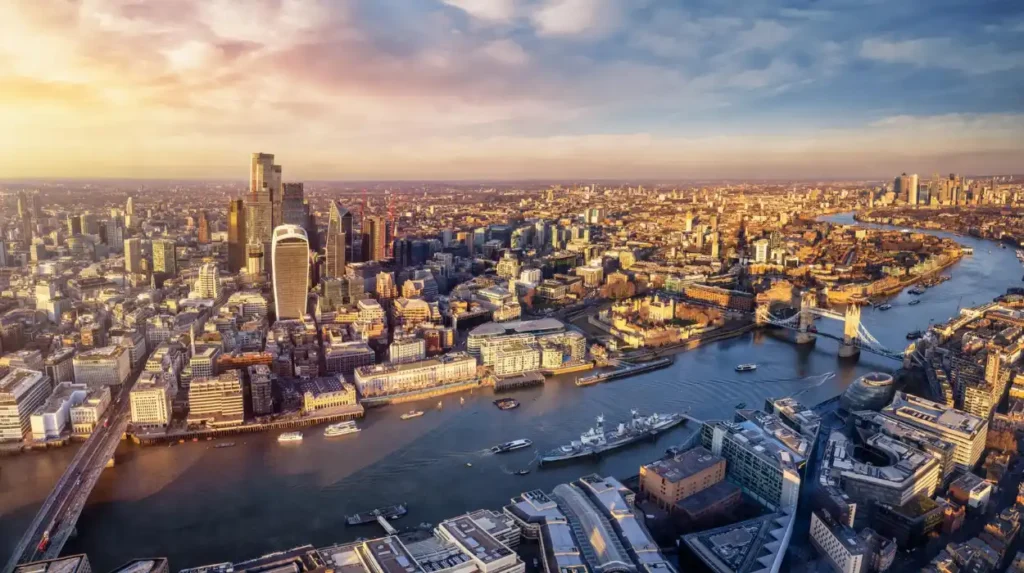
Although completed in 2012, The Shard complements historic architecture by providing elevated observation points overlooking centuries of urban development. From its viewing gallery, photographers capture expansive panoramas stretching across Greater London.
To experience these historic landmarks in person today, consult our comprehensive [History of London’s Skyline Through the Centuries] for itineraries and visiting parameters.
Where are the best elevated locations to photograph London’s sunset skyline?
Elevated viewpoints reveal London’s layered architectural history by combining panoramic perspectives, protected sightlines, extensive city coverage, and changing atmospheric conditions that enhance colour, depth, and landmark visibility during sunset and twilight photography sessions throughout the year.
Elevation transforms urban photography by revealing relationships between historic districts, transportation infrastructure, green spaces, and modern development.
Primrose Hill
Primrose Hill rises approximately 63 metres above sea level. Protected as part of Regent’s Park, it offers unobstructed views toward central London’s skyline. The foreground of mature parkland contrasts with distant architectural landmarks, producing balanced landscape compositions.
Parliament Hill
Located within Hampstead Heath, Parliament Hill has provided celebrated views since the eighteenth century. Artists, surveyors, and historians have documented London’s expansion from this location for generations. Sunset colours illuminate the skyline while retaining foreground vegetation that adds compositional depth.
Greenwich Park
Greenwich Park occupies former royal hunting grounds dating to the fifteenth century. Its elevated terrace overlooks the Queen’s House, Old Royal Naval College, Canary Wharf, and the River Thames. This combination presents several centuries of architectural development within a single frame.
Sky Garden
Situated atop the “Walkie Talkie” building, Sky Garden offers free public access through advance booking. The enclosed observation area provides panoramic city views regardless of weather while allowing photographers to capture landmarks extending from Westminster to Docklands.
The Garden at 120
This publicly accessible rooftop garden provides another excellent elevated platform overlooking the City of London. Historic churches rebuilt after 1666 stand alongside financial district skyscrapers, illustrating London’s continuous urban transformation.
How does the River Thames enhance sunset photography across London?
The River Thames strengthens sunset photography by reflecting changing light, creating symmetrical compositions, connecting major historic landmarks, and preserving historic transport corridors that shaped London’s political, commercial, and architectural development across nearly two thousand years.
The River Thames has always been London’s defining geographical feature. Roman Londinium developed around its navigable waters, enabling trade throughout the Roman Empire. Medieval commerce expanded along its banks, while Victorian embankments modernised flood protection and transportation.
Photographically, the Thames functions as a reflective surface that amplifies sunset colours. Calm conditions produce mirror-like reflections, while gentle tidal movement introduces texture without obscuring landmark visibility.
Several riverfront locations consistently produce outstanding results.
The South Bank provides uninterrupted perspectives toward Westminster and the City.
Bankside frames St Paul’s Cathedral alongside Millennium Bridge.
Butler’s Wharf combines Tower Bridge with historic warehouse architecture.
Greenwich Riverside captures maritime heritage against modern Canary Wharf.
The Thames also creates natural leading lines that guide viewers’ attention toward major architectural subjects. These compositional advantages explain why countless paintings, engravings, and photographs throughout history have centred upon London’s river.
How have London’s parks preserved historic sunset viewpoints?
London’s royal and public parks preserve historic landscapes, protect significant viewing corridors, maintain ecological diversity, and provide open foregrounds that frame architectural landmarks while preventing excessive urban development from obstructing traditional panoramic perspectives.
London contains more than 3,000 public parks and green spaces covering approximately 18 percent of Greater London’s land area. Many originated as royal hunting grounds before becoming public amenities.
Hyde Park preserves broad western perspectives where evening light reflects across the Serpentine before illuminating distant city architecture.
Richmond Park, designated a National Nature Reserve, combines ancient woodland, historic deer populations, and elevated viewpoints overlooking the Thames Valley.
Greenwich Park integrates formal landscaping with UNESCO-recognised maritime heritage.
Hampstead Heath retains extensive natural topography that escaped intensive Victorian urbanisation, preserving historic skyline views documented for centuries.
These parks perform important conservation functions beyond recreation. Open landscapes protect visual relationships between heritage monuments while supporting biodiversity within one of Europe’s largest metropolitan areas.
Their continued preservation demonstrates how environmental management and heritage conservation reinforce one another.
What historical and architectural periods are visible from London’s sunset viewpoints?
London’s skyline presents Roman foundations, Norman fortifications, medieval churches, Georgian planning, Victorian engineering, twentieth-century reconstruction, and contemporary skyscrapers within a single panoramic landscape that illustrates continuous urban development over nearly two thousand years.
Few global cities display such a continuous architectural timeline.
Roman remains survive beneath the modern financial district and sections of the original London Wall remain visible today.
Norman architecture appears prominently in the Tower of London.
Medieval influences persist through Westminster Hall and surviving parish churches.
The aftermath of the Great Fire transformed central London through Christopher Wren’s rebuilding programme, particularly St Paul’s Cathedral and numerous City churches.
Georgian expansion introduced planned residential districts characterised by elegant terraces and formal squares.
Victorian engineering reshaped transportation through railway stations, bridges, embankments, and civic buildings.
Post-war reconstruction introduced modernist architecture following extensive damage during the Second World War.
Contemporary developments including The Shard, the Gherkin, and 22 Bishopsgate represent London’s continuing economic and architectural evolution.
Sunset photography captures these successive historical layers simultaneously, illustrating continuity rather than replacement.
When is the best time of year to capture London’s most memorable sunsets?
Seasonal changes influence sunset photography through varying daylight duration, atmospheric clarity, weather patterns, solar angles, and vegetation, producing distinct photographic opportunities that remain visually compelling throughout every month of the calendar year.
Spring introduces fresh foliage that frames architectural landmarks without completely obscuring sightlines. Moderate temperatures encourage extended outdoor photography sessions.
Summer offers the longest golden hour, with sunsets occurring after 9:00 pm near the June solstice. Extended daylight allows photographers additional time to explore multiple viewpoints.
Autumn often produces particularly rich colour because lower solar angles combine with seasonal atmospheric conditions. Tree-lined parks contribute colourful foregrounds that complement historic architecture.
Winter delivers shorter daylight hours but frequently offers crisp atmospheric visibility after cold fronts. Earlier sunsets also simplify photography for visitors who prefer evening activities without late-night schedules.
Weather remains an important variable. Broken cloud often enhances sunsets by scattering sunlight into vivid oranges, reds, and purples. Completely overcast conditions reduce colour intensity, while entirely clear skies generally produce shorter periods of dramatic illumination.
Planning around official sunset times and arriving at least one hour beforehand maximises photographic opportunities.
How are London’s historic viewpoints protected for future generations?
Historic viewpoints remain protected through heritage legislation, conservation areas, planning regulations, UNESCO recognition, environmental management, and strategic sightline policies that balance urban growth with preservation of London’s internationally significant historic skyline and cultural identity.
Heritage protection operates through several complementary mechanisms.
The London View Management Framework safeguards designated strategic views toward significant landmarks including St Paul’s Cathedral, the Palace of Westminster, and the Tower of London. Development proposals undergo rigorous assessment to ensure they do not obstruct protected sightlines.
More than 1,000 conservation areas preserve the historic character of neighbourhoods across Greater London. These areas regulate alterations affecting architectural integrity and visual coherence.
Listed building legislation protects structures according to national heritage significance. Thousands of London’s buildings receive statutory protection that limits inappropriate alteration or demolition.
The Maritime Greenwich World Heritage Site recognises the international importance of royal, naval, and scientific heritage surrounding Greenwich Park and the River Thames.
Historic England, local planning authorities, the City of London Corporation, and numerous charitable organisations collaborate to conserve landscapes, monuments, archaeological remains, and public spaces.
These preservation efforts benefit photographers, researchers, educators, residents, and future generations by maintaining authentic historical environments rather than reconstructed approximations.
Continued conservation also supports sustainable tourism by protecting the visual qualities that attract millions of annual visitors while reinforcing London’s identity as one of the world’s most historically significant capital cities.
London’s finest sunset viewpoints represent far more than scenic observation points. They are living records of nearly two thousand years of political authority, architectural innovation, engineering achievement, environmental stewardship, and cultural continuity. Every skyline photograph captures relationships between Roman foundations, Norman fortifications, medieval institutions, Georgian planning, Victorian infrastructure, post-war rebuilding, and twenty-first-century development.
The River Thames, protected parks, elevated hills, historic bridges, and carefully managed sightlines create an urban landscape where history remains visible within everyday city life. Conservation policies ensure these perspectives continue to educate visitors while preserving internationally significant heritage.
For photographers, sunset transforms London’s monuments through changing colour, contrast, and reflection. For historians, educators, and cultural tourists, these same locations provide tangible evidence of the city’s remarkable evolution. Together, they demonstrate why London’s skyline remains one of the world’s most enduring and historically meaningful urban panoramas.
What are the best places to watch the sunset in London?
Some of the most popular sunset locations include Primrose Hill, Parliament Hill, Greenwich Park, Sky Garden, The Garden at 120, the South Bank, and Tower Bridge. Each location offers unique perspectives of London’s historic landmarks and modern skyline during golden hour.