Kensington is one of London’s most important historic districts for understanding the relationship between monarchy, landscape design, architecture, science, art, and public culture. The area contains a concentrated group of royal residences, historic gardens, Victorian memorials, and internationally significant museums.
- Why is Kensington one of London’s best areas for historic attractions?
- What makes Kensington Palace the most important royal heritage attraction in Kensington?
- Why are Kensington Gardens essential for understanding London’s royal history?
- Why is the Albert Memorial one of Kensington’s most important Victorian landmarks?
- What is the historical importance of the Victoria and Albert Museum?
- Why is the Natural History Museum one of Kensington’s leading attractions?
- What makes the Science Museum important to Kensington’s cultural history?
- Why is South Kensington’s museum district historically unique?
- What other historic attractions should visitors see in Kensington Gardens?
- How has Kensington preserved its historic heritage into the modern era?
- What is the best historical way to understand Kensington’s attractions?
- Why does Kensington remain important to London’s historical identity?
- Frequently Asked Question
Its development reflects major periods of British history. Tudor royal land management shaped its earliest landscape. The Stuart monarchy established Kensington Palace in 1689. Georgian rulers redesigned Kensington Gardens. Victorian investment transformed South Kensington into a major cultural and educational district after the Great Exhibition of 1851.
Today, Kensington offers an exceptional concentration of preserved heritage. Visitors can move from a royal palace associated with William III, Queen Mary II and Queen Victoria to gardens shaped by Queen Caroline, then reach museums containing collections that document thousands of years of human creativity and billions of years of natural history.
The district also demonstrates an important historical transition in London. Spaces once controlled primarily by monarchs and aristocratic institutions gradually became accessible to the public. Royal landscapes became public parks. Private collections developed into national museums. Victorian cultural policy created institutions designed to educate a rapidly expanding urban population.
For history enthusiasts, cultural tourists, educators, academic students, heritage preservationists, and genealogical researchers, Kensington provides a concentrated record of British social and institutional history.
Why is Kensington one of London’s best areas for historic attractions?
Kensington is one of London’s leading historic districts because it combines a royal palace, 265 acres of historic gardens, major Victorian monuments, and internationally important museums documenting art, design, science, and natural history within a closely connected cultural landscape.
Kensington developed through several major historical transformations. Its landscape first formed part of royal hunting territory. The establishment of Kensington Palace created a permanent royal focus in the late seventeenth century. Georgian monarchs transformed the surrounding landscape, while Victorian planners created South Kensington’s internationally important museum district.
The historical importance of Kensington therefore extends beyond individual buildings. The area functions as a connected cultural landscape.
The principal historical periods visible in Kensington include the Tudor era, represented by royal hunting land; the Stuart period, represented by the foundation of Kensington Palace; the Georgian period, represented by Queen Caroline’s landscape improvements; and the Victorian era, represented by the Albert Memorial and the South Kensington museums.
Kensington Gardens alone covers 265 acres and forms part of London’s eight Royal Parks. Its history began when land associated with the present gardens formed part of Hyde Park, which Henry VIII acquired for royal hunting during the sixteenth century.
The nineteenth century produced another major transformation. Prince Albert and Queen Victoria supported institutions intended to connect art, industry, education, and scientific knowledge. South Kensington became the physical centre of that programme after the Great Exhibition of 1851.
This combination gives Kensington unusual historical density. Royal government, court culture, landscape architecture, imperial collecting, scientific research, and public education all remain visible in the modern district.
To experience this historic landscape in person today, consult our comprehensive [How Chelsea Became One of London’s Most Fashionable Historic Neighbourhoods Today] for itineraries and visiting parameters.
What makes Kensington Palace the most important royal heritage attraction in Kensington?
Kensington Palace is Kensington’s central royal heritage attraction because it has served Britain’s monarchy since 1689 and preserves associations with William III, Mary II, Queen Anne, George II, Queen Victoria, Princess Margaret, and Diana, Princess of Wales.
Kensington Palace began as Nottingham House, a suburban residence acquired by William III and Mary II in 1689. The monarchs wanted a residence away from the unhealthy conditions associated with central London while remaining close enough to government and Parliament.
Architect Sir Christopher Wren was commissioned to transform the existing house into a royal palace. The work proceeded rapidly, and William and Mary moved into Kensington Palace on Christmas Eve 1689. The palace became one of the most important royal residences of the late Stuart and early Georgian periods.
How did Kensington Palace develop under the Stuart monarchy?
William III and Mary II established the palace as a working royal residence. Mary took a direct interest in its decoration and gardens.
The palace’s red-brick architecture reflects the speed and practical requirements of its construction. Major additions included state apartments, galleries, ceremonial spaces, and formal gardens.
Mary II died from smallpox in 1694. William III continued to use Kensington Palace until his death in 1702.
Queen Anne succeeded William and expanded the palace environment. Her architectural contribution included the Orangery, completed in 1705. The building was designed as an elaborate structure for protecting citrus trees and became an important setting for court life and entertaining.
Why is Kensington Palace important to Queen Victoria’s history?
Queen Victoria was born at Kensington Palace in 1819 and spent her childhood there. Her connection gives the palace a central place in nineteenth-century British royal history.
On 20 June 1837, the eighteen-year-old Victoria learned at Kensington Palace that King William IV had died and that she had become queen. She held her first Privy Council meeting in the palace’s Red Saloon on the same day.
This event marked the beginning of a reign that lasted more than sixty-three years and reshaped the public role of the British monarchy.
Victoria later moved to Buckingham Palace, but Kensington Palace remained associated with members of the royal family. Princess Louise, one of Victoria’s daughters and a professional sculptor, later contributed to the palace’s artistic history.
What modern royal history is connected with Kensington Palace?
The palace remained a royal residence during the twentieth century. Princess Margaret lived there, while Diana, Princess of Wales, occupied apartments at Kensington Palace from 1981 until her death in 1997.
The palace therefore connects several centuries of royal history. Its surviving interiors and exhibitions provide evidence of changing court culture, architecture, monarchy, and public memory.
Historic Royal Palaces manages Kensington Palace as one of Britain’s major historic royal sites.
Why are Kensington Gardens essential for understanding London’s royal history?
Kensington Gardens are essential because their 265-acre landscape records the transformation of royal hunting land into a formal palace garden, an innovative Georgian landscape, and a public park containing monuments, memorials, and surviving evidence of changing British society.
The history of Kensington Gardens began with Tudor royal land management. During the sixteenth century, Henry VIII acquired land that formed part of a larger royal hunting landscape.
The gardens remained connected with Hyde Park until William III and Mary II established Kensington Palace in 1689. The monarchs separated part of the surrounding landscape to create gardens associated directly with their new residence.
Mary II introduced formal gardens influenced by Dutch design. Flower beds, hedges, and carefully controlled layouts reflected European ideas about royal landscape architecture.
The gardens changed substantially during the eighteenth century under Queen Caroline, the wife of George II.
How did Queen Caroline transform Kensington Gardens?
Queen Caroline began a major redesign of the gardens in 1728. Working with landscape designer Charles Bridgeman, she helped create the landscape structure that continues to define Kensington Gardens.
The changes included the Long Water, the Round Pond, the Broad Walk, and extensive new views across the landscape.
One of the most significant innovations was the use of a ha-ha. A ha-ha is a recessed boundary ditch designed to separate land without blocking the view across the landscape.
The landscape also incorporated water in ways that reflected changing eighteenth-century ideas about naturalistic design. The Serpentine and Long Water became important examples of the movement away from rigidly formal garden layouts.
This transformation is historically significant because it demonstrates the development of British landscape architecture. Royal gardens increasingly combined controlled design with the visual appearance of natural scenery.
How did Kensington Gardens become a public space?
For much of the eighteenth century, access remained restricted. The gardens gradually became more accessible during the nineteenth century.
The transition from exclusive royal space to public park reflects a broader development across London. Royal parks increasingly became places used by the wider population.
Today, Kensington Gardens remains part of the Royal Parks system. The Royal Parks charity manages London’s historic royal parkland on behalf of the government.
The modern gardens therefore preserve both royal origins and public functions.
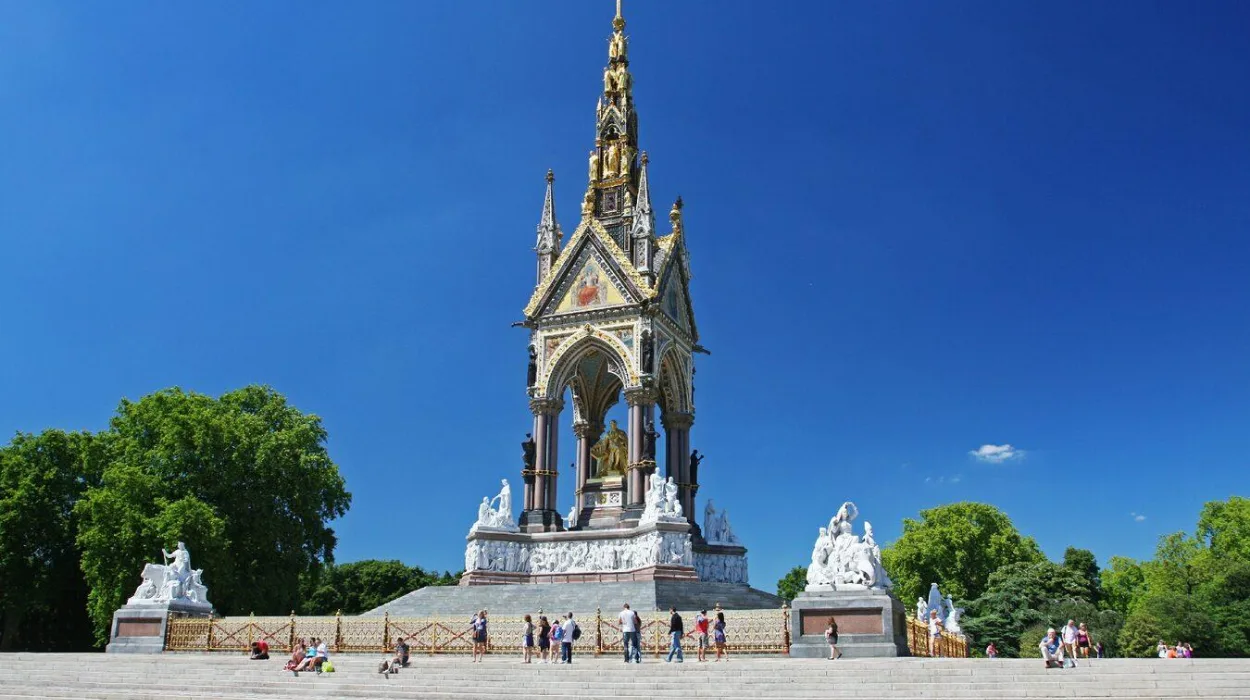
Why is the Albert Memorial one of Kensington’s most important Victorian landmarks?
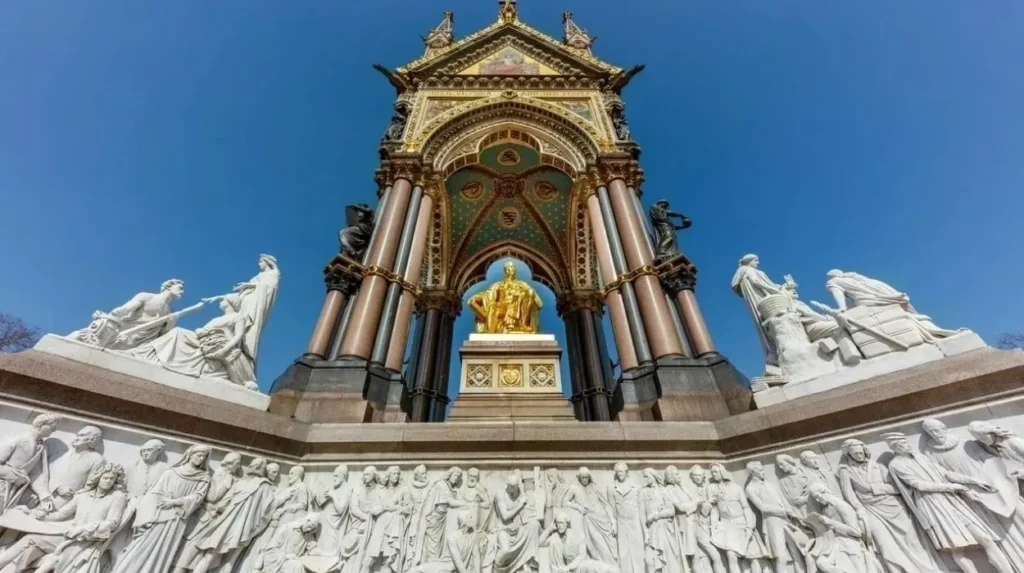
The Albert Memorial is one of Kensington’s most important Victorian landmarks because Queen Victoria commissioned it to commemorate Prince Albert after his death in 1861, creating a monumental expression of Victorian architecture, imperial identity, science, industry, and artistic achievement.
The Albert Memorial stands on the southern edge of Kensington Gardens near the Royal Albert Hall.
Prince Albert played a major role in the organisation of the Great Exhibition of 1851, an international exhibition that demonstrated industrial production, science, engineering, and artistic achievement.
After Albert’s death in December 1861, Queen Victoria commissioned a major memorial to commemorate her husband.
Architect Sir George Gilbert Scott designed the monument in the Gothic Revival style. The memorial combines sculpture, architecture, decorative arts, and symbolic references to nineteenth-century Britain.
The monument’s design reflects the intellectual world of Victorian Britain. Its sculptural programme connects Prince Albert with artistic achievement, scientific knowledge, manufacturing, and global influence.
The Royal Parks identifies the Albert Memorial as one of the defining historic features of Kensington Gardens and explains its direct connection to Prince Albert’s role in the Great Exhibition.
The memorial remains important for architectural history because it represents the Victorian Gothic Revival at a monumental scale.
It also demonstrates how public monuments preserve historical memory. The structure transformed personal royal mourning into a permanent landmark within London’s public landscape.
What is the historical importance of the Victoria and Albert Museum?
The Victoria and Albert Museum is historically important because it developed from Victorian educational reform after the Great Exhibition of 1851 and became a major international museum dedicated to art, design, craftsmanship, and the material history of human creativity.
The Victoria and Albert Museum, commonly known as the V&A, stands at the centre of South Kensington’s museum district.
Its institutional history is closely connected with the Great Exhibition of 1851. The exhibition demonstrated the importance of design, manufacturing, education, and international exchange.
Prince Albert supported the creation of institutions that would improve British artistic and industrial education. South Kensington became the centre of this programme.
The museum developed into a major collection of decorative arts and design. Its holdings document the history of furniture, textiles, sculpture, ceramics, fashion, architecture, photography, jewellery, and other forms of material culture.
The historical importance of the V&A lies in its ability to connect objects with social history.
A textile records manufacturing technology and trade. A piece of furniture records domestic life and craftsmanship. A religious sculpture records belief and artistic practice. A fashion collection records changing identity, production, and consumption.
For educators and academic researchers, this makes the museum a major resource for studying how societies expressed ideas through physical objects.
South Kensington’s concentration of the Victoria and Albert Museum, the Science Museum, and the Natural History Museum reflects the long-term success of Victorian cultural planning.
Why is the Natural History Museum one of Kensington’s leading attractions?
The Natural History Museum is one of Kensington’s leading attractions because it combines Victorian architecture with internationally significant scientific collections, using specimens, fossils, minerals, and biological research to document Earth’s history and the development of life across billions of years.
The Natural History Museum represents the scientific dimension of South Kensington’s Victorian cultural district.
Its collections support research into biodiversity, evolution, geology, palaeontology, and environmental change.
The museum holds approximately 80 million specimens, making its collections one of the world’s largest scientific resources for studying the natural world.
The building itself is also historically important.
Its architecture reflects Victorian confidence in scientific institutions and public education. The museum was designed to make scientific knowledge accessible through an impressive public building and carefully organised collections.
Why do natural history collections matter for historical research?
Natural history collections preserve physical evidence.
A fossil documents an extinct organism. A mineral records geological processes. A preserved specimen provides evidence about biodiversity at a particular point in time.
These collections allow researchers to compare historical and modern environments.
The museum therefore serves two functions. It is a public attraction and a research institution.
Its presence in Kensington demonstrates how nineteenth-century Britain invested in permanent institutions designed to preserve evidence and support scientific investigation.
What makes the Science Museum important to Kensington’s cultural history?
The Science Museum is important because it preserves objects associated with scientific discovery, engineering, medicine, transport, communication, and space exploration, continuing South Kensington’s Victorian mission to connect public education with technological and industrial development.
The Science Museum forms part of the same broader historical landscape created through Victorian investment in education and industry.
Its collections document technological change through physical objects and scientific instruments.
Examples include Stephenson’s Rocket, which represents the development of railway transport, and the Apollo 10 command module, which represents twentieth-century space exploration.
The historical value of the museum lies in its ability to show that scientific change depends on institutions, experimentation, engineering, investment, and communication.
Industrial development transformed Britain during the nineteenth century. Railways changed travel and trade. New manufacturing processes altered employment. Scientific research influenced medicine, communication, and infrastructure.
The Science Museum preserves objects connected with these processes.
Its location beside the Natural History Museum and the V&A creates a significant educational concentration. Art, design, natural science, and technology occupy neighbouring institutions because Victorian planners understood these fields as interconnected elements of national development.
Why is South Kensington’s museum district historically unique?
South Kensington is historically unique because its major museums emerged from a coordinated Victorian programme that used public institutions, education, architecture, and collections to strengthen artistic knowledge, scientific research, industrial design, and access to cultural resources.
The South Kensington museum district did not develop by accident.
Its growth followed the Great Exhibition of 1851 and the cultural programmes associated with Prince Albert.
The Victorian state and its associated institutions increasingly recognised the importance of public education.
Museums provided permanent access to objects and knowledge.
The South Kensington model brought several disciplines into one geographical area.
Art and design were represented through the Victoria and Albert Museum. Natural science was represented through the Natural History Museum. Technology and scientific development were represented through the Science Museum.
This physical concentration created a major educational landscape.
The district remains historically important because the original purpose continues. Students, researchers, educators, and visitors still use these institutions to examine evidence, objects, collections, and ideas.
Kensington and South Kensington are therefore important examples of institutional heritage.
What other historic attractions should visitors see in Kensington Gardens?
Kensington Gardens contain several additional historic attractions, including the Italian Gardens, Peter Pan statue, Round Pond, Broad Walk, and Serpentine landscape, each preserving evidence of Victorian commemoration, literary culture, Georgian design, and the continuing evolution of London’s public spaces.
The Italian Gardens represent Victorian landscape design and royal patronage.
Prince Albert gave Queen Victoria the gardens as a gift inspired by Italian garden landscapes associated with the royal family’s visits to the Isle of Wight. The gardens remain among the best-preserved ornamental features of Kensington Gardens.
The Peter Pan statue represents Kensington’s literary history.
Author J. M. Barrie developed a close association with Kensington Gardens through his writing. In 1912, a bronze statue of Peter Pan was installed in the gardens. The monument remains an important example of how literature became part of London’s physical landscape.
The Round Pond and Broad Walk preserve elements of Queen Caroline’s eighteenth-century redesign.
Together, these sites demonstrate the layered nature of Kensington’s heritage.
A visitor can examine Tudor land history, Stuart royal architecture, Georgian landscape planning, Victorian memorial culture, and twentieth-century literary commemoration within one connected area.
How has Kensington preserved its historic heritage into the modern era?
Kensington preserves its historic heritage through continued management by specialist institutions, including Historic Royal Palaces and the Royal Parks, alongside museums that conserve internationally significant collections while maintaining public access, research, education, and long-term preservation programmes.
Historic preservation requires more than maintaining old buildings.
A palace requires conservation of architecture, interiors, archives, and collections. A historic garden requires management of trees, water systems, paths, monuments, and biodiversity.
Museums require specialist conservation of objects that range from textiles and paintings to fossils and scientific instruments.
Kensington’s preservation system therefore involves several different institutions.
Historic Royal Palaces manages Kensington Palace as part of a group of nationally significant historic royal sites.
The Royal Parks manages Kensington Gardens within London’s historic Royal Parks landscape. The charity took responsibility for managing the Royal Parks in 2017 and supports conservation, education, and public access across approximately 5,000 acres of parkland.
Museums maintain collections through conservation, cataloguing, research, and interpretation.
This institutional structure protects Kensington’s heritage while allowing the district to remain an active part of modern London.
What is the best historical way to understand Kensington’s attractions?
The best way to understand Kensington is to view its attractions as one connected historical landscape, beginning with royal land and Kensington Palace, continuing through Georgian gardens and Victorian memorials, and ending with South Kensington’s museums of art, science, design, and natural history.
Kensington’s greatest historical value lies in the relationship between its attractions.
Kensington Palace explains the history of monarchy and court life.
Kensington Gardens explains the transformation of royal land and landscape design.
The Albert Memorial explains Victorian commemoration and Prince Albert’s cultural influence.
The Victoria and Albert Museum explains the history of art, design, and material culture.
The Natural History Museum explains the development of scientific collections and research.
The Science Museum explains technological and industrial change.
Together, these institutions and landscapes create a chronological record of British history.
The timeline begins with sixteenth-century royal hunting land. It continues through the establishment of Kensington Palace in 1689. It includes Queen Caroline’s eighteenth-century landscape transformation. It expands through the Victorian rebuilding of South Kensington after the Great Exhibition. It remains active through modern conservation, research, education, and public access.
For genealogical researchers, Kensington also provides valuable geographical context for understanding London family history. Royal households, aristocratic residences, servants, craftsmen, gardeners, museum workers, scientists, and educators all formed communities connected with the district.
For educators, the area provides direct access to evidence from multiple disciplines.
For cultural tourists, it provides a concentrated historical itinerary.
For heritage preservationists, Kensington demonstrates how buildings, landscapes, monuments, and collections can survive through institutional protection.
Why does Kensington remain important to London’s historical identity?
Kensington remains important to London’s historical identity because it preserves the physical evidence of changing monarchy, public space, landscape architecture, Victorian cultural policy, scientific research, and museum education, linking more than four centuries of British history within one internationally recognised district.
Kensington represents a major transition in London’s development.
Royal land became public landscape.
Private royal residences became partially accessible heritage sites.
Victorian collections became international museums.
Scientific institutions developed from nineteenth-century educational ambitions into modern research centres.
These changes explain why Kensington remains historically significant.
Its attractions are not isolated landmarks. They form a connected record of how Britain organised monarchy, culture, education, science, and public access.
Kensington Palace preserves the history of royal residence and constitutional transition.
Kensington Gardens preserve centuries of landscape design and changing public access.
The Albert Memorial preserves Victorian remembrance and architectural ambition.
The museums of South Kensington preserve physical evidence of human creativity, natural history, and technological development.
For anyone studying London’s past, Kensington provides an unusually complete historical environment. The district connects the Tudor monarchy with the modern museum. It connects royal gardens with public recreation. It connects Victorian cultural policy with contemporary education and research.
That continuity gives Kensington a permanent place among London’s most important destinations for royal heritage, historic gardens, and world-class museums.
Frequently Asked Question
What is the most famous royal attraction in Kensington?
Kensington Palace is the most prominent royal attraction in Kensington. Built as a royal residence from 1689, it is associated with William III, Mary II, Queen Anne, George II, Queen Victoria, Princess Margaret, and Diana, Princess of Wales.