Mayfair is one of London’s most established luxury districts, combining Georgian architecture, historic garden squares, bespoke tailoring, high-end retail, grand hotels, restaurants, galleries, and diplomatic residences. Its present identity developed from an 18th-century residential estate into a major international centre for hospitality, fashion, dining, culture, and commerce.
- Why is Mayfair regarded as one of London’s historic luxury districts?
- How did Mayfair develop from rural land into an elite London neighbourhood?
- Which historic areas of Mayfair are most important for luxury experiences?
- How does Mayfair’s Georgian architecture shape the luxury experience?
- Where can visitors experience fine dining with a Mayfair historical setting?
- How did Savile Row become a centre of luxury tailoring?
- What makes Mayfair shopping historically significant?
- Which Mayfair hotels provide the strongest connection between luxury and history?
- How did Mayfair change during the 19th and 20th centuries?
- How is Mayfair’s heritage protected while luxury development continues?
- What can visitors learn from Mayfair’s luxury heritage today?
- How does Mayfair’s history explain its modern luxury identity?
- Frequently Asked Question
The district occupies a central position in London’s West End, bordered broadly by Oxford Street to the north, Piccadilly to the south, Regent Street to the east, and Park Lane to the west. Its streets include Bond Street, Savile Row, Mount Street, South Audley Street, Berkeley Square, Grosvenor Square, and Carlos Place.
The history of Mayfair explains its concentration of luxury experiences. The area was planned during the early Georgian period when the Grosvenor family began developing land acquired through the marriage of Sir Thomas Grosvenor and Mary Davies in 1677. Grosvenor’s development of Mayfair began in 1720, replacing rural meadow, marsh, pasture, and orchard landscapes with planned streets and prestigious residences.
Today, visitors encounter luxury through established institutions rather than through a single architectural style. Georgian townhouses stand beside modern restaurants, fashion boutiques, galleries, hotels, offices, and redesigned public spaces. This mixture reflects more than three centuries of continuous adaptation.
Why is Mayfair regarded as one of London’s historic luxury districts?
Mayfair became a luxury district through planned Georgian development, aristocratic residence, royal proximity, high-quality architecture, fashionable commerce, and long-term investment. These factors created a concentrated environment for prestigious homes, tailoring, hospitality, dining, galleries, and specialist retail businesses.
The foundations of Mayfair’s reputation were established in the 18th century. After the Great Plague of 1665 and the Great Fire of London in 1666, London expanded westward as wealthy residents sought new residential districts beyond the crowded medieval core. The West End developed as an important area for fashionable housing and commercial activity.
The Grosvenor family acquired extensive land in 1677 through the marriage of Sir Thomas Grosvenor and Mary Davies. Mary Davies was the heiress to the Manor of Ebury, giving the Grosvenor family a substantial property interest west of the City of London.
Development began in earnest during the 1720s. Grosvenor Square became the principal planned space, surrounded by streets designed for substantial Georgian residences. The architectural programme established a pattern of broad streets, formal squares, brick terraces, sash windows, classical proportions, and carefully controlled building frontages.
Mayfair’s location strengthened its social status. It stood close to St James’s, the royal court, Hyde Park, and important routes through Westminster. The combination of accessibility, architecture, social status, and proximity to royal institutions encouraged aristocratic and wealthy residents to settle in the district.
The luxury economy developed alongside residential growth. Tradesmen, coach makers, chandlers, lacers, dressmakers, retailers, and other specialist businesses served residents. Over time, these commercial activities evolved into the tailoring houses, jewellery stores, restaurants, hotels, galleries, and luxury boutiques associated with Mayfair today.
Mayfair therefore represents a historical process rather than a modern marketing concept. Its luxury identity developed through land ownership, architecture, elite residence, specialist craftsmanship, retail infrastructure, hospitality, and cultural patronage.
How did Mayfair develop from rural land into an elite London neighbourhood?
Mayfair developed from rural meadow, pasture, marsh, and orchard land into a planned residential district during the early 18th century. Grosvenor development from 1720 created streets and squares that attracted aristocratic residents and established Mayfair’s enduring architectural and social status.
The district’s name is connected with the May Fair, a spring fair whose origins date to the 16th century and which moved into the area during the late 17th century. The fair contributed the name that remains attached to the district.
The transformation accelerated after 1720. Developers established a street grid centred on Grosvenor Square. The planned layout differed from the irregular medieval streets of the City of London and created a coherent residential environment for wealthy occupants.
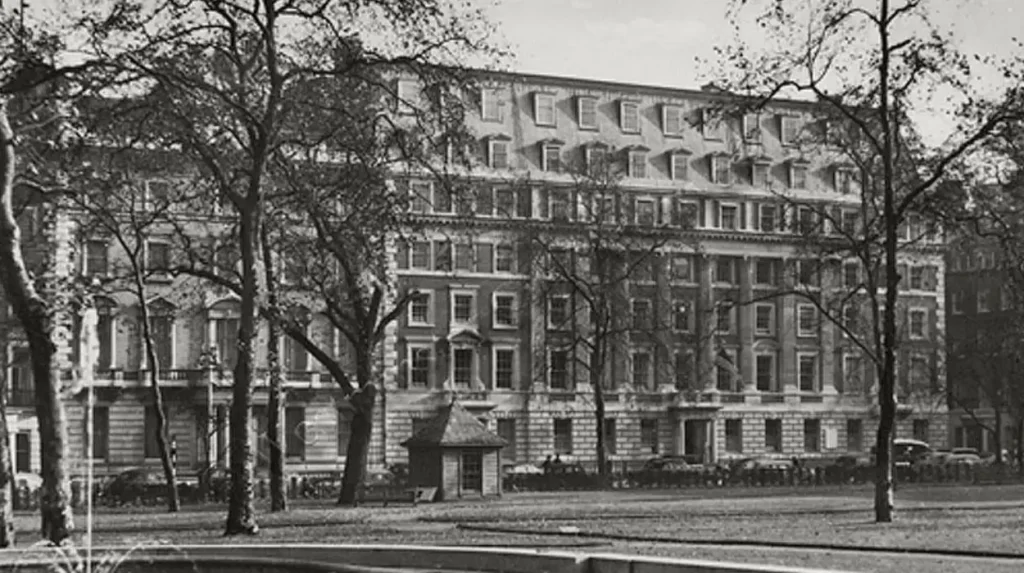
Grosvenor Square became a major architectural and social centre. The square was among London’s largest garden squares when created and provided an open landscaped setting surrounded by substantial residences.
The development was connected to broader political and economic changes. London expanded rapidly during the 18th century as commerce, government, finance, and imperial trade increased the wealth of the capital. The West End became an important location for people connected to aristocratic households, government, diplomacy, and fashionable society.
Mayfair’s architecture also contributed to its durability. The district retained substantial numbers of Georgian and later Georgian buildings, although many original interiors and structures were subsequently altered. Westminster City Council records Mayfair as a conservation area, recognising the architectural and historic character of the district. Mayfair Conservation Area was designated in 1969.
The original development pattern remains visible in streets such as Brook Street, Grosvenor Street, Duke Street, South Audley Street, and parts of Mount Street. These streets demonstrate how 18th-century planning continues to shape modern commercial activity.
The preservation of this framework is central to Mayfair’s current luxury economy. Historic buildings provide locations for modern retailers, restaurants, offices, galleries, and hotels while maintaining architectural continuity with the district’s Georgian origins.
Which historic areas of Mayfair are most important for luxury experiences?
Grosvenor Square, Bond Street, Savile Row, Mount Street, Berkeley Square, South Audley Street, and Carlos Place form major historic areas for luxury experiences. Each combines architectural heritage with specialised retail, tailoring, hospitality, dining, cultural institutions, or public spaces.
Grosvenor Square remains one of the most important historical spaces in Mayfair. Its current landscape incorporates the original 1720s planning concept while responding to modern environmental requirements. In July 2026, the square reopened following a £25 million transformation involving approximately 150,000 plants and bulbs, 44 trees, and new wetlands.
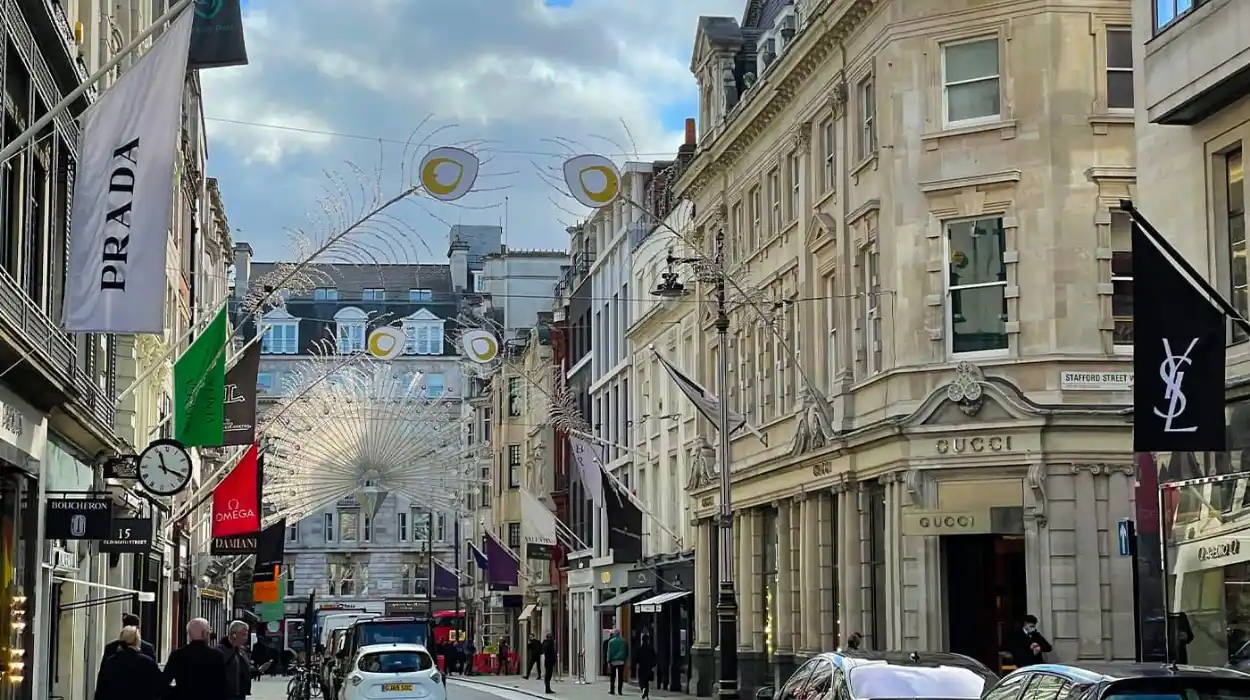
Bond Street developed into one of London’s principal luxury shopping streets. Its location between Oxford Street and Piccadilly places it within the central West End retail network. The surrounding streets contain jewellery houses, fashion brands, art galleries, watch retailers, and specialist businesses.
Savile Row represents another specialised form of luxury. Its importance derives from bespoke tailoring rather than conventional retail. The street became associated with high-quality made-to-measure clothing during the 19th century.
Mount Street combines historic architecture with contemporary luxury retail. Its buildings reflect the evolution of Mayfair from aristocratic residential district to mixed-use commercial neighbourhood.
Berkeley Square is another major historic space. Its Georgian setting connects residential architecture with modern hospitality, dining, and retail. The square and surrounding streets demonstrate the continuity between Mayfair’s original social function and its current commercial identity.
South Audley Street provides another link between architecture, luxury retail, and historic residential development. It connects Grosvenor Square with Hyde Park and forms part of the broader Grosvenor estate.
Carlos Place has become associated with high-end fashion, hospitality, and boutique activity. Its location near Mount Street and The Connaught places several luxury experiences within a compact walking area.
These areas are valuable for heritage visitors because the luxury economy remains embedded within the historic street plan rather than operating separately from it.
How does Mayfair’s Georgian architecture shape the luxury experience?
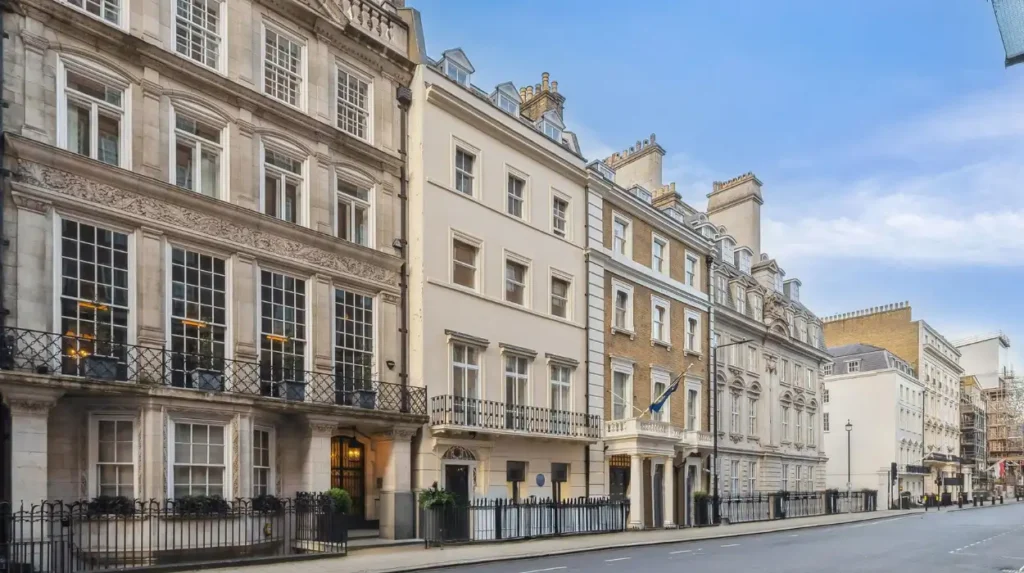
Mayfair’s Georgian architecture shapes luxury experiences through preserved street layouts, terraced townhouses, formal squares, classical façades, historic materials, and listed buildings. These structures provide the physical setting for modern hotels, restaurants, galleries, boutiques, offices, and specialist retail businesses.
Georgian architecture generally refers to British architecture associated with the reigns of George I, George II, George III, and George IV, covering much of the 18th and early 19th centuries. Mayfair contains substantial surviving examples of this architectural tradition.
Typical Mayfair townhouses use brick façades, stone detailing, timber sash windows, classical doorcases, and carefully proportioned elevations. The buildings were designed as residences for wealthy households and often included reception rooms, service areas, kitchens, bedrooms, and staff accommodation.
The original social structure is visible in the scale of the buildings. Large houses occupied valuable plots close to fashionable squares and streets. Their size reflected the wealth and social position of their occupants.
Commercial conversion changed this function. Houses that once served as private residences became embassies, clubs, offices, restaurants, boutiques, galleries, and hotels. This process accelerated during the 20th century.
Westminster City Council identifies conservation areas as places of special architectural and historic interest where the character and appearance require protection and enhancement. Mayfair received conservation-area designation in 1969.
Historic buildings therefore form part of the experience itself. Dining in a converted townhouse, visiting a boutique inside a Georgian building, or staying in a historic hotel places contemporary activities within structures connected to earlier phases of London’s development.
Heritage preservation also affects new construction. Modern schemes within Mayfair frequently incorporate existing façades, historic materials, and established street patterns. The South Molton development, for example, includes 22 listed buildings, including 14 Georgian terraced properties. Grosvenor states that Portland stone from historic buildings is being dismantled and reused within the project.
This approach demonstrates how preservation and commercial development operate together in a historic central London district.
Where can visitors experience fine dining with a Mayfair historical setting?
Mayfair’s fine-dining scene combines historic hotels, Georgian streets, modern restaurants, international cuisine, and Michelin-recognised establishments. The district provides French, British, Indian, modern European, and other culinary traditions within a concentrated central London area.
Fine dining in Mayfair developed from the district’s long relationship with wealthy residents, hotels, clubs, retailers, and international visitors. Modern restaurants continue this tradition through formal service, specialist ingredients, architectural interiors, and high levels of hospitality.
The Michelin Guide currently lists several starred restaurants in and around Mayfair. These include Hélène Darroze at The Connaught, Alain Ducasse at The Dorchester, Ormer Mayfair, and Benares.
Benares occupies 12a Berkeley Square and specialises in Indian cuisine. The restaurant holds one Michelin Star and provides an example of how Mayfair’s dining economy incorporates international culinary traditions within a historic British setting.
Ormer Mayfair operates at Flemings Mayfair on Half Moon Street. The Michelin Guide classifies its cuisine as modern British and records a one-star distinction. Its location inside a historic hotel reinforces the connection between fine dining and Mayfair hospitality.
Hélène Darroze at The Connaught represents another important dining institution. The restaurant is located within The Connaught, one of Mayfair’s established grand hotels, and is listed among London’s Michelin-starred restaurants.
Sketch on Conduit Street provides a different example. Its Gallery restaurant occupies a prominent Mayfair address and combines modern cuisine with a highly designed interior. The Michelin Guide records a major redesign by artist Yinka Shonibare and designer India Mahdavi in 2022.
Fine dining therefore forms part of Mayfair’s broader historical pattern. The district has repeatedly adapted to changing tastes while maintaining its association with high-value hospitality.
For visitors interested in heritage as well as contemporary experiences, restaurants within historic hotels and townhouses provide direct access to Mayfair’s architectural environment.
How did Savile Row become a centre of luxury tailoring?
Savile Row became a global centre of bespoke tailoring during the 19th century as specialist tailors attracted aristocratic and royal clients. Henry Poole played a central role, establishing a tailoring presence connected with the street and helping define its international reputation.
Bespoke tailoring means clothing commissioned for an individual client and produced according to a specific pattern and fitting process. The term derives from “bespeak”, meaning to order or reserve something in advance.
James Poole began his tailoring career in London in 1806. His business expanded during the Napoleonic period through military clothing. In 1828, the firm established a showroom and workshop at Old Burlington Street with a rear entrance onto Savile Row.
Henry Poole inherited the business in 1846. The company then established a major entrance on Savile Row and became increasingly connected with aristocratic and royal clientele. Henry Poole served figures including Napoleon III and Queen Victoria, while the patronage of the future Edward VII strengthened the firm’s position within fashionable London society.
Henry Poole also claims a significant place in the history of the dinner suit. The firm identifies 1865 as the year it created an early version of the tuxedo for the Prince of Wales.
The business expanded substantially during the late 19th and early 20th centuries. By the early 1900s, Henry Poole employed around 300 tailors and 14 cutters, according to the firm’s historical record.
The heritage of bespoke tailoring also survives through archives. Henry Poole holds more than 120 customer-order ledger books dating from 1846 to the 1950s, with each volume containing more than 1,000 pages. These records document orders, addresses, recommendations, and individual requirements.
Today, Savile Row remains associated with hand-made clothing and specialist craftsmanship. Henry Poole states that its current workshop offers more than 6,000 fabric choices and continues a bespoke production process at its Savile Row premises.
The street demonstrates how a historic specialist trade can survive within a modern luxury district through skills, archives, craftsmanship, and brand continuity.
What makes Mayfair shopping historically significant?
Mayfair shopping is historically significant because luxury retail developed alongside aristocratic residence and specialist craftsmanship. Bond Street, Savile Row, Mount Street, and nearby Piccadilly continue commercial traditions that evolved from 18th- and 19th-century demand for fashion, jewellery, food, clothing, and personal services.
The retail history of Mayfair is closely connected with the district’s original residents. Wealthy households required clothing, transport, furnishings, food, jewellery, and specialist services. Retailers established businesses close to these customers.
Bond Street became particularly associated with fashionable and luxury commerce. Its surrounding streets developed a concentration of specialist shops, galleries, and high-value retailers.
Savile Row represents the craft-based side of luxury retail. Customers commission garments rather than selecting standardised products from conventional stock. The process requires consultation, measurement, pattern cutting, fittings, and skilled handwork.
Mount Street provides a contemporary luxury-retail environment within historic buildings. The architectural setting contributes to the visual continuity of the street.
Food retail also has a long history near Mayfair. Fortnum & Mason was founded in Piccadilly in 1707 and developed into a major London destination for food and luxury goods. The company traces its origins to William Fortnum and Hugh Mason and records its establishment during the early 18th century.
This history demonstrates that luxury shopping in the West End is not exclusively a modern phenomenon. Specialist retail has served affluent London residents for centuries.
The modern luxury sector adds international fashion houses, jewellery brands, watchmakers, art dealers, and design businesses. These newer enterprises occupy a commercial environment shaped by earlier patterns of wealth, craftsmanship, and consumption.
Shopping in Mayfair therefore provides a direct way to examine the evolution of London’s consumer economy.
Which Mayfair hotels provide the strongest connection between luxury and history?
Mayfair’s grand hotels connect luxury accommodation with London’s social history through historic buildings, long-established hospitality traditions, central locations, preserved interiors, and relationships with royalty, politics, entertainment, diplomacy, and international visitors.
The Connaught is one of Mayfair’s best-known historic luxury hotels. Located on Carlos Place, it combines traditional architectural references with modern hotel design. The Michelin Guide currently gives The Connaught three Michelin Keys, its highest hotel distinction.
The hotel’s importance extends beyond accommodation. Grand hotels developed as institutions where wealthy residents, travellers, diplomats, entertainers, business leaders, and public figures could access accommodation, restaurants, lounges, and other services within a single establishment.
The Dorchester on Park Lane provides another major example. The hotel occupies a prominent position opposite Hyde Park and is recognised by the Michelin Guide with two Michelin Keys. It contains 241 rooms and represents the grand-hotel tradition of formal London hospitality.
The Biltmore Mayfair occupies the southern side of Grosvenor Square. Its current form dates from 2019, while its location connects it directly to one of Mayfair’s most important historic public spaces. The Michelin Guide lists 307 rooms and describes its interiors as combining London Art Deco references with contemporary design.
Flemings Mayfair provides another connection between historic hospitality and modern fine dining. Its Half Moon Street address places it within the historic Mayfair street network, while Ormer Mayfair operates within the hotel.
The importance of these hotels is not limited to their accommodation. They function as architectural, culinary, and social institutions. Restaurants, afternoon tea rooms, bars, lounges, and public-facing spaces extend the hotel experience beyond overnight stays.
For heritage-focused visitors, hotels also provide evidence of changing patterns of urban hospitality. The grand hotel developed as London became increasingly connected to international travel, finance, diplomacy, entertainment, and commerce.
How did Mayfair change during the 19th and 20th centuries?
Mayfair changed from an aristocratic residential district into a mixed-use commercial and diplomatic neighbourhood. The process involved changing household structures, new retail demand, office conversion, embassy occupation, wartime disruption, redevelopment, and renewed investment in historic buildings.
The 19th century brought major changes to London. Population growth, industrialisation, transport improvements, and commercial expansion increased pressure on central districts.
After the Napoleonic Wars ended in 1815, London’s expansion accelerated. New development south-west of Mayfair produced Belgravia and Pimlico, while Mayfair remained an established wealthy district.
The social geography of Mayfair changed gradually. Large private houses became increasingly difficult and expensive to maintain as the structure of domestic service and aristocratic households changed.
World War I accelerated the transformation. Grosvenor records that some of Mayfair’s grand houses became embassies and diplomatic residences, while substantial redevelopment affected Mount Street, Carlos Place, and Grosvenor Square.
The Second World War produced another significant shift. Bomb damage and disruption in the City of London encouraged businesses to relocate westward. Mayfair acquired a larger office function during the post-war period.
Temporary office permissions remained important for decades. Grosvenor states that these permissions finally ended in the early 1990s, after which some buildings reverted to residential use.
This history explains Mayfair’s mixed-use character today. Residential buildings coexist with offices, hotels, restaurants, embassies, galleries, retailers, and cultural businesses.
The transformation did not eliminate the district’s historic identity. Instead, historic buildings acquired new functions while the underlying street pattern remained recognisable.
How is Mayfair’s heritage protected while luxury development continues?
Mayfair’s heritage is protected through conservation-area designation, listed-building controls, restoration, adaptive reuse, historic-façade retention, planning policies, and investment in public spaces. These measures allow modern commercial activity while maintaining significant architectural and historic features.
Mayfair Conservation Area was designated in 1969. Conservation-area status recognises the collective value of buildings, streets, spaces, views, and architectural character rather than focusing only on individual listed structures.
Listed-building protection provides another layer of control. Westminster City Council maintains datasets identifying buildings included on the National Heritage List for England because of architectural or historic importance. Works affecting listed buildings and their curtilage can require listed-building consent.
Adaptive reuse is particularly important in Mayfair. Historic houses can support restaurants, shops, offices, galleries, and hotels without requiring complete replacement.
South Molton demonstrates this approach. The development includes 22 listed buildings, with 14 forming a row of Georgian terraces. The scheme retains historic façades and reuses Portland stone from existing buildings. Approximately 4,750 blocks of Portland stone weighing about 550 tonnes are being dismantled and rebuilt within the project.
Grosvenor Square provides another preservation example. The square’s 2026 redesign reinstated the original 1720s oval form while introducing contemporary ecological infrastructure. The £25 million project added 70,000 plants, 80,000 bulbs, 44 trees, and wetlands.
The square also preserves existing memorials, including those commemorating Franklin D. Roosevelt, the Eagle Squadrons, and victims of the 11 September 2001 attacks.
These projects demonstrate that heritage preservation is not limited to freezing buildings in their historical state. Contemporary conservation involves retaining significant architectural evidence while adapting spaces to current social, environmental, and economic requirements.
What can visitors learn from Mayfair’s luxury heritage today?
Visitors can use Mayfair’s luxury environment to study London’s urban development, Georgian architecture, aristocratic landownership, specialist craftsmanship, retail history, hospitality, conservation policy, and modern adaptive reuse within one compact central London district.
Mayfair provides an unusually concentrated historical environment. A visitor can examine an 18th-century garden square, Georgian townhouses, Victorian tailoring history, grand hotels, luxury retail streets, diplomatic buildings, modern restaurants, and contemporary public-space design within a relatively small area.
The district is also useful for academic study. Its history demonstrates how private landownership shaped urban development. The Grosvenor estate’s transformation of rural land into a planned neighbourhood provides a clear example of estate-led urban development.
Its architectural history demonstrates the relationship between planning and social class. Streets and squares were deliberately created for wealthy residents, producing a distinctive built environment that remains visible more than 300 years later.
Its commercial history demonstrates the evolution of specialist consumption. Tailoring, jewellery, food retail, hospitality, art dealing, and fine dining developed in response to the district’s wealthy customer base.
Its conservation history demonstrates how historic areas adapt to contemporary requirements. The 2026 Grosvenor Square project connects heritage with biodiversity, climate resilience, public access, and environmental education.
For visitors planning a wider exploration of the area, the historical context should be combined with practical information about routes, landmarks, opening arrangements, and visitor priorities. To experience this historic district in person today, consult our comprehensive [The History of Camden’s Markets and London’s Alternative Cultural Movement Explained] for itineraries and visiting parameters.
Mayfair also remains valuable for genealogical research. Historic addresses, rate books, business records, tailoring ledgers, maps, property records, and institutional archives can help researchers investigate former residents and commercial occupants.
Henry Poole’s surviving ledgers demonstrate the value of commercial archives. More than 120 large order books contain detailed customer information covering the period from 1846 to the 1950s. Such records provide evidence about clothing, addresses, social connections, and changing consumer practices.
Mayfair’s future historical relevance therefore rests on both preservation and continued change. The district remains an active commercial neighbourhood while retaining architectural evidence from earlier periods.
How does Mayfair’s history explain its modern luxury identity?
Mayfair’s modern luxury identity results from a continuous historical sequence: 18th-century planned development, aristocratic residence, specialist commerce, royal proximity, Victorian tailoring, grand hotels, international retail, conservation, and contemporary investment combined into one enduring central London district.
The district’s modern reputation is rooted in its physical structure. The Georgian street grid created in the 1720s remains fundamental to the visitor experience. Grosvenor Square continues to anchor the western part of Mayfair, while Bond Street and Savile Row retain their specialist commercial identities.
Luxury accommodation developed through the grand-hotel tradition. Fine dining expanded through restaurants operating within hotels, townhouses, and purpose-designed modern interiors. Shopping evolved from services for aristocratic households into an international luxury retail ecosystem.
Craftsmanship remains particularly important. Savile Row demonstrates that luxury can depend on skilled labour, training, archives, individual measurement, and long production processes rather than mass retail. Henry Poole’s continuing apprenticeship programme illustrates how historic craft knowledge is passed to new generations.
Architecture remains equally important. Mayfair’s listed buildings and conservation-area controls preserve evidence of earlier social and economic systems while permitting contemporary uses.
The transformation of Grosvenor Square adds a further dimension. Its 2026 redesign shows how a historic urban space can retain its original form while addressing biodiversity, stormwater management, urban heat, public accessibility, and environmental education. The redesigned square can absorb up to 1.4 million litres of stormwater and includes approximately 150,000 plants and bulbs.
Mayfair therefore provides more than a concentration of expensive restaurants, shops, and hotels. It represents a documented example of how London’s historic urban districts evolve.
Its luxury experiences are connected to landownership, architecture, craftsmanship, commerce, hospitality, conservation, and social history. Those connections explain why Mayfair remains one of London’s most important areas for studying the relationship between heritage and contemporary urban life.
The enduring significance of Mayfair lies in this continuity. The district has changed function repeatedly since its development in the 1720s, yet its streets, squares, buildings, institutions, and specialist businesses continue to reveal the historical forces that shaped London’s West End.
Frequently Asked Question
What makes Mayfair’s architecture historically important?
Mayfair contains extensive Georgian architecture, including terraced townhouses, formal garden squares, brick façades, sash windows, classical doorways, and carefully planned streets. Much of the area is protected through conservation and listed-building controls.