Camden’s markets developed from London’s industrial and transport economy into one of Britain’s most important centres of independent retail, alternative fashion, live music and youth culture. The transformation connected the Regent’s Canal, Victorian infrastructure, post-war migration, creative enterprise and the countercultural movements that reshaped London from the 1960s onward.
- How did Camden Town develop before its famous markets existed?
- When did street markets become part of Camden’s commercial history?
- How did Camden’s industrial landscape become a cultural landscape?
- When did Camden Market begin and how did it grow?
- What was London’s alternative cultural movement and why did Camden become part of it?
- How did music venues shape Camden’s alternative identity?
- How did alternative fashion transform Camden’s markets?
- How did Camden’s markets connect immigration, diversity and global food culture?
- What happened to Camden’s historic market buildings during redevelopment?
- How did Camden’s markets influence London’s wider cultural identity?
- Why is Camden’s market history still important today?
- How can visitors understand Camden’s history in the present day?
- Frequently Asked Question
For The Londoner News, the history of Camden provides an important example of how an urban district can preserve industrial structures while repeatedly changing its commercial and cultural purpose. Camden Town was not originally created as a market district. Its modern identity emerged through a sequence of developments involving planned urban expansion, canal transport, railway employment, street trading, music venues and the conversion of former industrial land into spaces for independent businesses.
Today, Camden’s market economy remains significant within the wider borough. Camden Council identifies at least 19 regular markets across the borough, while the wider market sector supports thousands of jobs and combines historic street markets with privately operated destinations.
How did Camden Town develop before its famous markets existed?
Camden Town developed from a late eighteenth-century planned settlement into a major transport and industrial district after the Regent’s Canal opened in 1820, creating warehouses, wharves, housing and employment that later supplied the physical foundations for Camden’s markets and cultural economy.
Camden Town takes its name from Charles Pratt, the first Earl Camden. Development began in 1791 on land associated with his estate. At that stage, the district consisted of a relatively small settlement beside an important northern route out of London.
Its location became increasingly important during the nineteenth century. London was expanding rapidly beyond its historic core, and transport infrastructure determined where new industries and working communities developed. Camden stood close to routes connecting central London with the northern counties and later gained direct access to the Regent’s Canal.
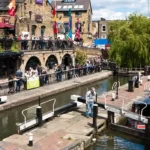
The Regent’s Canal opened to traffic in 1820. The waterway connected Paddington in west London with Limehouse and the River Thames in the east. Camden Lock became part of a transport system that moved coal, timber, grain, manufactured goods and other commercial cargoes through the expanding metropolis.
Why did the Regent’s Canal matter to Camden’s history?
The canal created an industrial landscape. Wharves, warehouses and service buildings appeared beside the water. Commercial activity attracted workers and supported housing development in the surrounding streets.
This infrastructure later became historically important for an entirely different reason. The buildings that served Victorian transport and industry survived long enough to become adaptable spaces for shops, stalls, entertainment and tourism.
Camden therefore demonstrates a major pattern in London’s urban history: obsolete industrial infrastructure was not simply demolished. Significant parts were reused for new economic functions.
The later market district depended heavily on this inherited physical environment. Canal-side warehouses provided distinctive architecture. Former yards created open commercial spaces. Industrial buildings supplied large interiors suitable for traders, designers and entertainment venues.
When did street markets become part of Camden’s commercial history?
Street markets formed an established part of Camden’s nineteenth-century commercial landscape, serving rapidly growing working-class communities with food, clothing and household goods before the specialised Camden Lock markets emerged as a separate cultural and tourist destination during the 1970s.
Camden’s market history extends beyond the famous canal-side complex.
Camden Council records several historic street markets within the borough. Chalton Street Market, originally known as The Brill, was established in 1795. Plender Street Market dates from 1851. Queen’s Crescent developed as a market location after traders moved there in 1876.
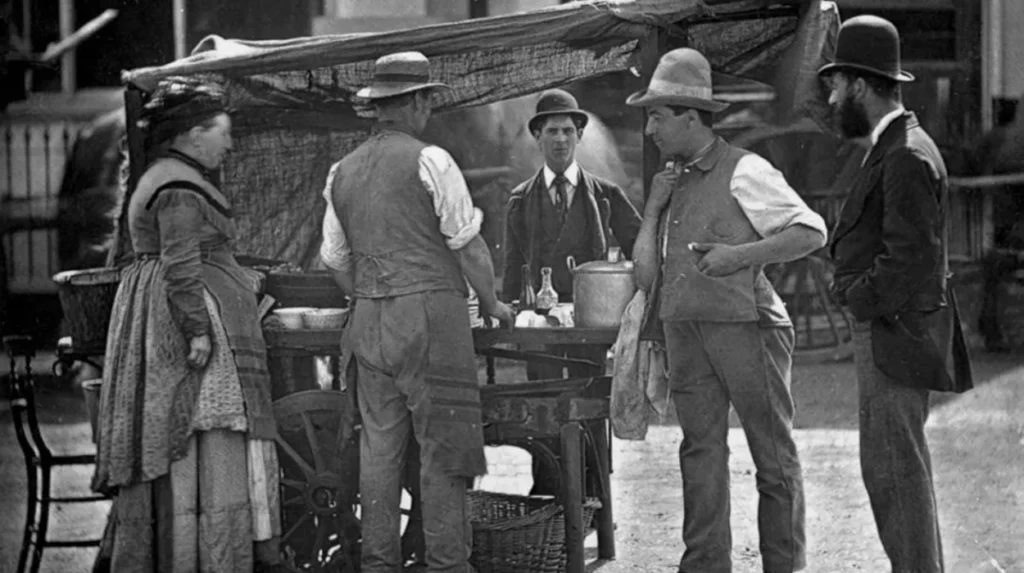
These markets served practical urban needs. Nineteenth-century London contained large populations living close to workplaces and without the modern supermarket system. Street traders sold affordable food, clothing, household goods and other daily necessities.
In Camden Town itself, street trading was connected with changes to the transport network. Camden Council identifies Inverness Street and Plender Street as remnants of the earlier Camden Town Market activity that moved away from Camden High Street after late nineteenth-century tram electrification altered the street environment.
What did Victorian market trading reveal about Camden society?
Markets revealed the social structure of the expanding city.
Industrial and transport employment brought large numbers of workers into districts around Camden, King’s Cross and St Pancras. These communities required inexpensive and accessible goods. Street markets supplied them through small-scale entrepreneurship.
The market trader became an important figure in London’s informal commercial economy. Unlike large department stores, markets allowed relatively small businesses to operate with lower barriers to entry.
This commercial structure remained historically significant after the Victorian period. Independent trading later became central to Camden’s identity, although the products changed dramatically from household necessities to vintage fashion, handmade goods, music-related merchandise and international food.
The continuity was therefore economic rather than stylistic. Camden repeatedly provided spaces where small traders could establish businesses outside conventional large-scale retail systems.
How did Camden’s industrial landscape become a cultural landscape?
Camden’s industrial landscape became a cultural landscape when declining canal and warehouse functions left adaptable buildings available for creative businesses, entertainment and markets, allowing former transport infrastructure to support London’s growing youth culture and independent commercial economy during the late twentieth century.
The twentieth century changed London’s industrial geography.
Railways and road transport reduced the commercial importance of many canal operations. Manufacturing patterns also changed. Former industrial districts increasingly contained underused warehouses, yards and service buildings.
Camden possessed an unusually valuable combination of surviving infrastructure and proximity to central London.
The district was accessible from major railway and Underground networks. It also contained industrial buildings with large spaces that were suitable for conversion.
Camden Council notes that the arrival of Euston Station in 1837, King’s Cross in 1852 and St Pancras in 1868 encouraged employment and industrialisation across the wider borough. Industries included piano and organ manufacturing, furniture production, light engineering and scientific instruments.
Why were old industrial buildings important to alternative culture?
Alternative cultural movements required affordable and flexible spaces.
Musicians needed venues. Designers needed workshops and small retail spaces. Independent traders needed premises that did not resemble conventional department stores or high-street chains.
Former industrial areas often provided these conditions.
Camden’s warehouses and yards also supplied a visual identity. Brick structures, railway infrastructure, canal bridges and former commercial buildings created an environment that differed sharply from the formal architecture of central London’s established shopping districts.
This physical difference reinforced Camden’s cultural distinction.
The architecture became part of the district’s identity rather than merely a background to commercial activity.
When did Camden Market begin and how did it grow?
Camden Lock Market began in 1974 as a small Sunday arts and crafts market with 16 stalls, expanding rapidly as independent traders, creative businesses and visitors transformed former canal-side industrial land into a major commercial and cultural destination.
The decisive change occurred during the 1970s.
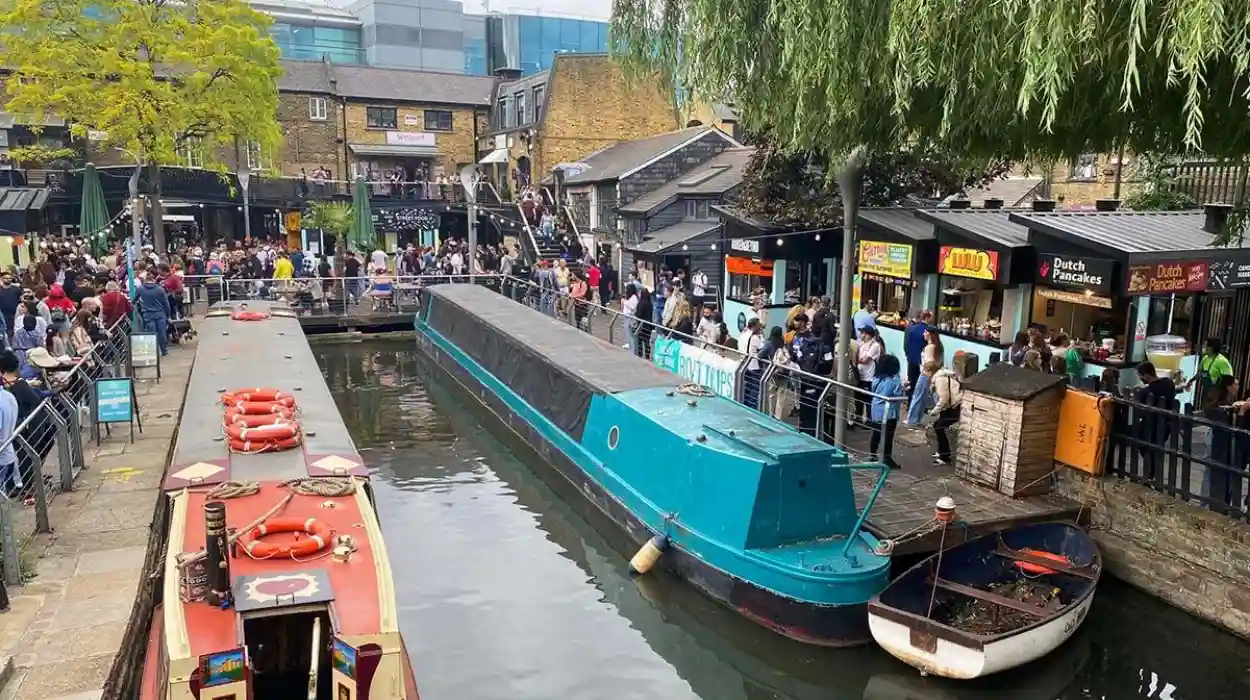
Camden Market traces its origins to a small arts and crafts fair established behind the Dingwalls building. The market began as a temporary Sunday operation with 16 stalls. Its popularity created the foundation for a much larger commercial district.
The timing was important.
Britain in the 1970s experienced significant economic and social change. Traditional manufacturing employment was under pressure. Young people developed new cultural identities through music, fashion and independent publishing. Alternative businesses sought spaces outside established commercial systems.
Camden provided a meeting point for these developments.
How did the market’s business model support creative traders?
The market format supported small-scale enterprise.
A trader could sell handmade goods, clothing, jewellery, records or other specialised products without operating a conventional permanent high-street shop.
This structure encouraged experimentation.
Independent designers could test new products. Vintage sellers could build specialist audiences. Craftspeople could reach customers directly.
Camden Market therefore developed as more than a shopping destination. It became part of London’s infrastructure for cultural production.
The relationship between traders and visitors also shaped the district. Customers arrived specifically because the market offered goods that differed from mainstream retail.
The demand for difference became a defining economic force.
What was London’s alternative cultural movement and why did Camden become part of it?
London’s alternative cultural movement consisted of interconnected youth, music, fashion and artistic communities that rejected conventional commercial identities, and Camden became a major centre because its venues, independent businesses and adaptable industrial spaces supported visible cultural experimentation.
Alternative culture describes communities and creative practices operating outside dominant mainstream social and commercial norms.
In post-war Britain, youth culture became increasingly influential. Music, clothing and visual identity allowed young people to express group affiliations.
Several major movements shaped London’s cultural landscape. These included mods, rockers, hippies, punks, Goth communities and later New Romantic and Britpop audiences. Camden became associated with examples of these overlapping musical and fashion cultures rather than representing a single subculture.
The district’s importance came from concentration.
Music venues, pubs, independent shops and market stalls existed within a relatively compact area. People could attend performances, meet other participants and buy clothing connected with particular scenes.
Camden History Society identifies the district as a major centre for rock and punk and records its association with movements including UK punk, Two-Tone, New Romantic culture and Britpop.
How did music venues shape Camden’s alternative identity?
Camden’s music venues established the district as a national cultural centre by providing stages for emerging and established artists, linking live performance with nearby independent businesses and creating a concentrated environment where music scenes influenced fashion, retail and youth identity.
The Roundhouse played a central role in Camden’s cultural development.
The building was originally constructed as a railway engine shed and turntable structure during the nineteenth century. Its later conversion into an arts and performance venue demonstrated the wider reuse of industrial architecture occurring across Camden.
During the 1960s, the Roundhouse hosted significant performances and experimental cultural events. Camden History Society records its importance as a venue for challenging film, philosophy, theatre and major musical acts, including Jimi Hendrix and Pink Floyd.
Dingwalls became another important venue in the Camden area.
The relationship between music and markets became increasingly direct. Visitors did not experience Camden’s retail spaces separately from its nightlife and entertainment. The same district supported both activities.
Camden Market identifies the 1960s and later decades as crucial to the development of its music identity, linking Dingwalls and the Roundhouse with rock and punk culture.
How did punk change Camden’s cultural reputation?
Punk established a highly visible connection between music, clothing and independent production.
The British punk movement developed during the mid-1970s through independent bands, record labels, venues, fashion and graphic design.
Camden became associated with this wider cultural environment because its venues and retail spaces supported audiences interested in non-mainstream music and style.
The process mattered as much as the individual performers.
A band created music. Independent venues presented performances. Designers produced clothing. Traders sold visual symbols associated with scenes. Customers adopted and adapted those symbols.
Camden concentrated these activities geographically.
The district became a place where cultural identity was commercially visible.
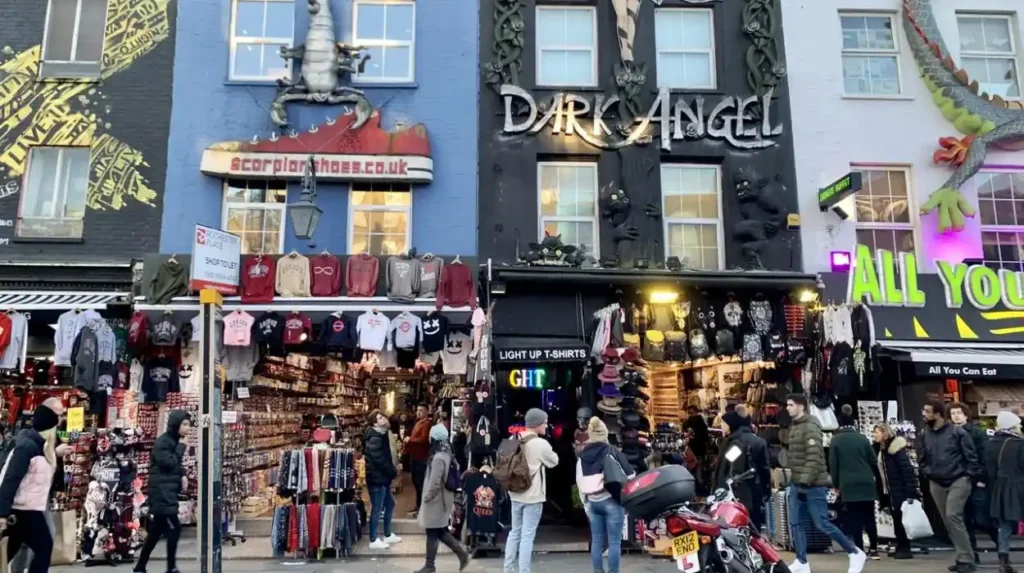
How did alternative fashion transform Camden’s markets?
Alternative fashion transformed Camden’s markets by making clothing a visible form of subcultural identity, as independent designers and traders sold vintage, customised and experimental styles to communities connected with punk, rock, Gothic and other youth movements.
Fashion became one of Camden’s strongest cultural identifiers.
Traditional high-street retail generally followed mass-market production and established seasonal trends. Market traders operated differently.
Small businesses could respond quickly to changing cultural interests.
Vintage clothing became particularly important. Older garments could be reused, altered and combined with contemporary items. Customisation allowed customers to create distinctive appearances.
Camden Market’s own historical account connects the growth of alternative fashion with the district’s expanding music culture, describing how young designers experimented with new styles and sold them through market stalls to communities including mods, rockers, punks and bohemians.
Why did fashion matter to subcultural communities?
Fashion communicated affiliation.
A person’s clothing could indicate musical interests, social networks or participation in a specific youth culture.
This made independent retail culturally significant.
Camden was not simply selling garments. Its traders supplied objects used in the construction of public identity.
The market also created visibility.
Different communities encountered each other in shared public spaces. This encouraged the overlap of styles and ideas.
Over time, Camden’s reputation became internationally recognisable. Alternative fashion itself became part of the district’s tourist identity.
This created a historical contradiction that remains important: practices that began outside mainstream retail eventually became commercially valuable symbols of London’s cultural identity.
How did Camden’s markets connect immigration, diversity and global food culture?
Camden’s markets connected London’s diverse communities through small-scale trading and international food, continuing the historic market function of serving local populations while adapting to migration, tourism and changing consumer demand in one of Britain’s most internationally connected cities.
Markets have always reflected population change.
Earlier Camden markets sold practical goods to local working communities. Modern market spaces serve local residents, workers and international visitors while offering products associated with London’s increasingly diverse population.
Food provides the clearest example.
International migration changed London’s restaurants, shops and markets throughout the twentieth and twenty-first centuries. Market trading enabled smaller food businesses to introduce regional cuisines without requiring large restaurant premises.
This created opportunities for culinary entrepreneurship.
Camden Council describes the borough’s markets as important to its culture, history and economy and states that the market sector provides employment for more than 4,000 people.
Why does market diversity have historical significance?
Diversity records demographic and economic change.
The products available in a market reveal connections between local populations and wider international networks.
Camden’s modern food and retail economy therefore represents a continuation of London’s historic role as a commercial city shaped by migration and exchange.
The goods have changed, but the market mechanism remains recognisable.
Small traders identify demand, obtain products and meet customers in shared public space.
What happened to Camden’s historic market buildings during redevelopment?
Camden’s historic market buildings experienced repeated redevelopment, restoration and reuse, preserving major elements of the canal-side and industrial environment while adapting commercial spaces to modern safety, tourism and retail requirements after fires and large-scale regeneration projects.
Historic commercial districts require constant adaptation.
Camden’s popularity increased pressure on buildings originally designed for industrial and transport purposes. Market spaces required improved access, utilities and safety systems.
Fire also became an important factor in the district’s recent history.
The Camden People’s Museum records that the 2008 fire at Camden Lock Market destroyed significant sections of the site, including six shops, 90 market stalls and part of The Hawley Arms. The event became a major moment in subsequent redevelopment.
What does preservation mean in a working market district?
Preservation does not require freezing a district in one historical period.
Camden’s significance depends partly on continued use.
Former warehouses became markets. Railway structures became performance spaces. Commercial yards became retail destinations.
Adaptive reuse preserves historical evidence while allowing buildings to remain economically active.
The surviving industrial character therefore remains central to Camden’s identity.
Modern Camden Market describes its principal areas as Camden Lock, Stables and Hawley Wharf, demonstrating how historic spaces and newer redevelopment now operate within one larger destination.
How did Camden’s markets influence London’s wider cultural identity?
Camden’s markets influenced London’s wider cultural identity by demonstrating how independent retail, live music, alternative fashion and historic industrial architecture could operate together, creating an internationally recognised district that connected local entrepreneurship with global tourism and cultural exchange.
Camden became a symbol of a particular form of London.
This identity differed from Westminster’s political institutions and the City of London’s financial role.
Camden represented independent culture.
Its importance came from the interaction of commerce and creativity.
Markets provided trading spaces. Music venues supplied audiences. Fashion businesses produced visible identities. Historic buildings created a distinctive environment.
These elements reinforced one another.
The result became internationally recognisable.
The London Museum describes Camden as historic, artistic and diverse, noting its long association with music, particularly rock and punk, and identifying Camden Market as a major feature of the borough’s identity.
How did tourism change Camden?
Tourism expanded the audience for Camden’s cultural identity.
Visitors increasingly arrived to experience a place already associated with alternative music, fashion and independent shopping.
This created economic opportunities for traders.
It also changed the scale of the district.
A market originally based on a small number of craft stalls became part of a major international visitor economy.
Camden Market now describes more than 1,000 places to shop, eat, drink and participate in experiences across its historic location.
The transformation illustrates how local cultural practices can become global heritage assets without losing their historical relationship to place.
Why is Camden’s market history still important today?
Camden’s market history remains important because it documents London’s transition from industrial production to cultural enterprise, preserves evidence of independent trading and youth movements, and demonstrates how historic buildings can support modern economic activity without losing their connection to urban history.
Camden’s historical importance extends beyond tourism.
The district provides evidence of major changes in London’s economy.
The nineteenth century established Camden through transport and industry.
The twentieth century saw industrial decline and cultural transformation.
The late twentieth century created new forms of independent retail, music and alternative fashion.
The twenty-first century continues the process through redevelopment, international tourism and digital promotion.
These stages remain physically visible.
The Regent’s Canal survives. Historic industrial structures remain part of the commercial landscape. Street markets continue operating across the borough. Music venues maintain Camden’s association with performance culture.
Camden Council identifies the conversion of Camden Lock’s wharves and warehouses into craft markets during the 1970s as a development that secured Camden Town’s future as one of London’s major tourist attractions.
What can historians learn from Camden’s continuing transformation?
Camden demonstrates that urban history is cumulative.
New cultural movements do not erase earlier infrastructure completely.
The canal shaped industrial development.
Industrial development created buildings.
Those buildings later supported markets.
Markets attracted creative communities.
Creative communities established an international cultural reputation.
This sequence explains why Camden’s physical heritage and cultural heritage cannot be separated.
The buildings alone do not explain the district. The social activities that transformed those buildings are equally important.
For educators, researchers and heritage preservationists, Camden provides a concentrated case study of adaptive reuse, urban regeneration, youth culture and independent enterprise.
For genealogical researchers, the wider borough’s industrial and transport history also provides essential context for understanding the occupations and movements of families who lived and worked in the area.
How can visitors understand Camden’s history in the present day?
Visitors can understand Camden’s history by recognising the surviving relationship between the Regent’s Canal, former industrial buildings, historic street trading, music venues and alternative retail, which together preserve the physical and cultural layers created over more than two centuries.
Camden is best understood as a historical landscape rather than a single attraction.
The Regent’s Canal explains the district’s commercial geography.
Former industrial structures explain the architecture of the market environment.
Street markets demonstrate older traditions of small-scale urban trading.
Music venues explain Camden’s role in London’s alternative culture.
Independent shops and traders continue the economic traditions established through market enterprise.
To experience this historic district in person today, consult our comprehensive [Best Luxury Experiences in Mayfair for Fine Dining, Shopping, and Elegant Stays] for itineraries and visiting parameters.
The modern market environment remains connected to its historical foundations.
Camden Market identifies its principal historic and contemporary areas as Lock, Stables and Hawley Wharf. These spaces demonstrate how London continuously reuses valuable urban land while preserving elements of earlier economic activity.
The history of Camden’s markets explains one of the most important transformations in modern London.
Camden Town began as a planned late eighteenth-century settlement. The opening of the Regent’s Canal in 1820 connected the district to London’s industrial transport network. Warehouses, wharves and commercial infrastructure followed. Railways expanded employment and intensified urban development.
Street markets served the growing population throughout the nineteenth century.
The 1970s created the decisive transition. Former industrial spaces became available for new uses. Camden Lock Market began in 1974 with 16 arts and crafts stalls. Independent traders expanded the commercial model. Music venues strengthened the district’s cultural identity. Alternative fashion connected retail directly with youth movements.
Camden became a centre where commerce and culture operated together.
Punk, rock, Gothic fashion and other alternative communities found visible expression through venues, markets and independent businesses. The district’s physical environment reinforced this identity. Canals, warehouses, railway structures and historic yards created spaces that differed from conventional shopping districts.
Modern redevelopment has changed Camden again, but its central historical pattern remains clear.
Infrastructure created industry. Industry created buildings. Buildings supported markets. Markets supported independent culture. Alternative culture created a global identity.
That sequence explains why Camden remains historically significant.
Its markets are not simply places to buy goods. They are surviving evidence of London’s changing economy, architecture, migration, entrepreneurship and cultural life. From Victorian street trading to the 1974 opening of Camden Lock Market and the continuing reuse of historic industrial spaces, Camden records more than two centuries of urban transformation in one of Britain’s most recognisable cultural districts.
Frequently Asked Question
When did Camden Market first open?
Camden Lock Market began in 1974 as a small Sunday market with approximately 16 arts and crafts stalls. It later expanded into one of London’s best-known market and cultural destinations.