Camden is one of London’s strongest concentrations of market culture, live music, independent retail and international street food. Its present identity developed from a sequence of industrial, transport, commercial and cultural changes that transformed Camden Town from a small settlement into a major cultural district.
- Why is Camden historically important to London’s cultural identity?
- How did Camden’s markets develop from industrial trading into cultural destinations?
- What makes Camden Market historically significant for independent culture?
- How did Camden become one of London’s most important live music districts?
- How does Camden’s street food reflect its cultural and commercial history?
- Which Camden places best connect markets, music and industrial heritage?
- How did Camden’s cultural identity change from the 1970s to the present?
- How can Camden’s markets and music heritage be preserved for the future?
- Frequently Asked Question
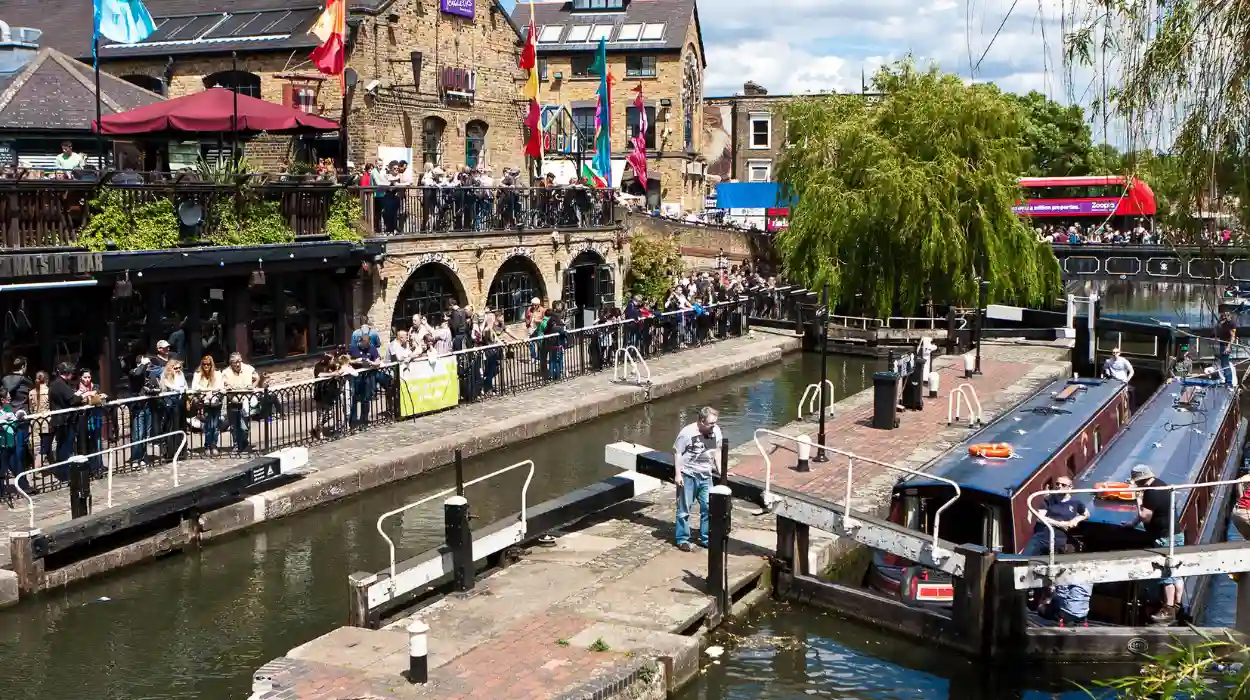
The area’s history begins with the development of Camden Town in 1791 under Charles Pratt, first Earl Camden. The Regent’s Canal then provided the decisive economic infrastructure. The canal reached Camden in the early nineteenth century and connected the district with London’s wider waterborne trading network. Camden Town expanded rapidly as employment, housing and transport infrastructure followed.
The industrial landscape included warehouses, distilleries, workshops and transport facilities. The canal supported commercial activity around Camden Lock, while railway development added further employment and industrial capacity. Euston opened in 1837, King’s Cross in 1852 and St Pancras in 1868. These railway termini strengthened Camden’s position within London’s expanding transport system.
The cultural transformation occurred much later. Industrial decline after the Second World War left warehouses and commercial premises underused. During the 1960s and 1970s, former industrial buildings became important spaces for music and alternative culture. The Roundhouse and Dingwalls became significant venues, while the Camden Market that opened in 1974 established a new form of cultural commerce beside the Regent’s Canal.
Today, Camden combines historic industrial structures with market trading, live music, independent businesses and international food. Camden Council identifies at least 19 regular markets across the borough, including eight public street markets managed by the council. These markets employ more than 4,000 people and form an important part of Camden’s economy and cultural identity.
Why is Camden historically important to London’s cultural identity?
Camden became culturally important because industrial transport, market trading, music venues and alternative creative communities developed in the same district. The Regent’s Canal created the commercial foundation, while twentieth-century music and market culture transformed former industrial spaces into major cultural destinations.
Camden’s significance rests on the interaction between infrastructure and cultural production. The district did not begin as a purpose-built entertainment quarter. Its cultural identity emerged from earlier economic functions.
Charles Pratt began developing Camden Town in 1791. The settlement initially consisted of relatively few buildings beside a major road. The opening of the Regent’s Canal transformed its economic prospects. Camden Town became the canal’s important northern terminus and developed as an industrial centre.
The canal supported movement of goods and created demand for warehouses, workshops and associated businesses. Distilling became particularly important. Camden Market’s historical account records gin as a major nineteenth-century industry, with gin transported through the Regent’s Canal.
Railway construction reinforced this industrial development. Euston, King’s Cross and St Pancras brought passenger and freight connections, workers and industrial investment. Camden subsequently became associated with industries including piano and organ manufacturing, furniture production, light engineering and scientific instruments.
After the Second World War, road transport increasingly displaced canal-based freight. Industrial premises lost their original functions. This decline created vacant buildings and spaces that later supported cultural uses.
The transition was especially important during the 1960s and 1970s. Former industrial buildings became music venues and cultural spaces. The Roundhouse developed into an important arts and music venue, while Dingwalls hosted performances associated with emerging alternative music. Camden Council describes the 1960s and 1970s as a period when the area re-emerged as a cultural centre associated with live music and creative culture.
Camden’s cultural importance therefore has a clear historical mechanism. Transport generated industry. Industrial decline created adaptable spaces. Cultural organisations occupied those spaces. Markets, music and independent commerce then reinforced one another.
How did Camden’s markets develop from industrial trading into cultural destinations?
Camden’s market culture developed through several stages, including nineteenth-century industrial trading, traditional street markets, the 1974 Camden Lock market and later expansion into fashion, crafts, independent retail and international street food. Each stage reflects changes in transport, commerce and consumer culture.
Traditional street trading existed in Camden before the modern Camden Market. Camden Council records the history of Inverness Street Market as part of the older Camden Town Market, which operated on Camden High Street during the nineteenth century. Transport changes later pushed market activity away from the main road.
The original Camden Town Market sold everyday goods rather than functioning primarily as a tourist attraction. Fruit and vegetables formed an important part of its traditional trade. Inverness Street later retained part of this market function, although its commercial focus changed as Camden’s visitor and nightlife economies expanded.
The modern Camden Market story began in 1974. The first market at Camden Lock opened on 30 March 1974 with 16 traders selling antiques, jewellery, arts and crafts. It was initially a small market connected to the vacant yard of Dingwalls Timber Merchants beside the canal.
The location was significant. The market occupied a former industrial environment rather than a purpose-built shopping centre. The surrounding canal, warehouses and historic infrastructure provided a distinctive physical setting.
Planning restrictions also shaped the original market. The market was designed to avoid direct competition with established shops on Camden High Street. Its early focus therefore centred on non-essential goods and craft products that could be produced independently and sold from temporary stalls.
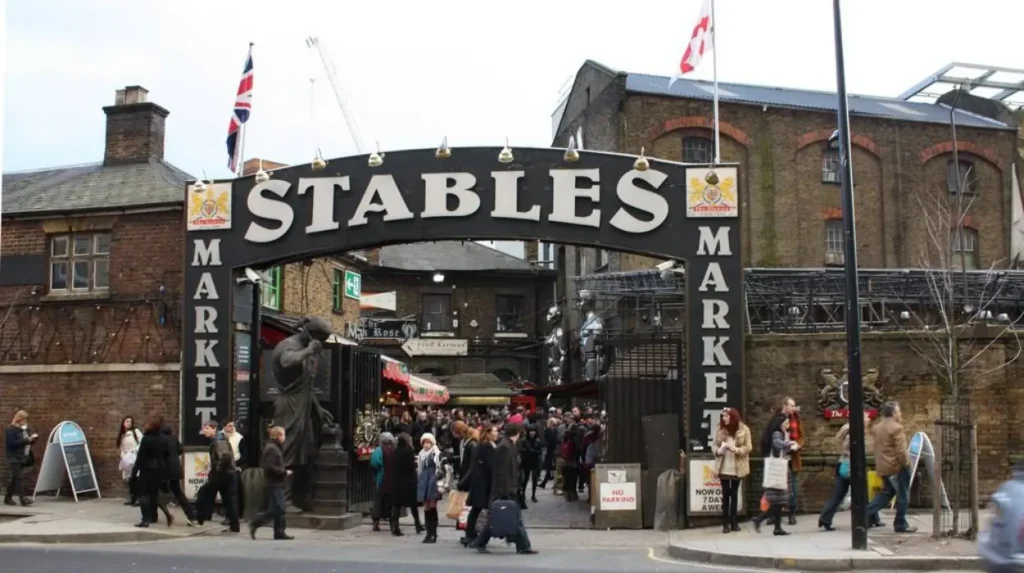
The model expanded rapidly. Camden Market evolved from 16 traders into a major commercial and cultural complex. Its current operation includes Camden Lock, Stables, North Yard and Hawley Wharf. The market describes itself as a community of creative sellers, street-food traders and independent stores with more than 1,000 places to shop, eat, drink and dance.
This development demonstrates how markets can change function without losing their connection to place. Camden’s modern market culture retains the physical traces of its industrial past while supporting contemporary retail, food and cultural activity.
What makes Camden Market historically significant for independent culture?
Camden Market became historically significant because its early craft-trading model created commercial space for independent sellers, while its location beside former industrial buildings connected new creative businesses with Camden’s emerging music and alternative cultural communities.
The 1974 market was fundamentally different from a conventional department store. Its early traders sold antiques, jewellery and handmade arts and crafts. This structure gave individual sellers direct access to customers without requiring traditional permanent retail premises.
The connection between markets and alternative culture strengthened during the following decades. Camden’s music venues attracted audiences interested in new forms of music, fashion and youth culture. Market stalls provided retail space for clothing and accessories associated with emerging subcultures.
Camden Market’s own historical account links the growth of alternative fashion with the area’s music scene. Mods, rockers, punks and bohemians became associated with the market environment, while young designers used stalls to develop and sell new styles.
This relationship between cultural production and commercial activity remains important. A market is not simply a place where finished products are sold. In Camden’s case, it became part of the infrastructure through which independent designers, traders and creative businesses reached audiences.
The physical character of the market also contributes to its heritage. Former warehouses, canal infrastructure, cobbled areas and industrial buildings remain important components of Camden’s visual identity. The current market incorporates historic locations while adapting them to contemporary commercial requirements.
Camden Council’s planning evidence identifies the market, live music venues and creative industries as important components of Camden Town’s character. The area’s cultural environment developed through the interaction of market activity, music and alternative culture.
The preservation issue is therefore broader than protecting individual buildings. Cultural heritage also includes trading practices, independent businesses, music venues and the relationship between public space and creative activity.
Camden Council maintains a Local List for historic buildings, spaces and features that contribute to local identity even when they do not have another form of statutory designation. The adopted Local List dates from 21 January 2015.
How did Camden become one of London’s most important live music districts?
Camden became a major live music district during the 1960s and 1970s when venues such as the Roundhouse and Dingwalls occupied former industrial spaces. Punk, rock and later electronic music strengthened Camden’s association with alternative performance and nightlife.
The Roundhouse provides one of Camden’s clearest examples of industrial heritage becoming cultural infrastructure. The building originated as a Victorian steam-engine repair shed. Its circular industrial architecture later became the setting for major performances and artistic activity.
During the 1960s and 1970s, the Roundhouse hosted performers including Jimi Hendrix, Patti Smith and Pink Floyd. The venue subsequently developed a broader programme that connected music, performance and youth culture.
The building’s cultural role continued into the twenty-first century. The Roundhouse reopened in 2006 following a £30 million refurbishment. Its programme subsequently included major international artists alongside emerging performers and creative projects.
Dingwalls provided another important connection between the canal-side market environment and music culture. Camden Market records Dingwalls and the Roundhouse as venues that helped change London’s music scene during the 1960s and later supported rock and punk culture.
The Electric Ballroom added another layer to Camden’s musical history. Camden Council’s conservation documentation identifies the building as a notable music venue with a history extending across four decades. Its earlier role included an Irish music club before it became associated with performers such as Sid Vicious, Madness and The Clash during the 1970s.
Camden’s music history then continued through later cultural movements. Camden Council’s recent Camden Town Vision identifies the 1980s expansion of electronic music and DJ culture, the area’s importance to Britpop during the 1990s and its mainstream cultural expansion during the 2000s.
This chronology establishes a continuous cultural sequence: experimental arts in the 1960s, punk and alternative music in the 1970s, electronic nightlife in the 1980s, Britpop in the 1990s and broader international entertainment in the 2000s and beyond.
The surviving venues therefore have value beyond individual performances. They document changes in London’s popular music, youth culture, creative industries and patterns of night-time activity.
How does Camden’s street food reflect its cultural and commercial history?
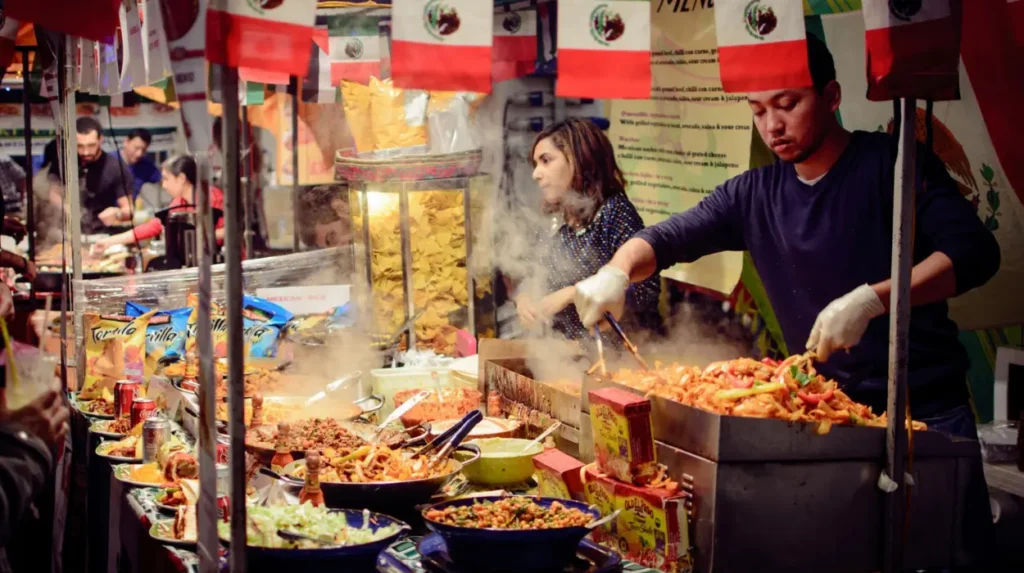
Camden’s street food reflects the district’s transformation from traditional food markets into an international visitor economy. Historic trading spaces now accommodate independent food businesses offering cuisines from different regions, linking contemporary eating culture with Camden’s long market tradition.
Food has always formed part of Camden’s market economy. Traditional street markets supplied everyday produce, including fruit and vegetables. The commercial function changed as supermarkets, tourism and nightlife altered demand.
Inverness Street provides a clear example. Camden Council records that the market remained predominantly focused on fruit and vegetables until the 2010s. As Camden High Street developed more bars and eateries and the visitor economy expanded, the market shifted towards clothing, souvenirs and street food.
Queen’s Crescent demonstrates another form of cultural continuity. Its market includes fresh produce, bread, household supplies, flowers and street food, alongside independent shops and cafés. The market therefore retains a traditional local-service function while supporting contemporary food businesses.
The significance of independent street food lies in the structure of market commerce. Small food businesses can operate from relatively compact trading spaces and serve customers without the costs associated with large restaurants. This model fits Camden’s historical pattern of small-scale independent commerce.
Camden Market has expanded this model substantially. Its current market areas include food and beverage businesses alongside fashion, gifts, crafts, entertainment and independent retail. Camden Council’s economic study records more than 1,000 market units across Camden Market’s Stables, Hawley Wharf and Camden Lock areas.
The food offer also demonstrates Camden’s international character. Contemporary market trading brings together food traditions from different countries within a single urban environment. This reflects wider changes in London’s population, migration patterns and consumer culture.
Street food therefore forms part of Camden’s cultural history rather than existing separately from it. The trading method is rooted in London’s historic market economy, while the range of food reflects the international character of modern London.
Which Camden places best connect markets, music and industrial heritage?
The strongest cultural connections occur around Camden Lock, Stables Market, the Regent’s Canal, the Roundhouse, Dingwalls and the Electric Ballroom. Together, these places preserve the physical and cultural relationship between industrial buildings, markets, independent commerce, music and contemporary food.
Camden Lock is central to understanding the relationship between canal infrastructure and market culture. The Regent’s Canal created the industrial environment that preceded the modern market, while the 1974 market reused a former industrial yard beside the water.
The Stables Market extends the historic connection between commerce and adaptive reuse. Its present market environment occupies an area associated with Camden’s former industrial functions and has become a major centre for independent retail, food and cultural activity.
Hawley Wharf represents a newer phase of regeneration. It provides canal-side retail, food and leisure space while forming part of the wider Camden Market complex. The site demonstrates how historic industrial districts can be adapted to contemporary commercial use.
The Roundhouse provides the clearest music connection. Its Victorian industrial structure became a cultural venue during the 1960s and remains a major performance space.
Dingwalls connects music history directly with the market environment. Its proximity to Camden Lock made it part of the cultural transformation that developed around the canal during the 1970s.
The Electric Ballroom provides another important surviving music landmark on Camden High Street. Its history demonstrates the movement from local club culture into the wider alternative music scene.
These places should be understood as components of one cultural landscape rather than isolated attractions. The canal explains the industrial history. The market explains the commercial transition. The music venues explain the cultural transformation. Street food and independent businesses represent the contemporary commercial layer.
To experience this historic cultural landscape in person today, consult our comprehensive [How Greenwich Shaped Britain’s Maritime Legacy and Global Timekeeping Standards Forever] for itineraries and visiting parameters.
How did Camden’s cultural identity change from the 1970s to the present?
Camden’s cultural identity changed from a small alternative market and music district into an international visitor destination. The transition involved market expansion, tourism, nightlife, commercial investment and redevelopment, while historic venues and industrial structures continued to anchor local identity.
The 1970s established the foundations of modern Camden. The first Camden Lock market opened with 16 traders in 1974. Around the same period, music venues developed strong links with punk, rock and alternative culture.
The 1980s brought further changes. Camden Town’s nightlife expanded with electronic music and DJ culture. Market spaces remained associated with alternative fashion and cultural communities.
The 1990s added another major cultural phase through Britpop. Camden became associated with a wider British music movement and attracted increasingly large audiences.
The 2000s accelerated mainstream recognition. Camden developed into an international visitor destination with a large concentration of retail, food, nightlife and entertainment. The market became significantly larger than its original craft-trading model.
This commercial growth produced cultural benefits and preservation pressures. Greater visitor numbers supported traders, venues and businesses, but increased commercialisation also altered the balance between independent culture and tourism.
Camden Council’s recent evidence base identifies a decline in creative and cultural production over the previous two decades while recognising the continuing importance of music venues, counterculture and markets. It also records the historical importance of the 1960s, 1970s, 1980s, 1990s and 2000s in shaping the district’s cultural identity.
The challenge for heritage management is therefore not to freeze Camden in one historical period. Camden has always changed. The relevant preservation objective is to retain evidence of the different economic and cultural phases that produced its present identity.
This includes industrial buildings, canal infrastructure, market spaces, music venues, independent businesses and public areas associated with cultural activity.
How can Camden’s markets and music heritage be preserved for the future?
Preserving Camden’s cultural heritage requires protection of historic buildings, recognition of market traditions, support for independent cultural activity and careful management of redevelopment. The objective is to retain physical heritage while allowing contemporary commerce, food and music to continue.
Camden’s heritage strategy already recognises the importance of non-designated historic assets. The council’s Local List identifies buildings, spaces and features valued for their contribution to local character and community identity.
The Local List is important because cultural heritage extends beyond nationally designated monuments. Ordinary commercial buildings, market environments and historic streets can document how communities lived and worked.
Camden’s industrial heritage also requires contextual preservation. The Regent’s Canal, former warehouses, market structures and surviving industrial buildings explain why Camden developed as a commercial centre in the first place.
Music heritage requires a similar approach. The Roundhouse demonstrates successful adaptive reuse: a Victorian industrial building became a major cultural venue while retaining its historic architectural identity.
The continued operation of music venues is also important because cultural heritage is not limited to buildings. The significance of the Roundhouse, Dingwalls and Electric Ballroom includes their roles in the development of London’s live music culture.
Markets present another preservation issue. Camden Council recognises that markets form an important part of the borough’s culture, history and economy. Its current market network includes traditional street markets and privately managed destinations, demonstrating that market culture operates at several scales.
The future historical value of Camden will depend on whether these layers remain legible. A visitor should still be able to understand the relationship between canal transport, industrialisation, market trading, music culture and contemporary independent commerce.
Camden’s history demonstrates that cultural districts are created through accumulated economic and social change. The 1791 development of Camden Town, the early nineteenth-century canal economy, nineteenth-century market trading, twentieth-century industrial decline, the 1974 market opening and the rise of music culture each contributed a distinct layer.
For history enthusiasts, Camden provides a concentrated study of urban transformation. For cultural tourists, it offers direct access to markets, food and music within a historic environment. For educators and students, it provides evidence of how infrastructure, commerce, migration, popular culture and adaptive reuse influence the development of a London district.
The most important historical fact is that Camden’s cultural identity was constructed rather than created at one moment. Its markets emerged from earlier trading traditions. Its music venues occupied industrial buildings. Its street food developed from the evolution of market commerce. Its present international reputation rests on these earlier layers.
Camden therefore remains significant as a living cultural landscape. Its value lies not only in what survives from the past, but also in the continuing relationship between historic places and contemporary independent activity.
Sources and historical basis
This article draws on records and research published by Camden Council, Camden Market, the Canal & River Trust and the Roundhouse. Camden Council provides historical information on Camden Town, the Regent’s Canal, railway development and market history. Camden Market provides documentation of the 1974 market opening and subsequent commercial development. The Roundhouse provides institutional records of its industrial origins and cultural history.
Camden Council’s Local Studies and Archives Centre also preserves photographs, illustrations and documents relating to the borough’s history. Its collections include historical images of the Roundhouse and other local places, providing primary-source material for research into Camden’s built and cultural environment.
For readers researching Camden’s historical development, these institutional collections provide a strong starting point because they connect architectural evidence, municipal records, market history and cultural documentation.
Frequently Asked Question
What is the history of Camden Town?
Camden Town began developing in 1791 under Charles Pratt, the first Earl Camden. The Regent’s Canal, opened in the early nineteenth century, encouraged industrial growth, while railway construction later strengthened Camden’s commercial importance.