


The United Kingdom experiences highly variable seasonal weather, but extreme thermal events are increasing in frequency, duration, and magnitude. When public discussions focus on rising summer temperatures, the Met Office (the UK’s national meteorological service) relies on strict, data-driven frameworks rather than casual observations to officially declare a heatwave. This comprehensive guide by The Londoner News explores the exact science, geographical thresholds, historical contexts, and infrastructural impacts of prolonged extreme heat across the British Isles.
- What Is the Official Met Office Definition of a UK Heatwave?
- How Does a Heatwave Form Over the United Kingdom?
- How Does Climate Change Affect UK Heatwave Frequency?
- What Is the Urban Heat Island Effect During a London Heatwave?
- How Do Met Office Severe Weather Warnings Differ From Heat Health Alerts?
- What Impact Do Heatwaves Have on UK Transport and Infrastructure?
- What Actions Should Individuals Take to Remain Safe During a Forecast Heatwave?
- How Will the UK Adapt to Future Extreme Heat Events?
What Is the Official Met Office Definition of a UK Heatwave?
A official UK heatwave occurs when a specific monitoring station records at least three consecutive days with daily maximum temperatures meeting or exceeding the heatwave temperature threshold designated for that local county.
The Met Office establishes this framework to differentiate standard summer warmth from anomalies that threaten infrastructure and public safety. These limits are calculated using the 1991–2020 climate averaging period, which reflects regional baseline deviations across the British Isles. The specific threshold values are fundamentally tied to geographic location because ambient baseline temperatures vary significantly between northern and southern regions.
The administrative thresholds are divided into four distinct temperature tiers ranging from 25°C to 28°C:
- 25°C Threshold: Applies to Scotland, Wales, Northern Ireland, and northern English counties such as Cumbria, Northumberland, and Yorkshire.
- 26°C Threshold: Covers the Midlands, portions of Southwest England, and parts of Eastern England, including Lincolnshire.
- 27°C Threshold: Encompasses southern home counties such as Hampshire, West Sussex, and portions of East Anglia.
- 28°C Threshold: Applies exclusively to London, Greater London, and surrounding urbanized zones like Berkshire and parts of Essex.
How Does a Heatwave Form Over the United Kingdom?
A heatwave forms over the United Kingdom when slow-moving, high-pressure atmospheric systems park over the British Isles, causing the jet stream to shift northward and forcing skies to clear while incoming solar radiation continuously heats the land surface.
The underlying mechanism of a heatwave relies on dynamic atmospheric circulation patterns. Under typical conditions, the jet stream (a fast-flowing ribbon of air high in the atmosphere) guides low-pressure weather systems across the Atlantic Ocean directly toward northern Europe, bringing cloud cover and rain. During summer, if a large ridge of high pressure develops over the continent or the UK, it acts as a atmospheric blocking mechanism. This block deflects the jet stream far to the north, usually near Iceland or northern Scandinavia, preventing unstable weather systems from entering the region.
Within these high-pressure zones, air sinks toward the surface in a process known as subsidence. Sinking air compresses and warms adiabatically (heating due to pressure increase without losing heat to the surroundings), which suppresses cloud formation. This leads to clear skies and uninterrupted solar exposure for up to 16 hours a day during mid-summer.
Furthermore, the clockwise rotation around these high-pressure cells can draw warm air masses from continental Europe or North Africa. A prime example is a Spanish Plume, an atmospheric pattern where hot, dry air originates over the Iberian Peninsula and travels north across the English Channel. When this dry air overrides the cooler, humid surface layers of the UK, it causes extreme daytime spikes in temperature and frequently triggers violent nighttime thunderstorms.
How Does Climate Change Affect UK Heatwave Frequency?
Human-induced climate change elevates the frequency, severity, and longevity of UK heatwaves by raising baseline global temperatures by 1.3°C above pre-industrial levels, transforming historically rare atmospheric anomalies into routine meteorological events.
According to empirical research published by the Met Office, greenhouse gas emissions have permanently altered the baseline probability of extreme thermal events in northwestern Europe. A definitive attribution study concerning the historic summer heatwave of 2018 concluded that such intense, prolonged hot spells are now 30 times more likely to occur than they were prior to the industrial revolution (the period between 1850 and 1900).
The impacts of this shifting baseline are evident in recent annual data compiled by climate scientists:
- 2022: The UK breached 40°C for the first time in recorded history, peaking at 40.3°C on July 19 at Coningsby, Lincolnshire.
- 2023: Confirmed as the second-warmest year on record for the UK, characterized by an unprecedented, late-season heatwave in September.
- 2025: Reached an absolute annual average temperature of 10.09°C, making it the warmest year ever recorded in British meteorological history.
Met Office attribution models show that an annual mean temperature exceeding 10.09°C would occur only once every 780 years under a pre-industrial atmosphere. In the current climate, however, this threshold is crossed approximately every three years. Predictive climate modeling under high-emissions scenarios (such as Representative Concentration Pathway 8.5) indicates that by the 2050s, summers of the magnitude seen in 2018 or 2022 could occur every other year. By 2070, the probability of southern UK regions experiencing consecutive days above 30°C will increase sixteenfold.
What Is the Urban Heat Island Effect During a London Heatwave?
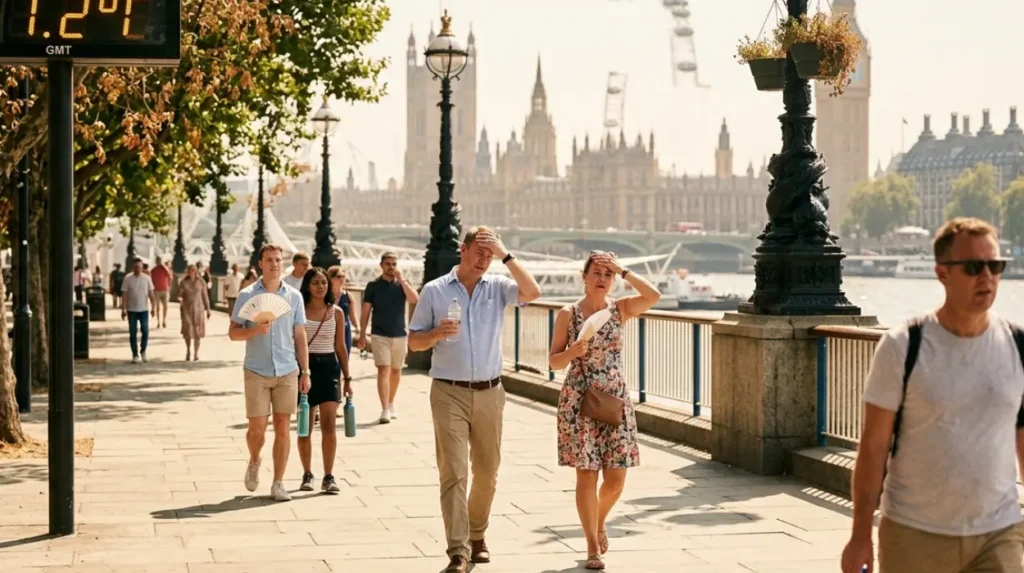
The Urban Heat Island effect raises nighttime temperatures in built-up areas like London by up to 10°C compared to surrounding rural areas because dense building materials absorb solar radiation during the day and slowly radiate it at night.
The Urban Heat Island (UHI) effect is a localized microclimate phenomenon driven by urbanization and modification of the land surface. In a major metropolis like London, natural vegetation and permeable soils are replaced by structural materials like concrete, brick, tarmac, and stone. These materials possess high thermal mass and low albedo (solar reflectivity), meaning they absorb and store vast amounts of shortwave solar radiation during daylight hours. Rural environments, by contrast, utilize incoming solar energy for evapotranspiration (the process where plants release water vapor), which exerts a natural cooling effect.
The stored heat in urban structures is slowly released back into the atmosphere as longwave thermal radiation after sunset. This process restricts night-time cooling, causing peak UHI intensity to occur around dawn. While daytime temperatures between the city center and the countryside may remain relatively similar, the minimum overnight temperatures diverge dramatically.
During intense summer heatwaves, the Met Office frequently records Tropical Nights within central London—meteorological events where the surface air temperature fails to drop below 20°C overnight. This lack of nocturnal cooling presents a major health hazard. Without relief from daytime heat, the human cardiovascular system cannot recover from heat stress, significantly increasing the risk of heat exhaustion and heatstroke. Met Office projections suggest that the average summer-night UHI within London will increase by an additional 0.5°C by the end of the century due to an increase in clear-sky days.
How Do Met Office Severe Weather Warnings Differ From Heat Health Alerts?
Met Office Extreme Heat Warnings communicate widespread, impact-based risks to life and infrastructure across the entire public sector, while UK Health Security Agency Heat Health Alerts focus specifically on operational pressures within health and social care services.
To protect the public and assist emergency planners, the UK utilizes two parallel alerting frameworks that serve different operational purposes. The Met Office administers the National Severe Weather Warning Service (NSWWS), which issues impact-based Extreme Heat Warnings. These warnings use a color-coded hierarchy—Yellow, Amber, and Red—to evaluate both the probability of an event and its potential impact on daily life.
A Red Extreme Heat Warning indicates a Level 4 national emergency. This signifies a severe threat to life, extending beyond vulnerable groups to include healthy individuals. It also indicates a high risk of widespread infrastructure failure across transport, power, and water networks.
In tandem with these warnings, the UK Health Security Agency (UKHSA), in partnership with the Met Office, manages the Adverse Weather and Health Plan for England. This framework issues regional Heat Health Alerts specifically calibrated for the medical and social care sectors. These alerts track how prolonged high temperatures impact human physiology and healthcare delivery, such as increased emergency department admissions and ambulance response delays.
An Amber Heat Health Alert, for instance, warns healthcare providers of a projected surge in admissions for heat-related illnesses, including severe dehydration, acute kidney injury, and respiratory distress. This system enables hospitals, care homes, and local authorities to proactively reallocate staff, distribute extra fluids, and check on vulnerable individuals, including adults over 75, people with chronic cardiovascular conditions, and those living alone.
What Impact Do Heatwaves Have on UK Transport and Infrastructure?
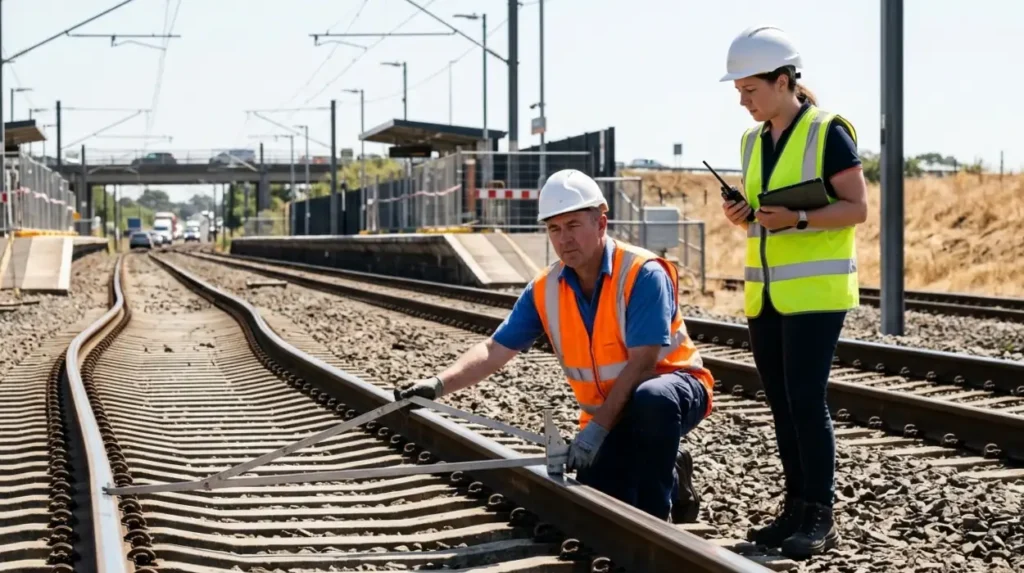
Extreme heat disrupts UK transport networks by causing steel rail tracks to buckle under thermal expansion, melting asphalt road surfaces, sagging overhead electric cables, and over-allocating power grids due to surge demands for air conditioning.
The physical infrastructure of the United Kingdom was historically designed and engineered to withstand a temperate maritime climate, with peak summer tolerances rarely exceeding 30°C. When ambient air temperatures surpass 35°C, structural materials face immense mechanical stress. On the rail network, steel tracks absorb direct solar radiation, frequently heating up to 20°C above the surrounding air temperature. This rapid absorption causes thermal expansion. When the expanding steel runs out of physical space within its layout, it warps out of alignment—a dangerous failure known as rail buckling.
To prevent derailments during heatwaves, Network Rail must implement mandatory speed restrictions, which causes widespread delays and cancellations. Other critical infrastructure vulnerabilities include:
- Overhead Line Sag: Intense heat causes overhead copper electrical wires to expand and sag. Passing trains can catch and tear these wires down, disabling entire rail lines.
- Tarmac Softening: Asphalt road surfaces absorb heat and can begin to soften or melt. Local highway authorities must deploy gritters to spread sand and crushed stone over the binding roads to maintain vehicle traction.
- Electrical Grid Strain: Power transmission lines lose operational efficiency as temperatures rise, causing wires to sag. At the same time, the surge in demand for air conditioning and mechanical cooling can overload local sub-stations, leading to localized power outages.
What Actions Should Individuals Take to Remain Safe During a Forecast Heatwave?
Individuals can mitigate severe heat risks by drinking plenty of fluids to prevent dehydration, sealing windows and drawing blinds during peak daylight hours, avoiding strenuous outdoor activities, and checking on isolated neighbors.
During periods of extreme heat, individuals must adapt their behavior to protect their health. The human body cools itself primarily through the evaporation of sweat, a process that can rapidly deplete bodily fluids and essential electrolytes. To counter this, people should drink water consistently, even if they do not feel immediately thirsty, while limiting consumption of dehydrating substances like alcohol, caffeine, and high-sugar drinks.
Since the UK housing stock is structurally optimized to retain heat for winter warmth, indoor environments can overheat quickly, especially top-floor flats. Windows should remain closed during the hottest parts of the day if the outside air temperature exceeds the indoor temperature. This keeps out ambient heat and hot air currents. Blinds and reflective curtains should be drawn to block direct solar gain.
Physical exertion should be rescheduled to cooler times of day, such as early morning or late evening after sunset. Finally, community vigilance is vital. Taking time to check on elderly relatives, isolated neighbors, or individuals with pre-existing medical conditions can prevent minor heat stress from escalating into a life-threatening medical emergency.
How Will the UK Adapt to Future Extreme Heat Events?
The United Kingdom must upgrade its national infrastructure by retrofitting buildings with passive cooling designs, planting urban forests to counteract heat islands, and updating engineering codes to handle summer temperatures above 40°C.
As climate projections indicate that extreme heatwaves will become more frequent, the UK must shift from reactive emergency management to proactive long-term climate adaptation. The Climate Change Committee (CCC)—an independent statutory body established under the Climate Change Act 2008—continually emphasizes that the nation’s built environment is not adapting fast enough to rising temperatures. Future civil engineering and architectural practices must integrate heat resilience directly into urban planning frameworks.
Architectural standards for new housing developments must move away from large glass facades without external shading. Instead, they should incorporate passive cooling features, such as external shutters, high-albedo cool roofs that reflect solar energy, and advanced mechanical ventilation systems.
In urban environments, expanding green space is essential. Planting urban forests and creating green corridors introduces natural cooling through plant transpiration, helping to break up heat accumulation in dense concrete areas. Additionally, utility and transport operators must update their engineering standards. This includes pre-stressing steel rails to higher temperature thresholds and using advanced polymer asphalt mixes on roads to ensure the UK remains resilient in a warming world.
What is officially considered a heatwave in the UK?
A heatwave is officially declared when a location records at least three consecutive days with maximum temperatures meeting or exceeding the Met Office threshold for that area. Thresholds vary by region and range from 25°C to 28°C.