
London transforms after sunset into one of the world’s most photogenic historic capitals. Centuries-old monuments, Victorian engineering, royal architecture, modern skyscrapers, and riverside landscapes become illuminated through carefully designed lighting schemes that highlight the city’s architectural heritage. Night photography in London combines history, urban design, engineering, and cultural preservation, allowing photographers to document landmarks from entirely different visual perspectives than those seen during daylight.
- Why is London considered one of the world’s greatest cities for night photography?
- Which London landmarks produce the most spectacular illuminated photographs?
- Where can photographers capture the best panoramic night views of London?
- How does the River Thames improve night photography compositions?
- Why is Tower Bridge one of London’s most iconic night photography locations?
- Why does Westminster offer classic London night photography?
- What makes St Paul’s Cathedral exceptional for evening photography?
- Which lesser-known London locations deserve attention for night photography?
- How has heritage preservation influenced London’s illuminated skyline?
- How can photographers responsibly capture London’s historic landmarks at night?
- Why will London’s illuminated historic skyline remain globally significant?
From medieval fortresses to twenty-first-century observation towers, London’s illuminated skyline tells the story of nearly 2,000 years of continuous urban development. Every major landmark reflects a distinct architectural period, while carefully planned public lighting enhances both safety and heritage appreciation.
Why is London considered one of the world’s greatest cities for night photography?
London combines nearly two millennia of architectural history with modern urban lighting, an extensive riverside setting, protected heritage landmarks, accessible public viewpoints, and year-round evening illumination. These elements create exceptional opportunities for photographing historic buildings under carefully designed lighting conditions.
London’s history began as the Roman settlement of Londinium around AD 47. Over successive centuries, Saxon expansion, Norman fortification, medieval commerce, Tudor government, Georgian planning, Victorian engineering, and contemporary architecture shaped today’s cityscape.
Unlike many global capitals, London’s principal landmarks remain concentrated along the River Thames. This geographical arrangement provides uninterrupted sightlines that become especially dramatic after sunset when reflections multiply architectural details.
Historic preservation policies also contribute significantly. Thousands of protected buildings retain original architectural features while modern lighting systems emphasize their structural forms without damaging historic fabric.
The city’s lighting strategy balances conservation with tourism. Government agencies, borough councils, heritage organisations, and property owners coordinate illumination that highlights important architectural elements rather than overwhelming them.
Night photography therefore becomes an educational record of London’s architectural evolution.
Which London landmarks produce the most spectacular illuminated photographs?
London’s most photographed illuminated landmarks include Tower Bridge, the Palace of Westminster, St Paul’s Cathedral, Tower of London, The Shard, Millennium Bridge, Westminster Abbey, and the London Eye. Each landmark represents a different historical era and architectural tradition.
Tower Bridge
Completed in 1894, Tower Bridge represents Victorian engineering at its peak. Designed by Sir Horace Jones and engineered by Sir John Wolfe Barry, the combined bascule and suspension bridge became an international symbol of London.
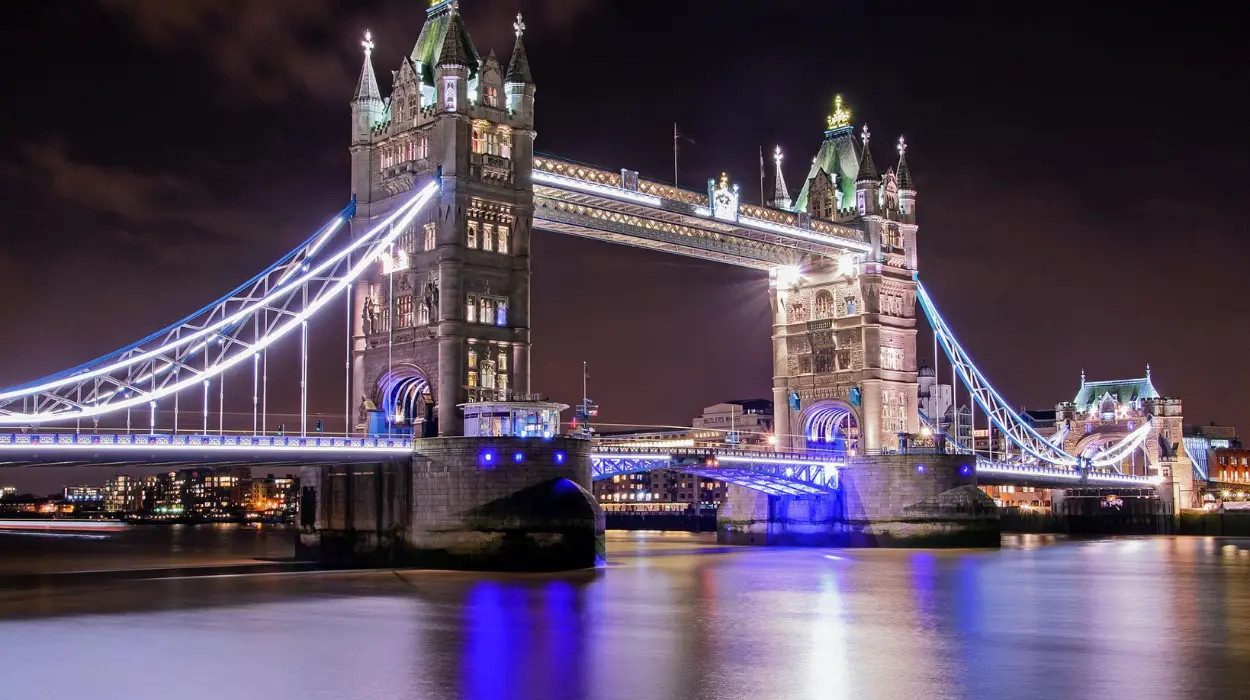
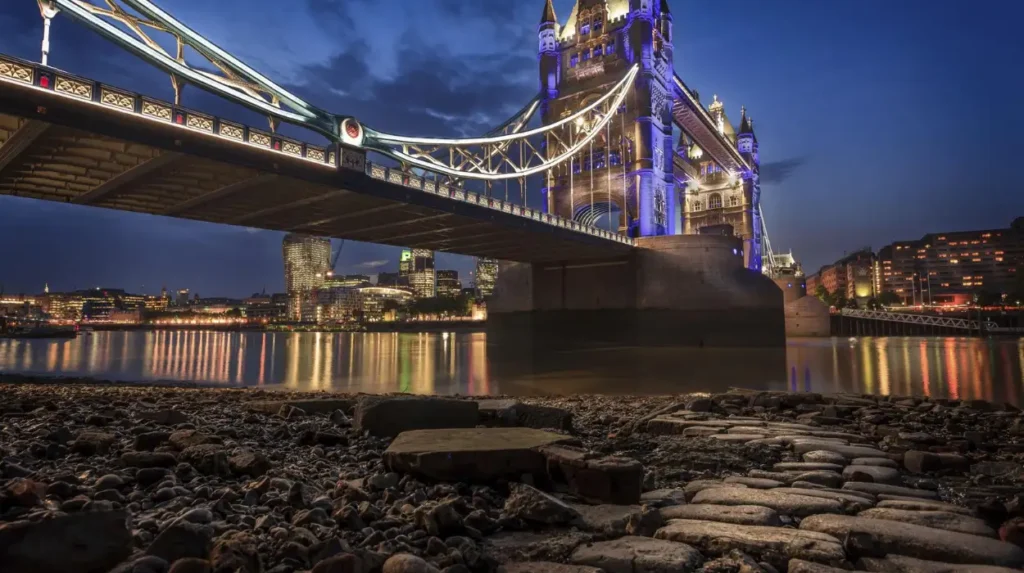
Its nighttime lighting emphasizes the Gothic Revival towers while reflecting across the River Thames. Long-exposure photography captures moving river traffic beneath the illuminated structure.
Palace of Westminster
The Palace of Westminster largely dates from reconstruction following the catastrophic fire of 1834. Architects Charles Barry and Augustus Pugin created one of Europe’s finest examples of Gothic Revival civic architecture.
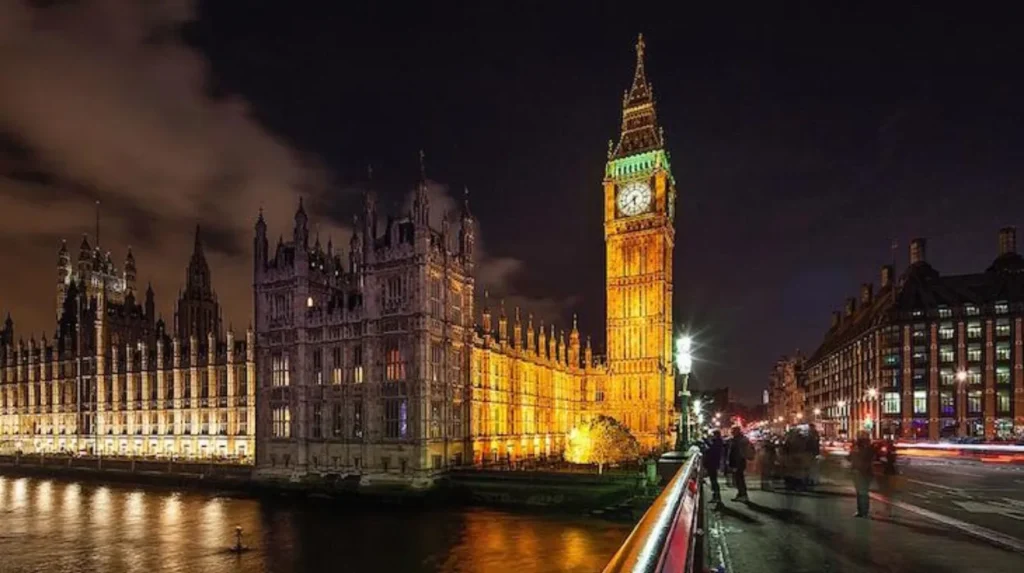
Evening illumination highlights intricate stone carvings, towers, pinnacles, and the famous Elizabeth Tower housing Big Ben.
St Paul’s Cathedral
Sir Christopher Wren completed St Paul’s Cathedral in 1710 following the Great Fire of London in 1666.
The cathedral’s white Portland stone dome appears especially striking after sunset, when carefully positioned lighting reveals its Baroque proportions against darker skies.
Tower of London
Established by William the Conqueror during the 1070s, the Tower of London remains one of Europe’s best-preserved medieval fortresses.
Night lighting accentuates Norman defensive walls, towers, battlements, and the White Tower, producing dramatic historical compositions.
The Shard
Completed in 2012, The Shard demonstrates London’s continuing architectural development. Designed by Renzo Piano, the building rises 310 metres, becoming Britain’s tallest completed structure.
After sunset, internal lighting transforms the glass façade into a prominent vertical feature within London’s skyline.
Where can photographers capture the best panoramic night views of London?
Several elevated viewpoints provide sweeping nighttime panoramas across London’s illuminated skyline. These locations combine historic perspectives, protected viewing corridors, riverside composition, and architectural diversity, making them valuable for documenting the capital’s evolving built environment after dark.
Primrose Hill has served as a viewing location since the nineteenth century. The elevated park overlooks central London, allowing photographers to capture illuminated skyscrapers alongside historic monuments.
Greenwich Park provides another historic perspective. The Royal Observatory hill overlooks Canary Wharf, maritime Greenwich, and the River Thames, creating layered compositions that combine centuries of development.
Parliament Hill on Hampstead Heath offers one of London’s legally protected strategic viewpoints. Planning regulations preserve this skyline from inappropriate development, maintaining historic visual connections.
Modern observation platforms also contribute unique perspectives. Public viewing spaces within contemporary buildings reveal relationships between medieval churches, Georgian districts, Victorian railways, and modern commercial towers.
How does the River Thames improve night photography compositions?
The River Thames creates reflections, natural leading lines, balanced compositions, and unobstructed viewing corridors. These characteristics enhance architectural photography while illustrating the river’s historic role as London’s principal commercial, political, and transportation corridor for almost two thousand years.
The Thames shaped London’s development from Roman occupation onwards. Commerce, royal authority, industry, and international trade concentrated along its banks.
At night, reflections double visual interest. Long exposures smooth water movement while preserving detailed architectural lighting.
Bridges provide elevated perspectives over illuminated landmarks. Westminster Bridge, Waterloo Bridge, Blackfriars Bridge, Southwark Bridge, London Bridge, and Tower Bridge each produce distinctive photographic angles.
The South Bank also offers uninterrupted walking routes between major landmarks, enabling photographers to compose multiple heritage structures within a single evening.
To experience these historic landmarks in person today, consult our comprehensive [London’s Streets Through History and Their Influence on Modern Urban Development Today] for itineraries and visiting parameters.
Why is Tower Bridge one of London’s most iconic night photography locations?
Tower Bridge combines Victorian engineering, Gothic Revival architecture, programmable illumination, Thames reflections, riverside viewpoints, and uninterrupted skyline perspectives. These characteristics consistently make it one of London’s most recognisable and photographed landmarks after sunset throughout every season.
Construction began in 1886 because increasing commercial river traffic required a crossing that preserved shipping access.
Its bascule mechanism remains operational today, opening for authorised vessels throughout the year.
Modern LED lighting installed during twenty-first-century refurbishment reduced energy consumption while improving colour consistency for both public appreciation and photography.
Photographers frequently position themselves near Butler’s Wharf, St Katharine Docks, Potters Fields Park, and the South Bank for varying perspectives.
The bridge’s symmetry particularly benefits long-exposure compositions.
Why does Westminster offer classic London night photography?
Westminster concentrates Britain’s constitutional, religious, and ceremonial institutions within a compact riverside district. Illuminated Gothic architecture, historic bridges, monuments, and government buildings create internationally recognised compositions that represent London’s political identity after sunset.
Westminster developed into England’s political centre during the medieval period.
Westminster Abbey hosted coronations beginning with William the Conqueror in 1066.
The Palace of Westminster evolved into Parliament following centuries of constitutional development.
Nearby landmarks include Parliament Square, Whitehall, and Horse Guards.
Evening lighting emphasizes architectural ornament while reducing daytime visual distractions such as heavy traffic and large visitor crowds.
Photographers often combine Big Ben, Westminster Bridge, passing buses, and river reflections into a single composition that immediately identifies London.
What makes St Paul’s Cathedral exceptional for evening photography?
St Paul’s Cathedral displays monumental Baroque architecture illuminated against London’s modern financial district. This visual contrast illustrates London’s continuous architectural development from post-Great Fire reconstruction through contemporary commercial expansion within the historic City of London.
Following the Great Fire, Sir Christopher Wren proposed numerous reconstruction plans before finalising the present cathedral.
Its dome remained London’s tallest structure for over 250 years.
Protected sightlines still regulate surrounding development to preserve important historic views.
Popular nighttime viewpoints include Millennium Bridge, Peter’s Hill, One New Change public terrace, and Bankside.
The cathedral frequently serves as the focal point of compositions combining historic religious architecture with modern office towers.
Which lesser-known London locations deserve attention for night photography?
Several historic districts provide outstanding night photography opportunities beyond London’s famous landmarks. Leadenhall Market, Greenwich, St Katharine Docks, Neal’s Yard, Smithfield, and the City of London preserve distinctive architectural environments illuminated with carefully designed heritage lighting.
Leadenhall Market originated during the fourteenth century and occupies part of Roman London’s commercial district.
Its ornate Victorian roof structure produces exceptional architectural photographs during evening hours.
Greenwich combines maritime heritage with illuminated riverside buildings, historic colleges, and the Royal Naval College.
St Katharine Docks preserves nineteenth-century dock infrastructure adapted into a modern marina surrounded by historic warehouses.
Smithfield Market retains substantial Victorian market architecture that appears especially atmospheric after dark.
These locations demonstrate London’s architectural diversity beyond internationally recognised monuments.
How has heritage preservation influenced London’s illuminated skyline?
Historic preservation legislation, conservation areas, listed-building protection, strategic planning policies, and sensitive lighting design preserve London’s architectural character while allowing responsible nighttime illumination that supports education, tourism, and cultural appreciation without compromising historic integrity.
Britain introduced increasingly comprehensive heritage protection throughout the twentieth century.
Listed-building legislation protects structures according to architectural and historic significance.
Conservation areas preserve entire historic neighbourhoods rather than isolated buildings.
Modern lighting projects require careful consultation between engineers, architects, conservation specialists, local authorities, and heritage organisations.
Lighting installations minimise structural intervention while improving public appreciation of important buildings.
Protected skyline views ensure historic landmarks remain visually dominant despite continuing urban development.
This careful planning allows photographers to document both preservation success and architectural evolution simultaneously.
How can photographers responsibly capture London’s historic landmarks at night?
Responsible night photography respects public spaces, follows local regulations, protects heritage sites, avoids obstructing pedestrian movement, and preserves the historic environment while documenting London’s architectural legacy through careful, ethical photographic practice for future generations.
Many of London’s most important landmarks remain active public spaces rather than museums.
Government buildings continue operating after dark.
Religious buildings conduct services.
Transport infrastructure remains busy throughout the evening.
Photographers should avoid blocking pavements, entrances, and emergency access routes when using tripods.
Flash photography generally serves little purpose for large architectural subjects and should never disturb visitors or worshippers.
Respecting temporary security restrictions around government buildings ensures public safety while maintaining access for legitimate photography.
Historic environments benefit from careful treatment by every visitor.
Why will London’s illuminated historic skyline remain globally significant?
London’s illuminated skyline represents nearly two thousand years of uninterrupted urban history, protected architectural heritage, engineering innovation, conservation policy, and cultural identity. Night photography preserves visual evidence of this evolving historic landscape for education, research, tourism, and future historical documentation.
London continues evolving through carefully managed development.
Historic landmarks remain protected alongside contemporary architecture.
Engineering innovation continues while respecting legally protected sightlines.
New public spaces improve photographic access without compromising heritage conservation.
Digital photography has expanded documentation of London’s built environment, creating valuable visual archives for historians, conservation specialists, architects, and educators.
The city’s illuminated landmarks therefore serve both artistic and documentary purposes.
Every nighttime photograph records architectural details, lighting technologies, preservation standards, and urban design decisions specific to its historical moment.
As London advances through the twenty-first century, these images become increasingly valuable records of one of the world’s most historically significant urban landscapes.
What is the best place for night photography in London?
Tower Bridge is widely regarded as London’s best night photography location because it combines Victorian Gothic architecture, River Thames reflections, and dramatic illumination. Westminster, St Paul’s Cathedral, and Greenwich also provide outstanding nighttime compositions.