The global automotive landscape is undergoing a structural transition driven by electrification mandates, stringent emissions regulations, and shifting consumer demographics. For decades, the Italian luxury sports car manufacturer Ferrari N.V. maintained its market dominance through the production of high-performance internal combustion engines. In 2026, the company is executing a multi-layered product strategy that simultaneously preserves its internal combustion heritage while establishing a foundational footprint in the zero-emission luxury vehicle sector. This analysis by The Londoner News explores the core engineering, strategic positioning, and architectural shifts defining the new Ferrari lineup.
- What is the Strategic Direction of the New Ferrari Lineup?
- How Does the Ferrari Luce Redefine the Brand?
- What Technologies Govern the Handling of the All-Electric Ferrari?
- How Does the Ferrari 12Cilindri Preserve the Combustion Legacy?
- What Aerodynamic and Digital Transformations Define the Modern Range?
- What are the Market and Environmental Implications of this Strategy?
What is the Strategic Direction of the New Ferrari Lineup?
The new Ferrari lineup represents a dual-track strategy designed to preserve the heritage of naturally aspirated internal combustion engines while simultaneously executing a complete architectural transition toward high-performance electrification, as evidenced by the launch of five distinct models throughout 2026.
The Multi-Energy Platform Strategy
The foundational framework of Ferrari’s contemporary product architecture relies on flexibility. Rather than abandoning the propulsion systems that established the brand’s equity, the engineering department in Maranello, Italy, has developed separate vehicle architectures.
The strategy divides production into three distinct powertrain categories:
- Pure internal combustion engines (ICE)
- Plug-in hybrid electric vehicles (PHEV)
- Battery electric vehicles (BEV)
This approach ensures the manufacturer can comply with Euro 7 emissions standards in Europe and Corporate Average Fuel Economy (CAFE) regulations in the United States without alienating its historical collector base.
The Financial and Production Outlook
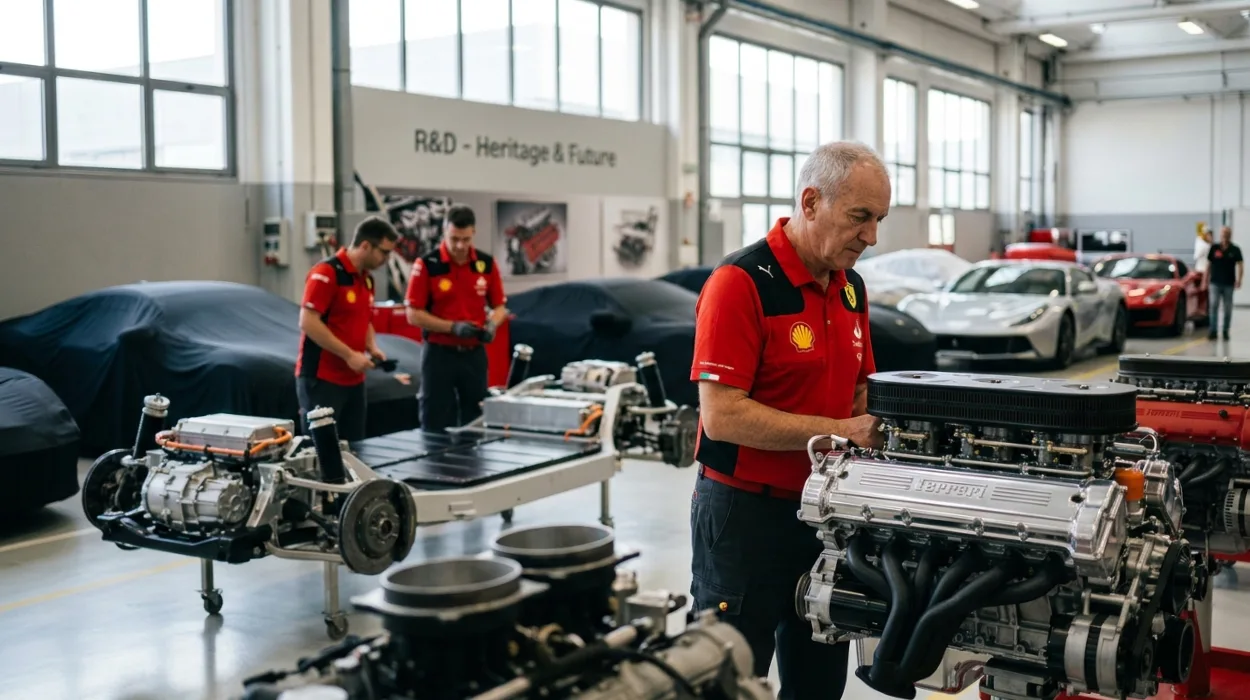
During the presentation of the 2025 financial results, executive leadership outlined an optimized industrial plan forecasting a 6 percent growth in earnings for 2026. This growth is directly linked to the rollout of five new models. Production relies on a flexible manufacturing line inside the new e-building facility in Maranello. This specialized facility allows automated guided vehicles to assemble combustion, hybrid, and fully electric powertrains on the same physical line, optimizing capital expenditure and mitigating market demand volatility.
How Does the Ferrari Luce Redefine the Brand?
The Ferrari Luce redefines the brand by serving as the manufacturer’s first-ever fully electric production vehicle, utilizing a quad-motor, four-wheel-drive architecture that delivers 1,050 horsepower while introducing the brand’s first five-seat grand tourer cabin layout.
Power Delivery and Powertrain Architecture
Unveiled in Rome, the Luce introduces an 880-volt electrical architecture built completely in-house. The propulsion system features four independent electric motors assigned to each individual wheel. The front axle integrates two engines spinning up to 30,000 revolutions per minute (RPM), producing a peak power output of 105 kilowatts (kW) per motor at 93 percent energy efficiency. The rear e-axle utilizes two high-rotational engines operating up to 25.5K RPM, with each rear motor producing a peak power output of 310 kW.
The system leverages a Halbach array rotor configuration. This magnetic geometry, derived from Formula 1 energy recovery technology, arranges permanent magnets to focus the magnetic field on one side of the array while cancelling it to near-zero on the other. This maximizes torque density and eliminates heavy electromagnetic shielding.
The absolute performance metrics of this configuration are:
- Total Output: 1,050 horsepower (cv) in boost mode
- Acceleration: 0 to 100 kilometres per hour (km/h) in 2.5 seconds
- Top Speed: 310 km/h
Battery Systems and Structural Integration
Energy storage is managed by a 122-kilowatt-hour (kWh) battery pack utilizing an evolved cell chemistry that yields an energy density of 195 watt-hours per kilogram (Wh/kg). The pack is physically integrated into the floor of the vehicle between the front and rear axles, which locates 85 percent of the mass centrally to minimize the polar moment of inertia. The remaining 15 percent of the modules reside beneath the rear passenger seats.
To prevent thermal runaway during sustained track driving, the assembly incorporates an integrated aluminum cooling plate that acts as both a thermal regulator and a structural skid plate protecting the cells from vertical impacts. The battery can absorb up to 500 kW (half a megawatt) of continuous power during regenerative braking or ultra-fast direct current (DC) charging, enabling a driving range exceeding 530 kilometres (330 miles) on the Worldwide Harmonised Light Vehicles Test Procedure (WLTP) cycle.
What Technologies Govern the Handling of the All-Electric Ferrari?
The handling of the all-electric Ferrari is governed by a quad-motor torque vectoring system, electronic four-wheel steering, and third-generation active suspension technology that dynamically balances cornering forces to counteract the vehicle’s 2,260-kilogram curb mass.
Advanced Torque Vectoring and Mechanical Dynamics
Because each wheel is driven by its own dedicated electric motor, the vehicle bypasses the mechanical latency associated with traditional central differentials or hydraulic braking systems. The onboard Side Slip Control (SSC) software calculates optimal torque distribution every millisecond. When entering a corner, the outer motors increase torque while the inner motors apply negative torque (regenerative braking). This process generates a yaw moment that rotates the vehicle into the apex.
A mechanical front disconnect system can completely disengage the front axle during highway cruising, transforming the vehicle into a rear-wheel-drive platform to reduce parasitic drag and maximize overall efficiency.
Weight Management and Suspension Architecture
The inclusion of a 122 kWh battery requires substantial mass management, resulting in a curb weight of 2,260 kilograms. To preserve sports car dynamics, the chassis is manufactured utilizing 75 percent recycled aluminum, featuring the largest single-piece hollow casting in the brand’s history within the rear sub-frame. This geometry reduces noise, vibration, and harshness (NVH) while matching structural rigidity requirements.
The third-generation active suspension system utilizes high-pitch ball screw actuators inside the dampers. The ball screw features a 20 percent higher pitch than previous iterations, allowing the dampers to react with greater velocity to vertical forces. This allows the suspension to exert active downward or upward forces on individual wheels, eliminating body roll during high-g cornering maneuvers without requiring stiff, compromised mechanical anti-roll bars.
How Does the Ferrari 12Cilindri Preserve the Combustion Legacy?
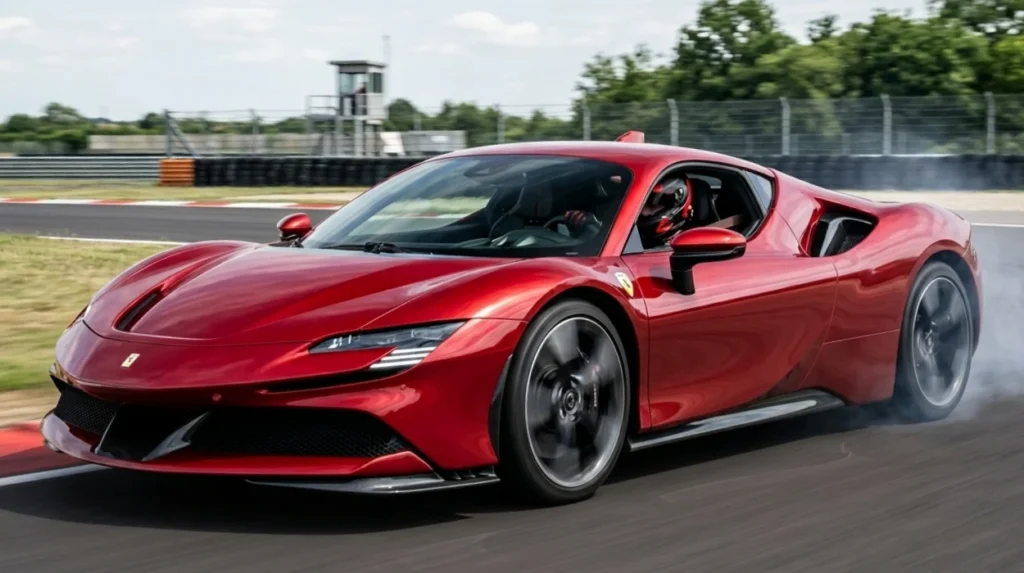
The Ferrari 12Cilindri preserves the combustion legacy by utilizing a naturally aspirated 6.5-litre V12 engine that revs to 9,500 RPM, producing 830 horsepower without any form of forced induction or hybrid electrical assistance.
The F140 HD Engine Architecture
The heart of the 12Cilindri (designated model code Tipo F167) is the 6.5-litre F140 HD internal combustion engine. This powerplant represents the furthest evolution of Maranello’s classic 65-degree V12 architecture. To achieve an operating ceiling of 9,500 RPM, engineers re-engineered the internal reciprocating mass using Formula 1-derived components, such as titanium connecting rods which reduce moving mass by 40 percent compared to steel equivalents. The pistons are forged from a lightweight aluminum alloy, and the camshafts employ a diamond-like carbon (DLC) coating to lower the coefficient of friction within the valvetrain.
The mechanical performance specifications include:
- Maximum Power: 830 metric horsepower (PS) / 819 brake horsepower (hp) at 9,250 RPM
- Peak Torque: 692 Newton-metres (500 lb-ft) at 7,250 RPM
- Specific Output: 128 horsepower per litre
Acoustic Engineering and Exhaust Dynamics
To pass modern drive-by noise regulations while retaining the characteristic high-frequency auditory signature of a V12, the exhaust system utilizes equal-length exhaust tracts and a 6-in-1 manifold for each cylinder bank. The addition of a ceramic catalytic converter is paired with precisely positioned resonators on the intake plenum. These intake resonators alter the pressure waves inside the manifold to amplify middle-frequency notes, ensuring the combustion sound fills the cabin proportionately to engine load.
Furthermore, the implementation of Aspirated Torque Shaping (ATS) software electronically sculpts the torque delivery curve in third and fourth gears. This electronic modulation linearizes acceleration perception, preventing torque drop-off at high RPM and encouraging the driver to utilize the full rev range.
What Aerodynamic and Digital Transformations Define the Modern Range?
The aerodynamic and digital transformations define the modern range through the integration of speed-activated active rear flaps, three-screen digital cockpits, and a return to physical tactical interfaces to replace capacitive touch-sensitive controls.
Active Aerodynamic Structures
Modern sports car design requires low drag for high-speed efficiency alongside high downforce for cornering stability. The 12Cilindri resolves this conflict using two distinct geometric configurations: Low Drag (LD) and High Downforce (HD). Active aerodynamic flaps integrated into the rear decklid remain completely flush with the bodywork below 60 km/h and above 300 km/h to minimize drag. Between these velocities, the flaps deploy into the HD configuration based on lateral and longitudinal acceleration data, generating substantial rear downforce.
The underbody works in tandem with the rear flaps. The front underbody houses three pairs of wind-tunnel-optimized vortex generators that accelerate airflow beneath the car, creating a low-pressure zone that pulls the front axle toward the tarmac. This low-pressure air is directed toward the braking system for cooling, while a separate pair of rear vortex generators channels exhaust air efficiently out of the rear diffuser.
The New Human-Machine Interface Philosophy
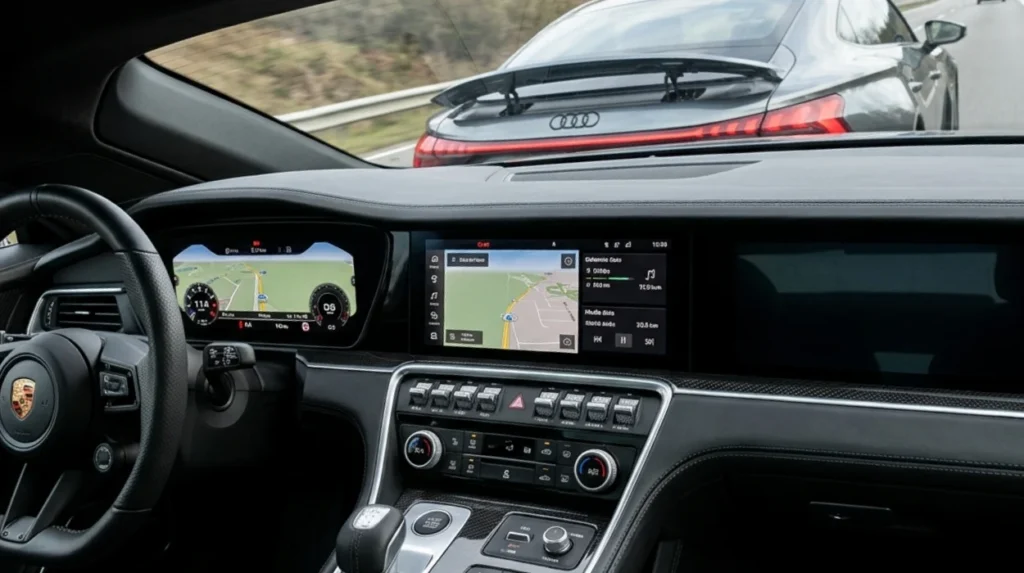
The interior design of the newest models establishes a dual-cockpit symmetry that divides digital responsibilities across three individual dashboard displays.
The primary components of this Human-Machine Interface (HMI) include:
- Driver Display: A 15.6-inch curved screen showing primary vehicle dynamics, engine status, and telemetry data.
- Central Touchscreen: A 10.25-inch capacitive display managing navigation, media, Apple CarPlay, and Android Auto.
- Passenger Display: An 8.8-inch interactive screen allowing the co-driver to view speed, RPM, and navigation parameters.
Following consumer and critical feedback regarding the touch-sensitive steering wheel buttons on previous models (such as the Roma and SF90), Ferrari has implemented a physical interface design for the 2026 model year. The Luce and 12Cilindri feature a newly designed capacitive steering wheel with indented, physical switches and rotary tactile controls for key operations, including the Manettino drive-mode selector and climate control arrays.
What are the Market and Environmental Implications of this Strategy?
The market and environmental implications of this strategy include an expanded luxury vehicle demographic, an immediate reduction in fleet-wide emissions, and the preservation of low-volume, ultra-exclusive combustion vehicles for the collector market.
Sustainability and Environmental Compliance
The implementation of 75 percent recycled aluminum in chassis construction, combined with the zero-emissions capability of the quad-motor BEV platform, alters the environmental profile of the manufacturer. While a V12 model like the 12Cilindri emits a combined 353 grams of carbon dioxide per kilometre (g/km) under WLTP testing, the addition of the Luce balances the corporate average emissions profile. This prevents costly regulatory penalties from international governing bodies like the European Commission.
Demographic Shifts and Market Competitiveness
The introduction of four-door configurations and five-seat capabilities represents an expansion of the company’s target market. Historically confined to two-seat sports cars, the brand has successfully validated more practical form factors with vehicles like the Purosangue. The new electric grand tourer appeals directly to technology-driven ultra-high-net-worth individuals who require zero-emission capability for restricted urban centers, such as London’s Ultra Low Emission Zone (ULEZ).
Concurrently, by offering an eight-year warranty on the battery and electric powertrain alongside the standard seven-year maintenance programme, the manufacturer protects secondary market residual values. This strategic diversification ensures that Ferrari stabilizes its long-term financial position while continuing to fund the limited production of highly sought-after, naturally aspirated combustion vehicles for its core enthusiast base.
For an in-depth visual review of Ferrari’s modern V12 front-engine design philosophy and its real-world sound profile on the road, watch this comprehensive 2026 Ferrari 12Cilindri Review. This detailed video showcases the practical driving dynamics, the performance of the 9,500 RPM engine, and the visual layout of the dual-cockpit interior design discussed above.
What is Ferrari’s overall strategy for 2026?
Ferrari N.V. is pursuing a dual-track strategy that combines traditional internal combustion engines with hybrid and fully electric vehicles. The goal is to preserve the brand’s performance heritage while meeting future emissions regulations and expanding into new market segments.