
The Londoner News offers this comprehensive analytical assessment of Polestar Automotive Holding UK PLC, trading under the NASDAQ ticker symbol PSNY. Polestar represents a distinct industrial shift within the premium automotive market, operating as an independent, design-focused electric vehicle manufacturer. This investigation covers the corporate origins, vehicle line-up configurations, technological ecosystems, and structural market transitions shaping the company through 2026, with a particular focus on how these shifts impact London and the broader United Kingdom automotive sector.
- What is Polestar and how did the automotive brand originate?
- What specific vehicles comprise the modern Polestar product lineup?
- How do Polestar vehicles function technologically and mechanically?
- What do the global manufacturing footprint and supply chain look like?
- What financial and sales metrics define Polestar’s current market position?
- How do geopolitical regulations and trade policies impact Polestar?
- What are Polestar’s environmental targets and future product strategies?
What is Polestar and how did the automotive brand originate?
Polestar is a Swedish premium electric vehicle manufacturer headquartered in Gothenburg, Sweden, which operates under the joint ownership of Volvo Car AB and Zhejiang Geely Holding Group. The company initially originated in 1996 as Flash Engineering, a Swedish motorsport racing team.
The historical trajectory of the entity involves a multi-stage transition from track performance to mass-market electrification. In 2005, the racing outfit underwent a rebranding phase to become Polestar Performance AB, acting as an official performance tuning partner for Volvo passenger cars. Volvo Car AB acquired the performance software and performance hardware division of Polestar Performance AB in July 2015 to establish an in-house performance tuning branch.
In October 2017, Volvo Car AB and Zhejiang Geely Holding Group announced that Polestar would pivot to become an independent brand focused entirely on high-performance electric vehicles. The corporate transformation led to a public listing on the NASDAQ stock exchange via a special purpose acquisition company merger in June 2022. This structural alignment allowed Polestar to leverage the engineering resources, platform architectures, and global manufacturing footprint of its parent organizations while remaining a separate legal and financial entity.
Corporate leadership underwent a fundamental shift in September 2024 when Michael Lohscheller assumed the role of Chief Executive Officer. Under this executive direction, the corporate strategy pivoted from an indirect sales model to an active retail agency system across global operations, including key European capitals like London. By early 2026, Polestar had expanded its physical retail presence to 192 operational sales points across 31 individual international markets.
What specific vehicles comprise the modern Polestar product lineup?
The Polestar vehicle lineup comprises five specialized product entries designated numerically from Polestar 1 through Polestar 5, encompassing grand tourers, fastbacks, and sport utility vehicles. Each numerical index corresponds chronologically to the development sequence rather than the physical size of the vehicle.
Polestar 1
The Polestar 1 represents the inaugural halo vehicle of the brand, produced between 2019 and 2021 at the production plant in Chengdu, China. The vehicle is a low-volume, plug-in hybrid grand tourer coupe featuring a carbon fiber reinforced polymer body. The powertrain produces a total output of 609 horsepower and 1,000 Newton-meters of torque, utilizing two rear electric motors alongside a front-mounted 2.0-liter supercharged and turbocharged petrol engine. The vehicle features a 34-kilowatt-hour battery pack, delivering an all-electric operating range of 124 kilometers under World Harmonized Light Vehicle Test Procedure testing protocols.
Polestar 2
The Polestar 2 entered series production in March 2020 as the first fully electric mass-market model of the manufacturer. This five-door fastback utilizes the Compact Modular Architecture platform developed jointly by Volvo and Geely. Mechanical updates introduced for the 2024 model year shifted the single-motor variants from front-wheel drive to rear-wheel drive configurations. Battery options include a 69-kilowatt-hour pack and an 82-kilowatt-hour pack, providing maximum driving ranges up to 655 kilometers under official European testing criteria.
Polestar 3
The Polestar 3 launched into global markets as a mid-size luxury battery electric sport utility vehicle. The vehicle shares the Scalable Product Architecture 2 platform with the Volvo EX90, prioritizing aerodynamic efficiency with front and rear integrated wing structures. The electrical architecture relies on a 111-kilowatt-hour lithium-ion battery pack operating a dual-motor configuration that generates up to 517 horsepower when equipped with the optional Performance Pack.
Polestar 4
The Polestar 4 is an aerodynamic D-segment sport utility vehicle coupe positioned between the Polestar 2 and Polestar 3 in terms of market pricing. The vehicle utilizes the Sustainable Experience Architecture developed by Geely Holding Group. A key design characteristic of the vehicle is the elimination of the conventional rear window, replaced by a high-definition roof-mounted camera feed displayed on a digital rearview mirror inside the cabin.
Polestar 5
The Polestar 5 enters full commercial distribution in mid-2026 as a premium four-door electric grand tourer. The vehicle serves as the production iteration of the 2020 Polestar Precept concept car, incorporating a bespoke bonded aluminum chassis developed at the engineering facility in Coventry, United Kingdom. The dual-motor performance variant delivers a total system output of 884 horsepower using an 800-volt electrical architecture that allows a 10% to 80% direct current fast charging cycle in 22 minutes.
How do Polestar vehicles function technologically and mechanically?
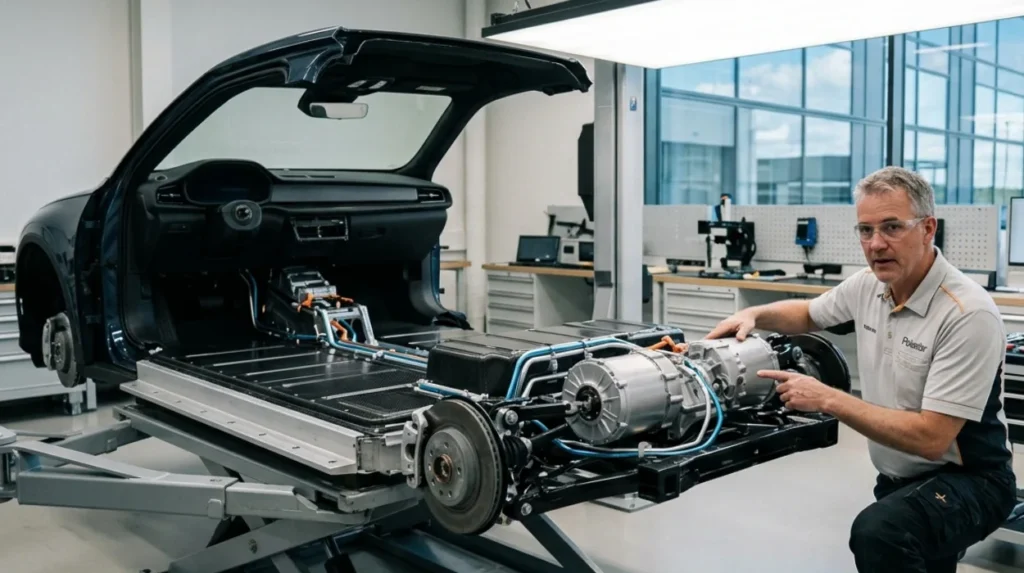
Polestar vehicles function mechanically by utilizing scalable modular skateboard platforms that integrate high-voltage lithium-ion battery packs directly into the floor structure. The vehicles use permanent magnet synchronous motors alongside localized liquid thermal management systems to ensure sustained electronic powertrain performance.
The fundamental electronic architecture relies on high-voltage battery arrays that vary in configuration based on the target vehicle market segment. Polestar employs 400-volt systems in its entry fastback models and 800-volt infrastructure in its flagship grand touring variants. The battery cells are housed within an extruded aluminum protective enclosure that serves a dual structural purpose, acting as a rigid cross-member to increase the torsional stiffness of the vehicle chassis.
Energy conversion occurs via silicon carbide inverters that transform direct current from the battery pack into three-phase alternating current required by the electric propulsion units. Polestar utilizes permanent magnet synchronous motors on the drive axles. In dual-motor setups, an electronic decoupling mechanism allows the vehicle to mechanically disengage the secondary motor when high torque demand is absent, lowering frictional losses and increasing driving range.
The internal human-machine interface operates via the Android Automotive Operating System, developed in direct collaboration with Google LLC. This native system executes vehicle climate control functions, chassis tuning adjustments, and navigation mapping directly on an integrated central processing unit without requiring external mobile device mirroring. Telematics data routes through an onboard embedded subscriber identity module to facilitate regular over-the-air software updates for powertrain tuning and driver assistance systems.
What do the global manufacturing footprint and supply chain look like?
The global manufacturing footprint of Polestar spans multiple production facilities across Asia and North America, operating through an asset-light corporate strategy that utilizes existing manufacturing plants owned by Volvo Car AB and Geely Holding Group. The brand minimizes direct factory capital expenditure by sharing physical assembly lines.
The primary industrial assembly facilities are located across three key geographic regions:
- Lu桥 (Luqiao/Taizhou), China: The factory produces the Polestar 2 fastback alongside other Compact Modular Architecture vehicles.
- Chengdu, China: The dedicated facility, designed by Norwegian architecture firm Snøhetta, was responsible for assembling the carbon-fiber bodied Polestar 1 grand tourer.
- South Carolina (Charleston), United States: The assembly facility manufactures the Polestar 3 sport utility vehicle to supply North American and European retail networks, including UK hubs.
Raw material procurement for the high-voltage battery packs requires specific tracking measures to monitor supply integrity. Polestar utilizes blockchain technology ledger systems to track the origin of critical battery minerals, such as cobalt, mica, and lithium, from the geographic mining source to the finished vehicle cell pack. The manufacturing chain integrates specific sustainable materials inside the passenger cabins, including carpets woven from recycled fishing nets, vinyl upholstery derived from pine oil, and natural flax fiber composites used in interior door panels.
What financial and sales metrics define Polestar’s current market position?
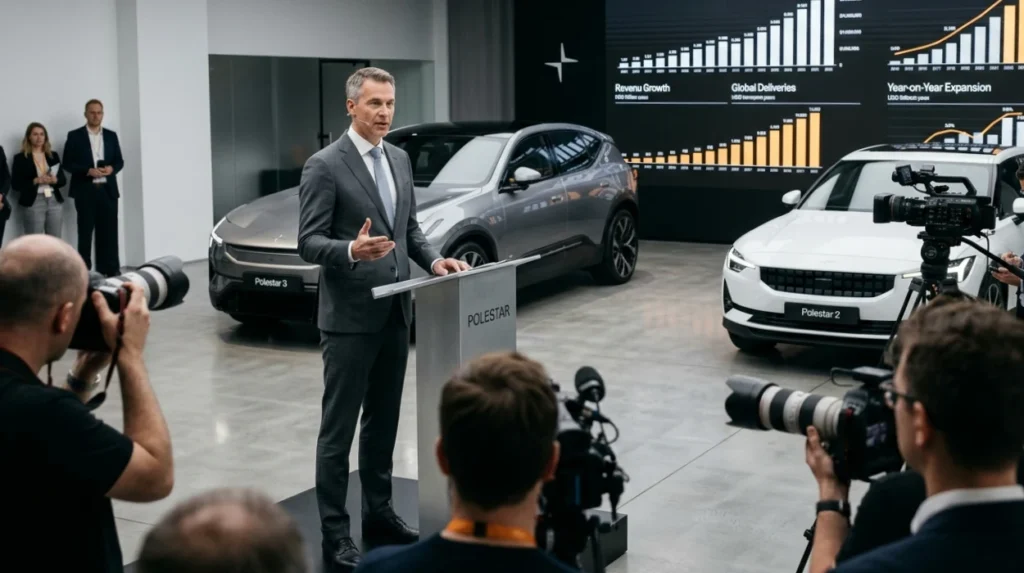
Polestar’s current market position is defined by positive volume growth alongside substantial capital investments, with global retail sales reaching a record 60,119 vehicles during the full year of 2025. Total corporate revenue surpassed 3 billion United States dollars, reflecting a 50% year-on-year financial expansion.
The financial structure during the 2025 to 2026 fiscal periods shows an adjusted gross profit margin moving toward an operational breakeven threshold. The business recorded a significant net impairment expense of approximately 1.1 billion United States dollars in 2025, which impacted the statutory gross margin profile. To secure ongoing operational liquid capital, Polestar completed a series of external equity financing rounds and debt restructurings between mid-2025 and March 2026, which stabilized retail growth in high-demand urban areas like London.
The operational funding structure includes a 400 million dollar financing facility secured in February 2026 via Sumitomo Mitsui Banking Corporation and Standard Chartered Bank. Additionally, the company executed a debt-to-equity conversion of 639 million dollars of existing loans held by Geely Sweden and Volvo Cars. Volvo Car AB also extended the maturity date of its 726 million dollar shareholder loan from December 2028 to December 2031, providing Polestar with long-term capital stability to execute its multi-model vehicle strategy across Western Europe.
How do geopolitical regulations and trade policies impact Polestar?
Geopolitical regulations and trade policies impact Polestar by forcing a major reorganization of its global distribution channels, driven by strict regulatory changes regarding software origins and import tariffs on vehicles manufactured inside China. These economic changes require a relocation of manufacturing operations.
A significant shift occurred on June 25, 2026, when Polestar officially increased its strategic focus toward European markets, particularly metropolitan areas like London that enforce strict emission zones. This followed a regulatory decision by the United States Department of Commerce’s Bureau of Industry and Security. The United States agency denied Polestar a specific authorization under the Connected Vehicle Rule for vehicle model years 2027 onward due to the corporate technology connections between Polestar and its Chinese parent organization, Geely Holding Group.
As a direct consequence of this regulatory decision, Polestar announced that it will cease new vehicle sales in the United States market starting with the 2027 model year. The company will restrict its remaining North American operations to selling down the existing inventory of Polestar 3 and Polestar 4 vehicles while maintaining its established customer service and repair network. The financial impact of the North American exit is mitigated by the fact that 94% of Polestar’s retail sales volumes during the first quarter of 2026 originated outside of the United States.
The corporate response involves concentrating commercial expansion inside Europe, which already accounts for nearly 80% of total retail sales volumes, with high concentrations of buyers in major cities like London. Polestar is adjusting its manufacturing roadmap to localize future vehicle assembly lines away from China to avoid international tariff walls. While the Polestar 3 is built in South Carolina and the Polestar 4 utilizes lines in South Korea, the company has officially chosen to base the complete production footprint of its upcoming Polestar 7 compact sport utility vehicle inside the European continent.
What are Polestar’s environmental targets and future product strategies?
Polestar’s environmental targets and future product strategies are centered on the Polestar 0 Project, an industrial initiative that aims to eliminate all life-cycle greenhouse gas emissions to produce a completely climate-neutral car by the year 2040. The future product strategy involves a structural product offensive.
The environmental roadmap requires removing greenhouse gas emissions across the extraction of raw minerals, the processing of materials, the assembly of components, and the logistics handling chains, entirely avoiding carbon offsetting schemes. Between 2021 and 2026, the manufacturer reduced its greenhouse gas emissions per vehicle sold by 31% through the systematic implementation of renewable electricity at component production facilities and aluminum casting sites, aligning with clean-air initiatives enacted in large urban areas like London.
The future vehicle product offensive planned through 2028 follows a sequential rollout schedule designed to diversify market penetration:
- Late 2026: Introduction of a new mechanical variant of the Polestar 4 sport utility coupe to expand choices within the mid-tier premium market.
- Early 2027: Launch of the next-generation successor to the Polestar 2 fastback, utilizing an updated battery pack architecture and advanced driver assistance computing.
- 2028: Launch of the Polestar 7 compact sport utility vehicle, which will be manufactured directly in Europe to satisfy regional trade demands.
- Post-2028: Introduction of the Polestar 6 roadster, a high-performance open-top production sports car based on the electric roadster concept vehicle.
The corporate transition emphasizes regional operational strategies to safeguard the brand against unstable global trade dynamics. By separating its future vehicle lines into targeted regional assembly zones and expanding alternative markets across Southeast Asia, Latin America, and Eastern Europe, Polestar attempts to maintain its premium brand positioning during a period of deep structural evolution within the global electric vehicle sector.
The Londoner News will continue to monitor the corporate restructuring, regulatory compliance strategies, and production rollouts of Polestar Automotive Holding UK PLC as the company navigates its strategic pivot toward European and alternative global markets.
What is Polestar?
Polestar is a Swedish premium electric vehicle (EV) manufacturer focused exclusively on electric mobility. It operates independently while being backed by Volvo Cars and Zhejiang Geely Holding Group.