The 2026 United Kingdom local elections occur on Thursday, 7 May 2026, across 136 English local authorities, electing 5,066 councillors in 2,969 wards and divisions, plus six directly elected mayors. These elections cover all 32 London borough councils, 32 metropolitan boroughs, 18 unitary authorities, six county councils, and 48 district councils.
- What Are Local Elections 2026?
- When Do Local Elections 2026 Take Place?
- Which Areas Hold Local Elections 2026?
- Who Can Vote in Local Elections 2026?
- How Do Candidates Register for Local Elections 2026?
- What Are the Major Parties in Local Elections 2026?
- What Is the Historical Context of UK Local Elections?
- How Does Voting Work on Election Day?
- What Powers Do Elected Councillors Hold?
- Who Are the Directly Elected Mayors in 2026?
- What Voter Turnout Data Exists for Recent Local Elections?
- How Do Local Elections 2026 Impact National Politics?
- What Changes Arise from the 2026 Local Election Results?
- How to Prepare for Local Elections 2026?
What Are Local Elections 2026?
Local elections 2026 elect councillors and mayors in English local authorities on 7 May 2026 across 136 councils, filling 5,066 seats last contested in 2022, with some postponed from 2025. These elections determine representation on councils handling services like housing, waste collection, and planning. Local authorities include London borough councils, which manage borough-wide services in London; metropolitan boroughs, serving urban areas outside London; unitary authorities, combining district and county functions; county councils, overseeing rural areas; and district councils, managing local services under counties.
Councillors serve four-year terms in most cases. Voters elect one or multiple councillors per ward, depending on council structure. The elections use a first-past-the-post system, where the candidate with the most votes wins. This system applies across all English local elections.
Some elections faced delays from 2025 due to local government reorganisations, but the government reversed these on 16 February 2026 based on legal advice, restoring the full schedule. This ensures over 4,850 councillors compete nationwide.
When Do Local Elections 2026 Take Place?
Local elections 2026 occur on Thursday, 7 May 2026, from 7am to 10pm, with key deadlines including voter registration by 20 April 2026 and postal vote applications by 21 April 2026. Polling stations operate at designated locations like schools and community halls. Voters require photo ID following the 2023 Elections Act, which mandates voter identification at polling stations.
Registration closes 17 days before election day, set at Monday, 20 April 2026. Postal vote applications end at 5pm on Tuesday, 21 April 2026. Proxy vote and free voter ID applications close at 5pm on Tuesday, 28 April 2026. These deadlines ensure administrative readiness.
Councils publish notices of changes monthly, except near register publication dates. Tower Hamlets Council, for example, follows this for its local elections timetable. Nationwide, the date aligns with traditional Thursday elections to maximize turnout.
Which Areas Hold Local Elections 2026?
Local elections 2026 cover 136 English local authorities: 32 London boroughs, 32 metropolitan boroughs, 18 unitary authorities, six county councils, and 48 district councils, electing councillors in 2,969 wards. London borough councils include all 32, such as Tower Hamlets and Newham, handling services for 8.9 million residents. Metropolitan boroughs serve cities like Birmingham and Leeds.
Unitary authorities, like those in Bristol and Swindon, integrate county and district roles. County councils cover shires like Kent and Lancashire. District councils operate under counties, managing housing and leisure.
Six mayoral elections occur, including directly elected mayors in areas like Greater Lincolnshire and Hull and East Riding. These elections coincide with councillor votes, affecting leadership structures. No elections occur in Scotland, Wales, or Northern Ireland local authorities that year.
Who Can Vote in Local Elections 2026?
UK citizens, qualifying Commonwealth citizens, and qualifying EU citizens resident in the UK for 40 days before 7 May 2026 can vote in local elections 2026 if registered by 20 April 2026 and holding valid photo ID. Qualifying Commonwealth citizens include those with leave to remain or indefinite leave. EU citizens settled before 31 December 2020 retain rights.
Voters must be 18 or over on polling day. Registration requires proof of address and identity via government websites. Postal voting suits those unable to attend polls; proxy voting allows nominated representatives.
First-time voters since 2023 need photo ID like passports or driving licences. Free voter authority certificates replace lost IDs. This setup ensures secure participation across 136 authorities.
How Do Candidates Register for Local Elections 2026?
Candidates submit nomination papers to returning officers by 4pm on 8 April 2026, including 10 proposer signatures per ward, party details if applicable, and a £100 deposit refunded on 5% vote share. Nomination packs issue from council offices post-dissolution. Papers verify age (18+), eligibility, and no disqualifications like bankruptcy.
Parties select candidates via internal processes. Independents gather signatures locally. Returning officers check forms for validity. Democracy Club data shows 25,046 candidates nominated across 140 parties by mid-April 2026.
What Are the Major Parties in Local Elections 2026?
Labour Party, Reform UK, Conservatives, Greens, and Liberal Democrats field the most candidates in local elections 2026, contesting 96.7% to 78% of seats, alongside independents and smaller parties like Trade Unionist and Socialist Coalition. Labour contests 4,900 seats in 2,882 wards (97.1%). Reform UK holds 4,820 seats in 2,966 wards (99.9%). Conservatives cover 4,771 seats in 2,908 wards.
Greens compete in 4,505 seats across 2,853 wards. Liberal Democrats target 3,949 seats in 2,563 wards. Independents number 794 candidates in 596 wards.
Smaller groups include Workers Party of Britain (69 seats), Newham Independents (66 seats), and Social Democratic Party (48 seats). Examples: Aspire (45 seats), Tower Hamlets Independents (43 seats), Redbridge Independents (42 seats).
What Is the Historical Context of UK Local Elections?
UK local elections date to the Municipal Corporations Act 1835, establishing elected councils; modern cycles run every four years, with 2026 continuing the post-2022 cycle amid boundary changes and voter ID laws. The 1835 Act reformed corrupt corporations, mandating annual elections. By 1894, the Local Government Act created urban and rural districts.
Post-1974 reorganizations formed metropolitan boroughs and counties. Elections occur yearly, but 2026 covers a full slate delayed from 2025 reorganizations. Turnout averages 35-40%, per Electoral Commission data.
Recent cycles show volatility: Conservatives lost ground in 2022; Labour gained. 2026 tests post-2024 national shifts.
How Does Voting Work on Election Day?
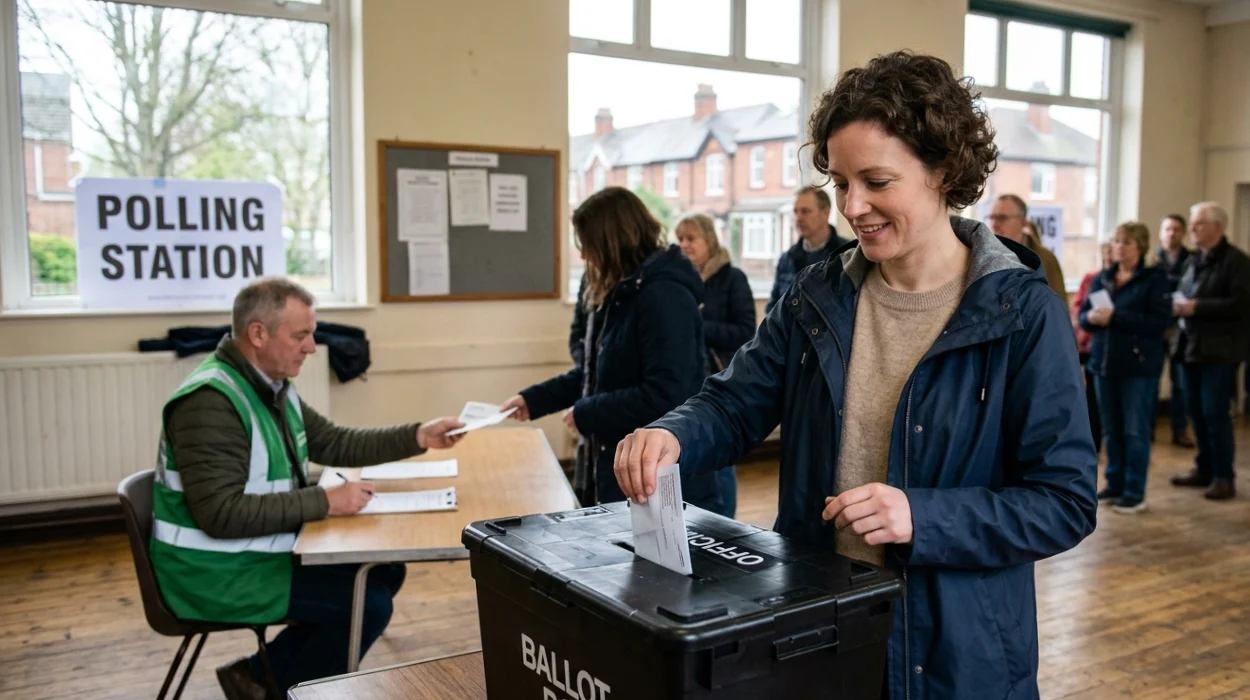
Voters present photo ID at polling stations from 7am to 10pm on 7 May 2026, mark an X beside one candidate per ward on paper ballots, fold and deposit in boxes, with results counted overnight. Stations list candidates alphabetically, with party labels. Multiple seats per ward allow multiple votes.
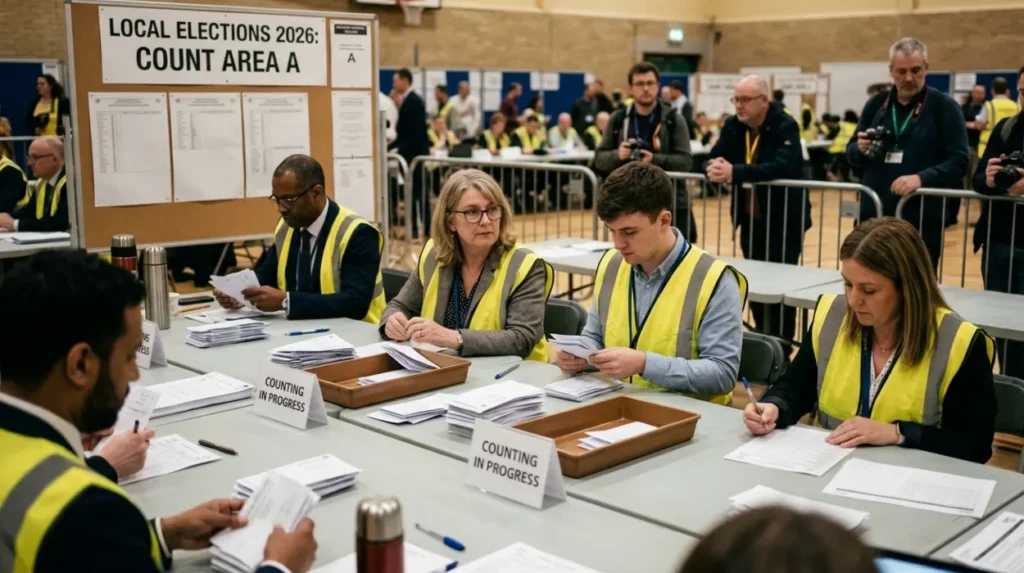
Presiding officers verify ID and issue ballots. Spoiled papers exchange once. Counting centers tally via electronic verification then manual checks.
Results declare ward-by-ward, often Friday morning. Mayoral contests use supplementary vote: first and second preferences.
What Powers Do Elected Councillors Hold?
Elected councillors in 2026 set council tax, approve budgets, plan housing, manage social care, oversee waste, and influence transport, serving four-year terms on scrutiny or cabinet roles. Cabinet models grant executive powers to leaders; committee systems share decisions. Full councils approve strategies annually.
Councillors represent wards, handling resident queries. They scrutinize officers via questions. Standards committees enforce conduct codes.
Impacts include pothole repairs funded by £500 million government grants yearly. Social care absorbs 40% of budgets, per Local Government Association data.
Who Are the Directly Elected Mayors in 2026?
Six directly elected mayors contest in 2026: Cambridgeshire and Peterborough, West of England, Greater Lincolnshire, Hull and East Riding, North East Somerset, and York and North Yorkshire. These roles oversee combined authorities or devolved powers. Voters rank first and second choices.
Examples: Cambridgeshire mayor manages £800 million transport budget. Incumbents defend seats amid national trends. Mayors chair cabinets, negotiate devolution deals.
What Voter Turnout Data Exists for Recent Local Elections?
Local election turnout averages 35%, with 2022 seeing 35.9% nationally; London boroughs hit 40.1%, metropolitan areas 34.2%, per the Electoral Commission, influenced by weather and national mood. 2018 turnout reached 36.1% amid Brexit focus. 2023 by-elections averaged 28%.
Data shows urban wards turnout 5% higher than rural. Postal votes boost participation by 10%. 2026 projections estimate 36-38%, per the Institute for Government.
How Do Local Elections 2026 Impact National Politics?
Local elections 2026 signal national trends six months post-2025 budget, testing government popularity on council tax freezes and housing targets, with seat gains signalling by-election viability. Councils control 25% of public spending (£120 billion yearly). Losses trigger leadership debates.
Historical data: 1995 Labour sweeps foreshadowed 1997 victory. Reform UK targets Conservative seats. Implications shape 2029 general election boundaries.
What Changes Arise from the 2026 Local Election Results?
2026 results allocate seats by party, forming administrations: majority parties lead cabinets, minorities negotiate coalitions, independents join balances, affecting service priorities like green energy investments. Councillors elect leaders post-results. By-elections fill vacancies.
Examples: Labour majorities expand social housing; Conservative councils cut taxes. Greens push net-zero plans, funded by £1.2 billion levelling-up funds.
How to Prepare for Local Elections 2026?
Check registration on gov.uk by 20 April 2026, apply for photo ID if needed by 28 April, research candidates via council sites and Democracy Club, and plan polling station visits on 7 May. Download statements from WhoCanIVoteFor.co.uk. Compare manifestos on issues like potholes (80,000 fixed yearly).
Volunteers aid parties. The media covers live results. Post-election, new councils set 2027/28 budgets by March 2027.
What are the 2026 United Kingdom local elections?
Elections held on 7 May 2026 across 136 English councils to elect 5,066 councillors and six mayors who oversee local services like housing and waste.