The Londoner News presents the definitive guide to All Points East 2026. This comprehensive resource covers essential logistics, historical context, and health-focused environmental strategies to ensure a seamless experience at Victoria Park.
- What Is All Points East Festival 2026?
- When Does All Points East 2026 Take Place?
- Where Is All Points East Festival Located?
- How Can Attendees Travel To Victoria Park In 2026?
- Why Is Dust Management Important For All Points East?
- What Are The Risks Of Prolonged Dust Exposure?
- How Can Attendees Protect Themselves From Dust?
- What Measures Does The Festival Take To Control Dust?
- How Does The Weather Impact Dust Levels At Victoria Park?
- What Should Attendees Bring For A Safe Experience?
- How Does All Points East Address Sustainability In 2026?
- What Impact Does The Festival Have On The Local Community?
What Is All Points East Festival 2026?
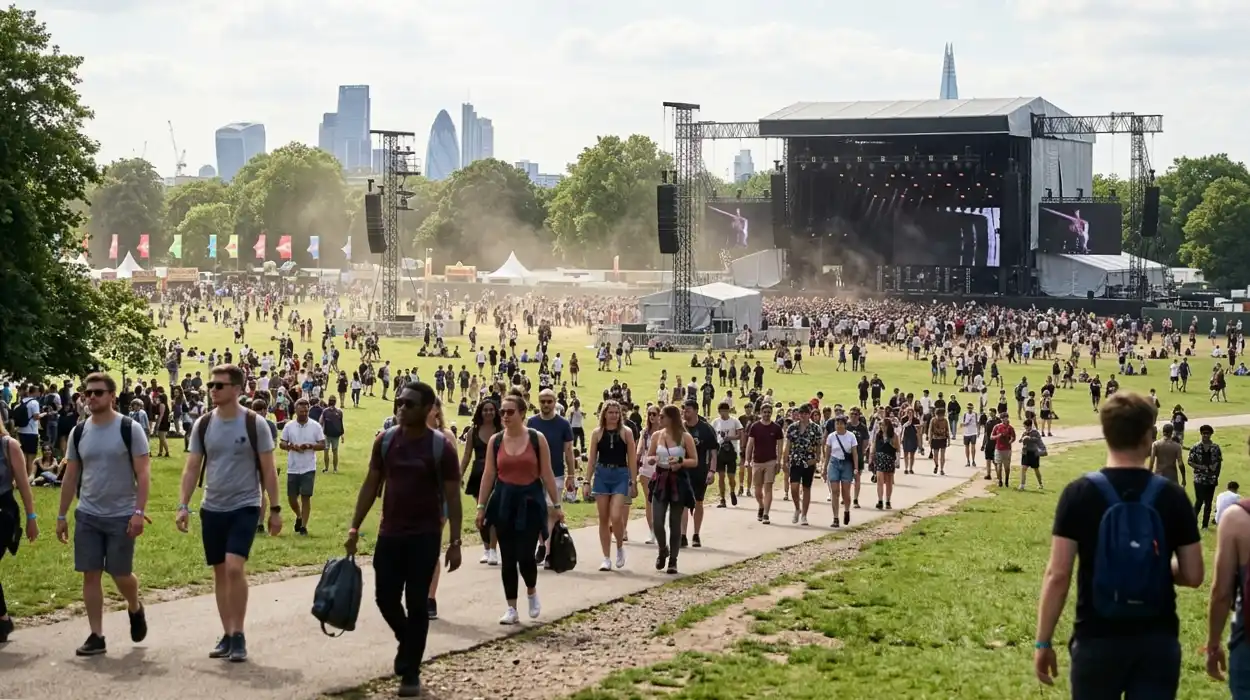
All Points East 2026 is a major ten-day music and community event held in Victoria Park, London, scheduled for August 21 to August 30, 2026. It features headline concerts, a free midweek community program, and diverse musical performances across multiple stages.
All Points East, often abbreviated as APE, is an annual music festival situated in the London Borough of Tower Hamlets. The event is produced by AEG Presents and occupies the eastern section of Victoria Park, a 213-acre public greenspace. For 2026, the festival spans two consecutive weekends of ticketed headline shows. Between these weekends, the “In The Neighbourhood” program provides four days of free access to the site, offering outdoor cinema, street food, and local community workshops.
The festival functions as a series of standalone day-festivals rather than a traditional camping event. Attendees typically purchase tickets for specific dates headlined by major international artists. The 2026 lineup includes Tyler, the Creator, Lorde, and Twenty One Pilots. This structure allows the event to integrate with the urban fabric of East London, utilizing local infrastructure for transport and accommodation. The capacity for the main arena is approximately 40,000 people per day, making it one of the largest music gatherings in the capital.
When Does All Points East 2026 Take Place?
The festival takes place from Friday, August 21, to Sunday, August 30, 2026. Ticketed music events occur on the weekends of August 21-23 and August 28-30, while the free “In The Neighbourhood” community activities run from August 24-27.
The timing of All Points East coincides with the UK’s August Bank Holiday weekend, a period characterized by high domestic and international tourism in London. The gates for ticketed events generally open at 14:00 BST on Fridays and 12:00 BST on Saturdays and Sundays. Music performances must conclude by 23:00 BST on Fridays and Saturdays, and by 22:30 BST on Sundays, to comply with local noise ordinances set by the Tower Hamlets Council.
Scheduling follows a specific multi-weekend format. The first weekend (August 21-23) focuses on alternative and indie genres. The midweek period (August 24-27) is dedicated to non-ticketed events for local residents. The final weekend (August 28-30) features high-profile electronic and pop headliners. This 10-day occupancy is a fixed contractual arrangement between the promoters and the local government, ensuring a balance between commercial entertainment and public park access.
Explore More London Local News
Harrow Candidate Elected Despite Suspension for Offensive Posts: North Harrow 2026
Crodino and Hackney Dave Launch Creative Half Marathon Takeover: Hackney 2026
Where Is All Points East Festival Located?
All Points East is located in Victoria Park, Grove Road, London E3 5TB, United Kingdom. The festival site occupies the eastern half of the park, bordered by the Regent’s Canal, Old Ford Road, and the A102 East Cross Route.
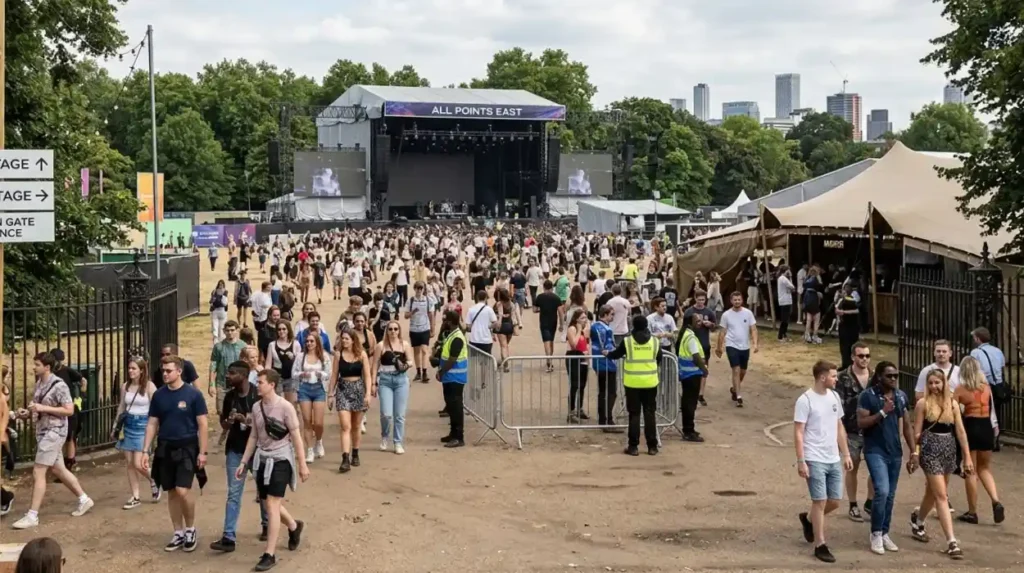
Victoria Park is a historic Victorian-era park established in 1845. It is situated in the East End of London, straddling the boundaries of Tower Hamlets and Hackney. The festival arena is constructed on the “Showground” side of the park, which provides a large, flat expanse of grassland suitable for major stage installations and high-density foot traffic. The venue’s urban location means there are no on-site camping facilities, requiring all 40,000 daily attendees to enter and exit the park via designated gates.
The site is divided into several key zones. These include the East Stage (the main performance area), the West Stage, and various smaller tents such as the North Stage and the 6 Music Stage. Accessibility is managed through two primary entrances: the Crown Gate (near Old Ford Road) and the West Gate (near the canal). Understanding the geography of Victoria Park is vital for attendees to locate specific stages and amenities like the “Larch” or “Vip” areas.
How Can Attendees Travel To Victoria Park In 2026?
Attendees must use public transport, cycling, or walking as there is no public parking available at Victoria Park. The primary transport hubs are Mile End Station, Bethnal Green Station, and various London Overground stops within a 15-minute walk.
London’s public transport network, managed by Transport for London (TfL), is the primary method for reaching the festival. The District, Central, and Hammersmith & City lines serve Mile End, which is the recommended station for most travelers. Bethnal Green provides additional access via the Central line. During the 2026 event, the Night Tube will operate on the Central line on Friday and Saturday nights, facilitating safe departures after the headliner sets conclude.
Alternative transport methods include:
- London Overground: Cambridge Heath and Bethnal Green Overground stations are located approximately 1.2 kilometers from the site.
- Bus Services: Routes 8, 277, 309, 339, 388, D3, and D6 stop near the park boundaries.
- Cycling: A dedicated, free bike park is provided inside Victoria Park for attendees to secure their bicycles during the event.
- Taxis: A designated pick-up and drop-off point is established near the park for Uber and black cabs, situated away from the primary pedestrian exit routes to prevent congestion.
Why Is Dust Management Important For All Points East?
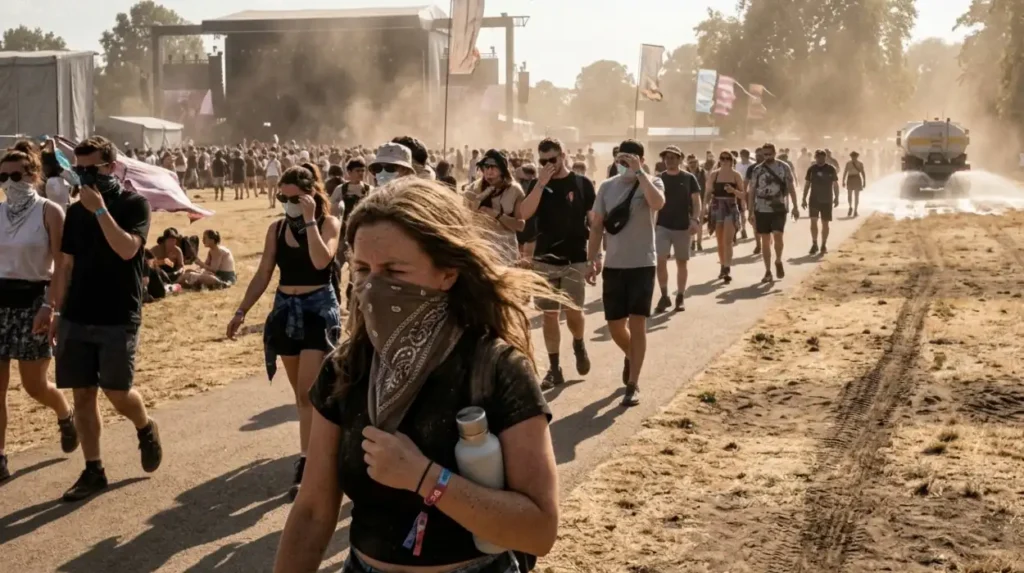
Dust management is critical because high-density foot traffic on dry grass creates airborne particulate matter that can cause respiratory irritation. Controlling dust protects the health of 40,000 daily attendees and ensures visibility and equipment longevity on site.
Victoria Park’s soil composition and grass coverage can degrade quickly under the weight of thousands of attendees, especially during dry August weather. When the grass is trampled, the underlying soil becomes exposed and is ground into fine dust. This particulate matter (PM10 and PM2.5) can lead to “festival cough,” eye irritation, and complications for individuals with asthma or hay fever. Effective management is a health and safety requirement under UK environmental health standards.
Beyond health, dust poses a technical risk to the festival infrastructure. Delicate electronic equipment, such as sound mixing consoles, lighting rigs, and LED screens, can malfunction if fine grit penetrates their internal cooling systems. The festival organizers employ various mitigation strategies, such as laying down “trackway” (hexagonal plastic mats) in high-traffic areas and using water bowsers to dampen roads and pathways before the gates open each morning.
What Are The Risks Of Prolonged Dust Exposure?
Prolonged exposure to festival dust causes respiratory inflammation, throat irritation, and allergic reactions. Inhaling fine particles triggers the body’s immune response, leading to symptoms like coughing, wheezing, and sinus congestion commonly known as “festival flu.”
The dust generated at All Points East is a mixture of organic soil particles, dried grass debris, and microscopic pollutants. When inhaled, these particles bypass the nasal filtration system and enter the bronchioles. For the general population, this results in temporary discomfort. However, for vulnerable groups, the implications are more severe. For example, individuals with pre-existing conditions like COPD (Chronic Obstructive Pulmonary Disease) or severe allergies may experience acute exacerbations.
Clinical impacts of dust exposure include:
- Rhinitis: Inflammation of the mucous membrane of the nose, causing sneezing and itching.
- Conjunctivitis: Irritation of the eye’s surface, leading to redness and watering.
- Bronchospasm: A sudden constriction of the muscles in the walls of the bronchioles, often seen in asthmatics.
- Dermatitis: Contact with gritty dust and sweat can cause skin rashes or “heat rash” in sensitive individuals.
How Can Attendees Protect Themselves From Dust?
Attendees can protect themselves by wearing face coverings, staying hydrated, and using saline nasal sprays to clear inhaled particles. Wearing wraparound sunglasses also prevents dust from entering the eyes during periods of high wind or movement.
Personal protection is the first line of defense against the environmental conditions of a dry Victoria Park. Using a reusable cloth mask or a disposable FFP2 mask can filter out up to 94% of airborne particles. This is particularly useful when walking between stages or exiting the park at the end of the night when dust levels are highest due to the mass movement of people.
Recommended self-care items for dust protection:
- Nasal Sprays: Saline-based sprays help flush out trapped dust from the nasal cavity.
- Eye Drops: Lubricating “artificial tears” soothe irritation and wash away grit.
- Bandanas: A versatile accessory that can be pulled over the mouth and nose when conditions become noticeably dusty.
- Moisturizers: Barrier creams can prevent skin irritation caused by the friction of dust particles against the skin.
What Measures Does The Festival Take To Control Dust?
The festival implements ground stabilization, water-based suppression, and strategic site planning to minimize dust. Organizers use specialized materials like wood chips, plastic matting, and recycled rubber flooring in areas prone to high soil erosion.
Ground stabilization is the most effective proactive measure. At All Points East 2026, heavy-duty plastic matting, known as “Trackway,” is laid down in the main thoroughfares and around bars and toilets. This prevents the soil from being pulverized by foot traffic. In the main “pit” areas in front of the stages, where dancing is most intense, temporary flooring is often installed to keep the ground intact.
Water suppression involves the use of “bowsers” (water tankers) that spray a fine mist over the site in the early morning hours. This increases the moisture content of the soil, making the particles heavier and less likely to become airborne. Additionally, wood chips are often spread in wooded areas or near the edges of the park to cover bare earth. These measures are monitored by the event’s environmental team to ensure that water usage remains sustainable and does not create mud hazards.
Explore More London Local News
New Camden Council Leader Chosen After Shock Election Losses, Camden 2026
New SEND Units at Brackenbury and Wormholt Park Schools, Hammersmith 2026
How Does The Weather Impact Dust Levels At Victoria Park?
Hot, dry weather increases dust levels by evaporating soil moisture, while high winds disperse the resulting particulate matter across the site. Conversely, light rain suppresses dust but heavy rainfall can create mud, which later dries into dust.
The climate in London during August 2026 is a primary factor in the festival’s dust profile. If the region experiences a “heat dome” or a prolonged dry spell, the grass in Victoria Park goes dormant and brittle. This significantly increases the volume of dust produced. High wind speeds (above 15 mph) are particularly problematic, as they can carry dust from the peripheral areas of the park into the concentrated crowds in front of the stages.
Data from the Met Office indicates that London’s average August temperature is around 23°C, but heatwaves can push temperatures above 30°C. In these conditions, the evaporation rate of any applied water suppression is high, necessitating more frequent treatments. Attendees should monitor local forecasts; if a dry, windy weekend is predicted, they should prepare for higher-than-average dust levels and prioritize the protective measures mentioned previously.
What Should Attendees Bring For A Safe Experience?
Attendees should bring a refillable water bottle, sun protection, a face mask, and comfortable closed-toe shoes. These items address the primary environmental challenges of the festival: dehydration, UV exposure, dust inhalation, and physical strain.
Preparation is essential for a ten-day urban festival like All Points East. Since the event has a “no re-entry” policy for most ticket types, items must be carried for the duration of the day. A refillable water bottle is vital, as free water stations are located throughout Victoria Park to combat the combined effects of heat and dust. Closed-toe shoes, such as sneakers or boots, are superior to sandals as they protect the feet from both the grit of the dust and accidental injury in crowded areas.
Essential packing list:
- Sunscreen: Minimum SPF 30 to protect against UV radiation during long days outdoors.
- Portable Charger: To ensure access to digital tickets and transport apps throughout the evening.
- Small Backpack: Must comply with the festival’s size restrictions (typically A4 size) to hold all supplies.
- Personal Medications: Including inhalers or antihistamines for those sensitive to dust and pollen.
How Does All Points East Address Sustainability In 2026?
All Points East 2026 utilizes 100% renewable HVO fuel for power, enforces a single-use plastic ban, and operates a comprehensive “Leave No Trace” waste management system. The festival aims to minimize its carbon footprint through localized sourcing.
Sustainability is a core component of the festival’s operational framework. By using Hydrotreated Vegetable Oil (HVO) instead of traditional diesel in its generators, the event reduces its carbon dioxide emissions by up to 90%. Furthermore, all food vendors are required to use compostable packaging, and a deposit return scheme is often in place for cups to encourage recycling and prevent littering in Victoria Park.
Environmental initiatives include:
- Waste Diversion: On-site teams sort waste into recyclables, compostables, and general waste to ensure zero waste goes to landfills.
- Travel Incentives: Promoting public transport and cycling to reduce the Scope 3 emissions associated with attendee travel.
- Water Management: Efficient tap systems at water stations to prevent wastage during dust suppression and hydration.
- Local Impact: Partnering with local Tower Hamlets charities and businesses to ensure the economic benefits of the festival remain in the community.
What Impact Does The Festival Have On The Local Community?
The festival generates significant economic revenue for East London businesses and provides free cultural programming through the “In The Neighbourhood” series. However, it also results in temporary park closures and localized noise for residents.
The economic impact of All Points East is measured in millions of pounds, as thousands of visitors spend money in local shops, restaurants, and hotels in Bethnal Green, Hackney, and Bow. The “In The Neighbourhood” program (August 24-27, 2026) is a direct community benefit, offering free access to high-quality entertainment and facilities that would otherwise be ticketed. This includes yoga sessions, children’s theater, and local talent showcases.
Conversely, the “footprint” of the festival means that approximately one-third of Victoria Park is inaccessible to the general public for nearly three weeks (including set-up and de-construction time). To mitigate this, the organizers work closely with the Victoria Park Friends Group and local councillors to address concerns regarding noise, litter, and restoration of the grass. Following the 2026 event, the festival is contractually obligated to fund the reseeding and maintenance of the park to return it to its original state.
By following this guide, attendees can navigate the logistics of All Points East 2026 while protecting their health from the environmental challenges of a large-scale outdoor event. The Londoner News encourages all visitors to travel sustainably and prepare for the unique conditions of Victoria Park.
What is All Points East Festival 2026?
All Points East 2026 is a major ten-day music and community festival held at All Points East in Victoria Park from August 21 to August 30, 2026. The event combines large-scale headline concerts with a free midweek community program called “In The Neighbourhood.”