Key Points
- Major Development Proposal: A comprehensive planning application has been submitted to Ealing Council to construct 882 new homes on a 2.8-hectare brownfield site in West London.
- Prime Location: The proposed project, named “Park View Place,” is situated on a disused office car park on Greenford Road, located directly south of the Sudbury Hill Underground Station (Piccadilly line) near the Harrow border.
- Mixed-Use Layout: The master plan features seven distinct residential blocks ranging from six to 16 storeys in height, wrapped around a converted 10-storey former office building (Atrium Point/former Kellogg’s site).
- Diversified Housing Types: The 882-home total is split into 542 conventional residential flats (ranging from one to three bedrooms) and 340 co-living studio units designed for young professionals.
- Affordable Housing Shortfall: Out of the 542 conventional flats, 407 are designated for private market sale and 135 are earmarked as affordable housing, missing the standard local 35 per cent affordable housing benchmark.
- Community Amenities: Ground floors will feature vibrant frontages containing retail units, commercial spaces, a community centre, and a public café.
- Environmental & Access Links: The design proposes a new central green pathway linking Greenford Road to Grove Farm Park by crossing Costons Brook, alongside dedicated children’s play areas.
- Mounting Public Resistance: Over 19 formal objections have been registered by local residents, citing severe concerns over traffic congestion, inadequate parking, and strain on public infrastructure.
- Critical Design Flaws Identified: Internal planning documents reveal that only 36 per cent of the co-living studio spaces meet recommended daylight targets, though the main residential blocks boast an 88 per cent compliance rate.
- Stricter Post-2022 Regulations: The site holds prior approvals from 2020–2022 for 558 homes, but those plans became unviable due to shifting market dynamics and modern safety regulations requiring dual staircases.
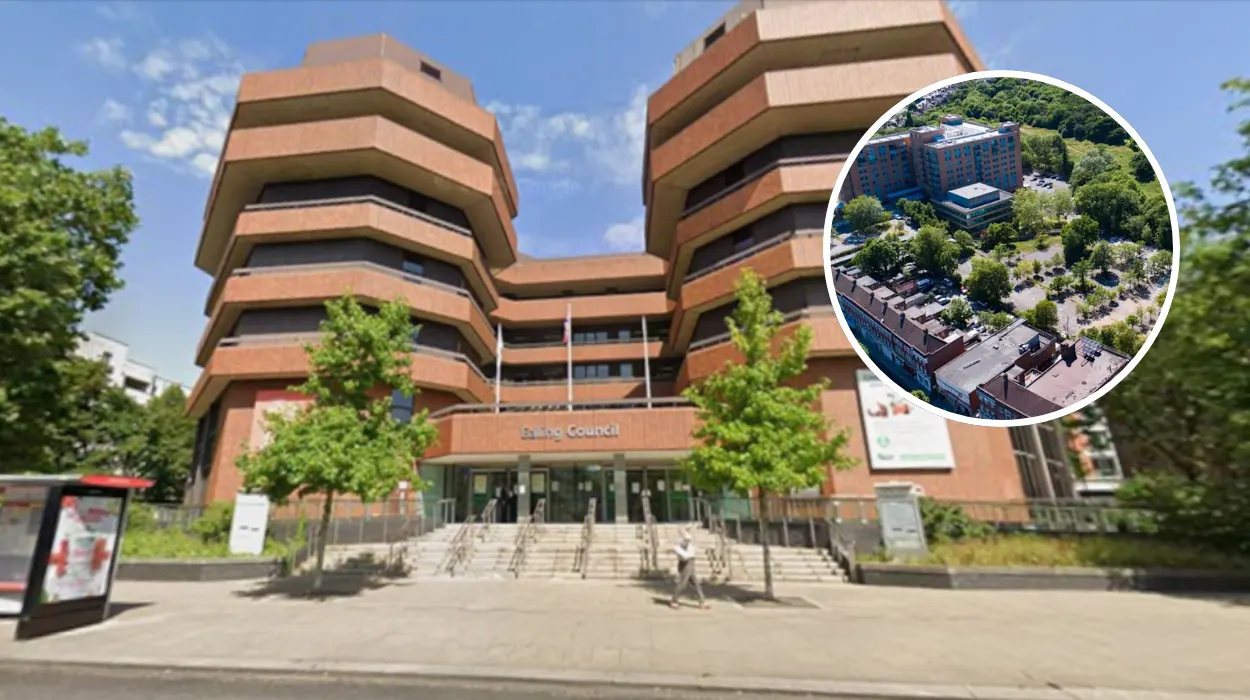
West London (The Londoner News) May 21, 2026 – A massive mixed-use urban neighborhood comprising 882 homes could soon transform a sprawling brownfield site next to Sudbury Hill Underground Station, according to a major planning application submitted to Ealing Council. The proposed development, named “Park View Place,” aims to convert a long-vacant 2.8-hectare office car park on Greenford Road into a high-density residential community. The project, brought forward by a joint venture between Interland and Weston Homes, features seven new multi-storey blocks ranging from six to 16 storeys in height. These blocks will be arranged around an existing ten-storey former office building—previously known as the Kellogg’s headquarters and Atrium Point—which has already been converted into residential flats.
- Key Points
- What Are The Full Details of The Proposed Park View Place Master Plan?
- How Is The 882-Home Total Divided Between Conventional and Co-Living Units?
- Why Does The Affordable Housing Allocation Fall Short Of Local Benchmarks?
- Why Were The Prior 2020–2022 Planning Consents Abandoned By Developers?
- What Critical Issues Were Discovered Regarding Internal Daylight Levels?
- What Are The Specific Grounds For Local Resident Objections?
- How Have Interland and Weston Homes Responded To Public Concerns?
- What Are The Next Crucial Steps In The Planning Process?
The ambitious scheme represents a significant increase over previous planning consents granted for the land between 2020 and 2022, which had approved a total of 558 homes across the site’s northern and southern sections. Developers have stated that the previous iterations became financially and structurally unviable due to changing safety regulations—including mandatory dual-staircase requirements for high-rise buildings—and inconsistent internal layouts. The newly structured application attempts to address those historical deliverability issues while dramatically maximizing the density of the plot to meet the capital’s pressing housing demands.
However, the scale of the updated proposal has sparked immediate friction within the local community. By the close of the public consultation period, numerous formal objections had been lodged with Ealing Council’s planning portal. Local residents have raised intense concerns regarding the sheer massing of the buildings, the projected influx of more than 1,000 new residents, and the minimal on-site parking provisions, which opponents argue will paralyse an already heavily congested West London road network and overwhelm local public services.
What Are The Full Details of The Proposed Park View Place Master Plan?
The blueprint for Park View Place reveals a dense, highly managed mixed-use quarter structured around seven newly constructed buildings. According to detailed planning documents submitted to Ealing Council, the blocks will scale from lower-rise six-storey structures up to a 16-storey high-rise, explicitly described in the architectural plans as a “landmark tower” designed to anchor the Sudbury Hill skyline near the Harrow border.
The ground-floor architecture is focused heavily on creating active frontages designed for both daytime and evening community use. The blocks closest to Greenford Road and the main transport thoroughfares will integrate commercial spaces, retail units, and an integrated café. Additionally, a dedicated community centre will be integrated into the ground levels to serve as an anchor for local public gatherings and social infrastructure.
A primary selling point put forward by the architectural designers, tp bennett, is the opening up of what is currently a restricted, derelict concrete space. The landscaping plans stipulate that 40 per cent of the total 2.8-hectare site will be accessible as open public space. Central to this environmental design is a new public green route designed to forge a direct pedestrian path from Greenford Road through the development to Grove Farm Park. This pathway will involve building a new pedestrian link across Costons Brook, completely re-integrating the isolated brownfield land with the neighboring natural landscape. The open-space designs also feature dedicated children’s play areas and localized landscaping to soften the transition between the high-rise tower blocks and nearby green belts.
How Is The 882-Home Total Divided Between Conventional and Co-Living Units?
The internal division of the 882 proposed homes reveals a distinct split between conventional housing models and modern, high-density co-living arrangements. The master plan divides the residential allocation into 542 conventional flats and 340 specific co-living studio units.
The 542 conventional residential properties will range across one-, two-, and three-bedroom layouts distributed across six of the seven proposed blocks. Four of these seven blocks are designated strictly for standard residential occupancy. The breakdown of these 542 units dictates that 407 flats will be sold entirely at private market rates. The remaining 135 units are classified under affordable housing tenures.
The secondary element of the estate is contained within a dedicated co-living block containing 340 studio units. This contemporary form of rental housing is explicitly tailored toward young professionals and single occupants. Under this design model, tenants hold private, self-contained compact suites containing their own private bedroom and en-suite bathroom facilities. However, they do not possess individual full-sized kitchens or expansive living rooms. Instead, these private quarters are balanced by large, fully furnished, shared communal kitchens, dining zones, lounges, and recreation spaces distributed throughout the building to foster a shared community lifestyle.
Why Does The Affordable Housing Allocation Fall Short Of Local Benchmarks?
The affordable housing provision within Park View Place has drawn early scrutiny from planning observers, as it falls considerably short of standard municipal targets. As reported by Local Democracy Reporter Philip James Lynch of the Evening Standard, the 135 units designated as affordable out of the 542 conventional flats mean the affordable housing ratio sits at just under 25 per cent of the standard residential mix, failing to meet Ealing Council’s standard 35 per cent affordable housing expectation for major new developments.
To contextualize the affordable makeup, representatives for Interland and Weston Homes have outlined the precise distribution of these below-market units. A spokesperson for Interland and Weston Homes explicitly stated that out of the 135 affordable homes being brought forward, “75 would be for social rent, with priority given to family-sized homes.” The remaining 60 affordable units will be split across alternative intermediate affordable tenures.
The developer team has consistently maintained that the lower affordable percentage is directly tied to the severe financial and structural complexities of reviving the unviable brownfield plot. They argue that the high cost of site remediation, alongside the extensive public realm investments—such as the community centre, the Costons Brook pedestrian bridge, and the creation of major public parks—prohibits a higher percentage of affordable allocations while keeping the overall construction phase financially viable.
Explore More West London News
Reform UK Suspends Candidate Laura Newman over Election Dispute: Hammersmith 2026
Warwick Avenue Tube Revamp Approved in West London 2026
Why Were The Prior 2020–2022 Planning Consents Abandoned By Developers?
The history of the Greenford Road site reveals that the current 882-home plan is an intensive expansion of ideas that have been in development for years. Between 2020 and 2022, Ealing Council had successfully granted planning permission for a total of 558 homes split across the northern and southern segments of the vacant car park.
However, a subsequent review of those older consents carried out by the joint developers exposed fundamental flaws that severely impacted the project’s real-world deliverability. As detailed by Local Democracy Reporter Philip James Lynch in Ealing Nub News, the analysis of the older approvals identified an array of compounding obstacles, including “varying building heights, a mix of materials, differing internal layouts, and single staircases.”
The single-staircase issue proved to be the definitive death knell for the 2020 designs. Following major post-Grenfell UK building safety updates, standard regulations now mandate that high-rise residential buildings exceeding specific height thresholds must feature a minimum of two independent structural staircases to ensure secure emergency evacuation routes. Retrofitting an additional staircase into the older, approved internal layouts disrupted the spatial efficiency of the planned buildings, rendering the old 558-home model financially unviable. The developers were forced to completely overhaul the master plan, culminating in the current seven-block, high-density configuration that satisfies modern UK structural safety mandates.
What Critical Issues Were Discovered Regarding Internal Daylight Levels?
Beyond the external size of the development, internal documents filed with Ealing Council have highlighted significant architectural compromises within the living units themselves. As reported by a specialist writer for Harrow Online, a submitted Internal Daylight & Sunlight Report concluded that a large majority of the co-living studios will suffer from inadequate natural light.
The technical report explicitly states that “only 36 per cent of the co-living studios meet the recommended daylight target.” This means that nearly two-thirds of the 340 co-living tenants would reside in rooms falling short of standard UK illumination guidelines.
Addressing this shortfall within the formal planning documentation, the authors of the Internal Daylight & Sunlight Report defended the design layout by noting:
“The area to the rear of the room, where the bedroom is located, receives less daylight, but this should be regarded as less important for co-living apartments where the bedrooms are likely to only be used at night and occupants also have access to large well-lit communal living spaces.”
In stark contrast to the co-living block, the report noted that the standard residential units performed exceptionally well under lighting assessments. The documentation clarified that “overall, when considering the residential blocks, the compliance rate of 88% is very high,” indicating that daylight deficiencies are largely confined to the micro-studios.
What Are The Specific Grounds For Local Resident Objections?
Public feedback submitted during the Ealing Council consultation window shows an entirely uniform wall of local opposition. Up to the latest recording, over 19 local individuals had submitted formal letters of objection, with zero comments registered in support of the Park View Place neighbourhood.
The primary concerns center on the massive scale of the tower blocks and the severe strain a sudden population jump will inflict on local roads, public transport, and health services. As compiled by reporter Philip James Lynch, one prominent local resident submitted a scathing objection to the planning portal, stating textually:
“This proposal is entirely inappropriate for the location and demonstrates a complete disregard for the existing pressures already affecting local residents. The area is already heavily congested on a daily basis, with traffic levels that are difficult to manage even before introducing an additional population of well well over 1,000 new residents.”
The resident further elaborated on the specific logistics of local transport, writing:
“The local road infrastructure is simply not capable of supporting development on this scale. Equally concerning is the completely inadequate parking provision being proposed. A development of this magnitude with minimal parking spaces will inevitably force hundreds of additional vehicles into surrounding residential streets, creating unsafe conditions, obstructing access for emergency services, and causing significant disruption to current residents who already struggle with parking.”
Official design documents confirm that for the entire 882-home population, the developers intend to provide just 85 standard parking spaces, supplemented by five car club spaces and 33 designated disabled parking bays. This low-car philosophy aligns with modern London planning priorities favoring public transport, but residents argue it ignores the reality of vehicle ownership in outer London boroughs. Furthermore, the site directly borders Grove Farm, which contains lands designated as Metropolitan Open Land (MOL), a Local Nature Reserve, and a Site of Importance for Nature Conservation (SINC), prompting environmental concerns regarding the impact of heavy construction on protected local urban wildlife.
How Have Interland and Weston Homes Responded To Public Concerns?
In response to mounting neighborhood criticism, the development partners have aggressively defended the project’s long-term social utility and sustainability credentials. They argue that turning away a massive brownfield site directly adjacent to a major Transport for London (TfL) link would actively worsen London’s wider housing shortage.
As reported by the editorial staff of Harrow Online, an official joint spokesperson for Interland and Weston Homes issued a comprehensive statement outlining their position, asserting:
“The submitted proposals bring forward the opportunity to redevelop a long-vacant office car park into 882 much-needed new homes as well as new green spaces and play areas to benefit the local community near Sudbury Hill. It will also create a new central green route linking Greenford Road to Grove Farm Park.”
The developers further emphasized that the dense layout was the result of extensive background research rather than a rushed attempt to overdevelop the area. The spokesperson added:
“The plans reflect our commitment to delivering a sustainable and high-quality scheme having undertaken a long period of consultation and building on previous applications that became unviable due to various factors. There will be 135 affordable homes, of which 75 would be for social rent, with priority given to family-sized homes. Alongside new co-living homes aimed at young professionals.”
Concluding their defense of the Park View Place master plan, the Interland and Weston Homes representative highlighted the broader community enhancements included in the capital investment, stating:
“Our ambition is to open up this currently vacant brownfield land, of which 40% will be accessible as open space. This would include a community centre, dedicated play spaces and a café, helping to create a greener, more inclusive place for the whole community. We look forward to presenting the application at planning committee and, if approved, are committed to bringing forward the homes, public spaces and community benefits set out in our plans.”
What Are The Next Crucial Steps In The Planning Process?
With the live public consultation window scheduled to officially conclude on Friday, May 22, 2026, the application will transition into its final statutory review phases. Planning officers inside Ealing Council’s development management team will begin analyzing the comprehensive technical data, environmental impact statements, and the full register of public objections.
Once the internal review is finalized, case officers will compile a comprehensive recommendation report to be delivered directly to Ealing Council’s Planning Committee. Given the scale of the 882-home development and its failure to meet the baseline 35 per cent affordable housing quota, the application will undergo a rigorous public debate at a future committee hearing. If Ealing Council ultimately chooses to approve the application, the sheer size of Park View Place means it will automatically be referred to the Mayor of London at City Hall for a final Stage 2 review, where the Greater London Authority holds the ultimate legal power to either uphold the council’s decision or step in to overturn it.