

The commercial landscape across Greater London is undergoing a structured transformation driven by targeted public sector funding and localized economic interventions. Small independent business owners face persistent operational pressures arising from shifting consumer behaviors, rising localized costs, and macroeconomic re-alignments. To preserve the economic vitality and social infrastructure of local urban centers, the Greater London Authority alongside individual London Borough councils has instituted new support frameworks and capital funding allocations for the 2026 financial year. This comprehensive analysis by The Londoner News details the available funding mechanisms, eligibility criteria, structural shifts, and operational implications for independent retail, hospitality, and service-based enterprises operating within the capital.
- What is the macro context of the London high street recovery in 2026?
- Which specific support grants are accessible to independent business owners?
- What are the strict eligibility criteria for independent businesses?
- How does the application process operate across different London boroughs?
- What specific business upgrades and interventions do these grants fund?
- What are the long-term economic implications for London communities?
What is the macro context of the London high street recovery in 2026?
The 2026 London high street recovery represents a coordinated, multi-million-pound public funding intervention designed to stabilize independent businesses and diversify local commercial centers across the capital following structural economic shifts, inflationary pressures, and changes in post-pandemic hybrid working patterns.
High streets constitute an essential element of the urban neighborhoods where citizens live, work, and congregate. Statistics from the Greater London Authority indicate that approximately 90% of Londoners reside within a 10-minute walk of at least one of the capital city’s 600 distinct high streets (Blunt et al., 2026). These spaces function as vital economic nodes and crucial components of local social infrastructure, particularly for vulnerable or aging demographics who rely on local commercial centers for community cohesion and personal well-being (Brunelli, 2025).
However, structural challenges have necessitated state-backed intervention. Independent business owners face compounding pressures from the cost-of-living crisis, evolving consumer shopping preferences, commercial rent dynamics, and the climate crisis (Blunt et al., 2026). For example, historical data from distinct micro-markets like Brick Lane showed that commercial closures and structural vacancies escalated sharply during economic shocks, rising from a baseline of 9% in 2019 up to 29% during peak disruption cycles (Alexander, 2021).
To counter structural decline, the London Growth Plan and the London Plan framework have legally shifted focus toward the adaptation, regeneration, and diversification of high streets. This planning paradigm ensures long-term economic vitality by transitioning spaces from monocultural retail zones into multi-functional destinations. Public funding allocations distributed in late 2025 and stretching through the 2026–2029 local government finance settlement prioritize needs-based equalisation and direct capital injections into borough-led town center initiatives (Blunt et al., 2026; Sandford, 2026).
Explore More Things To Do
Billericay High Street Independent Shop And New Business Openings Guide, Billericay
Westfield Croydon 2026 Redevelopment: Homes, Shops, North End Quarter
Which specific support grants are accessible to independent business owners?
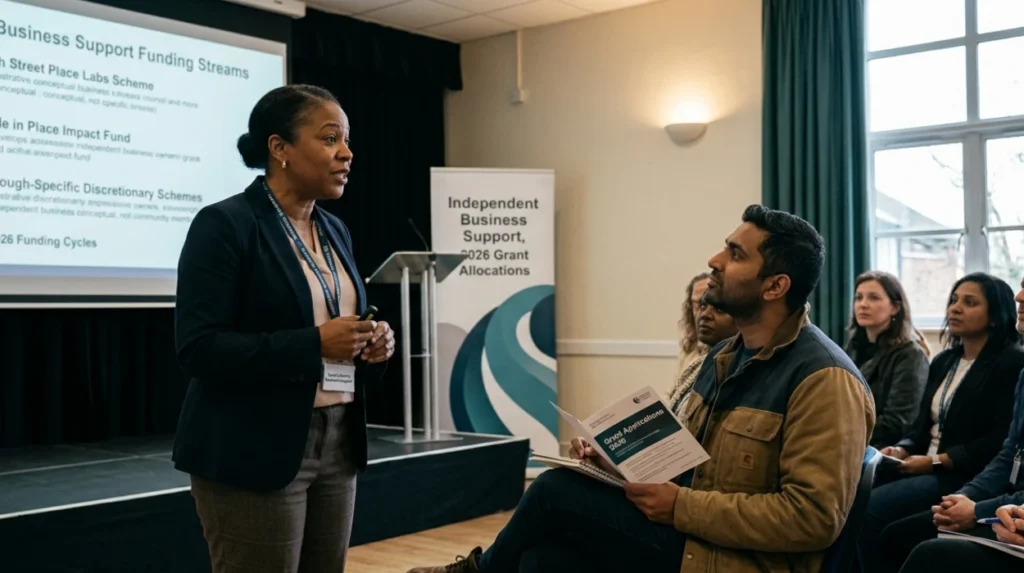
Independent business owners can access three primary funding streams in 2026: the High Street Place Labs allocations, the Pride in Place capital grants, and localized borough-specific discretionary business funds distributed via individual London local authorities.
Public sector funding models have transitioned from generalized pandemic-era relief toward targeted growth and infrastructure modification grants. The primary available mechanisms include:
- The High Street Place Labs Scheme: Administered via the Greater London Authority, this initiative provides early-stage capital to test localized commercial concepts and boost footfall. An example includes the London Borough of Newham, which secured initial allocations to design and launch economic activation strategies (Blunt et al., 2026).
- The Pride in Place Impact Fund: This capital funding pool delivers large-scale infrastructure investments directly to local councils to accelerate high street modernization. Multiple areas receive multi-million-pound commitments, such as the £1.5 million capital injection distributed across East Ham, Beckton, and Stratford to reimagine town centers as accessible, safe, and welcoming destinations (Blunt et al., 2026).
- Borough-Specific Discretionary Schemes: Individual local authorities utilize localized allocations to support independent enterprises. These mechanisms include the London Borough of Havering’s targeted regeneration joint ventures, such as the Bridge Close Regeneration project, which integrates commercial property modernization with community infrastructure investments (Reviewing, 2026).
What are the strict eligibility criteria for independent businesses?
To qualify for the 2026 recovery grants, an enterprise must operate as a registered small or medium-sized enterprise, maintain an active physical commercial presence on a designated London high street, and fall within specific statutory rateable value thresholds.
Local authorities apply strict statutory definitions to prevent the misallocation of public funds to multinational chains or online-only corporations. The baseline requirements encompass:
- Enterprise Scale: The applicant must fulfill the legal criteria of a small or medium-sized enterprise (SME). This requires employing fewer than 250 full-time equivalent staff members and maintaining an annual turnover below prescribed threshold limits.
- Geographic Constraints: The business must occupy a physical ground-floor commercial unit situated within a strictly delineated town center boundary or high street zone as defined by the local council’s planning office.
- Financial and Rateable Parameters: Grant allocations are directly tied to the property’s rateable value, which is determined by the Valuation Office Agency. Preference and maximum funding match rates are legally restricted to properties with low-to-medium rateable values, frequently capped at £51,000 or less, to shield vulnerable independent operators from displacement.
Furthermore, applicants must demonstrate structural viability. Funding cannot be used to service preexisting corporate debt or long-term arrears; instead, it must be designated for forward-looking operational diversification or physical energy-efficiency upgrades.
How does the application process operate across different London boroughs?
The application process operates via a decentralized structure where the Greater London Authority sets strategic parameters while individual London boroughs manage the digital intake portals, verify local compliance, and distribute the capital allocations directly to businesses.
Because London’s local governance model divides functional responsibilities between citywide strategies and localized day-to-day service delivery, business owners must apply directly to their respective local authority (Eke, 2026). The execution pathway follows a standardized four-stage mechanism:
- Digital Submission and Documentation: Business owners access the business support portal of their specific borough. They must upload mandatory verification evidence, including certified business accounts, current commercial lease agreements, valid proof of business rates alignment, and a itemized investment proposal outlining exactly how the grant capital will be deployed.
- Local Authority Needs Assessment: Following changes introduced in the local government finance settlement, councils evaluate applications based on targeted local needs assessments rather than generic incentive metrics (Sandford, 2026). Priority scoring is applied to businesses that actively advance borough objectives, such as transition toward net-zero operations, enhancement of public safety, or provision of social value to the immediate neighborhood (Blunt et al., 2026).
- Due Diligence and Legal Approvals: Council finance officers verify the documentation against statutory frameworks. This includes checking internal business rates retention scheme records and verifying that the enterprise is not undergoing active insolvency or liquidation proceedings (Sandford, 2026).
- Capital Disbursement and Monitoring: Approved funds are transferred directly to the commercial bank account of the enterprise. Recipients are legally required to submit formal expenditure receipts and evidence of completion within a fixed timeframe, usually six months post-disbursement, to satisfy local public accounting audits.

What specific business upgrades and interventions do these grants fund?
The 2026 recovery grants explicitly fund capital expenditures targeted at physical storefront modernization, energy-efficiency retrofitting, digital infrastructure integration, and operational diversification to ensure long-term commercial resilience.
Funding rules prohibit the allocation of these specific recovery grants toward ongoing revenue expenditures such as routine staff salaries, utility bills, or general inventory acquisition. Instead, permissible usage falls into distinct capital upgrade categories:
- Physical and Aesthetic Modernization: Independent operators can utilize funds to restore historic storefronts, install uniform signage, and replace outdated window displays to create an inviting visual environment. This aligns with broader civic cleanliness and environmental quality initiatives across major high streets (Blunt et al., 2026).
- Environmental Retrofitting: Grants support the installation of energy-efficient lighting systems, commercial heat pumps, high-grade insulation, and circular economy waste facilities to reduce overhead expenses and align with local climate action strategies.
- Digital Infrastructure Integration: Businesses can draw down capital to implement modern inventory management software, e-commerce ordering integrations, and advanced point-of-sale systems. This enables independent traders to transition toward an omnichannel model, combining traditional brick-and-mortar sales with digital fulfillment.
What are the long-term economic implications for London communities?
The long-term economic implications involve the structural transformation of high streets into diversified, socially resilient community hubs that possess the financial capacity to withstand macroeconomic fluctuations and support sustained local employment.
A persistent reliance on pure retail models exposes local centers to systemic vulnerability during financial downturns or rapid shifts in real estate markets. By deploying capital grants to adapt and diversify high streets, public policy is deliberately fostering mixed-use urban ecosystems (Blunt et al., 2026).
Data shows that vibrant high streets generate critical non-economic externalities that sustain the social fabric of the capital. These areas serve as essential platforms for face-to-face contact and public engagement, reinforcing a sense of mastery, autonomy, and local identity among residents (Brunelli, 2025). When independent coffee shops, community-led workspaces, and cultural spaces are financially stabilized through capital injections, the immediate result is an increase in localized footfall that benefits all adjacent traders.
Furthermore, structural changes to the Business Rates Retention Scheme occurring after April 2026 ensure that a portion of local commercial growth is retained within the host borough (Sandford, 2026). This financial retention mechanism provides local authorities with a sustainable revenue stream to fund ongoing public realm improvements, clean-air corridors, and community safety initiatives. Consequently, independent businesses are not merely passive recipients of public aid; they function as active economic anchors that drive inclusive growth, protect local employment, and maintain civic cohesion across London’s diverse neighborhoods.
What is the London high street recovery programme?
The 2026 high street recovery programme is a coordinated public funding initiative led by the Greater London Authority and individual London borough councils to support independent businesses, regenerate town centres, and improve long-term economic resilience across London.