
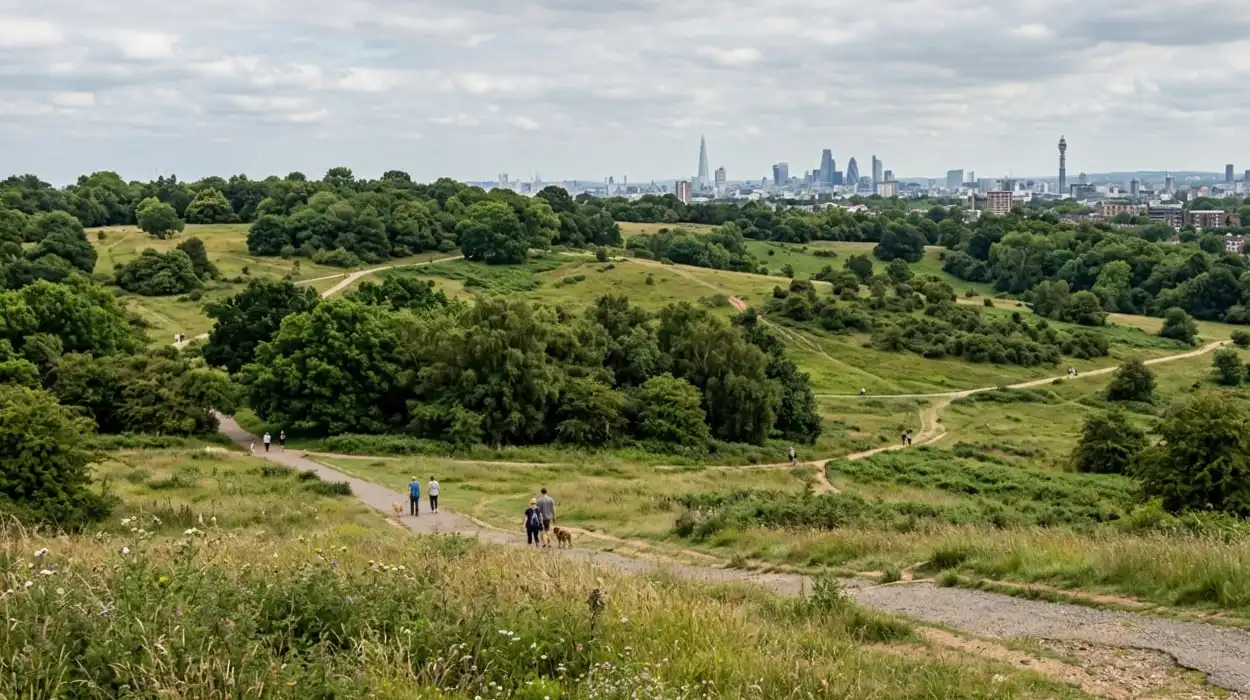
Hampstead Heath is an ancient 320-hectare public parkland in north London, managed by the City of London Corporation. It is historically significant because it represents a rare survival of medieval wood-pasture, common land, and open space amidst intensive urban expansion.
- How Did The Hampstead Heath Act Of 1871 Save The Landscape From Development?
- Which Historical Figures Shaped The Expansion And Preservation Of The Heath?
- How Did The Acquisition Of Kenwood House Alter The Footprint Of The Park?
- What Is The Ecologies and Management History of the Heath’s Famous Ponds?
- How Did Custodianship Shift Between Municipal Authorities Over The Past Century?
- What Modern Conservation Strategies Protect the Heath’s Biodiversity?
The geographical footprint of Hampstead Heath sits upon a high sandy ridge of Bagshot Beds, which overlays dense London Clay. This specific geological composition created a landscape of natural springs, bogs, and sandy gorse-covered hills that historically resisted traditional intensive agriculture. Recorded history of the area begins in the 10th century when King Ethelred the Unready granted land at Hampstead to the monastery of St Peter at Westminster in 986 AD. By the time of the Domesday Book in 1086, the manor of Hampstead was established, and its manor lands formed the core of what is today the public Heath. Throughout the medieval and early modern periods, local residents, known as commoners, utilized this land for essential survival practices, including pasturing livestock, gathering gorse for fuel, and extracting sand and gravel.
The transformation of Hampstead from a rural agrarian manor into a famous cultural destination accelerated during the early 18th century. In 1700, Dr. John Soame identified the chalybeate waters (springs rich in iron) on the eastern fringes of the Heath as possessing medicinal qualities. This led to the rapid development of the Hampstead Wells spa along Well Walk, turning the rugged common land into a fashionable retreat for affluent Londoners seeking health and recreation. The influx of visitors stimulated the local economy and initiated a shift in how the public perceived the Heath. It ceased to be merely an economic resource for agrarian commoners and became a highly valued landscape for leisure, artistic inspiration, and escape from the growing industrial pollution of central London.
The long-term survival of this open space is remarkable given the rapid urbanization of surrounding areas like Camden, Islington, and St Pancras during the 19th century. As the population of London swelled from 1 million in 1801 to over 4 million by 1881, the economic pressure to build residential housing on open land intensified. The preservation of Hampstead Heath represents one of the earliest and most influential victories for the modern environmental conservation movement. The legal battles fought to protect its open spaces established crucial precedents in English property law, demonstrating that the public interest in health, recreation, and ecological preservation could successfully challenge the absolute property rights of private landowners.
How Did The Hampstead Heath Act Of 1871 Save The Landscape From Development?
The Hampstead Heath Act of 1871 saved the landscape by authorizing the Metropolitan Board of Works to purchase 240 acres of the main Heath from the Lord of the Manor, legally extinguishing development rights and dedicating the land to public recreation forever.
The crisis that led directly to the 1871 legislation began in 1829 when Sir Thomas Maryon Wilson inherited the Manor of Hampstead as the tenant for life. Seeking to capitalize on the Victorian building boom, Sir Thomas made repeated attempts to secure private Acts of Parliament that would allow him to grant long-term building leases on his inherited estate. He envisioned covering the open ridge of the Heath with lucrative villas, roads, and formal residential squares. His ambitions faced immediate, organized resistance from affluent local residents and legal challenges from the copyhold tenants of the manor, who argued that his construction plans would illegally infringe upon their ancient customary rights to graze animals and harvest resources on the common land.
For four decades, Sir Thomas Maryon Wilson engaged in a protracted legal and political war against the local community and the Metropolitan Board of Works (the regional administrative body established in 1855). He built a series of experimental brick kilns on the Heath, began digging up deep foundations on the ridge, and constructed a large viaduct over a valley on his land in 1845 to demonstrate his intent to build. The conflict reached a climax in 1866 with the formation of the Commons Preservation Society, an influential pressure group led by figures such as George Shaw-Lefevre and John Stuart Mill. The society used aggressive public campaigns and strategic litigation to obstruct Sir Thomas at every turn, successfully blocking his building bills in Parliament a total of 12 times.
The deadlock finally broke following the death of Sir Thomas Maryon Wilson in 1869. His brother and successor, Sir John Maryon Wilson, proved far more willing to compromise and opted to sell the land to the public rather than continue the expensive, exhausting legal battles. This compromise enabled the drafting and successful passage of the Hampstead Heath Act in 1871. Under this historic statute, the Metropolitan Board of Works paid £45,000 to purchase the initial 240 acres of the Heath. The act explicitly mandated that the purchasing board must preserve the natural capital, features, and topography of the Heath, ensuring its open spaces remained unbuilt, unfenced, and freely accessible to all citizens.
Which Historical Figures Shaped The Expansion And Preservation Of The Heath?
Historical figures who shaped the Heath include social reformer Octavia Hill, who co-founded the National Trust, local advocate Henrietta Barnett, who secured the Extension, and prominent artists like John Constable, who documented and popularized its unique topography.
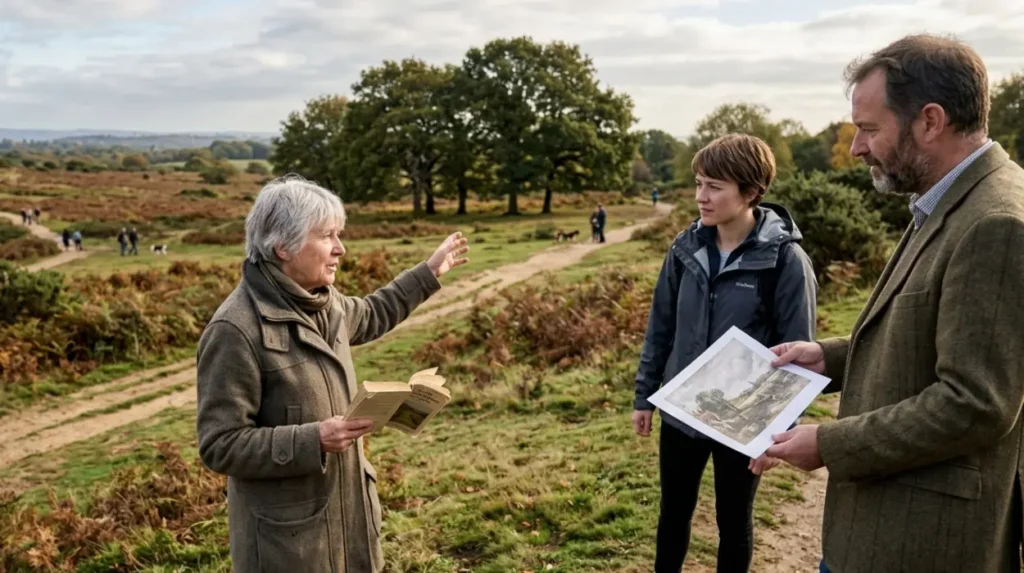
Octavia Hill played a foundational role in shifting the public debate around the Heath from narrow legal property disputes to a broader moral campaign for public health and spiritual well-being. As a pioneering social reformer, she recognized that the dense, unsanitary tenements of Victorian London caused immense physical and psychological harm to the working-class population. Hill argued passionately that open green spaces were “open-air sitting rooms” essential for the urban poor. Her activism on the Heath directly informed her work in co-founding the National Trust for Places of Historic Interest or Natural Beauty in 1895, ensuring that the preservation techniques developed at Hampstead became a blueprint for national conservation policy.
In the early 20th century, Henrietta Barnett became the driving force behind the largest single expansion of the parkland, known as the Hampstead Heath Extension. In 1896, Barnett and her husband Samuel founded Toynbee Hall, a settlement house in the East End, before moving to Hampstead. When she learned that the newly planned Charing Cross, Euston and Hampstead Railway (now the Northern Line) would terminate near the northern edge of the Heath, she realized the adjacent agricultural fields of Wyldes Farm would be rapidly consumed by speculative suburban developers. In response, Barnett formed the Hampstead Heath Extension Council in 1903, launching a massive fundraising campaign that successfully raised £132,000 from public authorities and private donors to buy 80 hectares of farmland, protecting it from development in 1907.
The cultural status and public affection that fueled these preservation campaigns were largely built by the work of prominent British artists and writers during the 19th century. John Constable lived at No. 2 Lower Terrace from 1819 and painted hundreds of detailed oil sketches and finished canvases of the Heath, capturing its dramatic sky formations, sandpits, and rolling topography. Writers like John Keats, who composed Ode to a Nightingale in a Hampstead garden, and Leigh Hunt transformed the area into a symbol of romantic naturalism. This deep cultural legacy turned the Heath into a sacred landscape in the public imagination, making any commercial development appear to be an act of cultural vandalism.
How Did The Acquisition Of Kenwood House Alter The Footprint Of The Park?
The acquisition of Kenwood House between 1922 and 1928 altered the footprint by adding 74 hectares of historic landscaped estate, ancient woodland, and a major Neoclassical mansion to the northern boundary of the public parkland.
The estate of Kenwood, originally known as Caen Wood, developed separately from the main common land of Hampstead Heath. In 1754, William Murray, the Attorney General who later became the 1st Earl of Mansfield, purchased the property as a country seat. In 1764, Mansfield commissioned the renowned Scottish architect Robert Adam to extensively remodel the existing house. Adam transformed the structure into a masterpiece of Neoclassical architecture, adding a grand south front, a magnificent library designed for entertaining, and a striking portico. The surrounding grounds were simultaneously transformed by the 2nd Earl of Mansfield, who hired the legendary landscape architect Humphry Repton to replace the formal geometric gardens with a fashionable, naturalistic landscape featuring sweeping lawns, serpentine lakes, and strategic perimeter woodlands.
By the early 20th century, the 6th Earl of Mansfield decided to sell the estate, placing this historic landscape at immediate risk of demolition and redevelopment. In 1914, a syndicate of building developers secured an option to buy the entire property to build high-density luxury housing across the historic Repton landscape. This threat triggered the formation of the Kenwood Preservation Council, led by local activists who worked tirelessly to raise funds during the economic instability following the First World War. The council successfully bought 100 acres of the estate’s woods and meadows in 1922, transferring them directly to the London County Council to be integrated into the public open space of the Heath.
The final preservation of the house and its immediate grounds was achieved through the philanthropy of Edward Guinness, the 1st Earl of Iveagh. In 1925, Lord Iveagh purchased the mansion, the remaining 74 hectares of land, and an extraordinary collection of Old Master paintings, which included works by Rembrandt, Vermeer, and Gainsborough. Upon his death in 1927, he bequeathed the entire estate, its grounds, and the art collection to the British nation. The Iveagh Bequest officially opened to the public in 1928, seamlessly merging the private aristocratic estate of Kenwood with the democratic public space of Hampstead Heath, creating a continuous, protected green corridor across north London.
Explore More History Of London News
Battlefields and Grade Listed Victorian Architecture Tours in Barnet
How the River Lea Shaped Industrial Heritage and Communities in North London
What Is The Ecologies and Management History of the Heath’s Famous Ponds?
The management history of the Heath’s ponds spans their 17th-century origin as industrial water reservoirs to their modern status as heavily regulated public swimming facilities and complex, protected wetland ecosystems.
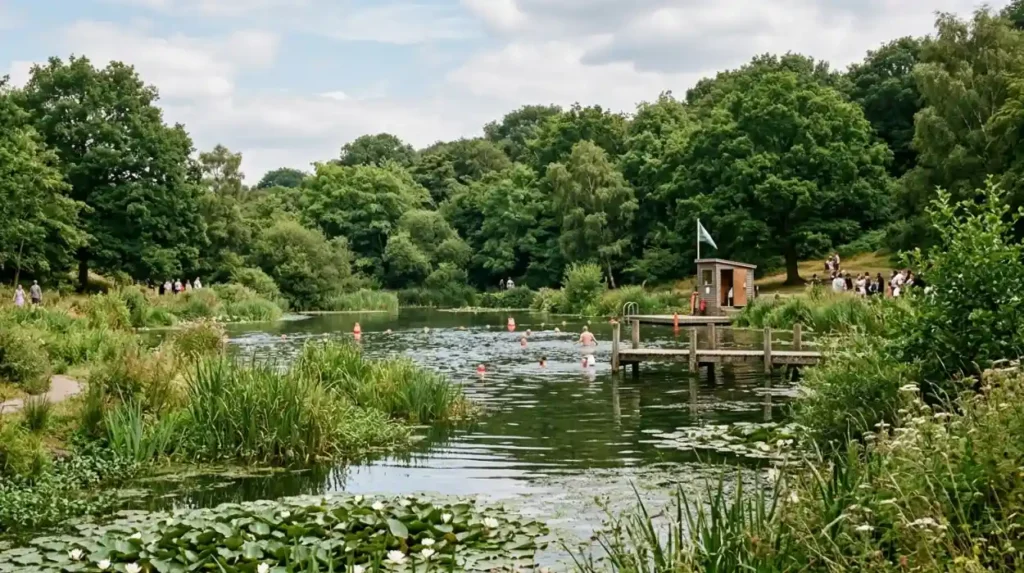
The 30 ponds across Hampstead Heath are largely artificial structures engineered to fulfill specific economic and hydrological functions over the centuries. They are divided into two main drainage systems: the Hampstead Ponds on the western side, which feed the River Fleet, and the Highgate Ponds on the eastern side, which feed the Ambrook stream. In 1692, the Hampstead Waterworks Company was established by an Act of Parliament to meet the water demands of London’s growing population. The company dammed the natural streams flowing from the Heath’s sandy ridge, creating a sequence of stepped reservoirs designed to catch, store, and filter rainwater before piping it down to central London.
As London found cleaner, alternative water sources in the mid-19th century, the reservoirs lost their industrial utility and evolved into popular sites for public recreation. Casual, unregulated bathing had occurred on the Heath for decades, but during the late Victorian era, the authorities formalised swimming by designating specific ponds for public use. Today, three historic lifeguarded enclosures remain famous worldwide: the Kenwood Ladies’ Pond, the Highgate Men’s Pond, and the Hampstead Mixed Pond. These locations represent a unique survival of open-water swimming culture, operating daily throughout the year and fiercely defended by dedicated local clubs against attempts at over-commercialization or closure.
Managing these bodies of water requires continuous, sophisticated engineering to balance public access with strict ecological preservation. Between 2015 and 2016, the City of London Corporation implemented the extensive Hampstead Heath Ponds Project, a £23 million flood-defense scheme designed to satisfy the rigorous requirements of the Reservoirs Act 1975. The project involved reinforcing individual earthen dams, constructing new spillways, and creating a massive new catchpit ecosystem at the Model Boating Pond to protect downstream residential areas from catastrophic dam failures during extreme rain events. Crucially, the engineering works integrated extensive ecological enhancements, including the planting of native reed beds, marginal vegetation, and floating islands to naturally filter the water, improve biodiversity, and secure vital habitats for protected wildfowl, amphibians, and fish species.
How Did Custodianship Shift Between Municipal Authorities Over The Past Century?
Custodianship shifted through three distinct administrative eras: the Metropolitan Board of Works (1871–1889), the London County Council and Greater London Council (1889–1986), and finally the City of London Corporation (1989–present).
The initial management era under the Metropolitan Board of Works focused squarely on securing the physical perimeter of the Heath and preventing illegal encroachment, turf-cutting, and unregulated sand extraction. In 1889, the Metropolitan Board of Works was replaced by the London County Council, a progressive, directly elected municipal authority that took a proactive approach to public recreation. The council recognized that the Heath was a vital leisure asset for London’s working classes and expanded its footprint by acquiring Parliament Hill Fields for £301,000 in 1889, followed by the Golders Hill estate in 1898. The council added public amenities, including sports pitches, bandstands, and changing facilities, while maintaining the natural character of the core heathland.
In 1965, the London County Council was reorganized into the Greater London Council, which managed the Heath during a period of rising social change and financial constraints. The council maintained the delicate balance between formal sports administration on the flat expanses of Parliament Hill and ecological conservation on the wilder parts of the upper Heath. However, the abolition of the Greater London Council in 1986 by the Local Government Act 1985 triggered a major crisis of custodianship. For three years, the future governance of the Heath was uncertain, sparking intense public anxiety that the land might be fragmented, neglected, or sold off to private interests by various local borough councils.
To resolve this crisis, Parliament passed the Hampstead Heath Act 1989, officially transferring ownership and management responsibility to the City of London Corporation. Although the corporation is historically based in the financial square mile of central London, it possessed the substantial independent financial resources and institutional longevity required to manage large public open spaces. The 1989 act established the Hampstead Heath Management Committee, which includes representatives from local amenity groups, ensuring that management decisions remain transparent, accountable, and deeply rooted in the preservation of the Heath’s unique ecology, history, and character.
What Modern Conservation Strategies Protect the Heath’s Biodiversity?
Modern conservation strategies protect biodiversity through targeted habitat management, including continuous veteran tree care, seasonal division of meadows to protect nesting birds, and strict monitoring of invasive species across the wetland networks.
The modern management of Hampstead Heath is guided by a comprehensive Management Framework that prioritizes ecological resilience alongside heavy public recreational use. The Heath contains a remarkably diverse mosaic of habitats, featuring ancient woodland, acid grassland, neutral meadows, and complex wetlands. Over 650 species of wild flowers, 40 species of breeding birds, 9 species of bats, and hundreds of distinct fungi species have been documented within its boundaries. To maintain this biodiversity, the City of London Corporation employs a dedicated team of conservationists, arborists, and keepers who work in partnership with local volunteer groups like the Heath Hands charity.
One of the most critical conservation priorities on the Heath is the management of its veteran trees, which include ancient oaks and beeches that are over 400 years old. These trees are invaluable ecological niches, providing homes for rare invertebrates and roosting sites for bats. Conservationists use specialized techniques like “retrenchment pruning”—a method that mimics the natural aging process of a tree by gradually reducing the upper canopy—to prevent top-heavy ancient trees from collapsing under their own weight. Additionally, large zones of standing and fallen deadwood are deliberately left untouched across the woodland floor to support complex fungal communities and wood-boring insects.
Another major challenge is preserving the rare acid grassland habitats found on the high sandy ridges of the Heath. Acid grassland has declined dramatically across the United Kingdom due to agricultural intensification and urban development. On the Heath, these areas are vulnerable to scrub encroachment—where aggressive plants like bramble and European gorse overrun delicate native grasses—and soil compaction caused by millions of human footsteps. Management strategies include the rotational fencing of vulnerable zones, manual scrub clearance, and the occasional reintroduction of traditional livestock grazing to naturally maintain the open structure of the grassland, ensuring this historic landscape survives for future generations.
To experience this historic landmark in person today, consult our comprehensive [Hampstead Heath Visitor Guide and Things to Do Article] for itineraries and visiting parameters.
What is Hampstead Heath?
Hampstead Heath is a 320-hectare historic park and nature reserve in North London managed by the City of London Corporation. It is one of London’s largest surviving areas of ancient woodland, heathland, and open countryside.