Key Points
- Community Backlash: Norbury residents and the Love Norbury community group are fiercely opposing an application by Merkur Slots Ltd to convert a former NatWest bank into an adult gaming centre.
- Explosive Growth in Gambling Terminals: The proposed venue would introduce an additional 41 slot machine terminals to the area, more than doubling the existing count of 31 across four local venues.
- 24-Hour Operation Concerns: Merkur Slots Ltd seeks a 24-hour gaming licence with a minimum of two staff members present between the hours of 8:00 pm and 6:00 am, triggering major local fears over nocturnal noise, loitering, and anti-social behaviour.
- Proximity to Residential Units: Campaigners highlight that the front entrance of the planned adult gaming centre sits just 12 paces away from residential flats located on Semley Road.
- Substantial Public Backing: A community petition organized by Love Norbury has generated over 1,000 signatures from residents, local businesses, and 19 distinct faith groups.
- Political Endorsement: Local political leaders, including Norbury and Pollards Hill Councillor Leila Ben Hassell, have formally backed the campaign, publicly stating that gaming centres have no place on the local high street.
- Legal Obstacles for Local Authorities: Despite immense community resistance, Croydon Council faces rigid legal limits under the 2005 Gambling Act, which campaigners argue heavily rewards corporate applicants over local councils.
Norbury (The Londoner News) June 24, 2026 – A fierce planning and licensing battle has erupted in a South London neighbourhood as residents, faith groups, and local politicians unite to stop the expansion of high street gambling. Campaigners in Norbury, Croydon, are mobilising against a formal application by corporate gaming giant Merkur Slots Ltd to turn a prominent, vacant former bank branch into a round-the-clock adult gaming centre. The community warns that the development will bring “no benefit whatsoever” to the thriving residential high street and will dramatically accelerate local issues tied to problem gambling, anti-social behaviour, and financial distress.
- Why are Norbury residents protesting against the new adult gaming centre?
- How will the proposed Merkur Slots venue affect local housing and residents?
- What are the key concerns outlined in the 1,000-signature petition?
- What positions have local politicians taken on the Norbury gambling dispute?
- Why does Croydon Council face legal limits in blocking gambling apps?
- How does Merkur Slots Ltd defend its high street expansion plans?
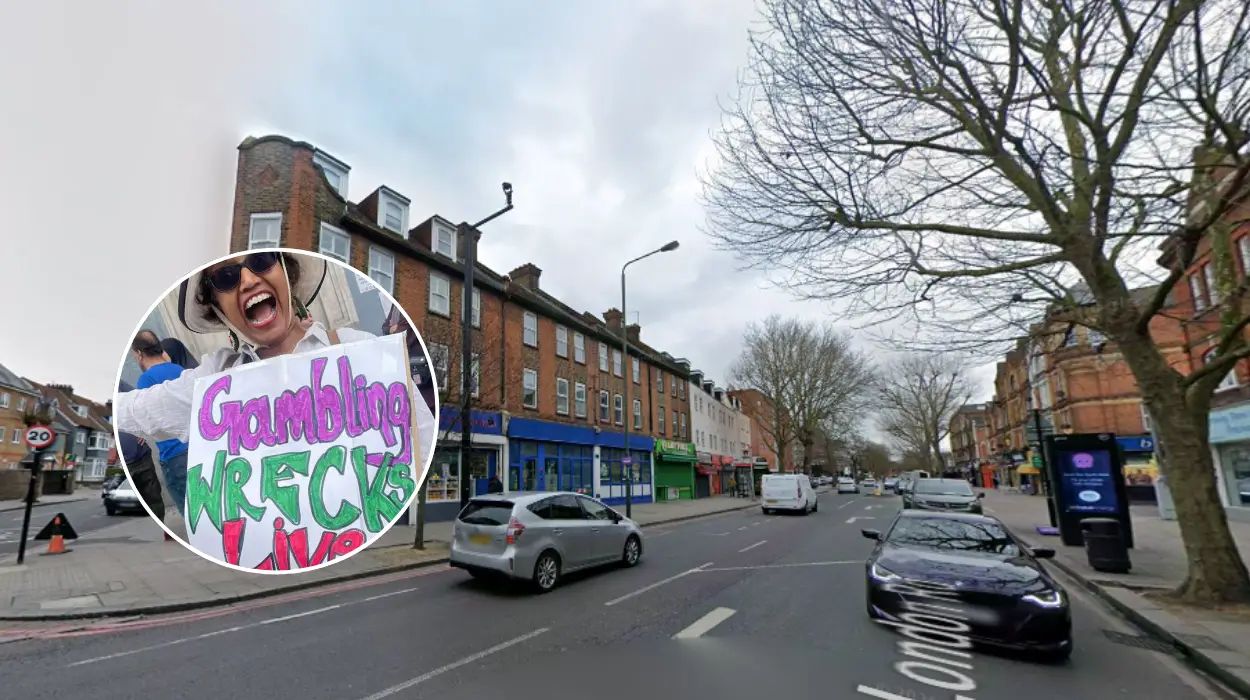
The proposed establishment, set to occupy the former NatWest bank site on London Road, has triggered widespread alarm because it would more than double the concentration of high-stakes electronic slot machines in the immediate vicinity. According to community figures, the venue would add 41 new betting terminals to the 31 already operating within a few hundred yards of the site. On Saturday, June 20, members of the Love Norbury community coalition staged a high-profile protest outside the closed bank doors, highlighting that the development threatens the safety and character of what remains a heavily family-oriented shopping district.
Why are Norbury residents protesting against the new adult gaming centre?
As reported by Harrison Galliven, the Local Democracy Reporter for MyLondon, the primary catalyst for the escalating community backlash is the belief that the high street is already oversaturated with gambling establishments. Norbury currently hosts four separate betting operations situated within a small geographic pocket along London Road. Local campaigners argue that adding a fifth, high-capacity adult gaming centre provides no social or economic utility to the neighbourhood.
Expressing the deep frustration felt across the South London borough, Paloma Lacy, a prominent member of the Love Norbury community group, spoke directly to the Local Democracy Reporting Service (LDRS). As tracked in the reporting of Harrison Galliven of MyLondon, Lacy stated that “There is enough of a gambling presence in Norbury. This is a family area,” before adding, “Give me another vape shop, butcher, café—anything other than another gambling centre.”
The community’s anxiety is deepened by the specific operational details requested in the corporate licensing application. Merkur Slots Ltd has sought permission to operate the adult gaming centre 24 hours a day, 7 days a week. While the operator has pledged to maintain a minimum of two staff members on site during the overnight window between 8:00 pm and 6:00 am, residents argue that a round-the-clock commercial gambling venue will inevitably become a magnet for late-night loitering, noise disruption, and public nuisance.
How will the proposed Merkur Slots venue affect local housing and residents?
A critical issue raised by the campaign is the extreme proximity of the proposed commercial gambling unit to existing residential properties. High street layouts in South London frequently feature residential flats directly adjacent to or above retail units, making commercial shifts highly impactful on domestic life.
Deborah Bestwick, the Chair of Love Norbury—an umbrella organisation representing 19 local faith groups, residents’ associations, and independent businesses—strongly criticised the spatial arrangement of the planned development. As recorded by Harrison Galliven of MyLondon, Bestwick told the LDRS: “The people of Norbury do not want this here. This is a residential shopping street; it is a thriving neighbourhood. This gambling centre would bring no benefit whatsoever.”
To illustrate just how integrated the site is within the immediate residential framework, Bestwick provided a striking spatial measurement to reporters. As reported by Harrison Galliven of MyLondon, Bestwick noted that “The main door is only 12 paces away from the flats on Semley Road.” This exceptionally short physical distance has fueled fears that overnight foot traffic, smoke breaks, and street-level congregations will directly damage the quality of life and sleep schedules of neighbouring families.
What are the key concerns outlined in the 1,000-signature petition?
The grassroots resistance against Merkur Slots Ltd has rapidly crystallised into a formal petition, which has successfully gathered over 1,000 signatures from concerned citizens in a matter of weeks. The text of the petition outlines serious socio-economic risks, warning that expanding electronic gambling options targets vulnerable populations during an ongoing economic squeeze.
A major concern raised by local organizers is the immediate physical environment surrounding the old NatWest bank. The community petition specifically notes a troubling geographical synergy on the high street. As detailed by Harrison Galliven of MyLondon, the petition’s author pointed out that “the adjacent Cash Exchange pawnbroker creates an immediate and obvious route to fund gambling losses.”
Local advocates argue that positioning a 24-hour slot machine terminal next to a pawn shop sets an explicit financial trap for individuals struggling with problem gambling. The petition warns that the infrastructure encourages a destructive loop of pawning personal assets to instantly chase losses next door. As highlighted by Harrison Galliven of MyLondon, the petition added:
“By permitting Merkur Slots to establish operations at this location, we are allowing the infiltration of our community through more gambling opportunities, potentially leading to higher rates of addiction, financial distress, and mental health issues among our residents.”
What positions have local politicians taken on the Norbury gambling dispute?
The escalating row has drawn sharp criticism from local political figures, who have formally sided with Love Norbury to pressure licensing authorities. Politicians are echoing the community’s sentiment that commercial high streets require diverse regeneration rather than an expansion of the betting economy.
Providing heavy political backing to the local campaign, Councillor Leila Ben Hassell, who represents the Norbury and Pollards Hill ward, has taken a firm public stance against the corporate application. Ben Hassell, who carries significant political influence as the Deputy Leader of the Opposition and Shadow Cabinet Member for Finance on Croydon Council, has made it clear that the development conflicts with local urban development goals. As recorded by Harrison Galliven of MyLondon, Ben Hassell stated unequivocally that “A gaming centre has no place here.”
Political opposition is also tied to a broader disappointment regarding the loss of vital banking infrastructure. The site in question became available following the closure of the NatWest branch in June 2024, an exit that left a severe vacuum for local cash and face-to-face banking services. Residents have expressed ongoing frustration that Norbury is not currently slated to receive a LINK banking hub—a collaborative physical banking space run by high street banks—despite such hubs being successfully introduced in nearby Mitcham and Coulsdon.
Explore more South London News:
£17m Walnuts Leisure Centre Transformation Reopens: Orpington 2026
Southwark Council Court Case Over Emergency Housing List: South London 2026
Why does Croydon Council face legal limits in blocking gambling apps?
One of the most complex challenges facing the anti-gambling coalition is the rigid legal framework governing commercial betting licenses in the United Kingdom. Local authorities frequently find their decision-making hands tied by historical national statutes that limit local democratic vetoes.
Deborah Bestwick acknowledged that stopping the corporate application through Croydon Council’s regulatory channels will be an uphill battle due to statutory constraints. As reported by Harrison Galliven of MyLondon, Bestwick acknowledged that Croydon Council’s structural powers to reject gambling applicants were significantly restricted under the 2005 Gambling Act, a piece of national legislation she believes is “entirely in favour of the applicants.”
Under the current legal layout, local authorities across England cannot reject a gambling licence based on moral objections, general community opposition, or a perceived lack of commercial demand. Instead, a council can only legally block an application if it successfully demonstrates a direct conflict with one of four strictly defined licensing objectives:
- Preventing crime and disorder or being associated with crime.
- Ensuring that gambling is conducted in a fair and open way.
- Protecting children and other vulnerable persons from being harmed or exploited by gambling.
- Maintaining public safety and preventing public nuisance.
How did timing affect the use of new devolution powers?
The battle in Norbury has also highlighted a frustrating legislative near-miss regarding local authority powers. The UK Parliament recently passed the English Devolution and Community Empowerment Act 2026, which received Royal Assent on April 29, 2026. This updated legal framework explicitly grants councils the power to produce mandatory Gambling Impact Assessments when evaluating applications for new betting premises, giving local communities a much stronger statutory voice.
However, the timing of the corporate submission effectively bypassed this protective shield. As tracked by Harrison Galliven of MyLondon, Bestwick explained that Merkur Slots Ltd submitted its formal paperwork just before the new devolution legislation officially received Royal Assent. Consequently, Croydon Council must evaluate the application under the older, more corporate-friendly criteria, leaving local planners with limited legal mechanisms to enforce a refusal.
How does Merkur Slots Ltd defend its high street expansion plans?
In the face of intensive community picketing, political resistance, and a 1,000-strong petition, the corporate applicant maintains that its project represents a positive step forward for Norbury’s commercial health. The company frames its proposal as an asset rehabilitation project that addresses the problem of high street vacancy.
Responding directly to the community pushback, a spokesperson for Merkur Slots Ltd defended the commercial logic of the adult gaming centre, arguing that converting the old NatWest bank prevents the high street from falling into urban decay. As reported by Harrison Galliven of MyLondon, the Merkur spokesperson stated:
“We believe this is an excellent opportunity to bring this important site, a closed venue in the heart of the town centre, back into commercial use. Our application, if approved, will create new local jobs and represents much-needed investment in the high street at a challenging time.”
The corporate entity argues that high streets across the country are facing unparalleled economic pressures, and that filling large, vacant banking halls with operational commercial businesses generates footfall and employment that benefits surrounding traders. This argument forms the baseline of the upcoming licensing and planning hearings, where Croydon Council’s committee will be forced to balance corporate investment claims against an exceptionally unified wall of community opposition.