
London’s hidden alleys preserve centuries of urban history beyond the city’s famous landmarks. Narrow medieval passages, secluded courts, and ancient lanes reveal how commerce, religion, crime, craftsmanship, and everyday life shaped the capital. Many survived the Great Fire of 1666, Victorian redevelopment, wartime bombing, and modern construction, making them valuable historical landscapes that continue to connect visitors with London’s earliest streetscape.
- What are London’s hidden historic alleys, and why are they historically significant?
- How did London’s medieval street network create hidden alleys?
- Which hidden alleys best preserve London’s forgotten history?
- How did trade and commerce shape London’s historic alleyways?
- What role did hidden alleys play in everyday London life?
- How did major historical events change London’s forgotten corners?
- Why are London’s hidden alleys important for archaeology and historical research?
- How are London’s forgotten historic alleys protected today?
- What makes London’s hidden alleys valuable for modern visitors?
What are London’s hidden historic alleys, and why are they historically significant?
London’s hidden historic alleys are narrow pedestrian passages dating from the medieval, Tudor, Stuart, Georgian, and Victorian periods. They preserve original street layouts, historic buildings, commercial traditions, and archaeological evidence, providing rare insight into London’s continuous urban development across nearly two thousand years.
Unlike London’s grand boulevards and famous shopping streets, hidden alleys developed naturally as the medieval city expanded around markets, churches, guild halls, docks, and residential neighbourhoods. Many originated before systematic urban planning became common.
These passages connected homes with workshops, warehouses, churches, inns, and riverside wharves. Before modern roads widened transportation routes, walking represented the primary form of movement inside the historic City of London. Every alley therefore served practical economic and social functions.
Several hidden alleys still follow routes established during the Roman occupation beginning in AD 43. Others emerged during the Norman period after 1066 or during London’s commercial expansion between the twelfth and fifteenth centuries.
Many retain original names reflecting historic occupations. Examples include streets associated with candle makers, iron merchants, fishmongers, brewers, and cloth traders. These names function as historical records of London’s medieval economy.
Today, conservation policies protect numerous historic passages because they demonstrate how the capital evolved before modern city planning transformed much of Britain.
How did London’s medieval street network create hidden alleys?
London’s medieval street network developed organically around defensive walls, churches, markets, rivers, and trade routes. Limited available space encouraged narrow passageways connecting commercial districts, resulting in a dense urban fabric that survives through many hidden alleys today.
Medieval London occupied only a fraction of the city’s present size. Most development remained inside the Roman walls until population growth required gradual expansion.
The city’s irregular street pattern reflected practical necessity rather than formal planning. Buildings expanded wherever space became available. Property owners subdivided land repeatedly over generations, creating narrow courts and interconnected passages.
Commercial growth accelerated between the twelfth and fourteenth centuries as London became England’s leading trading centre. Merchant houses required rear entrances for deliveries. Craftsmen established workshops behind main streets. Religious institutions enclosed churchyards with pedestrian access points.
Water also influenced street design. Small streams, drainage channels, and access routes to the River Thames generated winding passages rather than straight avenues.
Guilds played an important role in neighbourhood organisation. Individual trades often clustered together, creating specialised commercial districts linked by narrow alleys. Examples include districts associated with goldsmiths, leather workers, and spice merchants.
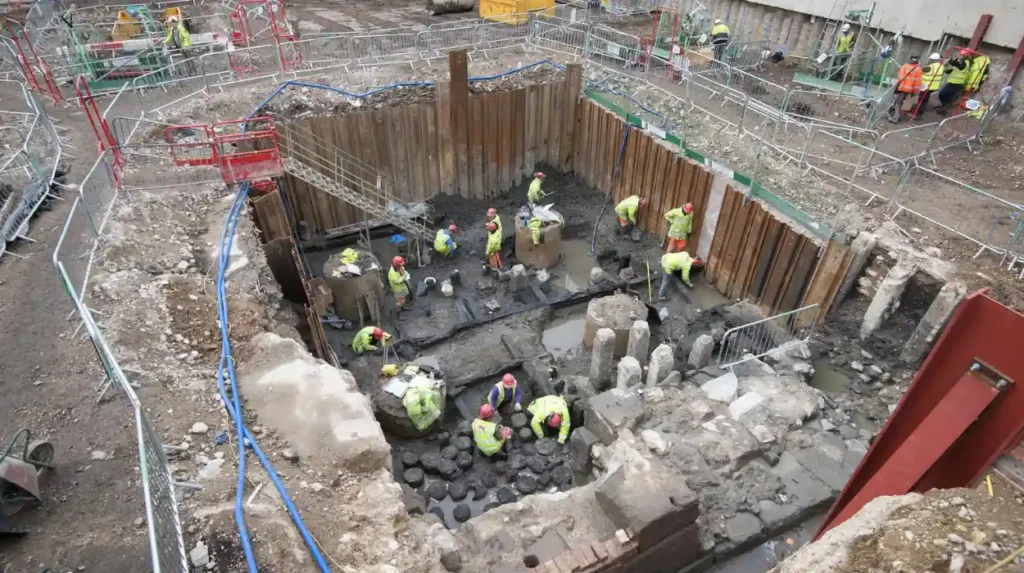
Archaeological excavations conducted before major construction projects continue to reveal medieval paving, drainage systems, timber foundations, pottery, coins, and household artefacts beneath these historic routes.
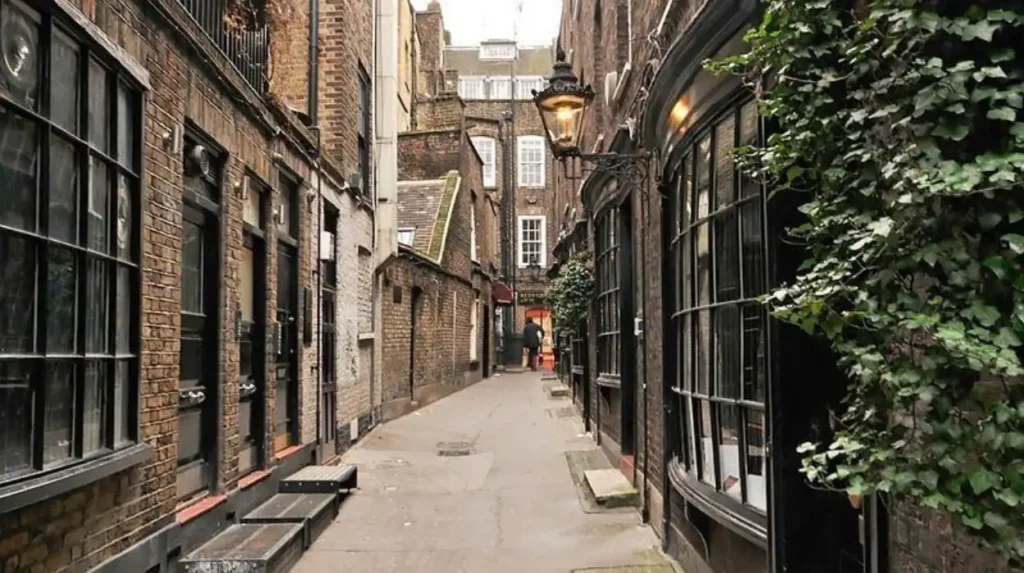
Which hidden alleys best preserve London’s forgotten history?
Several surviving alleys preserve exceptional historical character through medieval layouts, Georgian architecture, Tudor buildings, historic inns, churches, and commercial landmarks. These locations represent some of London’s most authentic surviving urban environments outside major tourist routes.
Among the finest surviving examples is Goodwin’s Court, a remarkably narrow passage near Covent Garden. Dating largely from the late seventeenth century, it retains timber-framed shopfronts, projecting windows, traditional lanterns, and an intimate scale that reflects pre-modern London.
Bleeding Heart Yard combines legend with documented history. Its enclosed courtyard originated during the seventeenth century and became associated with London’s legal and artisan communities. The surrounding brick buildings preserve characteristic Georgian architecture.
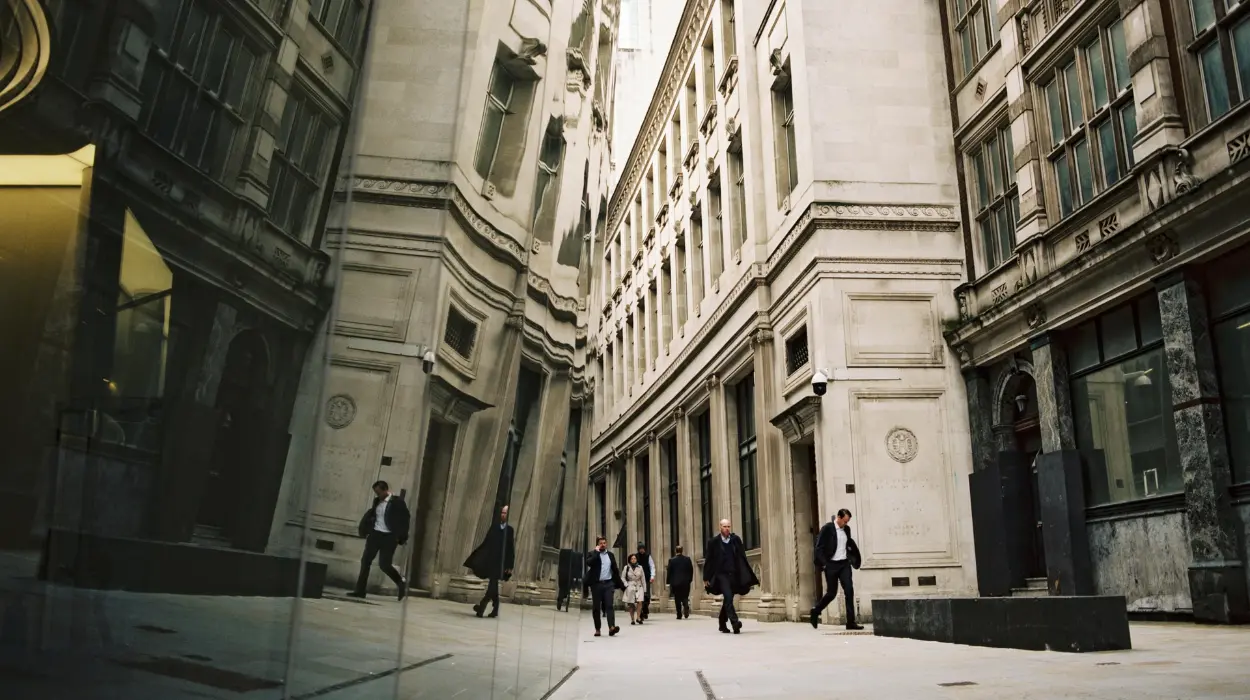
Angel Court in the City of London illustrates how commercial passages evolved around offices, warehouses, and merchant premises. Although modern buildings surround it, the historic street alignment survives.
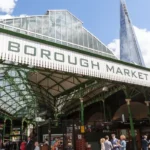
Stoney Street, beside Borough Market, reflects London’s long association with food trading. Medieval market activity continues in adapted form today, preserving continuity between historic commerce and modern retail.
The lanes surrounding St Dunstan-in-the-East combine medieval street layouts with one of London’s most distinctive historic churches. After wartime destruction during the Second World War, the church became a public garden, creating an unusual combination of archaeology, architecture, and landscape preservation.
Together these surviving spaces demonstrate the diversity of London’s historic urban fabric across different periods and economic activities.
How did trade and commerce shape London’s historic alleyways?
Trade transformed London’s hidden alleys into specialised commercial corridors serving merchants, craftsmen, warehouses, markets, and river transport. Their development reflected economic expansion from medieval guild systems through Britain’s emergence as a global trading power during the eighteenth century.
Commerce determined where many alleys formed.
The River Thames functioned as London’s commercial highway for centuries. Goods arriving from Europe and later from global trade networks moved inland through narrow passages connecting docks with warehouses.
Markets generated equally complex networks. Traders required storage areas separated from crowded public spaces. Rear courts accommodated carts, horses, workshops, and loading activities.
Guild regulations reinforced occupational clustering. Metalworkers concentrated near suppliers. Textile merchants grouped around cloth markets. Booksellers settled close to educational institutions and religious centres.
The expansion of international trade after the sixteenth century introduced imported products including sugar, tobacco, tea, coffee, spices, silk, and porcelain. Merchants operating from relatively modest premises participated in commercial networks extending across Europe, Asia, Africa, and the Americas.
Insurance businesses, financial services, and shipping companies later established offices near London’s commercial districts. Many historic passages therefore connected directly with institutions that influenced Britain’s expanding economy.
These commercial landscapes illustrate how seemingly modest streets supported one of the world’s largest trading cities.
What role did hidden alleys play in everyday London life?
Hidden alleys functioned as residential communities, workplaces, transport routes, religious access points, and neighbourhood meeting spaces. Their mixed-use character illustrates how people lived and worked within compact urban environments before modern planning separated residential and commercial districts.
Life inside historic alleys differed significantly from London’s grand ceremonial streets.
Families often lived above workshops or shops. Apprentices resided with masters while learning skilled trades. Courtyards contained communal wells, storage facilities, kitchens, and small gardens where space permitted.
Many alleys connected directly with parish churches. Religious observance formed an important part of community identity, and churches frequently organised charitable assistance for nearby residents.
Coffee houses emerging during the seventeenth century transformed some passages into centres of discussion, commerce, journalism, and finance. Merchants negotiated contracts while intellectuals exchanged political ideas.
Public houses provided accommodation for travellers, employment for local residents, and meeting places for guilds, clubs, and professional associations.
Urban density also created public health challenges. Limited drainage, overcrowding, and periodic disease outbreaks influenced successive improvements in sanitation during the nineteenth century.
Historic census records, parish registers, tax documents, and property surveys allow historians and genealogical researchers to reconstruct many of these neighbourhood communities in remarkable detail.
How did major historical events change London’s forgotten corners?
Major historical events including the Great Fire of 1666, industrialisation, Victorian redevelopment, the Blitz, and post-war reconstruction reshaped London’s historic alleys while leaving important surviving examples that illustrate different phases of urban resilience and preservation.
The Great Fire destroyed approximately 13,200 houses, 87 parish churches, and most medieval buildings inside the City of London in September 1666.
Although reconstruction followed more organised principles, many earlier street alignments remained because existing property boundaries proved difficult to reorganise completely.
During the Georgian era, brick construction replaced many timber buildings, reducing fire risk while introducing more regular architectural styles.
Victorian infrastructure projects eliminated numerous medieval courts. Railway stations, wider roads, commercial buildings, and sanitation improvements required extensive demolition throughout central London.
The Second World War produced another major transformation. German bombing damaged historic districts across the City and East London between 1940 and 1941.
Post-war planners balanced reconstruction with heritage protection. Several bomb-damaged structures became preserved ruins rather than being completely rebuilt, creating distinctive historical landscapes visible today.
Since the late twentieth century, conservation areas, listed building legislation, and archaeological requirements have improved protection for surviving historic passages.
To experience this historic landscape in person today, consult our comprehensive [Why London’s Famous Streets Were Built and How They Shaped the City] for itineraries and visiting parameters.
Why are London’s hidden alleys important for archaeology and historical research?
Historic alleys preserve archaeological deposits, documentary evidence, architectural features, and property boundaries spanning multiple historical periods. Researchers use these surviving environments to reconstruct London’s economic, social, architectural, and demographic development through interdisciplinary historical investigation.
Urban archaeology has transformed understanding of London’s past.
Excavations beneath historic streets frequently uncover Roman roads, medieval drainage systems, Tudor household objects, Georgian foundations, and Victorian infrastructure within remarkably small excavation areas.
The Museum of London Archaeology has documented thousands of archaeological discoveries during redevelopment projects across central London.
Property boundaries visible today often correspond closely with medieval land divisions recorded in historical documents.
Architectural historians analyse brickwork, timber framing, windows, roofing materials, and construction techniques to determine building phases spanning several centuries.
Genealogists benefit from parish registers, tax assessments, probate records, electoral rolls, and insurance documents linked to identifiable historic addresses.
Digital mapping projects now combine historical maps with modern geographic information systems, allowing researchers to compare centuries of urban development with unprecedented precision.
These combined approaches provide one of Europe’s richest continuous records of urban evolution.
How are London’s forgotten historic alleys protected today?
Historic alleys receive protection through listed building legislation, conservation area designation, archaeological planning policies, heritage organisations, and municipal preservation strategies that safeguard architectural integrity while supporting sustainable public access and continued urban use.
Heritage protection operates through several complementary systems.
Thousands of historic buildings throughout Greater London hold listed status because of architectural or historical significance.
Conservation areas regulate alterations affecting streetscapes, building appearance, demolition, and new development.
Planning authorities require archaeological assessments before many construction projects proceed within historically sensitive districts.
National heritage organisations collaborate with local authorities, universities, museums, and community groups to document threatened sites.
Building owners increasingly restore historic façades using traditional materials and conservation techniques rather than wholesale replacement.
Interpretation panels, guided heritage walks, digital archives, and educational programmes improve public understanding without compromising historic authenticity.
Tourism also contributes positively when managed responsibly. Visitors who respect conservation rules support businesses occupying restored historic buildings, encouraging continued preservation.
Climate adaptation now represents an additional priority. Conservation specialists address flooding, pollution, weathering, and environmental change while protecting historic fabric for future generations.
What makes London’s hidden alleys valuable for modern visitors?
London’s hidden alleys provide authentic historical experiences beyond major landmarks by preserving original street patterns, architectural diversity, archaeological significance, and centuries of urban continuity. They enable visitors to understand how ordinary people shaped one of the world’s most influential cities.
Modern tourism often concentrates on internationally recognised landmarks, yet hidden alleys reveal aspects of history rarely visible within monumental architecture.
These spaces demonstrate how merchants, craftsmen, labourers, religious communities, printers, lawyers, sailors, and residents contributed to London’s development across successive centuries.
Walking through preserved passages allows visitors to observe changes in building materials, street widths, architectural proportions, drainage systems, and commercial layouts within relatively short distances.
Educational institutions increasingly incorporate these locations into urban history, architecture, archaeology, and heritage conservation programmes because they illustrate historical processes more effectively than isolated monuments.
For photographers, researchers, and cultural tourists, hidden alleys provide visual evidence of London’s layered development from Roman settlement through medieval commerce, Georgian expansion, Victorian industrialisation, wartime resilience, and twenty-first-century conservation.
Their continuing survival demonstrates that urban heritage includes ordinary streets as well as famous palaces, cathedrals, and government buildings. Preserving these overlooked corners ensures future generations can study, experience, and understand the everyday environments that shaped London’s long and complex history.
What are London’s hidden historic alleys?
London’s hidden historic alleys are narrow lanes, courts, and pedestrian passages that originated during the Roman, medieval, Tudor, Georgian, and Victorian periods. They preserve original street layouts, historic buildings, and centuries of urban history.