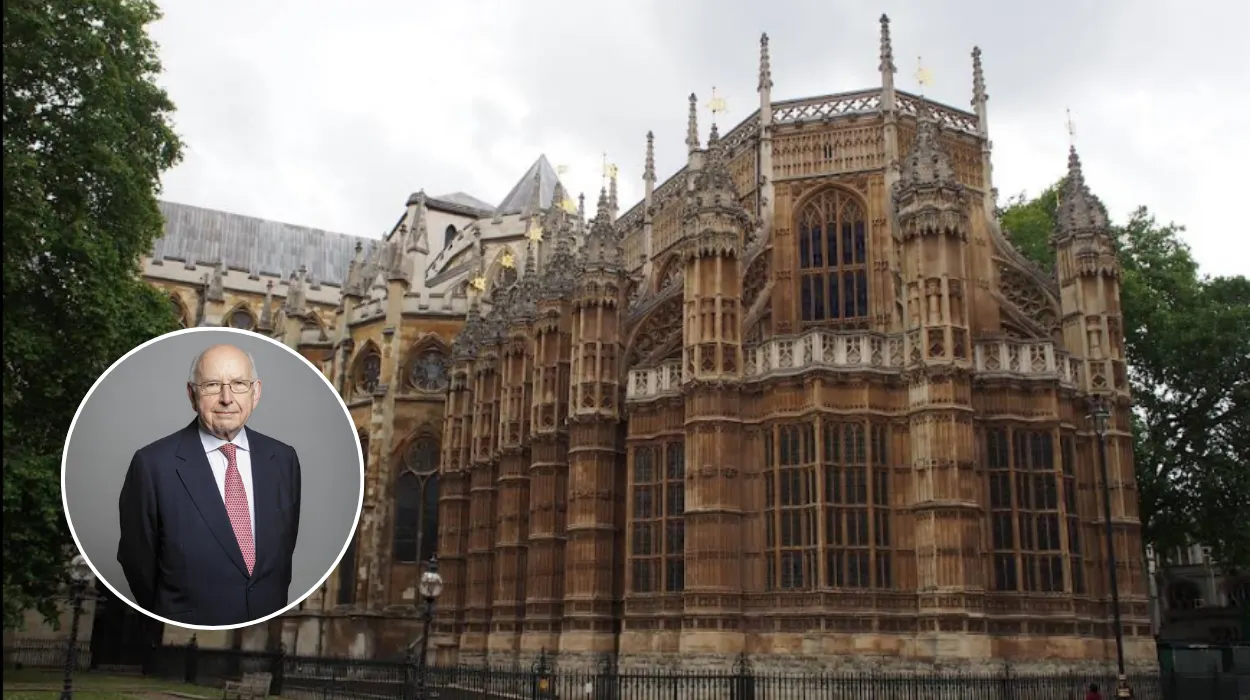
Key Points
- Former government minister and cross-party peer Lord John Horam has passed away at the age of 87.
- The peer died at St Mary’s Hospital in Paddington, London, following an accidental fall.
- The fatal accident occurred on July 2 as he was traveling home after a full day’s work at the House of Lords.
- Despite immediate medical intervention and dedicated care from both emergency paramedics and hospital staff, he never regained consciousness.
- Born in Lancashire, his varied early career included helping develop the After Eight mint for Rowntree before working as a journalist.
- Lord Horam holds a unique place in modern British political history as the only Member of Parliament to represent three separate political parties in the House of Commons.
- He was originally elected as the Labour MP for Gateshead in 1970, defected to help found the Social Democratic Party (SDP) in 1981, and later joined the Conservative Party.
- He served as a junior minister in both Labour and Conservative administrations throughout his extensive parliamentary career.
London (The Londoner News) July 25, 2026 — Former government minister and veteran parliamentarian Lord John Horam has died at the age of 87 following a tragic accident in the British capital. According to an official announcement released by his grieving family, the peer passed away at St Mary’s Hospital in Paddington after suffering a severe fall while making his way home from a day of working at the House of Lords. The incident, which took place on July 2, left the former politician gravely injured. Despite rapid medical assistance rendered by emergency paramedics at the scene and subsequent intensive care provided by specialized hospital medical staff, Lord Horam unfortunately never regained consciousness. His death marks the conclusion of a remarkable, multi-faceted public life that spanned journalism, corporate product development, and decades of high-level British politics across multiple political divides.
Who was Lord John Horam and what was his early background?
Tracing his roots back to the North West of England, John Rhodes Horam was born in Preston, Lancashire, on 7 March 1939. Before stepping into the formidable arena of national politics, he navigated a remarkably diverse professional pathway.
As documented in historical profiles and legislative records, his very first professional role involved working on the commercial development of the iconic After Eight mint confectionery for Rowntree.
Following his stint in the corporate food sector, he transitioned into the media industry, working as a professional journalist before setting his sights firmly on public service and electoral politics.
Explore More London Politics News
Andy Burnham’s Plans for Europe in London, 2026
PM Keir Starmer Faces Final Downing Street PMQs: London 2026
How did Lord John Horam make history in the House of Commons?
Lord Horam carved out a distinctive, unmatched niche in modern British constitutional history. As noted in political archives, he remains the only Member of Parliament in recent times to officially represent three different political parties within the House of Commons.
His parliamentary journey commenced in June 1970, when he was successfully elected to Parliament as the Labour MP for Gateshead West.
As political shifts shook the foundations of traditional British party politics in the early 1980s, Lord Horam chose a different path. In 1981, he joined the exodus from the Labour Party to become a founding member and high-profile defector to the newly established Social Democratic Party (SDP).
His political evolution did not stop there; he later aligned himself with the Conservative Party, securing election as the Conservative MP for Orpington in April 1992—a seat he held until stepping down ahead of the 2010 general election.
Which government ministries and ministerial roles did he hold?
Throughout his lengthy career in Westminster, Lord Horam crossed traditional partisan boundaries to serve as a minister under both Labour and Conservative administrations. During the Labour government of James Callaghan in the late 1970s, he served as the Parliamentary Under-Secretary of State for Transport from September 1976 until May 1979.
Decades later, under the Conservative government led by Prime Minister John Major, he returned to executive office. He served as Parliamentary Secretary to the Duchy of Lancaster office before taking up the post of Parliamentary Under-Secretary of State for Health in November 1995.
In his health portfolio, he managed vast areas of responsibility, including the restructuring of Community Health Councils and the rollout of the controversial Private Finance Initiative (PFI) until the Conservative administration fell in the 1997 general election.
What was his contribution to the House of Lords and later life?
Following his departure from the House of Commons, Lord Horam continued his public service journey. Between 2011 and 2018, he lent his expertise as a Commissioner at the Electoral Commission, supervising national elections and referendums.
Recognizing his extensive contributions to public life, he was created a working life peer on September 4, 2013, taking the title Baron Horam of Grimsargh in the County of Lancashire.
In the Upper House, Lord Horam remained active on numerous influential legislative panels, including the Delegated Powers and Regulatory Reform Committee, the Communications and Digital Committee, and the European Union Committee’s External Affairs Subcommittee.
Furthermore, he acted as a key founder and vice-chair of the Common Sense Group of Conservative parliamentarians. Tributes are expected to pour in from across the political spectrum as parliamentary colleagues, friends, and family mourn the loss of a dedicated public servant whose career mirrored the dramatic shifts in modern British democracy.