London is one of the world’s oldest continuously inhabited capital cities, with nearly 2,000 years of documented history. While landmarks such as the Tower of London, Westminster Abbey, and St Paul’s Cathedral attract millions of visitors annually, many lesser-known historic locations preserve equally significant chapters of London’s political, religious, commercial, and social development. These forgotten corners reveal evidence of Roman occupation, medieval craftsmanship, Tudor governance, Victorian industry, wartime resilience, and modern conservation.
- What are London’s forgotten historic corners?
- Why do many historic places in London remain overlooked?
- Which forgotten Roman sites still survive in modern London?
- Which medieval streets preserve London’s earliest urban character?
- What forgotten churches preserve London’s religious heritage?
- How did London’s hidden alleys shape commerce and daily life?
- What role did forgotten cemeteries and churchyards play in London’s history?
- Which forgotten industrial locations transformed London’s economy?
- How did hidden locations survive the Great Fire and the Blitz?
- What archaeological discoveries continue to reshape London’s history?
- How are London’s forgotten historic places protected today?
- Why do forgotten historic places remain important for understanding London’s future?
Many of these sites survive because of careful preservation by heritage organisations, archaeological excavations, local authorities, and community groups. Their stories provide valuable insights into how London evolved from the Roman settlement of Londinium into one of the world’s leading global cities.
What are London’s forgotten historic corners?
London’s forgotten historic corners are lesser-known streets, buildings, churchyards, alleys, archaeological remains, and public spaces that preserve important historical evidence but receive relatively few visitors despite their national cultural, architectural, religious, and archaeological significance.
Unlike London’s internationally recognised monuments, these locations often remain hidden within busy commercial districts or residential neighbourhoods. Many escaped redevelopment after the Great Fire of 1666, survived the Blitz during the Second World War, or were rediscovered through archaeological investigations during the twentieth and twenty-first centuries.
These places represent different historical eras, including three major periods: Roman Londinium, medieval London, and Victorian London. Examples include Roman walls, medieval churches, and Victorian industrial infrastructure.
Their significance extends beyond architecture. They document changes in governance, trade, religion, healthcare, immigration, education, and urban planning across nearly two millennia.
Studying these locations helps historians reconstruct everyday life rather than focusing only on royal events or military history.
Why do many historic places in London remain overlooked?
Many historic places remain overlooked because urban expansion, commercial redevelopment, changing transport routes, and tourism concentration direct most visitors toward internationally famous attractions while smaller heritage sites receive limited public attention despite exceptional historical importance.
London covers more than 1,500 square kilometres across Greater London, making it impossible for most visitors to explore every historic district.
Tourism naturally concentrates around Westminster, South Bank, the City of London, Kensington, and Greenwich.
Meanwhile, many remarkable heritage sites occupy narrow medieval lanes, hidden courtyards, former monastery grounds, or quiet residential streets.
Some locations lack large visitor centres, while others function as active churches, workplaces, or conservation areas rather than museums.
Urban archaeology also continues to uncover forgotten structures beneath modern office developments, expanding historical knowledge every decade.
Which forgotten Roman sites still survive in modern London?
Several Roman sites remain preserved beneath or alongside modern buildings, providing direct evidence of Londinium’s defensive systems, commercial activities, religious practices, and civic administration between AD 43 and the early fifth century.
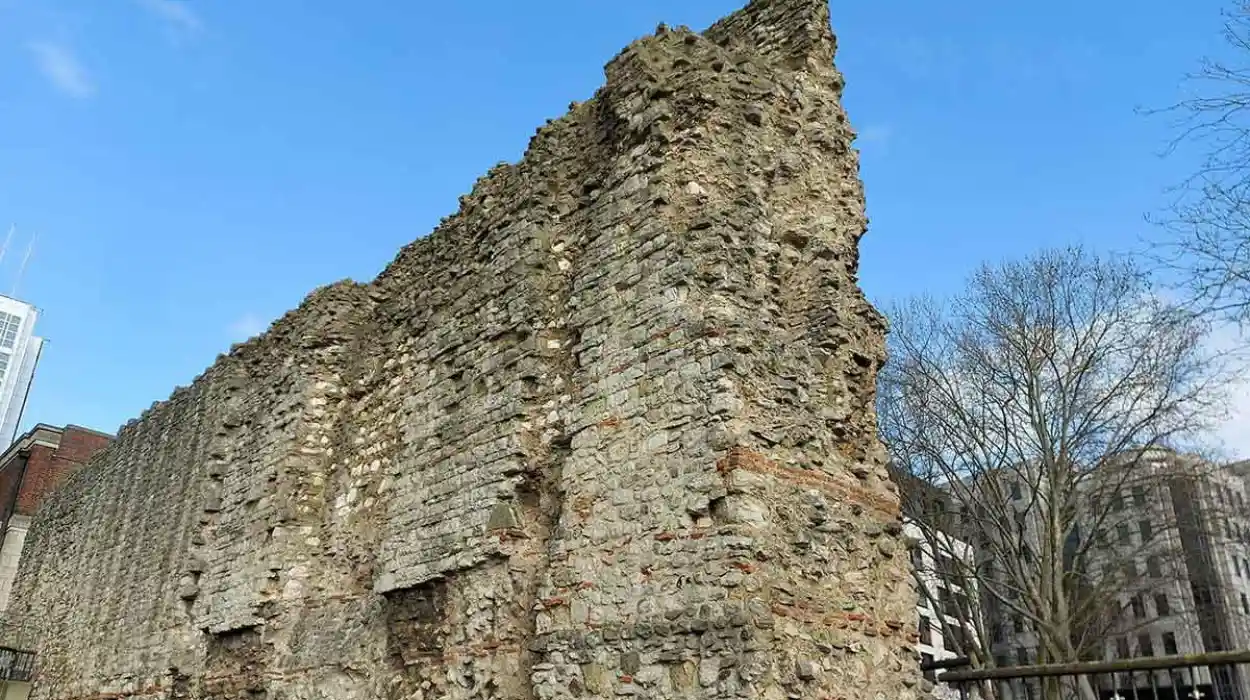
London Wall
Construction of London’s defensive wall began around AD 190–225.
Originally stretching approximately 3.2 kilometres, the wall enclosed nearly 134 hectares of Roman Londinium.
Substantial surviving sections remain near Tower Hill, Noble Street, and the Barbican.
The wall demonstrates Roman engineering techniques using ragstone, tile courses, and mortar.
Archaeological excavations continue to improve understanding of Roman military strategy and urban planning.
Billingsgate Roman House and Baths
Excavated during the 1840s, the Roman bath complex contains mosaics, hypocaust heating systems, and foundations of an important waterfront residence.
These remains indicate London’s prosperity as a commercial port connected to the Roman Empire.
Roman Amphitheatre
Discovered beneath Guildhall Yard in 1988, London’s Roman Amphitheatre once accommodated approximately 6,000 spectators.
The structure hosted military ceremonies, athletic competitions, and public entertainment.
Modern glass flooring allows visitors to view surviving foundations beneath the Guildhall Art Gallery.
Which medieval streets preserve London’s earliest urban character?
Several medieval streets preserve London’s original street patterns, commercial traditions, and architectural character despite centuries of rebuilding following fires, wars, and continuous urban development.
Cloth Fair
Cloth Fair developed beside the former Priory of St Bartholomew during the medieval wool trade.
Several houses date from the seventeenth century following the Great Fire.
Its narrow layout reflects medieval property boundaries established hundreds of years earlier.
Bleeding Heart Yard
The courtyard derives its name from a seventeenth-century legend connected with Lady Elizabeth Hatton.
Although folklore surrounds its origin, the surviving Georgian buildings illustrate eighteenth-century residential development within historic Holborn.
St Mary Aldermary surroundings
The network of surrounding lanes retains elements of medieval London’s street arrangement despite later rebuilding.
Nearby alleys preserve the dense commercial environment characteristic of the medieval City.
To experience this historic landmark in person today, consult our comprehensive [Best Self-Guided Walking Tours Across London for Independent Sightseeing and Local Discovery] for itineraries and visiting parameters.
What forgotten churches preserve London’s religious heritage?
Historic churches outside London’s primary tourist circuit preserve important architectural styles, parish records, burial grounds, and evidence of religious life spanning the medieval, Tudor, Stuart, Georgian, and Victorian periods.
St Bartholomew the Great
Founded in 1123 by Rahere, this church represents London’s oldest surviving parish church.
Its Norman architecture includes massive stone columns, rounded arches, and medieval stonework rarely preserved elsewhere in central London.
The church survived both the Dissolution of the Monasteries and the Great Fire.
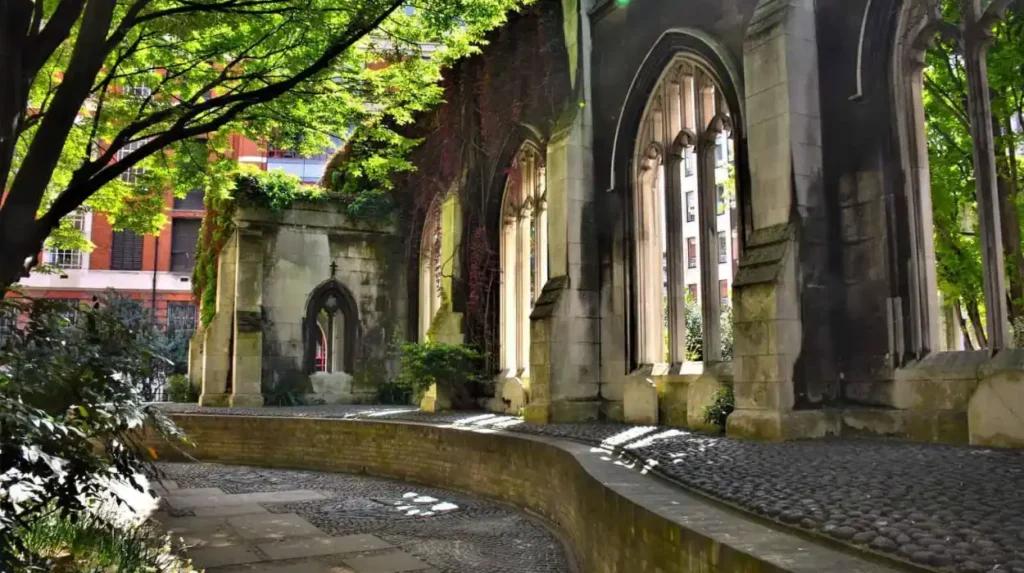
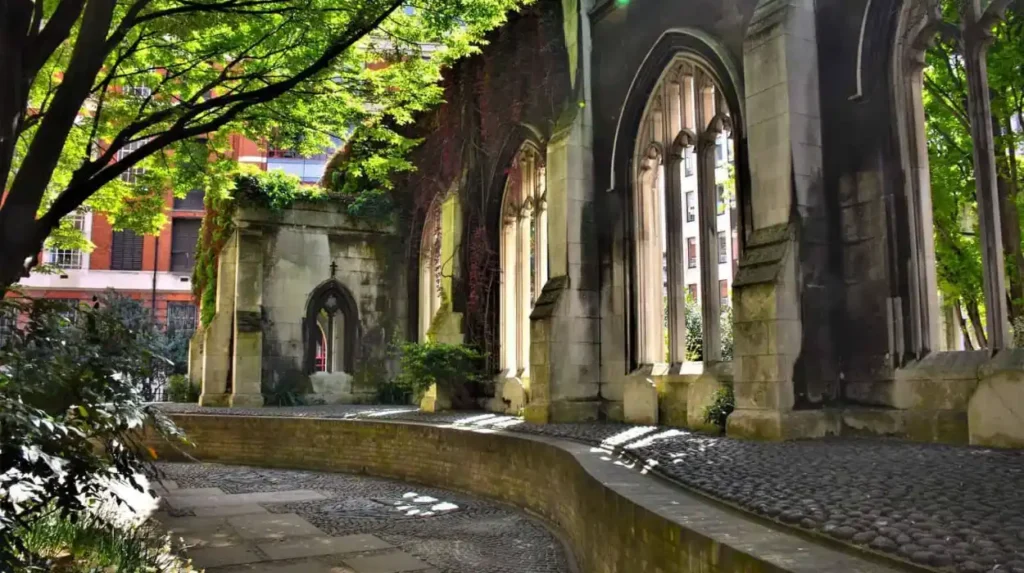
St Dunstan-in-the-East
Originally established around AD 1100, the church suffered severe bombing during the Blitz in 1941.
Instead of complete reconstruction, its ruins became a public garden.
The combination of Gothic stonework and modern landscaping creates one of London’s most distinctive conservation spaces.
St Etheldreda’s Church
Built during the thirteenth century, St Etheldreda’s remains one of London’s oldest Roman Catholic churches.
Its medieval architecture survived political upheaval during the English Reformation.
How did London’s hidden alleys shape commerce and daily life?
Historic alleys connected markets, workshops, taverns, docks, courts, and residential buildings, forming essential transport and commercial networks that supported London’s economic expansion for many centuries.
Many medieval lanes followed property boundaries established before the Norman Conquest.
Small workshops produced textiles, metal goods, leather products, books, and luxury items.
Merchants conducted business inside courtyards connected through narrow passageways.
Leadenhall Market’s surrounding lanes illustrate how wholesale trading expanded throughout medieval and early modern London.
Change Alley became famous during the late seventeenth and early eighteenth centuries for financial speculation connected with London’s growing banking sector.
These narrow routes also reveal how limited urban space influenced architectural design and commercial organisation.
What role did forgotten cemeteries and churchyards play in London’s history?
Historic cemeteries and churchyards preserve archaeological evidence, burial traditions, demographic information, epidemic responses, and social history that help researchers understand London’s population over many centuries.
Cross Bones Burial Ground in Southwark served London’s poorest communities for centuries.
Excavations have revealed valuable information regarding nutrition, disease, mortality, and social inequality.
Postman’s Park commemorates ordinary citizens who died while saving others.
Established in 1880, the park contains the Watts Memorial to Heroic Self-Sacrifice, inaugurated in 1900.
The memorial documents acts of everyday courage rather than military achievements.
Churchyard excavations across London continue to provide evidence regarding plague outbreaks, medieval health, and burial customs.
Which forgotten industrial locations transformed London’s economy?
Historic industrial locations demonstrate how manufacturing, shipping, engineering, warehousing, and transport infrastructure enabled London’s growth into one of the world’s largest commercial cities during the Industrial Revolution and beyond.
The former docks along the River Thames handled enormous volumes of international trade.
St Katharine Docks, opened in 1828, represented innovative dock engineering.
Although extensively regenerated, surviving warehouses illustrate nineteenth-century commercial architecture.
The Brunel Thames Tunnel, completed in 1843, became the world’s first tunnel successfully constructed beneath a navigable river.
Its engineering methods influenced later underground infrastructure worldwide.
Smithfield Market’s historic buildings reflect Victorian advances in wholesale food distribution and public sanitation.
Together these locations demonstrate the relationship between industrial innovation and urban expansion.
How did hidden locations survive the Great Fire and the Blitz?
Several overlooked historic locations survived because of geographical circumstances, reconstruction priorities, structural resilience, or careful post-war conservation that preserved important evidence of London’s changing urban landscape.
The Great Fire of 1666 destroyed approximately 13,200 houses, 87 parish churches, and numerous public buildings across the medieval City.
However, districts beyond the fire’s boundaries retained earlier layouts.
Following German bombing between 1940 and 1941, conservation authorities preserved selected ruins rather than replacing every damaged structure.
This policy created important educational landscapes illustrating wartime destruction.
The preservation of bomb-damaged churches, fragments of Roman walls, and surviving medieval buildings enables direct comparison between different historical periods.
These surviving structures provide physical evidence of London’s resilience across centuries.
What archaeological discoveries continue to reshape London’s history?
Modern archaeology regularly uncovers new evidence about Roman, medieval, Tudor, Stuart, Georgian, Victorian, and twentieth-century London through excavations associated with construction, infrastructure projects, and scientific research.
Large infrastructure programmes have transformed archaeological knowledge.
The Crossrail project generated one of Europe’s largest urban archaeological investigations.
Researchers recovered hundreds of thousands of artefacts representing daily life across nearly two millennia.
Excavations uncovered Roman roads, medieval cemeteries, Tudor objects, Victorian infrastructure, and Second World War remains.
Scientific techniques including radiocarbon dating, isotope analysis, pollen analysis, and DNA research continue improving historical understanding.
Digital recording technologies now preserve archaeological evidence before modern construction permanently alters excavation sites.
How are London’s forgotten historic places protected today?
Historic preservation combines national legislation, heritage designation, archaeological monitoring, conservation planning, museum research, and community engagement to protect London’s lesser-known historical sites for future generations.
The United Kingdom operates one of the world’s most comprehensive heritage protection systems.
Listed Building status protects structures possessing special architectural or historic interest.
Scheduled Monument designation protects nationally significant archaeological remains.
Conservation Areas preserve historic streetscapes rather than individual buildings.
Local authorities, universities, museums, and volunteer organisations collaborate on documentation, restoration, education, and archaeological research.
Digital archives increasingly improve public access to historical records, maps, photographs, excavation reports, and parish registers.
Preservation also supports sustainable tourism by distributing visitors beyond London’s busiest attractions while encouraging appreciation of neighbourhood heritage.
Why do forgotten historic places remain important for understanding London’s future?
Forgotten historic places remain essential because they preserve physical evidence of London’s cultural diversity, urban evolution, architectural innovation, environmental adaptation, and community resilience while informing future conservation, education, planning, and archaeological research.
Every historic building, alley, churchyard, warehouse, and archaeological site contributes unique evidence unavailable elsewhere.
Collectively these locations explain how London responded to invasion, disease, industrialisation, political reform, religious transformation, migration, and technological innovation.
Historical preservation strengthens cultural identity by connecting modern communities with earlier generations.
Educational institutions increasingly incorporate local heritage into teaching programmes because physical locations enhance historical understanding beyond textbooks.
Genealogical researchers also depend upon parish records, burial registers, historic maps, and neighbourhood archives preserved within these overlooked sites.
As London’s population continues to grow and redevelopment reshapes the urban landscape, protecting forgotten historic places ensures that evidence of nearly two thousand years of continuous history remains available for future historians, archaeologists, educators, policymakers, and visitors. Their continued conservation demonstrates that London’s greatest historical discoveries are not limited to internationally famous monuments. Many of the city’s most remarkable stories survive quietly within hidden courtyards, ancient churches, Roman foundations, medieval streets, industrial warehouses, and peaceful churchyards that continue to enrich the understanding of Britain’s capital long after their original purposes have changed.
What are the forgotten corners of historic London?
Forgotten corners of historic London are lesser-known streets, buildings, ruins, churches, cemeteries, and archaeological sites that preserve important evidence of London’s past but receive fewer visitors than famous landmarks such as the Tower of London or Westminster Abbey.