

Key Points
- Historic Loan: The 11th century Bayeux Tapestry, which is an amazing piece of medieval art that measures 70 metres long, has finally been loaned back to the United Kingdom after nearly 900 years.
- Exhibition Dates: The Bayeux Tapestry will be displayed at the Sainsbury Exhibitions Gallery of the British Museum from 10 September 2026 to 11 July 2027.
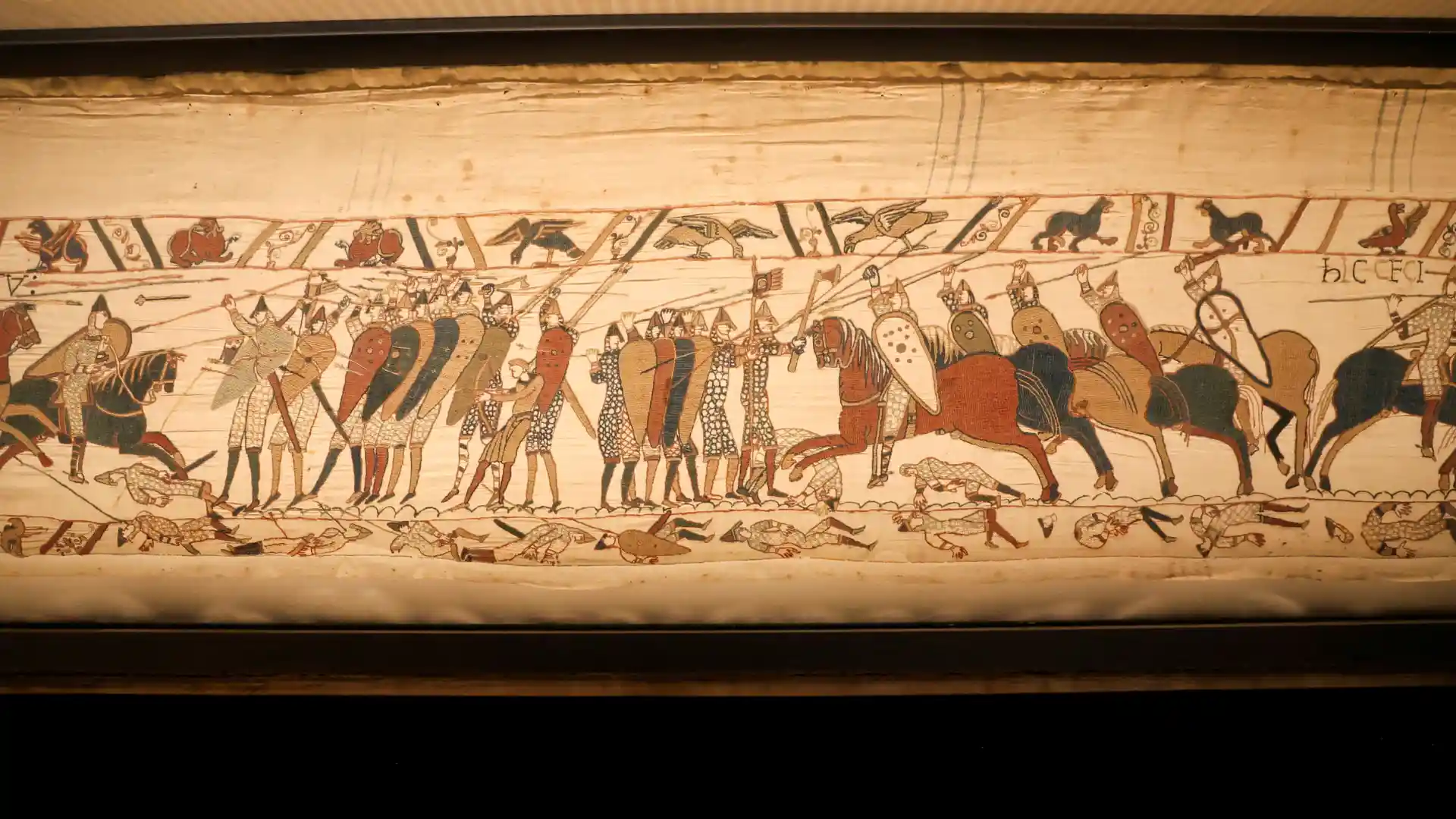
- Unprecedented Display: The tapestry will be displayed for the first time in one complete, flat horizontal stretch inside a specially designed cabinet.
- Reciprocal Exchange: In return, the British Museum has been making important objects from its collection available to France, including the Sutton Hoo collection and the Lewis Chessmen.
- Diplomatic Importance: The loan has been called a demonstration of long-standing ties between France and Britain, and it was agreed upon by the Prime Minister of the UK Keir Starmer and the French President Emmanuel Macron.
- Transportation: The tapestry arrived at the British Museum on 10 July 2026 from a mysterious place in northern France via the Channel Tunnel in an air-conditioned, shock-resistant box.
London (The Londoner News) August 11, 2026 – After an absence spanning nearly a millennium, the Bayeux Tapestry has returned to English soil, arriving at the British Museum ahead of a blockbuster exhibition that promises to reshape public understanding of the Norman Conquest of 1066. The 70-metre-long embroidery, widely considered one of the most significant cultural artefacts in the world, is slated to open to the public on 10 September 2026, marking a landmark moment in Anglo-French diplomatic and cultural relations.
- Key Points
- Why is the return of the Bayeux Tapestry considered a historic event?
- What will visitors experience at the British Museum’s exhibition?
- How did the agreement for this loan come to fruition?
- What is the historical context of the Bayeux Tapestry?
- What do potential visitors need to know about tickets and access?
Why is the return of the Bayeux Tapestry considered a historic event?
The arrival of the tapestry in London is being described by experts and officials as an “exhibition of the century.” As reported by Gareth Harris of The Art Newspaper, the medieval masterpiece was successfully transported from a secure location in northern France to the British Museum in the early hours of 10 July 2026.
The transit was a feat of engineering and high-stakes logistics. According to The Art Newspaper, the tapestry was housed in a temperature and humidity-regulated crate, which was then secured within an outer cage fitted with specialized shock absorbers to protect the fragile embroidery from vibrations during its 350-mile journey through the Channel Tunnel. The operation was managed under heavy protection, with the Metropolitan Police Service and Kent Police coordinating the final leg of the journey from Folkestone to the museum.
Upon its arrival, Nicholas Cullinan, Director of the British Museum, confirmed the event on social media, noting as reported by The Art Newspaper that this is
“the first time it has travelled across the Channel since it was made in the 1070s.”
What will visitors experience at the British Museum’s exhibition?
The upcoming exhibition is set to provide an unprecedented view of the tapestry. Unlike its traditional displays in France, where it has historically been mounted vertically, the British Museum has announced a departure from convention.
As stated in a press release from the British Museum, visitors will experience the tapestry displayed flat for the first time, presented in one continuous, unbroken length. This method is designed to allow the public to fully appreciate the scale and the sophisticated chronological narrative of the work. The exhibition will be hosted in the Sainsbury Exhibitions Gallery and will run until 11 July 2027.
Beyond the tapestry itself, the exhibition aims to contextualise the events of 1066. The British Museum plans to supplement the display with related artefacts, including the Junius II manuscript from the Bodleian Libraries at the University of Oxford and a charter of Edward the Confessor, which provides further insight into the political landscape of 11th-century England.
How did the agreement for this loan come to fruition?
The loan is the result of years of high-level diplomatic coordination between the United Kingdom and France. As documented in official records from the UK government (GOV.UK), the initiative was spearheaded by Prime Minister Keir Starmer and French President Emmanuel Macron.
The agreement serves as a cornerstone for a broader bilateral “season of culture” intended to celebrate the shared history between the two nations. In a reciprocal gesture, the British Museum has agreed to loan several of its own treasures to French institutions, most notably the Sutton Hoo collection—found in a seventh-century Anglo-Saxon ship burial—and the Lewis Chessmen.
According to government statements, Lord Peter Ricketts was appointed as the UK Government’s Envoy for the Bayeux Tapestry Loan to oversee the complexities of the transfer. The partnership also extends to various cultural organisations, including the British Film Institute and the National Trust, which are signing Memoranda of Understanding with their French counterparts to foster ongoing creative collaboration.
Explore more Central London News:
Prolific Watch Robber Jailed After Undercover Arrest in Mayfair, London 2026
Man Arrested for Tube Station Assault in Central London 2026
What is the historical context of the Bayeux Tapestry?
The Bayeux Tapestry is a fundamental piece of European history. It depicts the lead-up to the Battle of Hastings in 1066, a pivotal moment that saw William, Duke of Normandy, defeat King Harold Godwinson to become the first Norman King of England.
It is widely believed that the embroidery was commissioned by Bishop Odo of Bayeux, the half-brother of William the Conqueror, and likely created in Canterbury, England, shortly after the conquest. Because it serves as a visual record of the last time England was successfully invaded, it remains one of the most studied and recognisable objects in the world.
Nicholas Cullinan, reflecting on the importance of the loan, noted in an official museum statement:
“The Bayeux Tapestry is one of the most important and unique cultural artefacts in the world, which illustrates the deep ties between Britain and France and has fascinated people across geographies and generations.”
What do potential visitors need to know about tickets and access?
Given the anticipated demand for the exhibition, the British Museum has implemented a structured ticketing system. Tickets for the 40-minute experience were made available for purchase starting 1 July 2026, with prices ranging between £25 and £33 depending on the timing of the visit.
The museum has advised that tickets will be released in phases to manage capacity. Following the initial release for autumn 2026 dates, further tranches of tickets will be made available in October 2026 and January 2027 to cover the duration of the exhibition through July 2027. Members of the British Museum have been granted priority booking access, though all visitors are encouraged to register for the museum’s newsletter to receive the latest updates on availability.
The exhibition is supported by Igor Tulchinsky, who has provided generous backing for what the institution calls a “once-in-a-generation show.” In a statement, Tulchinsky remarked:
“One of the reasons I decided to sponsor this crucially important exhibition of British history was to allow art to be seen and to change the lives of those who see it.”
As the museum prepares for the official opening on 10 September, the cultural and historical significance of this return cannot be overstated. For millions of people, the coming months will offer a rare opportunity to engage with a primary witness to the formation of the modern British monarchy, serving as a testament to the power of international cooperation in the preservation and sharing of human history.