
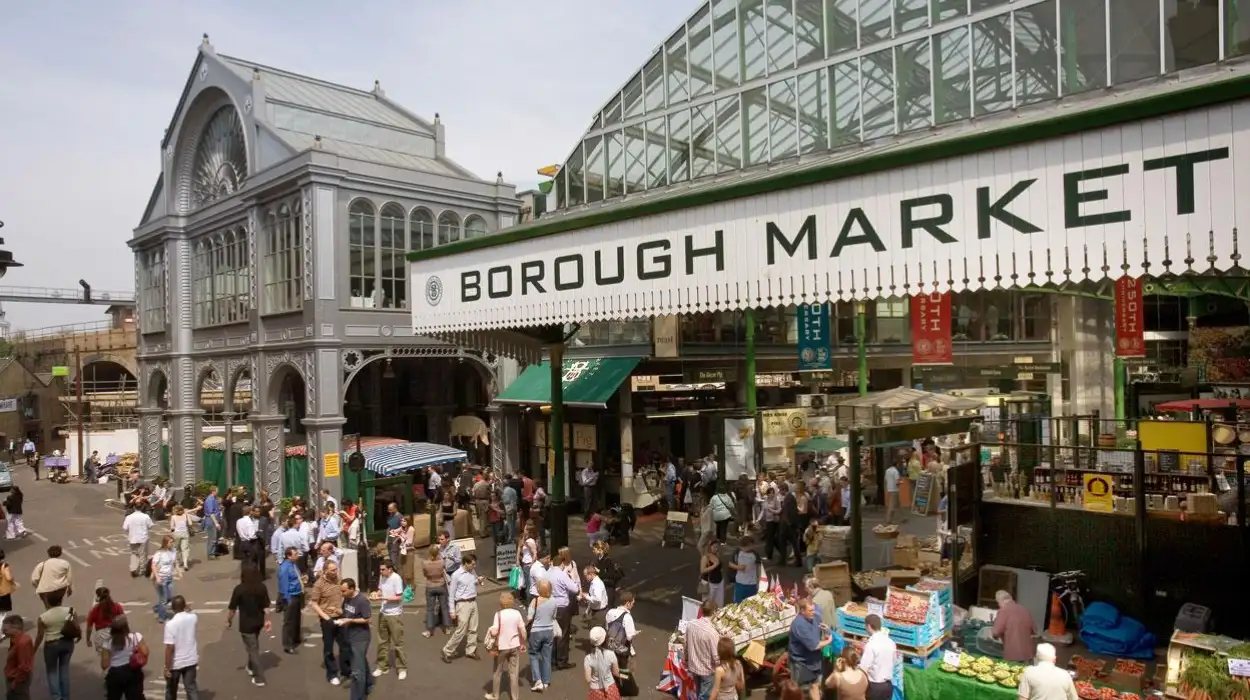
Borough Market is one of London’s most historically significant food markets. It stands on Southwark Street beside the southern approach to London Bridge and occupies a site with a food-trading history extending back around 1,000 years. The market combines wholesale commerce, specialist food production, retail trading and prepared food within a historic Southwark setting.
- How old is Borough Market and why is its history important?
- What traditional fresh produce can tourists experience at Borough Market?
- Which British cheeses and dairy foods should tourists explore at Borough Market?
- What bread, pastries and baked foods define the Borough Market experience?
- How can tourists experience British seafood at Borough Market?
- What cured meats, antipasti and preserved foods can tourists find?
- Which street-food experiences reflect Borough Market’s modern transformation?
- How does Borough Market connect British food with international cuisines?
- What historical buildings should tourists examine while eating at Borough Market?
- How did railways change the food sold at Borough Market?
- Why did supermarkets change Borough Market’s traditional food business?
- How does Borough Market preserve its food heritage today?
- How can tourists connect Borough Market food with the wider history of Southwark?
- What does eating at Borough Market reveal about London’s long-term food history?
- Frequently Asked Question
The modern market is especially associated with fresh produce, British and international foods, specialist cheeses, seafood, bread, cured products, fruit and vegetables, prepared meals and street food. Its present retail identity developed strongly from the 1990s after supermarkets weakened the traditional wholesale fruit and vegetable business.
For tourists, eating at Borough Market therefore involves more than selecting a meal. The food stalls, shops, Victorian structures, railway infrastructure and surrounding streets form part of a historical landscape shaped by London Bridge, river commerce, transport development and changing patterns of food distribution.
How old is Borough Market and why is its history important?
Borough Market has traded near London Bridge for about 1,000 years, with formal documentary evidence from the medieval period and its present site established in 1756 after Parliament closed the congested High Street market. Its food tradition connects medieval commerce with modern retail.
The origins of Borough Market are closely connected with London Bridge. Southwark developed as the southern bridgehead of London, creating a strategic position for movement between southern England and the capital. Archaeological evidence demonstrates extensive Roman occupation in the bridgehead area after the Roman settlement of Londinium began in the first century AD.
London Museum records food trading in Southwark by 1014, when grain, fish, vegetables and cattle were sold in the area. The first formal reference to a fruit and vegetable market dates to 1276, when the market was moved to the High Street.
Medieval trading was closely connected with the movement of people across London Bridge. Southwark’s position outside the medieval City of London also created a distinctive commercial environment. By the 13th century, the City attempted to control food purchasing in Southwark and restricted some forms of market activity.
The market experienced repeated administrative changes. Borough Market’s own historical timeline records major developments in 1550, 1676, 1754 and 1756. A major fire destroyed the market house in 1676. In 1754, Parliament acted against the increasingly congested High Street market. In 1756, local parishioners relocated the market to its present general location.
This relocation established the physical basis for the modern market. Southwark Council identifies Borough Market as the oldest fruit and vegetable wholesale market in central London and states that it has traded from its present 4.5-acre site since 1756.
The market’s historical importance therefore comes from continuity. Its purpose has changed substantially, but food trading has remained central to the site’s identity.
What traditional fresh produce can tourists experience at Borough Market?
Fresh fruit and vegetables remain fundamental to Borough Market’s identity because wholesale produce formed the market’s principal commercial role for centuries. Today, specialist produce traders connect visitors with seasonal fruit, vegetables, regenerative farming and high-quality ingredients from Britain.
Fruit and vegetables provide one of the clearest connections between Borough Market’s historic wholesale role and its present retail character. The market’s nineteenth-century development was strongly associated with supplying businesses rather than individual shoppers. Traders handled large quantities of produce for greengrocers, restaurants and other commercial customers.
Railways transformed this trade. Borough Market’s historical account records that a railway viaduct crossed the market in 1862 and that railway expansion helped turn Borough into a major fruit and vegetable wholesale hub.
The railway changed the practical geography of food distribution. Faster transportation allowed agricultural produce to reach London from increasingly distant production areas. Borough Market benefited from its location near London Bridge and the surrounding railway infrastructure.
Modern visitors can still experience produce trading through specialist fruit and vegetable businesses. The current trader directory includes 13 Acre Orchard, which describes its produce as coming from regenerative farms. The market also continues to classify fruit and vegetables as a dedicated trading category.
This experience has historical significance because fresh produce demonstrates how markets connect agriculture with urban consumption. A visitor purchasing vegetables at Borough Market participates in a commercial system that has operated around the London Bridge area for centuries, although the supply chains, farming methods and retail mechanisms have changed.
The modern emphasis on sustainability also reflects contemporary food policy. Borough Market’s current strategy places food quality, sustainable production, specialist knowledge and environmental considerations at the centre of its future direction.
Which British cheeses and dairy foods should tourists explore at Borough Market?
British cheese is a major specialist food experience at Borough Market, where traders represent regional dairy traditions and connect visitors with products made from different British milk sources. Cheese trading demonstrates the market’s modern emphasis on specialist knowledge, provenance and food craftsmanship.
Cheese provides an important example of Borough Market’s transformation from wholesale produce centre into specialist food destination. The modern market contains traders dedicated to dairy products, including businesses representing cheeses from specific British regions.
The current trader directory lists Bath Soft Cheese Co, which sells cheeses from Park Farm, and Alsop & Walker, which offers cheeses from East Sussex. These businesses illustrate the importance of geographic provenance in modern British food retail.
Food provenance means identifying where a product originates and understanding the production system behind it. In a historic market, provenance connects the urban consumer with agricultural production beyond London.
Borough Market’s modern retail revival also depended on specialist food businesses. Neal’s Yard Dairy and Brindisa were among the businesses associated with the revival of artisan food retail around the market in the 1990s. Their presence contributed to the transition from a primarily wholesale environment toward a market serving public consumers.
The cheese experience therefore has two historical dimensions. The first concerns Britain’s regional dairy traditions. The second concerns Borough Market’s late twentieth-century commercial transformation.
Visitors interested in food history can examine cheese not simply as a snack but as a product shaped by farming, regional identity, preservation methods, transport, retail and consumer demand.
What bread, pastries and baked foods define the Borough Market experience?
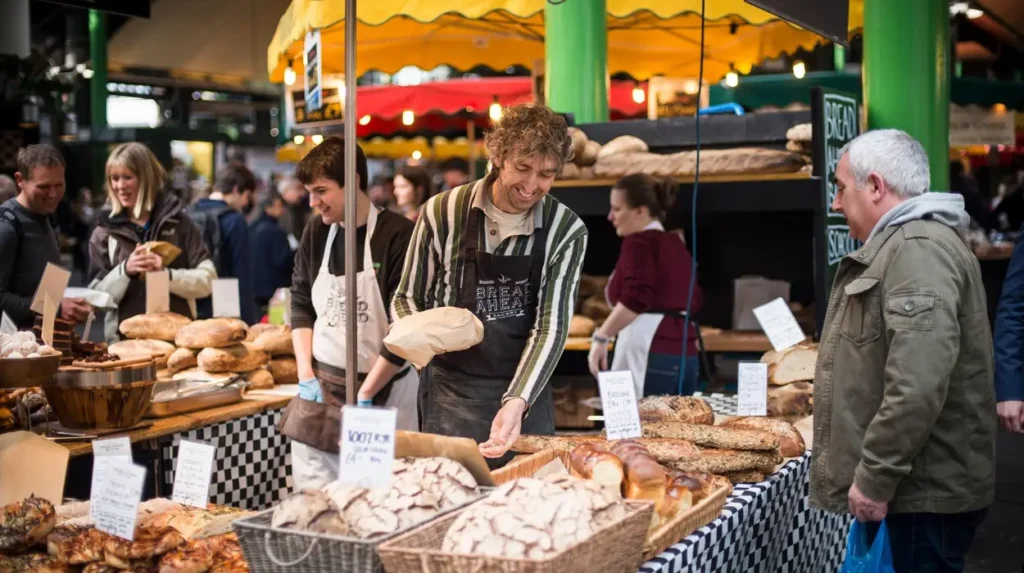
Bread and baked foods represent another important Borough Market experience, combining traditional baking practices with contemporary specialist retail. The market’s current trader community includes bakers and confectionery businesses, demonstrating the continuing importance of prepared grain-based foods in London’s food culture.
Bread has long held a central position in European urban food systems because grain was a fundamental staple. Historic London markets handled grain, flour and other agricultural commodities that supported the city’s growing population.
Borough Market’s early history included grain trading in Southwark. London Museum records the sale of grain alongside fish, vegetables and cattle in the area by 1014.
The modern market presents a more specialised baking culture. Its trader directory includes bakers, confectionery businesses and producers of cakes and pastries. Artisan Foods, for example, is listed as producing handmade cakes and pastries.
These products provide tourists with a direct way to experience contemporary British food retail while remaining within a location shaped by centuries of grain and produce commerce.
The modern baking sector also demonstrates how Borough Market’s retail function differs from its historic wholesale purpose. Historic traders primarily moved commodities through a distribution network. Contemporary food producers often present finished products directly to consumers.
That difference explains part of the market’s transformation during the late twentieth century. As supermarkets expanded and traditional wholesale customers declined, specialist producers and food retailers helped create a new commercial purpose for the market.
How can tourists experience British seafood at Borough Market?
British seafood forms a significant part of Borough Market’s present food offer and continues a longstanding Southwark connection with food arriving through London’s river and transport networks. Modern seafood traders emphasise British sourcing, specialist knowledge and sustainable supply alongside prepared seafood dishes.
Fish was among the foods traded in Southwark by the early medieval period according to London Museum’s historical account. The area’s position beside the River Thames and London Bridge placed it within major transport and commercial networks.
Modern seafood trading operates through highly developed supply chains. The current Borough Market directory lists Applebee’s Fish and Applebee’s as seafood businesses, with the latter described as offering sustainably sourced British seafood.
Seafood also demonstrates the importance of preservation. Fish requires rapid transport, refrigeration, salting, smoking or other preservation systems. Modern cold-chain logistics have transformed the speed and reliability with which seafood reaches London consumers.
The market’s seafood experience therefore connects historical food geography with modern supply-chain technology.
Visitors can also examine the difference between purchasing raw seafood and eating prepared seafood. A specialist seafood stall represents the market’s retail and ingredient functions, while nearby food businesses represent the market’s prepared-food economy.
This distinction is important because Borough Market has never operated solely as a restaurant district. Its identity combines ingredients, specialist producers, wholesalers, retailers and prepared-food businesses.
What cured meats, antipasti and preserved foods can tourists find?
Cured meats, olives, antipasti and other preserved foods show how Borough Market has expanded beyond traditional British produce into international specialist food retail. These foods demonstrate preservation techniques, regional cuisines and the market’s modern role as a specialist destination.
Preservation has always been essential to food commerce. Salting, drying, curing, fermenting and pickling extend shelf life and allow food to travel over greater distances.
Borough Market’s current trader directory includes cured-meat businesses, olives and antipasti traders, and specialist food retailers. Alpine Deli, for example, focuses on cured meats from South Tyrol.
South Tyrol is an Alpine region with a distinctive food culture influenced by Germanic and Italian traditions. Cured meat production in the region reflects climatic conditions, preservation techniques and agricultural practices.
The presence of such products demonstrates the international character of modern Borough Market. The market’s retail revival did not simply restore older British trading patterns. It created a commercial environment in which British producers operate alongside European and international food businesses.
Borough Market’s own history records that after the successful 1998 Food Lovers’ Fair, British traders were joined by producers from Europe and other parts of the world.
For tourists, preserved foods provide an especially clear way to understand the relationship between food and geography. A cured product contains information about climate, livestock, agricultural practice, preservation technology and regional identity.
Which street-food experiences reflect Borough Market’s modern transformation?
Street food represents Borough Market’s strongest modern retail development, especially after the market’s 1998 Food Lovers’ Fair demonstrated demand for specialist food sold directly to the public. Today, Borough Market Kitchen provides a dedicated area for prepared street-food traders.
The modern street-food culture of Borough Market developed during the market’s retail renaissance in the late 1990s.
In November 1998, Henrietta Green organised a three-day Food Lovers’ Fair at Borough Market as part of the Southwark Festival. Borough Market records that the event attracted major public interest and that traders sold out rapidly. The success helped establish a regular retail market.
The market subsequently developed regular retail trading. What began as a monthly event became weekly trading and eventually developed into an international food destination.
The current market divides its principal trading areas into Three Crown Square, Green Market and Borough Market Kitchen. The latter is specifically associated with street-food traders.
Contemporary examples include Bao Borough, which offers Taiwanese street food, and Arabica To Go, which offers salads, falafel wraps and chicken shawarma. These businesses demonstrate the international range of food available within the modern market.
Street food also represents a major change in consumer behaviour. Historic Borough Market primarily functioned as a place where businesses purchased ingredients. The modern retail market serves tourists, residents, office workers and other individual consumers seeking prepared food.
This transformation explains why Borough Market is now widely recognised as a food destination rather than solely a wholesale produce market.
How does Borough Market connect British food with international cuisines?
Borough Market connects British food traditions with international cuisines through specialist traders, restaurants and street-food businesses. Its modern retail identity includes British cheeses and seafood alongside Greek, Middle Eastern, Taiwanese, South Tyrolean and other food traditions represented by current traders.
International food is not a recent addition to London. Southwark has historically functioned as a transport and commercial gateway because London Bridge connected the capital with routes south of the Thames.
The modern market’s international character is particularly visible in its current trader directory. Agora is described as a Greek-inspired restaurant, Arabica provides Middle Eastern food, Bao Borough specialises in Taiwanese street food and Alpine Deli focuses on South Tyrolean cured meats.
These businesses represent different culinary systems. Greek food includes traditions involving olive oil, grains, vegetables, dairy and grilled foods. Middle Eastern cuisines include dishes based on grains, pulses, vegetables, herbs and meats. Taiwanese street food has developed from East Asian culinary traditions and urban food culture. South Tyrolean cured foods reflect Alpine preservation practices.
The significance lies in the coexistence of these traditions within one historic trading environment.
Borough Market’s modern international identity developed alongside its retail renaissance. The market’s history records that traders from Britain, Europe and other parts of the world became part of the retail market after 1998.
This makes food at Borough Market a useful subject for educators studying migration, trade, globalisation, urban geography and cultural exchange.
What historical buildings should tourists examine while eating at Borough Market?
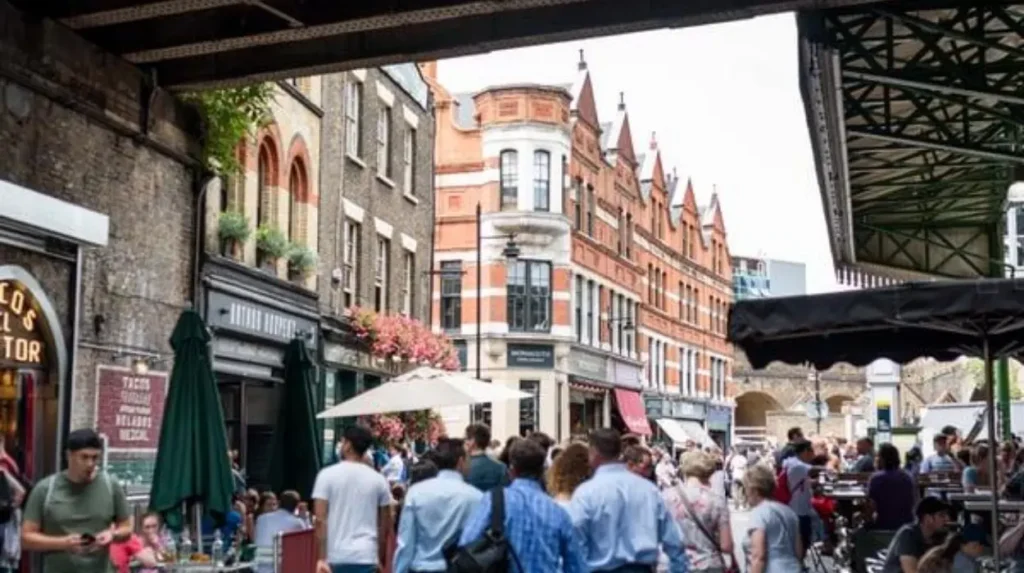
Borough Market’s food experiences take place within a historic architectural environment shaped by Victorian market construction, railway expansion and twentieth-century redevelopment. The surviving iron-and-glass structures provide a physical connection between nineteenth-century food distribution and today’s specialist retail market.
The present market architecture developed during the nineteenth century. Southwark Heritage records that the present building opened in 1851, received additions during the 1860s and gained an Art Deco entrance in 1932. Further rebuilding took place in 2001 and 2004.
The Victorian market structures are significant because they represent the architectural response to expanding urban commerce. Iron and glass allowed large covered trading spaces while providing natural light.
Railway infrastructure became equally important. In 1862, a railway viaduct crossed the market. Borough Market identifies railway growth as a major reason for the market’s emergence as a large fruit and vegetable wholesale centre.
The surrounding archaeological environment provides additional historical evidence. Archaeological excavations associated with the Thameslink project between 2009 and 2013 covered approximately 780 metres across Southwark, including an excavation area at Borough Market. Researchers identified evidence relating to Saxon, medieval and post-medieval occupation.
A substantial ditch at Bedale Street was investigated as a possible feature connected with the Saxon burh, while later archaeological deposits revealed changing patterns of buildings, yards, gardens and commercial activity.
Food therefore sits within a layered archaeological landscape. Market stalls occupy a site shaped by medieval boundaries, post-medieval buildings, Victorian market construction and modern transport infrastructure.
How did railways change the food sold at Borough Market?
Railways transformed Borough Market during the nineteenth century by improving the movement of agricultural produce into London. The 1862 railway viaduct became part of the market environment, while improved transport helped Borough develop into a major wholesale fruit and vegetable distribution centre.
Before modern transport systems, food distribution depended heavily on roads, rivers, animals and proximity to production areas. London Bridge gave Southwark an important transport advantage, but railways fundamentally increased the speed and scale of food movement.
Borough Market’s own historical timeline identifies 1862 as a decisive year. A railway viaduct sliced through the market, and railway expansion contributed to Borough’s rise as a major fruit and vegetable wholesale hub.
This change affected the market’s relationship with agriculture. Produce could arrive from areas farther from London, increasing the range and volume of food available to the capital.
The market consequently became part of a national distribution network rather than a purely local food economy.
Archaeological research around Borough Market also demonstrates the importance of transport and changing land use. Excavations connected with the Thameslink project identified different occupation patterns across Southwark and documented the area’s development through medieval and post-medieval periods.
The railway infrastructure remains visible today. Modern visitors encounter railway viaducts alongside the market’s historic buildings, providing a direct architectural reminder of the nineteenth-century transformation.
Why did supermarkets change Borough Market’s traditional food business?
Supermarkets weakened Borough Market’s traditional wholesale role during the late twentieth century by changing how consumers and retailers obtained fruit and vegetables. The market responded through specialist retail food, direct public sales and international products, creating its modern culinary identity.
Borough Market remained central to the fruit and vegetable trade during the 1950s. Its traditional customers included businesses such as greengrocers that purchased produce for resale.
The growth of supermarkets changed this system. London Museum explains that supermarkets increasingly displaced the traditional business customers who had depended on Borough Market for produce.
Borough Market’s own history identifies the 1980s and 1990s as a period when supermarket growth placed the market’s future in doubt.
The response was not to abandon food trading. Instead, the market developed a new retail model.
Specialist food businesses in nearby warehouses helped establish interest in artisan and high-quality food. Neal’s Yard Dairy, Brindisa and Turnips were among the businesses involved in events that demonstrated public demand for specialist food.
The 1998 Food Lovers’ Fair became an important milestone. Its success encouraged the creation of regular retail trading. The market gradually moved from primarily serving commercial buyers toward serving the general public while retaining wholesale functions.
This adaptation explains the market’s current combination of fresh produce, specialist ingredients, prepared food and restaurants.
How does Borough Market preserve its food heritage today?
Borough Market preserves its food heritage by maintaining food trading as its central purpose while supporting specialist producers, sustainable sourcing, public education and historic market architecture. Its charitable governance and current food strategy connect commercial activity with community and preservation responsibilities.
Borough Market is currently operated by a charitable trust. Its official history states that the market is run by a board of volunteer trustees with responsibilities toward shoppers, traders, neighbours and the wider community.
Its modern preservation model therefore extends beyond maintaining buildings.
The market’s 2030 strategy places food at the centre of its long-term identity. It identifies high-quality British and international food, sustainable production and specialist knowledge as important elements of the market’s future.
Food heritage includes knowledge as well as physical structures. A specialist cheesemonger, baker, fishmonger or produce trader carries knowledge about ingredients, production methods, seasonality and provenance.
Borough Market also operates educational and cultural activities through its official programme. Its current platform includes food-related articles, recipes, talks and other educational resources.
Southwark Council separately recognises Borough Market within an archaeological environment containing remains dating back more than 10,000 years. The council identifies Borough Market among the area’s important historic landmarks and maintains archaeological policies designed to protect Southwark’s historic environment.
The combination of architecture, archaeology, food production and charitable management gives Borough Market a wider heritage significance than its individual food stalls.
How can tourists connect Borough Market food with the wider history of Southwark?
Tourists can connect Borough Market food with Southwark’s wider history by examining London Bridge, Southwark Cathedral, medieval streets, railway infrastructure, historic market buildings and archaeological evidence alongside contemporary food trading. This approach places modern eating within a continuous urban historical landscape.
Borough Market sits within one of London’s richest historical districts. Southwark contains evidence from Roman settlement, medieval institutions, early modern commerce, Victorian transport and modern redevelopment.
The Roman connection is especially important. Southwark’s northern area developed after the Roman settlement of Londinium and formed the southern bridgehead of an early Roman bridge across the Thames.
The medieval period added further significance. The area around Borough Market was associated with St Mary Overie, the medieval priory that later became Southwark Cathedral. Archaeological research indicates that the area contained buildings, yards, roads and commercial activity across successive periods.
The surrounding historic landscape also includes the George Inn, the Clink and other landmarks identified by Southwark Council as important elements of the borough’s heritage.
For visitors who want to extend the historical experience beyond food trading, the market provides an effective starting point for understanding the development of Southwark.
To experience this historic district in person today, consult our comprehensive [How the City of London Became Britain’s Historic Financial and Commercial Centre] for itineraries and visiting parameters.
The connection between food and place is central to understanding Borough Market. Food arrived through transport networks, was stored and traded through market infrastructure, and reached consumers through changing commercial systems.
What does eating at Borough Market reveal about London’s long-term food history?
Eating at Borough Market reveals how London’s food system changed from medieval local trading to Victorian wholesale distribution and modern specialist retail. The market demonstrates how transport, population growth, commercial regulation, supermarkets, global supply chains and consumer demand reshaped urban food culture.
Borough Market’s history provides a concentrated record of London’s changing relationship with food.
The medieval market served a city where food distribution depended on proximity, transport routes and regulated marketplaces. The location beside London Bridge gave Southwark an important role in bringing food into the capital.
Parliament’s intervention in 1754 demonstrates the political consequences of urban market growth. Congestion became severe enough for the High Street market to be closed, leading to relocation in 1756.
The nineteenth century introduced a different model. Railway expansion increased the speed and geographical range of food distribution. Borough Market became a major wholesale centre for fruit and vegetables, linking London consumers with agricultural producers beyond the immediate city.
The twentieth century brought another major change. Supermarkets weakened traditional wholesale relationships, forcing Borough Market to develop a new commercial purpose.
The 1990s retail revival created the market’s present identity. The 1998 Food Lovers’ Fair demonstrated strong public demand for specialist food and helped establish regular retail trading.
The result is a market where historical continuity and commercial adaptation operate together. Fresh produce remains important, while specialist cheeses, seafood, baked goods, cured foods and international street food represent newer layers of the market’s history.
For history enthusiasts, Borough Market is therefore a food destination and a record of urban change. For cultural tourists, it provides access to British and international food traditions. For educators and students, it offers a practical case study in archaeology, transport, economics, architecture, food history and urban development.
Its long-term significance rests on continuity rather than uniformity. Borough Market has survived because its food function has repeatedly adapted to changing conditions.
Today, the market remains on its 4.5-acre site at 8 Southwark Street and continues to operate as a major food-trading destination in central London. Its modern food experiences sit within a landscape shaped by approximately 1,000 years of trading, centuries of regulation, nineteenth-century railway development and the retail transformation of the late twentieth century.
For tourists, the most historically meaningful way to experience Borough Market is to recognise the relationship between the food being sold and the infrastructure that made its sale possible. Every category, from fresh produce and British cheese to seafood, baked goods, cured meats and international street food, represents part of London’s evolving food system.
Borough Market’s continued relevance demonstrates the durability of food markets within major cities. Its buildings, archaeological surroundings, trading traditions and specialist food businesses preserve a living connection between London’s commercial past and its present-day culinary culture.
The historical information in this article is based primarily on records from Borough Market, Southwark Council, London Museum, Historic England, Southwark Heritage and Oxford Archaeology. These sources document the market’s chronology, architecture, archaeological context, food-trading history and modern transformation.
Frequently Asked Question
What is Borough Market famous for?
Borough Market is famous for its historic food trading, fresh produce, British cheeses, seafood, baked goods, cured meats, international foods and street food. Its food-trading history in the Southwark area dates back around 1,000 years.