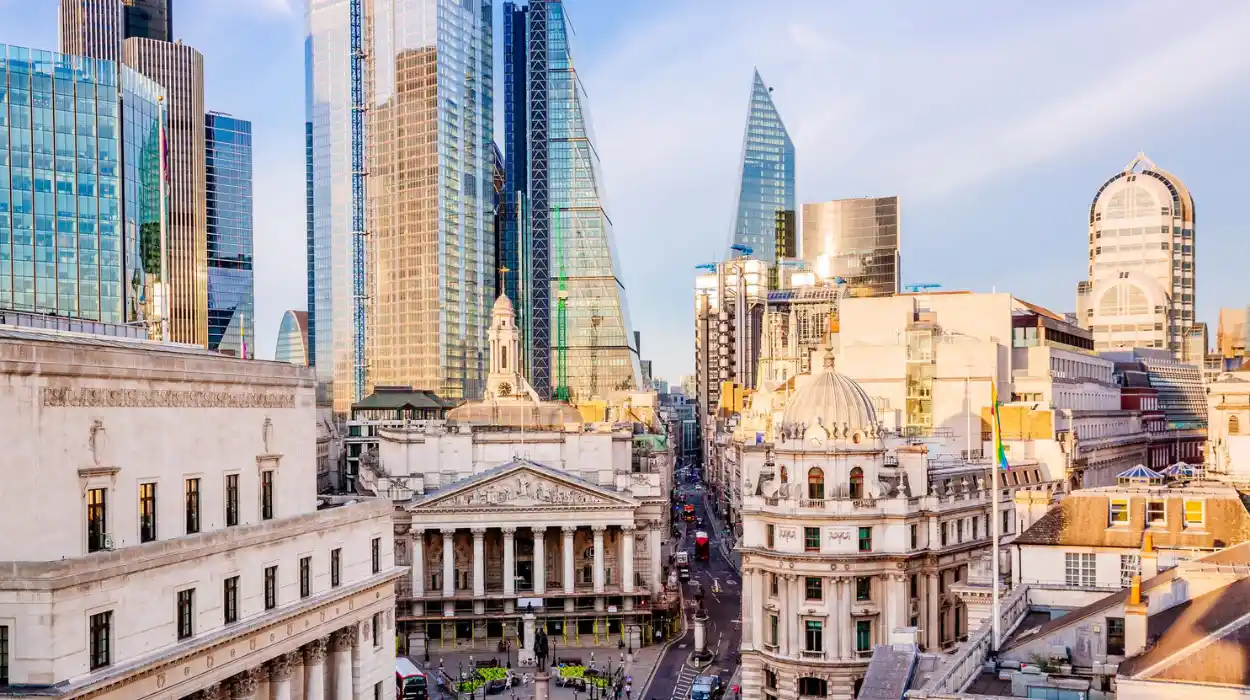
The City of London, often called the Square Mile, is the historic core of London and one of Britain’s most important financial and commercial districts. Its development began with Roman Londinium around AD 43–50 and continued through Saxon settlement, medieval trade, early modern finance, imperial commerce, industrial expansion and modern international banking.
- How did the City of London begin as a commercial centre?
- What happened to the City of London after Roman rule?
- Why did medieval London become Britain’s leading trading city?
- How did the Royal Exchange transform London’s commercial life?
- How did the Great Fire of London reshape the City’s commercial centre?
- Why was the Bank of England established in the City?
- How did insurance and securities markets strengthen the City’s financial role?
- How did the nineteenth and twentieth centuries turn the City into an international financial district?
- What historic evidence still survives in the City of London today?
- Why does the City of London remain historically important to Britain’s financial identity?
- Frequently Asked Question
The City occupies only a small part of Greater London, but its historical importance extends far beyond its physical size. It developed beside the River Thames, around the lowest convenient crossing point of the river, and became a port, marketplace, administrative centre and seat of civic government. These functions created the foundations for its later financial role.
Its history is therefore not simply the history of banks. The City became a financial centre because centuries of commerce created institutions, professional networks, legal customs, markets, archives, transport connections and specialist expertise. Merchants, insurers, bankers, brokers, lawyers and trading companies operated within a compact area where commercial information circulated quickly.
How did the City of London begin as a commercial centre?
The City of London began as Roman Londinium around AD 43–50 beside a strategic Thames crossing, where roads, river transport, port facilities and administrative buildings encouraged trade. Its location connected Britain’s interior with continental Europe and established commerce as a permanent feature.
Roman forces established Londinium shortly after the invasion of Britain in AD 43. The settlement developed around a crossing of the River Thames, close to the site associated with modern London Bridge. The location provided access to river transport and routes leading into Britain.
The Roman settlement expanded rapidly during the first century. Quays, warehouses, roads, public buildings and drainage works supported commercial activity. The forum served as a major civic and commercial complex, while the basilica provided administrative and legal functions.
The City of London Corporation describes Londinium as a settlement established around AD 50 at a key Thames crossing. The river location helped turn it into a trading port and an important commercial centre in Roman Britain.
The settlement also occupied favourable ground. Cornhill and Ludgate Hill stood above the surrounding floodplain. The Romans developed these higher areas while managing the Walbrook and other waterways.
By the early second century, Londinium had become a major centre of trade and commerce. Archaeological evidence shows substantial public construction, industrial activity and port development. The Roman forum was rebuilt on a much larger scale, demonstrating the economic importance of the settlement.
The Roman city also possessed an amphitheatre, fort, baths, temples and defensive walls. The Roman amphitheatre near Guildhall held up to approximately 6,000 spectators. The fort constructed around AD 110–120 covered about 12 acres and accommodated up to 1,000 soldiers.
The city suffered severe destruction during Boudica’s rebellion in AD 60–61. Londinium recovered rapidly. By the middle of the second century, its population reached an estimated 20,000–30,000 people.
This early commercial infrastructure established a pattern that survived later political changes: the City prospered because it connected production, transport, administration and markets.
What happened to the City of London after Roman rule?
After Roman rule ended in the early fifth century, settlement patterns changed, but London’s commercial importance eventually returned. Saxon Lundenwic developed west of the Roman walls before Viking attacks encouraged renewed occupation inside the old fortified City.
Roman Londinium declined during the later Roman period. Public buildings were dismantled or converted to other uses, port facilities contracted and parts of the settlement were abandoned. By the end of Roman rule in the early fifth century, substantial areas were no longer continuously occupied.
A new Saxon trading settlement developed outside the Roman walls. This settlement became known as Lundenwic and was located around the area of the Strand and Covent Garden rather than directly within the old Roman centre.
Viking attacks during the ninth century changed this pattern. Settlement shifted back within the Roman walls, where existing defensive structures offered protection. The walls were repaired, river defences were strengthened and the street network was reorganised.
This return to the old City created an important geographical continuity. The Roman defensive boundary again became the framework for urban development. Later medieval streets followed routes established through earlier occupation.
The Thames remained central to commercial activity. Queenhithe and Billingsgate developed as important landing places, while wharves and warehouses occupied the riverside.
The medieval City gradually became a dense trading environment. Its streets connected specialised markets, workshops, churches, merchant houses, warehouses and civic institutions.
The relationship between commerce and civic government also became increasingly important. London gained extensive privileges from successive monarchs because its population, wealth and trading role made the City economically significant.
Why did medieval London become Britain’s leading trading city?
Medieval London became Britain’s leading trading city because its Thames port, market network, civic privileges, merchant institutions and connections to national and international trade concentrated economic activity within the City and its surrounding riverfront.
During the medieval period, the City of London developed a distinctive system of commercial and civic government. The City Corporation traces its constitutional roots to privileges existing before the Norman Conquest in 1066. William the Conqueror confirmed London’s existing rights in a charter issued in 1067.
The City’s government became increasingly independent. The office of Mayor developed during the late twelfth century, with Henry FitzAilwin traditionally recognised as London’s first mayor from 1189. King John granted Londoners the right to elect their mayor annually in 1215.
This political structure supported commercial activity. Merchants required predictable rules for property, contracts, markets and trade. The City’s institutions developed mechanisms for regulating commerce and resolving disputes.
Livery companies also became important. These organisations developed from medieval craft and trade associations. They regulated particular occupations, maintained professional standards and participated in civic government. Their surviving halls, archives and charitable institutions remain important parts of the City’s heritage.
The river provided another major advantage. London Bridge connected the City with the southern bank of the Thames and remained the principal river crossing in London for centuries. The Pool of London became a major concentration point for shipping.
By the end of the Middle Ages, the Pool of London handled approximately half of the nation’s trade, according to City of London historical documentation. The riverside contained wharves, warehouses and commercial premises connected by narrow lanes.
The City therefore developed a complete commercial ecosystem. Goods arrived by river, merchants arranged transactions, craftsmen processed products, financial arrangements supported trade and civic authorities regulated economic activity.
This system created conditions for later financial markets. Finance did not suddenly replace commerce. It grew from the practical requirements of merchants engaged in increasingly complex trade.
How did the Royal Exchange transform London’s commercial life?
The Royal Exchange formalised London’s merchant economy by providing a recognised meeting place for traders. Founded by Sir Thomas Gresham in the sixteenth century, it strengthened the City’s position as a centre for domestic and international commerce.
The Royal Exchange was founded by Sir Thomas Gresham, a merchant and financier who sought to provide London with a dedicated centre for commercial activity. The first Royal Exchange opened in 1571 during the reign of Elizabeth I.
Its location at Cornhill placed it directly within the City’s established merchant district. The Exchange gave traders a central meeting place where commercial information, contracts, commodities and financial arrangements could be discussed.
The institution reflected a broader transformation in England’s economy. Overseas trade expanded, merchant companies became more important and long-distance commerce required increasingly sophisticated systems for credit and risk.
The Royal Exchange became one of the physical symbols of this commercial development. Its presence reinforced the concentration of financial and commercial activity around Cornhill, Lombard Street, Threadneedle Street and nearby thoroughfares.
The City’s commercial identity also became connected to global maritime trade. Shipping created demand for credit, foreign exchange, marine insurance and information about overseas markets.
This process produced a financial network rather than a single institution. Merchants depended on brokers, insurers, bankers, lawyers, accountants and trading specialists. The geographical concentration of these professions increased the efficiency of commercial transactions.
The City’s later financial identity therefore emerged from a long period of commercial specialisation.
How did the Great Fire of London reshape the City’s commercial centre?
The Great Fire of London in 1666 destroyed much of the medieval City, but reconstruction preserved its commercial role. New streets, churches, offices and commercial buildings created a rebuilt urban environment that supported expanding trade and emerging financial institutions.
The Great Fire began on 2 September 1666 and continued for several days. It destroyed a large proportion of the medieval City, including thousands of houses, numerous churches and important commercial premises.
The disaster created an opportunity for extensive reconstruction. Christopher Wren became one of the most important architects involved in rebuilding the City, designing or overseeing numerous churches and major civic structures.
The rebuilt City retained its commercial geography. The streets around the Royal Exchange, Lombard Street, Threadneedle Street, Cheapside and the riverside remained associated with trade and finance.
The rebuilding also produced a more monumental architectural environment. Churches, livery halls, markets and commercial buildings established a distinctive post-fire City landscape.
Guildhall survived the Great Fire, although surrounding buildings were destroyed. The present Guildhall complex remains closely connected with the City Corporation and its medieval civic history. The Great Hall was rebuilt after the fire while retaining important medieval elements.
Coffee houses became another important part of the post-fire commercial economy. During the late seventeenth century, coffee houses functioned as places where merchants exchanged information and conducted business.
Edward Lloyd’s Coffee House became particularly important to maritime commerce. The first recorded reference to Lloyd’s Coffee House dates from 1688. It became associated with shipping intelligence and marine insurance.
The rebuilding of the City therefore did not interrupt its commercial development. It created a physical environment in which older trading institutions and newer financial services continued to expand.
Why was the Bank of England established in the City?
The Bank of England was founded in 1694 to provide finance to the government during war with France. Its presence strengthened the City’s financial infrastructure and helped establish London as a centre for government debt, banking, monetary operations and national credit.
The Bank of England was established by Royal Charter on 27 July 1694. It was created primarily to raise money for the government during the war against France.
The original scheme raised £1.2 million through subscriptions. More than 1,200 investors purchased Bank stock, including merchants, professionals and members of the royal family.
The Bank opened for business on 1 August 1694 at Mercers’ Hall in Cheapside. Its early workforce consisted of fewer than 20 clerks and two gatekeepers.
The Bank eventually moved to Threadneedle Street in 1734. Its location placed the institution at the centre of London’s established financial district. Over the following century, it acquired adjoining properties and expanded across approximately 3.5 acres.
By the 1790s, the Bank had become firmly established as the government’s bank and was managing the national debt.
Its development changed the character of the City’s financial economy. Government borrowing, banking, securities and monetary operations became increasingly interconnected.
The Bank also strengthened the importance of Threadneedle Street and surrounding streets. Financial institutions benefited from proximity because transactions required communication between banks, merchants, brokers, insurers and government representatives.
The Bank of England eventually became Britain’s central bank. Its responsibilities expanded far beyond its original role as government banker. Its historical presence in the City remains one of the clearest physical indicators of London’s long financial development.
How did insurance and securities markets strengthen the City’s financial role?
Insurance and securities markets strengthened the City by converting commercial risks and investment opportunities into organised financial transactions. Lloyd’s developed marine insurance, while securities trading created specialised markets for government debt, company shares and other financial instruments.
The growth of international commerce increased exposure to financial risk. Ships carried valuable cargoes over long distances, and merchants needed mechanisms for protecting investments against losses.
Lloyd’s developed from Edward Lloyd’s Coffee House. By the late seventeenth century, the establishment had become associated with shipping information and marine insurance. In 1691, Lloyd’s moved to Lombard Street, closer to the centre of the City’s business district.
In 1771, New Lloyd’s was formally established. In 1774, the subscribers moved to premises at the Royal Exchange in Cornhill.
The insurance market became an essential part of Britain’s maritime economy. It also became connected to Britain’s imperial and slave-trading economy. Lloyd’s own historical research acknowledges its role in insuring the transatlantic slave trade and other shipping connected with slavery.
Securities markets developed alongside insurance. The City became a centre for trading government debt and company securities. The emergence of professional brokers and organised exchanges created additional layers of financial specialisation.
Guildhall Library preserves evidence of this financial development. Its collections include the London Stock Exchange records, annual reports of quoted companies dating from 1880–1965 and a Course of Exchange dating from 1698, described as the first printed list of securities and their prices.
The resulting financial system connected government borrowing, private investment, overseas trade, insurance and securities markets.
These institutions also generated large quantities of documentation. Ledgers, contracts, insurance policies, stock lists, company reports and commercial directories became evidence of economic activity.
For genealogists and historians, these records remain valuable. Guildhall Library holds extensive material relating to London businesses, trades, residents and institutions, while the Bank of England Archive contains banking records, staff records, customer accounts and stock ledgers.
How did the nineteenth and twentieth centuries turn the City into an international financial district?
Industrialisation, expanding global trade, railway connections, corporate finance, insurance and international banking transformed the City during the nineteenth and twentieth centuries. Financial services became increasingly specialised while the Square Mile remained Britain’s central commercial and banking district.
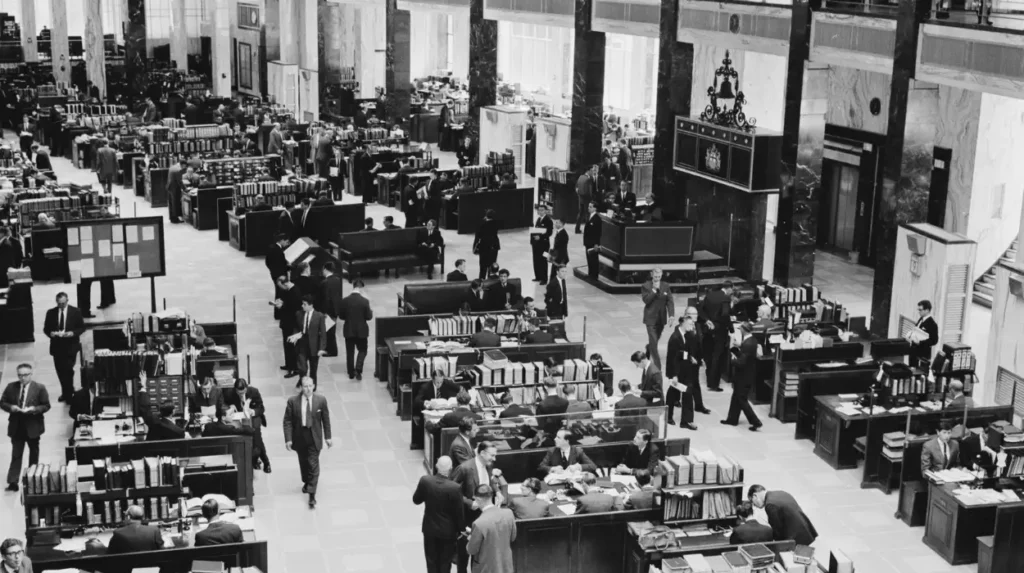
The nineteenth century brought major changes to London’s economy. Industrialisation increased production, trade and investment. Railways expanded national markets and connected the City with ports, industrial towns and regional centres.
The City’s streets became increasingly occupied by banks, insurers, brokers, company offices and professional firms. Financial services became more specialised as the British economy expanded.
The London Stock Exchange became an important institution for securities trading. The City also became the centre of a growing international network involving sterling, government debt, insurance, shipping finance and overseas investment.
Lloyd’s remained a major insurance institution. Its history demonstrates how specialist financial services evolved from relatively informal commercial networks into professional markets.
Architecture reflected the growing financial economy. Purpose-built banks, insurance offices, livery halls, warehouses and commercial buildings occupied the City. Later, large office buildings transformed the skyline.
The City also experienced severe population change. By the nineteenth century, overcrowding had become a major problem. City of London records state that the City population reached approximately 129,000 in the 1850s.
Over time, offices increasingly replaced residential uses within the central business district. The City became a place where large numbers of people worked during the day while relatively few residents lived permanently within its boundaries.
The twentieth century introduced further technological change. Telephones, telegraph systems, computers, electronic trading and international communications reduced the importance of physical distance between financial markets.
Yet the City retained its institutional concentration. Historic banks, insurance markets, professional firms, legal practices and financial exchanges continued to operate within a compact geographical area.
This combination of historical institutions and technological adaptation helped preserve the City’s role as an international financial centre.
What historic evidence still survives in the City of London today?
The City preserves Roman walls, archaeological remains, medieval streets, churches, Guildhall, livery halls, post-fire buildings, financial institutions and modern towers. More than 600 listed buildings and 48 scheduled ancient monuments demonstrate the exceptional depth of its historic environment.
The City’s historic character survives through both visible architecture and archaeological evidence.
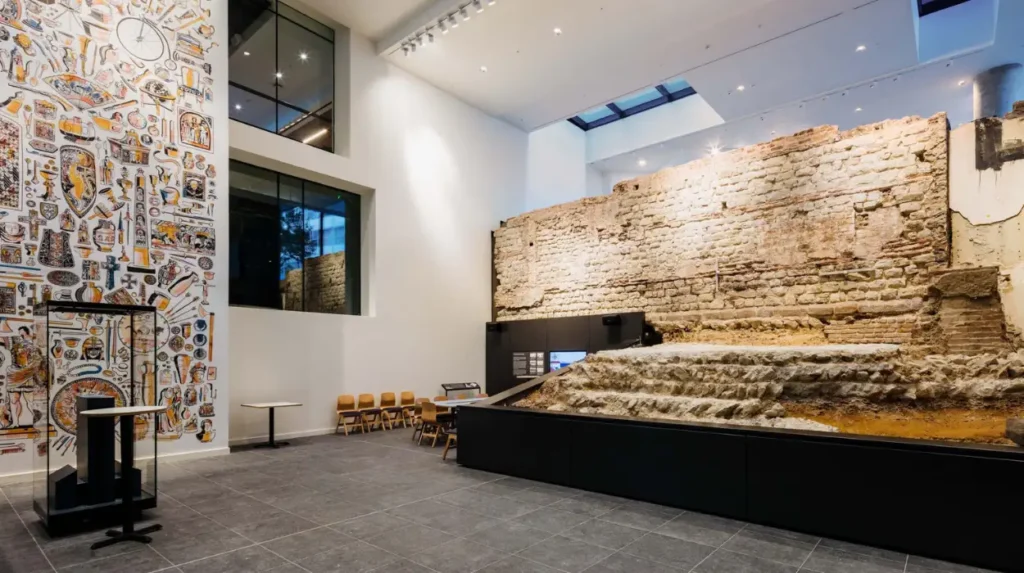
Parts of the Roman London Wall remain visible around Tower Hill, Aldgate, Bishopsgate, Barbican, Moorgate, Cripplegate, Newgate, Ludgate and Blackfriars. The original wall was approximately two miles long and reached about six metres in height.
The archaeological record is especially significant. Continuous occupation from Roman, Saxon and medieval periods created deep archaeological deposits beneath streets, buildings and open spaces. Excavations provide evidence about former land uses, inhabitants, industries and commercial activity.
The Roman amphitheatre beneath the Guildhall Art Gallery provides a direct physical connection with Londinium. Roman fort remains survive near the Barbican, including sections visible around Noble Street and London Wall.
Medieval architecture also remains. Guildhall represents the continuing civic importance of the City. Several churches survived the Great Fire, while others were rebuilt by Christopher Wren after 1666.
The City’s heritage environment currently includes more than 600 listed buildings, 28 conservation areas, 48 scheduled ancient monuments and four historic parks and gardens.
These assets exist alongside modern commercial architecture. The Barbican Estate demonstrates the post-war transformation of the City. Construction began in 1965 and continued for 11 years. The 40-acre estate was Grade II listed in 2001.
The coexistence of Roman remains, medieval churches, Victorian commercial buildings, twentieth-century architecture and contemporary towers demonstrates the City’s continuous adaptation.
To experience this historic financial district in person today, consult our comprehensive [Best Food Experiences in Borough Market Every Tourist Should Enjoy During Their Visit] for itineraries and visiting parameters.
Why does the City of London remain historically important to Britain’s financial identity?
The City remains historically important because its Roman port, medieval commercial institutions, civic privileges, Royal Exchange, Bank of England, insurance markets and securities networks created a continuous financial tradition that still shapes Britain’s economic and urban identity today.
The City of London became Britain’s historic financial and commercial centre through cumulative development rather than a single event.
Roman Londinium established the geographical foundation. Its Thames crossing, port and commercial buildings created an urban centre based on trade.
Saxon and medieval London restored the City’s role as a protected trading settlement. Medieval civic privileges strengthened local government and gave merchants a stable institutional environment.
The Royal Exchange formalised commercial interaction during the sixteenth century. The rebuilding after the Great Fire produced a new architectural framework without eliminating the City’s commercial geography.
The Bank of England then established a permanent centre for government finance and national credit in the City. Its move to Threadneedle Street in 1734 strengthened the concentration of financial institutions.
Insurance markets added another specialised function. Lloyd’s developed a system for marine insurance based on information, underwriting and shared risk. Securities markets created mechanisms for trading government debt and company investments.
The nineteenth and twentieth centuries expanded these functions into an international financial network.
The City’s importance also extends beyond finance. Its archives preserve evidence of merchants, workers, companies, institutions and ordinary Londoners. Guildhall Library holds more than 200,000 printed materials dating from the fifteenth to the twenty-first centuries and maintains extensive collections relating to London’s trade, people and buildings.
The Bank of England Archive also provides material for financial and genealogical research, including staff records, customer accounts, stock ledgers and architectural documentation.
The City therefore functions as both a working financial district and a historical archive embedded in the urban landscape.
Its future development continues to involve a balance between commercial growth and heritage protection. The City Corporation’s planning framework recognises the importance of archaeological remains, listed buildings, conservation areas and historic streets while supporting contemporary development.
The result is a distinctive historical environment in which ancient infrastructure and modern financial architecture occupy the same small geographical area.
The City of London’s transformation from Roman trading settlement to medieval merchant city, early modern commercial centre and global financial district explains its enduring position in British history. Its financial importance rests on more than banks and offices. It rests on nearly two millennia of trade, law, governance, infrastructure, information and institutional continuity.
That continuity is visible today in the Roman Wall, Guildhall, medieval street patterns, Wren churches, Royal Exchange, Bank of England, historic livery halls, insurance institutions, financial archives and modern office towers. Together, these surviving elements demonstrate how the Square Mile became one of the most historically significant commercial landscapes in Britain.
Frequently Asked Question
What is the City of London?
The City of London is London’s historic financial and commercial core, commonly known as the Square Mile. It covers the ancient centre of London and contains major institutions including the Bank of England, Guildhall and Royal Exchange.