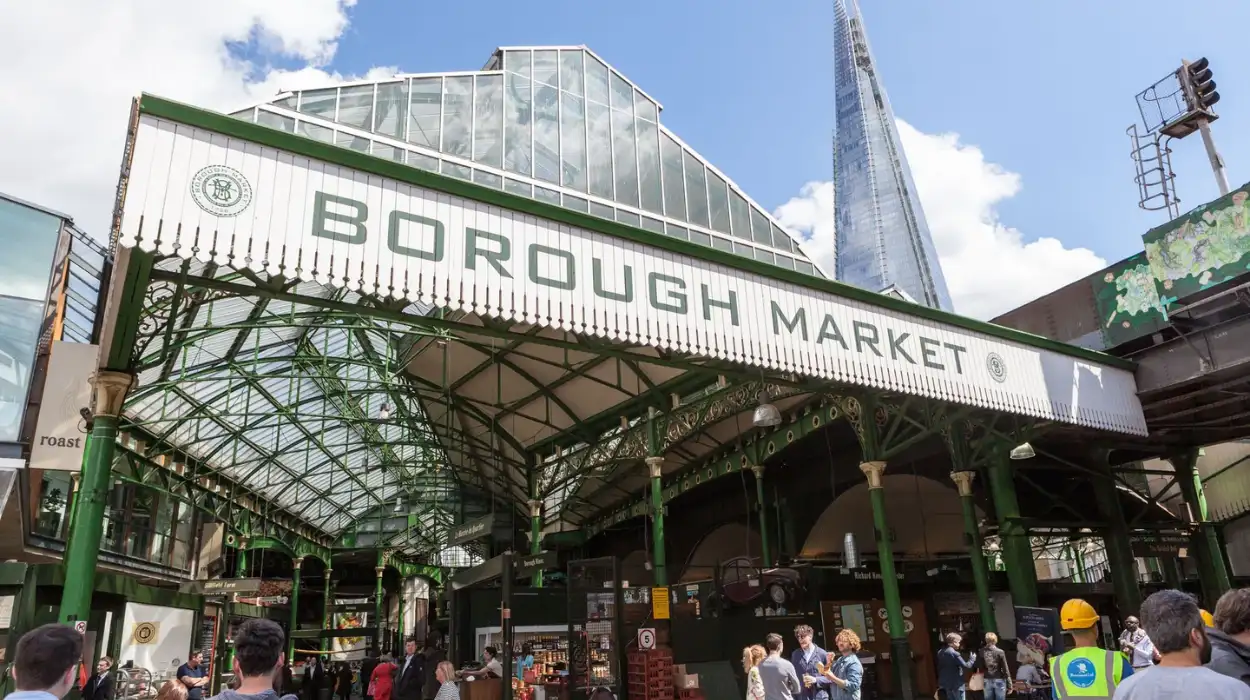
Borough Market is one of London’s most historically significant food markets. Its history connects medieval trade, London Bridge, Southwark, parliamentary regulation, railway expansion, wholesale commerce, and the modern revival of specialist food retail.
- When did Borough Market begin?
- How did London Bridge shape Borough Market’s development?
- What was Borough Market like during the medieval and early modern periods?
- Why was Borough Market moved in 1756?
- How did the railway transform Borough Market?
- How did Borough Market become a major wholesale fruit and vegetable market?
- Why did Borough Market face decline in the late 20th century?
- How did Borough Market become a modern food destination?
- What historic features and traditions remain at Borough Market today?
- Why is Borough Market historically important to London?
- Frequently Asked Question
The market’s origins reach back about 1,000 years. Borough Market itself describes its story as beginning when a food market developed at the foot of London Bridge in the early medieval period. Southwark Council identifies the present institution as the oldest fruit and vegetable wholesale market in central London and records continuous trading from its current 4.5-acre site since 1756.
The market therefore has two important historical identities. The first is the long tradition of food trading around London Bridge and Borough High Street. The second is the formally established market that moved away from the congested highway in 1756.
That distinction is essential when describing Borough Market as London’s oldest food destination. The market has occupied its present location for more than 250 years, while its wider trading tradition in Southwark extends considerably further back.
Its survival resulted from repeated adaptation. Medieval restrictions changed its trading environment. Early modern regulation attempted to control congestion. The Industrial Revolution transformed it into a major wholesale centre. Railways strengthened its distribution role. Supermarket expansion later weakened traditional wholesale markets. The food revival of the late 20th century then created a new retail identity.
When did Borough Market begin?
Borough Market’s food-trading history began around 1,000 years ago beside London Bridge, while its present market site dates from 1756. Medieval traders supplied grain, fish, vegetables, livestock, and other provisions to travellers, residents, and businesses using Southwark’s major route into London.
The market developed because Southwark occupied an exceptionally important transport position. London Bridge provided the principal connection between the City of London on the north bank and the roads leading south from the Thames.
The bridge itself was reconstructed in stone during the medieval period, but a bridge existed at London from the Anglo-Saxon era. Borough Market’s own historical research places the emergence of food trading in the area around the 11th century.
The road south from the bridge became Borough High Street. It connected London with settlements, agricultural districts, and ports across southern England. Farmers and merchants could therefore bring food into Southwark and sell it close to one of London’s busiest crossings.
This geography established the basic commercial mechanism that sustained the market for centuries: transport created customers, customers created demand, and demand attracted traders.
The market was not originally a single enclosed building. Medieval Borough consisted of trading spaces operating around the southern approach to London Bridge. Different markets served different purposes, including a market associated with St Thomas’ Hospital and a larger market near the bridge.
The market’s early importance also reflected the growth of pilgrimage. After the murder of Thomas Becket in Canterbury in 1170, Canterbury became a major pilgrimage destination. The road through Southwark became increasingly important for travellers heading south-east towards Canterbury.
Food sellers therefore served both a permanent population and a constant flow of travellers.
How did London Bridge shape Borough Market’s development?
London Bridge made Southwark a major commercial gateway because it concentrated travellers, animals, merchants, and food traders at one crossing. Borough High Street extended this movement southward, creating the transport and commercial conditions that allowed a permanent food market to develop.
London Bridge was the central geographical factor in Borough Market’s early history. Before modern bridges and tunnels multiplied crossings of the Thames, the bridge concentrated movement between the City and southern England.
Southwark occupied a different administrative and legal environment from the City of London. The distinction became important because the City’s authorities attempted to protect its own markets from competition.
During the 1270s, the City prohibited its citizens from travelling to Southwark to purchase food and other merchandise. The restrictions specifically targeted commodities such as corn and cattle. The City also prevented traders from establishing stalls on London Bridge itself.
These restrictions demonstrate the economic importance of the market. A market does not require large buildings to become strategically important. Control over customers, traders, prices, and movement provides substantial political and economic value.
Southwark’s position also created a complicated relationship with London authorities. The City wanted to control commercial activity south of the river while Southwark communities sought to protect their own trading rights.
The struggle continued through the medieval period. In 1406, Henry IV granted the City of London expanded rights in Southwark, including authority relating to markets and the regulation of provisions. Further charters in 1444 and 1462 reinforced London’s influence over the area.
Edward VI finally transferred Southwark to the City of London in 1550. The transaction cost slightly more than £1,000 and formally ended much of the long dispute over jurisdiction. The market was then permitted to trade four days a week rather than two.
The history of Borough Market is therefore also a history of municipal authority. Food markets were economically important institutions that required regulation because they affected prices, supplies, transport, taxation, and public order.
What was Borough Market like during the medieval and early modern periods?
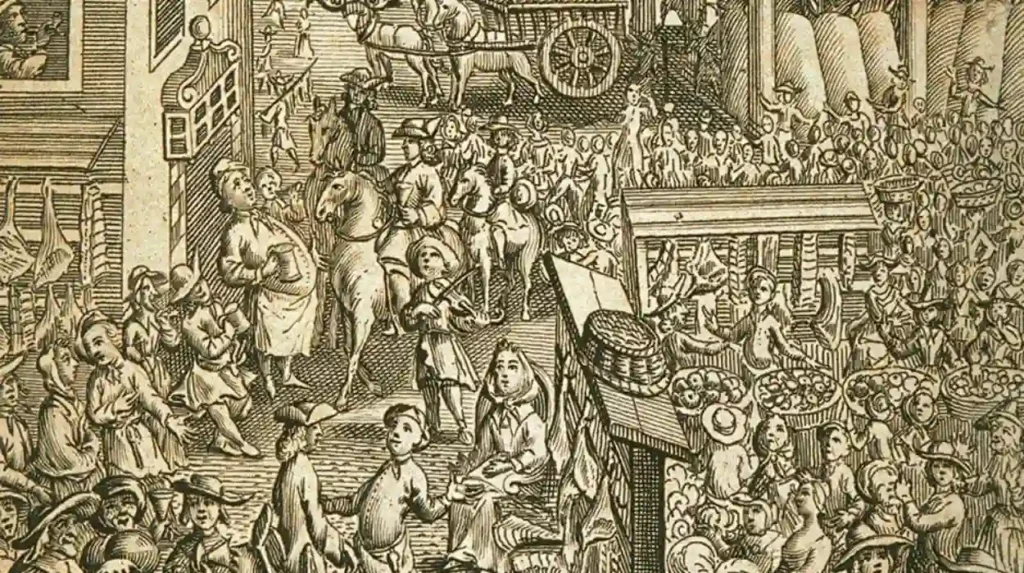
Medieval and early modern Borough Market operated as an open street market rather than today’s enclosed market complex. Traders sold grain, livestock, fish, vegetables, bread, poultry, and other provisions while authorities regulated stalls, prices, weighing, trading days, and movement along Borough High Street.
The market became increasingly integrated into the daily economy of Southwark. Traders arrived from surrounding counties, particularly Kent, Surrey, and Sussex. They supplied agricultural products to London’s growing population.
Borough High Street became the market’s main commercial corridor. The market was not separated from ordinary traffic. Stalls occupied space along the road, while livestock and carts moved through the same area.
This arrangement created persistent congestion.
Authorities attempted to impose order through stall regulations and inspections. Historical accounts record arrangements that placed different types of traders in designated sequences. Fish sellers, butchers, poulterers, oatmeal makers, fruit sellers, herb sellers, and bakers occupied defined areas.
Public weighing was another important feature. A weighing beam stood beside the pillory on Borough High Street, allowing sacks of grain to be weighed publicly before sale. A market house was later built to protect grain from the weather and provide administrative facilities.
The market also existed within a dense urban environment. Southwark contained inns, workshops, theatres, breweries, shops, houses, and entertainment venues. The area became closely associated with the theatrical world of Bankside during the Elizabethan and Jacobean periods.
William Shakespeare lived and worked close to this commercial environment. Historical material from Borough Market records that food purchased for the people of Bankside was commonly obtained from the market during the early 17th century.
The market was therefore part of the ordinary provisioning system supporting Southwark’s population and its cultural institutions.
Why was Borough Market moved in 1756?
Borough Market moved in 1756 because its stalls and livestock obstructed Borough High Street, one of London’s major southern routes. Parliament ordered the old market to close and authorised local parishioners to establish a replacement market away from the highway.
By the 18th century, congestion had become a structural problem. Borough High Street carried commercial traffic, travellers, carts, livestock, and pedestrians. Market activity occupied much of the same space.
The authorities increasingly viewed the obstruction as damaging to trade and movement.
In 1754, Parliament passed legislation requiring the existing market to close. The legal action reflected a conflict between two economic functions: the market supplied food, but the market’s physical location disrupted the road that carried people and goods into London.
Local residents responded by seeking permission to establish a new market away from the highway. Parliament authorised the parishioners of St Saviour’s to acquire land for this purpose.
The parish raised £6,000 through annuities and purchased an area known as The Triangle. A further £2,000 was later authorised for enlargement and construction.
The new market opened in 1756. It was located behind Three Crown Court, west of Borough High Street, and became the foundation of the market site that survives today.
This relocation changed the market’s physical form without ending its historical function. Food trading continued, but the market was now separated from the main road.
The move also created a long-term institutional structure. The market was established for the benefit of the parish, a principle that remains important to its modern charitable governance. Borough Market is now operated by a charitable trust rather than as a conventional municipal market.
The 1756 relocation therefore represents one of the most important turning points in the market’s history. It separated the market from the congestion that threatened its existence and created the permanent site associated with Borough Market today.
How did the railway transform Borough Market?
The railway transformed Borough Market during the 19th century by connecting the market directly to expanding transport networks and rapidly growing urban demand. The 1862 railway viaduct strengthened its role as a major wholesale centre for fruit and vegetables.
The Industrial Revolution fundamentally changed London’s food economy. London’s population expanded rapidly, creating demand for reliable supplies of fresh produce.
Borough Market was well positioned to serve this demand. Its location beside London Bridge provided road access, while the railway provided a faster distribution network connecting the market with producers and commercial centres.
In 1862, a railway viaduct was constructed through the market as part of the South Eastern Railway’s expansion from London Bridge towards Cannon Street and Charing Cross.
The railway brought disruption. It introduced infrastructure, noise, soot, and physical division into the market. It also delivered a major commercial advantage: improved access.
The market increasingly specialised in wholesale fruit and vegetables. Produce could arrive from agricultural regions and move efficiently into London’s distribution system.
The transformation made Borough Market an important wholesale institution rather than simply a neighbourhood market.
Expansion continued. The market acquired additional land, including the area that became the Green Market. Winchester Walk was also redeveloped as the market expanded.
A major architectural change followed in the late 19th century. The railway required further widening in 1897, creating additional disruption. The market’s earlier glass-and-iron domed roof was lost during this period.
The railway era demonstrates how transport infrastructure repeatedly shaped Borough Market. London Bridge created the original market. The railway created the large-scale wholesale market. Later changes in road transport, supermarkets, refrigeration, and logistics again transformed its commercial role.
How did Borough Market become a major wholesale fruit and vegetable market?
Borough Market became a major wholesale fruit and vegetable centre during the 19th century because London’s expanding population increased demand for fresh produce while railways and urban transport improved distribution. The market increasingly concentrated specialist traders, warehouses, merchants, and wholesale buyers.
Wholesale trade differs from ordinary retail trade because goods are purchased in larger quantities for resale, catering, shops, and commercial distribution.
Borough Market’s 19th-century development reflected this system. Farmers and agricultural suppliers brought produce into London, where specialist traders distributed it to retailers and other businesses.
The market’s proximity to London Bridge station became increasingly valuable. Railways could move produce faster and in larger quantities than traditional horse-drawn transport.
The market’s identity consequently became strongly associated with fruit and vegetables.
This wholesale role continued through the 20th century. Borough Market’s own historical records state that it remained at the centre of the fruit and vegetable trade after the Second World War.
The market also developed new buildings and governance arrangements. In 1906, its constitution changed so that management was placed in the hands of 21 voluntary trustees drawn from the local community.
The 1930s brought another major physical redevelopment. Three Crown Square had declined from a residential area into a collection of warehouses and commercial buildings. It was demolished as part of a redevelopment costing £50,000.
The project created the Art Deco entrance and office building associated with the market’s 20th-century architectural identity.
The Art Deco style belongs to an international design movement associated with geometric forms, modern materials, strong symmetry, and decorative surfaces. At Borough Market, the architectural redevelopment reflected the institutional importance of the wholesale market during the interwar period.
The market also became part of local social life. In 1930, Charlie Chaplin’s offer to sponsor the traders’ annual sports day attracted national attention.
These developments demonstrate that Borough Market was not simply a place where food changed hands. It was an economic institution with traders, trustees, buildings, workers, social activities, and established commercial networks.
Why did Borough Market face decline in the late 20th century?
Borough Market faced serious commercial pressure during the late 20th century because supermarkets, modern distribution systems, changing shopping habits, and large-scale food retail reduced the importance of traditional wholesale markets. Its historic wholesale model required a new commercial direction.
The post-war food economy became increasingly dominated by supermarkets and centralised distribution. Large retailers developed their own supply chains and purchasing systems.
This transformation weakened the traditional role of wholesale markets.
Borough Market remained an important fruit and vegetable centre during the 1950s and subsequent decades, but the growth of supermarkets during the 1980s and 1990s placed increasing pressure on its established business model.
The market’s location then became an asset for a different reason. Southwark experienced major regeneration, while nearby warehouses and industrial spaces attracted independent food businesses.
Specialist food companies including Neal’s Yard Dairy, Brindisa, and Turnips became associated with the market and its surrounding area. These businesses helped create an environment focused on specialist and high-quality food.
The market’s transformation was not an abandonment of its past. It represented a change in the type of customer and transaction.
Wholesale buyers remained important, but direct retail customers increasingly became central to the market’s future.
This shift accelerated in 1998. Food writer Henrietta Green organised a three-day Food Lovers’ Fair at Borough Market during the Southwark Festival in November 1998. The event attracted producers and large numbers of visitors, with traders reportedly selling out quickly.
The success demonstrated that Borough could function as a specialist retail food destination.
A regular retail market followed. It initially operated monthly, then expanded to weekly trading.
The late-20th-century revival created the foundation for the market’s current identity. Borough Market retained its historic association with food supply while becoming a destination for consumers seeking specialist produce, prepared food, and independent traders.
How did Borough Market become a modern food destination?
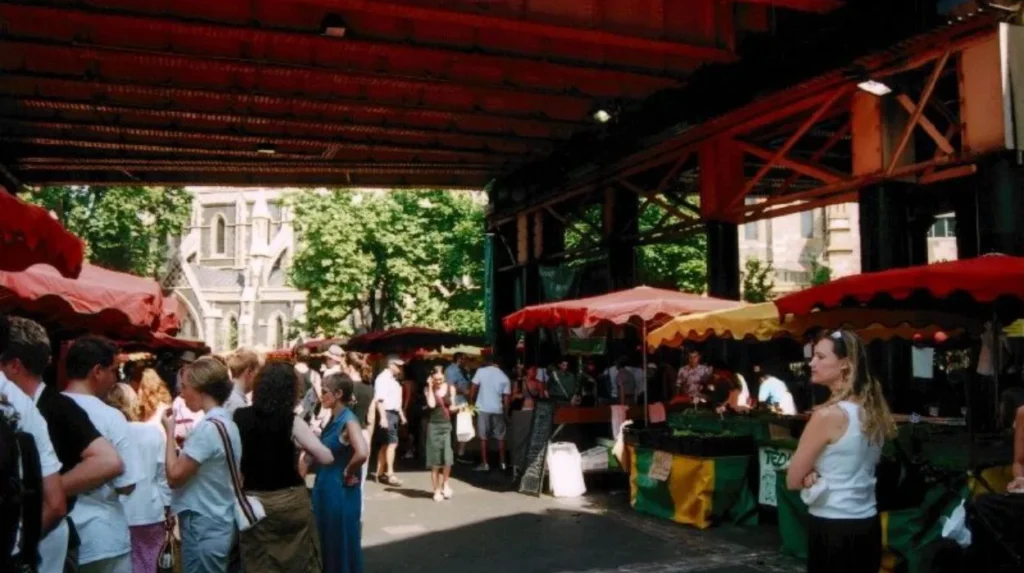
Borough Market became a modern food destination after its successful 1998 retail revival expanded from specialist food events into regular public trading. The market combined its wholesale heritage with independent producers, specialist retailers, prepared food, restaurants, education, and community-focused charitable activities.
The 1998 Food Lovers’ Fair marked a decisive change. Its success encouraged trustees to support a regular retail market alongside the established wholesale trade.
The retail operation initially opened on the third Saturday of each month. Demand led to expansion into weekly trading and eventually a much broader public-facing food market.
The transformation coincided with broader changes in London’s food culture. Consumers increasingly sought provenance, specialist production, regional products, artisan food, and international cuisines.
Borough Market provided a physical setting for these trends while retaining its historical relationship with agricultural supply.
Its modern trading environment includes fresh produce, specialist foods, prepared dishes, restaurants, cafés, and food businesses. The market’s official website describes its current mission in terms of food, community, and more sustainable approaches to production and consumption.
The market also developed a formal charitable structure. Borough Market was registered as a charity in 1999, with its principal charitable purpose centred on providing a market as a public amenity for the benefit of the public.
This governance model gives the market a distinct position within London’s commercial landscape. It is neither simply a private shopping centre nor a conventional council-run market.
Its community role also extends into education. The market’s contemporary programmes include activities designed to connect children, schools, traders, food producers, and the public with food knowledge.
The market continues to evolve. In 2021, Sunday opening was introduced in response to customer demand, extending its recent trading pattern.
For visitors interested in the market’s modern atmosphere as well as its historic surroundings, [Best Scenic Walks Around Richmond for Riverside Views and Historic Green Spaces] provides the appropriate visitor-focused route for exploring Borough Market and nearby Southwark attractions.
What historic features and traditions remain at Borough Market today?
Borough Market retains physical and institutional evidence of its long history through its permanent site, historic market structures, railway surroundings, Art Deco architecture, charitable governance, specialist trading culture, and continuing connection with food distribution in central London.
The strongest surviving historical feature is the location itself. Borough Market has traded from its present site since 1756. Southwark Council records the current market area as approximately 4.5 acres.
The railway viaduct remains another defining element. Its construction in 1862 fundamentally changed the market and continues to shape the physical environment.
The Art Deco entrance and office building represent the market’s 1930s redevelopment. They provide architectural evidence of the period when Borough remained a major wholesale institution.
The market’s location also preserves the relationship between food commerce and transport. London Bridge station remains nearby, continuing the historic association between the market and major movement routes.
The surrounding streets provide further historical context. Borough High Street, Stoney Street, Winchester Walk, and Southwark Street form part of a dense urban landscape that developed through successive periods of trade, transport, housing, industry, and redevelopment.
The market’s institutional continuity is equally important. The organisation remains governed through a charitable trust. Its trustees have responsibility for managing the market and ensuring that its activities benefit traders, shoppers, neighbours, and the wider community.
This combination of physical and institutional continuity explains why Borough Market remains historically significant.
Its importance does not depend solely on its age. Its significance comes from its ability to demonstrate how London’s food economy changed across different periods.
The market records the transition from medieval street commerce to regulated urban markets, from agricultural supply to railway-enabled wholesale distribution, and from traditional wholesale trading to modern specialist retail.
That continuity provides researchers with a valuable case study in London’s commercial history.
Why is Borough Market historically important to London?
Borough Market is historically important because its thousand-year food-trading tradition connects medieval Southwark with modern London. Its history demonstrates how transport, urban growth, regulation, wholesale commerce, railway infrastructure, retail change, and charitable governance shaped one enduring food institution.
Borough Market’s historical importance begins with geography. London Bridge created the commercial connection that allowed food traders to serve people travelling between the City and southern England.
Its second importance lies in municipal history. Medieval and early modern authorities repeatedly attempted to regulate the market because its economic activity crossed administrative boundaries and competed with established City markets.
Its third importance is urban history. The 1754 parliamentary closure demonstrates how a successful market could become incompatible with the traffic requirements of an expanding city. The relocation of 1756 created the permanent site that survives today.
Its fourth importance is industrial history. The railway viaduct of 1862 demonstrates the direct impact of transport infrastructure on food distribution. Borough developed into a major wholesale fruit and vegetable centre because rail connections supported large-scale movement of agricultural produce.
Its fifth importance is social and economic history. Generations of traders, farmers, wholesalers, retailers, workers, and customers depended on the market.
Its sixth importance is heritage preservation. The market provides a surviving example of a London institution that changed its commercial model without abandoning its central relationship with food.
Its seventh importance is modern food history. The retail revival beginning in 1998 demonstrates how historic markets can respond to changes in consumer behaviour. Borough Market moved from a predominantly wholesale model towards a combination of wholesale, specialist retail, prepared food, education, and public engagement.
The market therefore represents continuity through adaptation.
Its historical relevance also extends to academic research. Historians can use Borough Market to examine medieval commerce, municipal jurisdiction, food regulation, urbanisation, industrial transport, wholesale distribution, architectural change, and heritage management.
Genealogical researchers can also place historical residents, traders, farmers, workers, and businesses within the wider economic environment of Southwark. The market’s records and surrounding streets provide valuable context for understanding family connections to London’s food and commercial trades.
For cultural tourists, Borough Market provides a direct connection between present-day London and a trading tradition that began around the medieval approach to London Bridge.
For educators, the market offers a compact case study covering approximately a millennium of urban change.
Borough Market’s history is therefore not a single story of a market surviving for centuries. It is a record of repeated transformation. Its medieval origins, 1756 relocation, 19th-century wholesale expansion, railway development, 20th-century commercial pressures, and 1998 retail revival form a continuous historical sequence.
The market remains at 8 Southwark Street, close to London Bridge, occupying the site established in 1756. Southwark Council continues to identify it as the oldest fruit and vegetable wholesale market in central London.
Its modern identity as a food destination rests on this historical foundation.
Borough Market survives because its function has never been completely fixed. The products, customers, buildings, transport systems, governance arrangements, and commercial practices changed repeatedly. The underlying purpose remained consistent: bringing food into the centre of London and connecting producers, traders, and consumers.
That continuity gives Borough Market its enduring place in London’s history.
The market is both a surviving historic institution and an active part of the city’s present food economy. Its story links medieval Southwark, London Bridge, the expansion of Victorian London, the railway age, the rise of supermarkets, and the modern interest in specialist food.
For The Londoner News readers, Borough Market provides a clear example of how London’s historic places remain relevant when their original economic functions evolve without losing their historical foundations.
Frequently Asked Question
How old is Borough Market?
Borough Market has a food-trading history of around 1,000 years. Its present site in Southwark dates from 1756, when the market moved away from Borough High Street because of severe congestion.