South Kensington is one of London’s most important cultural and educational districts. It combines major museums, royal parkland, Victorian architecture, scientific collections, educational institutions, and public spaces within a compact area. For families, this concentration creates an unusual opportunity to connect historical knowledge with direct experiences.
- Why is South Kensington one of London’s best areas for family learning?
- What can families discover at the Natural History Museum?
- How can families use the Science Museum as an educational adventure?
- What can children learn from the Victoria and Albert Museum?
- How does Kensington Gardens add outdoor history to a family visit?
- What is the history of the Diana, Princess of Wales Memorial Playground?
- Why is the Royal Albert Hall important for families interested in history?
- How can families turn Exhibition Road into a historical learning route?
- How did transport help South Kensington become a cultural district?
- What historical evidence can students study in South Kensington?
- How has South Kensington preserved its historical identity?
- What makes South Kensington suitable for a full family history day?
- Why does South Kensington remain historically important today?
- Frequently Asked Question
The district’s modern identity developed from the Great Exhibition of 1851. Prince Albert, Queen Victoria’s husband, supported the creation of a permanent cultural and educational quarter after the exhibition generated a substantial financial surplus. The resulting development established museums and institutions across land in South Kensington and helped transform the area from suburban Brompton into a major international centre for education, science, art, and culture.
The area now contains the Victoria and Albert Museum, Natural History Museum, Science Museum, Royal Albert Hall, Imperial College London, Royal College of Music, Royal College of Art, and other cultural institutions. Local planning documentation describes South Kensington as an early example of a deliberately designed cultural and educational destination.
For families, its importance extends beyond entertainment. The museums preserve scientific specimens, industrial technology, decorative arts, architectural evidence, historical objects, and research collections. Kensington Gardens adds a contrasting environment of gardens, monuments, wildlife, and recreational spaces.
Why is South Kensington one of London’s best areas for family learning?
South Kensington brings science, natural history, art, architecture, royal history, gardens, and public recreation together within a concentrated cultural district, allowing families to combine museum visits with outdoor exploration and structured educational activities in one area.
The foundation of South Kensington’s educational character dates to the Great Exhibition of 1851. The exhibition took place in Hyde Park inside the Crystal Palace and attracted more than six million visitors during its four-month run. Its financial success generated a surplus that helped finance educational and cultural development in South Kensington.
The Commissioners for the Exhibition of 1851 acquired land in the area for institutions dedicated to art and science. Exhibition Road became the central route through this developing cultural quarter. The Victoria and Albert Museum, Natural History Museum, Science Museum, Imperial College London, Royal College of Music, and Royal Albert Hall subsequently became major components of the district.
The result was not simply a collection of unrelated attractions. South Kensington represented a Victorian idea that public education could be supported through museums, scientific collections, technological displays, architecture, and access to knowledge.
That principle remains visible today. A family can examine fossils at the Natural History Museum, study technological development at the Science Museum, investigate design and material culture at the Victoria and Albert Museum, and then continue the day in Kensington Gardens.
The district therefore works particularly well for educational visits because each institution provides a different form of evidence. Natural history uses specimens. Science uses machines, instruments, and technological objects. Art and design use manufactured objects, architecture, textiles, sculpture, and visual records. The surrounding landscape supplies further historical evidence.
What can families discover at the Natural History Museum?
The Natural History Museum provides families with direct access to natural history through fossils, minerals, zoological specimens, geological collections, scientific displays, and historic architecture, while its origins connect modern museum education with eighteenth-century collecting and nineteenth-century scientific organisation.
The Natural History Museum opened to the public on 18 April 1881. Its institutional origins reach back to Sir Hans Sloane, an eighteenth-century physician and collector whose collection contained more than 71,000 items. After his death in 1753, Parliament purchased the collection for £20,000, and the material contributed to the foundation of the British Museum.
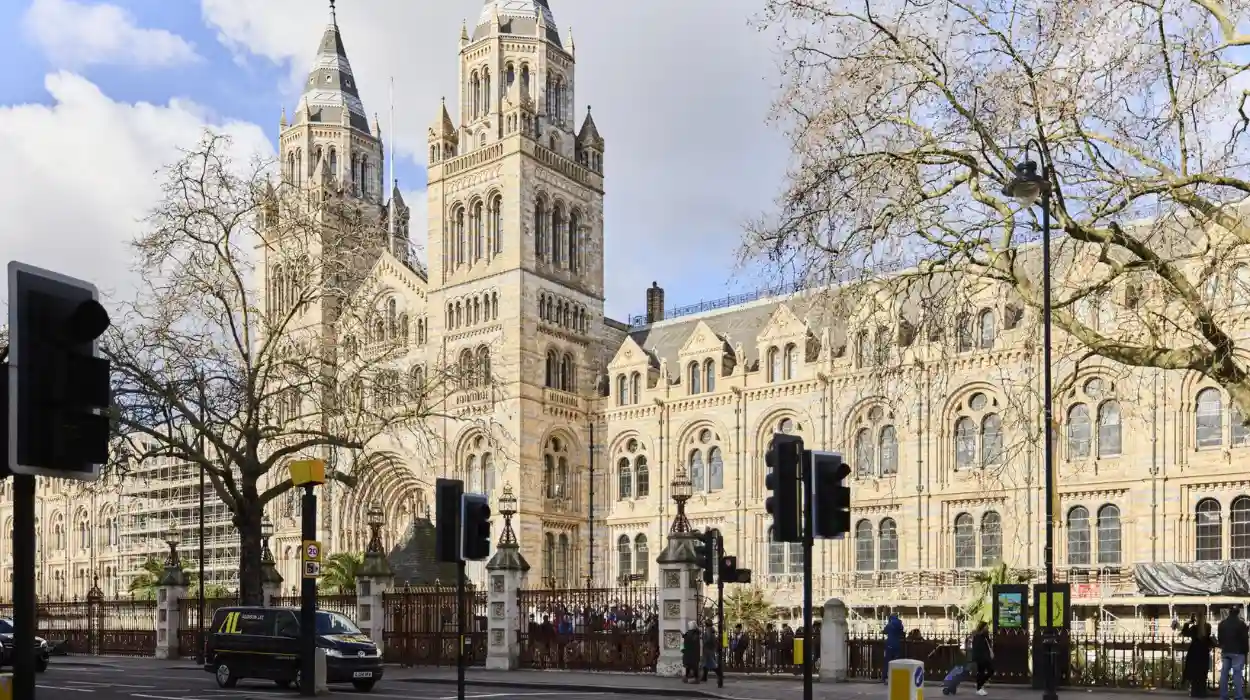
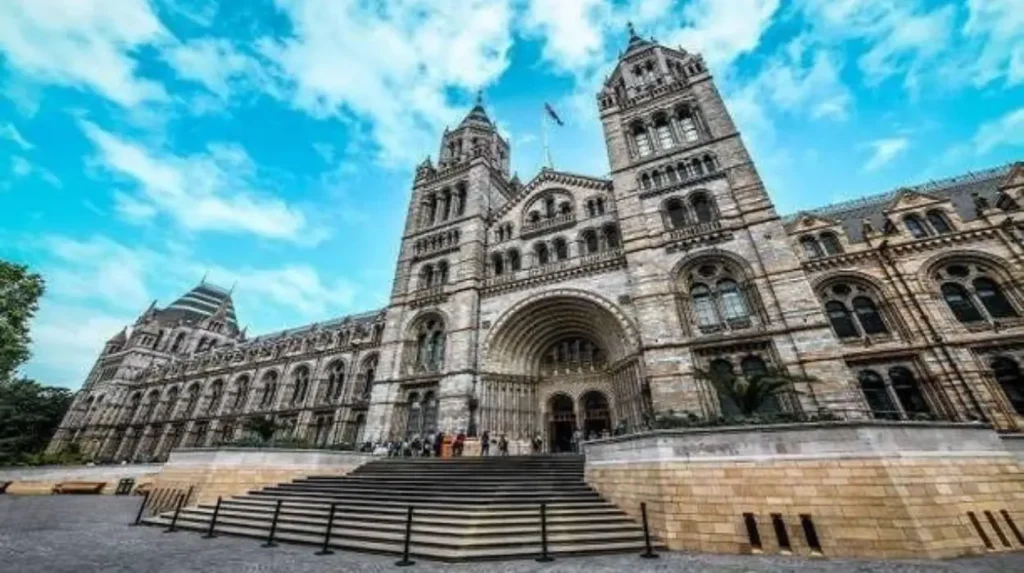
Natural history collections remained part of the British Museum until a purpose-built building was developed in South Kensington. Sir Richard Owen, a leading nineteenth-century comparative anatomist and palaeontologist, played a major role in establishing the new institution. Architect Alfred Waterhouse designed the building in a Romanesque style, producing one of South Kensington’s most recognisable Victorian structures.
The building itself forms part of the educational experience. Families can examine architectural decoration representing animals and natural forms while learning how Victorian architects integrated scientific themes into public buildings.
The museum’s collections also demonstrate the difference between a public museum and a research institution. Its collections support scientific investigation as well as visitor education. The Library and Archives contains more than one million items, including almost 400,000 books, 22,000 ongoing journal titles, 350,000 artworks, and more than 100,000 catalogued archival items.
The museum’s research history also provides a useful educational connection. Its collections cover taxonomy, botany, entomology, mineralogy, palaeontology, zoology, and related scientific fields. These subjects allow older children and students to connect museum displays with formal scientific disciplines.
The surrounding museum grounds add another educational layer. The site originally included landscaped gardens maintained by the Royal Horticultural Society during the 1860s. Work on the museum building began in 1873, while landscaping developed alongside construction.
How can families use the Science Museum as an educational adventure?
The Science Museum connects family learning with the history of invention, engineering, medicine, transportation, communications, and industrial development, making its collections useful for explaining how scientific knowledge and technological systems changed British society from the nineteenth century onward.
The Science Museum developed from the same South Kensington institutional programme that followed the Great Exhibition of 1851. Its predecessor, the South Kensington Museum, opened in 1857. The original institution combined industrial and decorative arts with scientific and technological material.
The South Kensington Museum operated from an early building constructed with an iron frame and corrugated iron. The structure became known as the “Brompton Boilers.” Its contents included machinery, building materials, food-related material, educational apparatus, and other objects associated with industrial knowledge.
The separation of art and science collections developed gradually. By 1893, the collections had separate directors, and the Science Museum was officially established in 1909.
This institutional history gives families a useful way to understand technological change. Machines displayed in museums are evidence of particular periods of engineering. They show how designers addressed practical problems involving transport, communication, energy, manufacturing, medicine, and measurement.
The Science Museum also connects scientific history with earlier intellectual developments. Its galleries examine periods in which astronomy, natural philosophy, engineering, and experimental science changed the way people understood the physical world.
For educators, museum objects provide primary-source material. A machine, instrument, photograph, model, or technical drawing can be treated as historical evidence. Students can examine what an object was designed to do, who used it, what materials were required, and which social or economic conditions supported its development.
This approach turns a museum visit into a structured historical investigation rather than a simple sightseeing activity.
What can children learn from the Victoria and Albert Museum?
The Victoria and Albert Museum introduces families to art, design, fashion, sculpture, architecture, textiles, ceramics, and material culture while demonstrating how manufactured objects reflect technological change, artistic movements, social customs, international exchange, and changing ideas about education.
The Victoria and Albert Museum began in 1852 as the Museum of Manufactures at Marlborough House. It became the Museum of Ornamental Art in 1853 and moved to its present South Kensington site in 1857 as the South Kensington Museum. Queen Victoria laid the foundation stone of later buildings in 1899, when the institution received its current name.
The museum’s development was closely linked to the Victorian belief that design education could improve manufacturing. Objects were collected not only for aesthetic appreciation but also for study and comparison.
That purpose remains relevant to family education. Children can examine how materials such as metal, wood, glass, ceramics, paper, and textiles were transformed into practical or decorative objects. Older students can investigate how design reflects technology, trade, wealth, fashion, and cultural exchange.
The museum also provides architectural evidence of South Kensington’s Victorian development. Its buildings form part of the wider cultural district established after 1851.
A family visit can therefore be divided into different learning themes. Younger children can identify colours, shapes, materials, and decorative patterns. Older children can investigate manufacturing techniques and historical context. Students can examine objects as evidence of economic and cultural relationships.
The V&A also demonstrates the global character of nineteenth-century collecting. Its collections contain objects from different regions and historical periods, providing opportunities to study international artistic traditions and the movement of objects through trade, collecting, imperial networks, and museum acquisition.
These subjects require careful historical interpretation because museum collections reflect the circumstances in which institutions acquired and classified objects.
How does Kensington Gardens add outdoor history to a family visit?
Kensington Gardens adds royal, architectural, landscape, literary, and environmental history to South Kensington’s museum district, giving families an outdoor setting where monuments, gardens, palace associations, wildlife, public recreation, and historical design can be examined together.
Kensington Gardens was originally part of Hyde Park. King William III and Queen Mary developed the area around Kensington Palace, establishing a royal garden associated with the palace. Later landscape changes created features that remain visible today.
Queen Caroline contributed to major eighteenth-century improvements, while Queen Victoria later commissioned two celebrated features: the Italian Gardens and the Albert Memorial. The Albert Memorial was created after the death of Prince Albert in 1861 and designed by Sir George Gilbert Scott.
The Albert Memorial provides a direct connection between the park and the Great Exhibition. The memorial depicts Prince Albert holding the catalogue of the 1851 Great Exhibition, linking the monument to the cultural project that transformed South Kensington.
The Italian Gardens provide another opportunity to study landscape design. Families can compare formal planting, water features, pathways, monuments, and open parkland.
Kensington Gardens also has an important literary connection. J. M. Barrie, creator of Peter Pan, was a local resident who drew inspiration from the park. A bronze Peter Pan statue was installed in 1912. The park also contains the Elfin Oak, a carved tree stump created by Ivor Innes in 1930.
These features demonstrate how parks preserve cultural history as well as natural landscapes.
Families can use the park to identify historical layers in the physical environment. A palace represents royal history. A memorial represents commemoration. A statue represents public art. A garden represents landscape design. A mature tree or ecological feature represents environmental history.
What is the history of the Diana, Princess of Wales Memorial Playground?
The Diana, Princess of Wales Memorial Playground opened in 2000 beside Kensington Palace and developed into a major family recreation site, combining Peter Pan-inspired design with inclusive play, while its 2025–2026 renewal demonstrates modern approaches to public heritage and accessibility.
The Diana, Princess of Wales Memorial Playground opened in 2000 in memory of Diana, Princess of Wales, who lived at nearby Kensington Palace. Its design draws on the adventures of Peter Pan and established a strong association between Kensington Gardens and children’s recreation.
The playground became one of the most heavily visited children’s play spaces in the Royal Parks. By 2025, it had welcomed more than one million visits during the year. The Royal Parks began a £3 million renewal programme because several major play structures had reached the end of their usable life.
The renewal illustrates how historic public spaces adapt to contemporary requirements. The redesigned playground includes a new wooden galleon, a multi-level treehouse, accessible routes, wheelchair-accessible picnic tables, sensory planting, improved water play, and facilities for younger children.
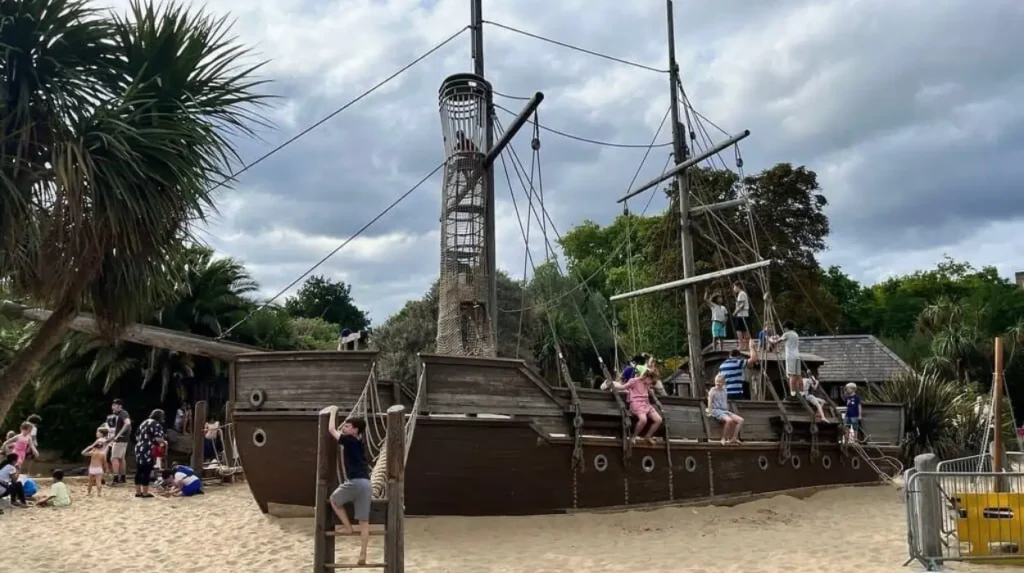
In February 2026, a new 17-metre wooden galleon arrived at Kensington Gardens. The structure was manufactured in Germany using sustainably managed mountain larch from the Bavarian Alps. It forms the centrepiece of the renewed playground.
The playground therefore provides an example of living heritage. Heritage management does not always mean preserving every physical element unchanged. It also involves maintaining the cultural purpose of a place while adapting facilities for safety, accessibility, sustainability, and changing patterns of public use.
Families visiting in 2026 should check the latest Royal Parks information because the playground renewal programme has affected opening arrangements. The Royal Parks states that the renewed playground is due to reopen during summer 2026.
Why is the Royal Albert Hall important for families interested in history?
The Royal Albert Hall represents the Victorian ambition to create major public cultural institutions in South Kensington, opening in 1871 after Prince Albert’s vision and becoming a lasting venue for music, education, public events, ceremonies, sport, and cultural performance.
The Royal Albert Hall was developed on land associated with the wider South Kensington cultural programme. The Commissioners for the Exhibition of 1851 granted a 999-year lease for the site at an annual rent of one shilling. Private investors contributed to construction by purchasing seats, with Queen Victoria and the Prince of Wales among the early purchasers.
Queen Victoria laid the foundation stone, and the building officially opened on 29 March 1871. Its original purpose reflected the Victorian ambition to establish a major cultural venue connected to the educational and scientific institutions around it.
The building provides a useful architectural lesson because it demonstrates how nineteenth-century Britain invested in permanent public institutions rather than relying solely on temporary exhibitions.
For families, the hall also extends the South Kensington experience beyond museums. Its programme has historically included classical music, popular music, educational events, sporting events, commemorations, and public speeches.
The building’s long history also connects different generations. Major musicians, political figures, scientists, performers, and public personalities have appeared at the venue since 1871. This makes it a useful case study in the changing role of public cultural institutions.
How can families turn Exhibition Road into a historical learning route?
Exhibition Road functions as the central historical corridor of South Kensington’s cultural quarter, connecting museums and institutions created through the legacy of the 1851 Great Exhibition and providing a practical route for studying Victorian urban planning.
The road takes its name from the Great Exhibition of 1851 and forms the geographic centre of the museum district. The development of South Kensington followed the purchase of approximately 87 acres of land using the exhibition’s financial surplus.
The Commissioners planned major roads, including Exhibition Road and Cromwell Road, alongside new museums and institutions. This demonstrates that the cultural quarter was supported by urban planning as well as individual buildings.
The district’s architecture records several phases of development. Victorian museum buildings stand alongside later additions, educational institutions, transport infrastructure, public spaces, and contemporary improvements.
One important example of infrastructure is the pedestrian subway associated with the Metropolitan Railway. Planning and construction records show that the railway pursued a pedestrian crossing beneath Exhibition Road during the late nineteenth century, with the tunnel largely completed by 1885.
Families can therefore treat Exhibition Road as an open-air urban history lesson. The route demonstrates how transport, education, museums, architecture, and public access developed together.
The area’s scale also supports practical family planning. Major institutions stand close enough for a museum-and-park day without requiring long journeys between attractions.
To experience this historic district in person today, consult our comprehensive [The History Behind Notting Hill’s Cultural Transformation and Global Popularity Today] for itineraries and visiting parameters.
How did transport help South Kensington become a cultural district?
Transport infrastructure helped South Kensington develop into an accessible cultural district by connecting museums, educational institutions, residential neighbourhoods, and central London, while nineteenth-century pedestrian and railway improvements addressed the practical demands created by growing public visitation.
The growth of South Kensington created new demands for transport and pedestrian access. The Metropolitan Railway’s development contributed to the district’s connectivity, while the pedestrian subway beneath Exhibition Road addressed the movement of visitors between major institutions.
Transport mattered because the cultural programme depended on public access. Museums established for education required visitors from different parts of London and beyond.
The relationship between transport and museums also illustrates a wider Victorian pattern. Industrial technology created both the cultural institutions and the infrastructure needed to support their audiences.
The district remains highly accessible through London’s transport network. This supports its role as a concentrated visitor destination rather than a collection of isolated attractions.
For families, transport planning also has educational value. The route from a station to Exhibition Road can be used to introduce children to the historical development of London’s railway network, urban growth, and changing patterns of mobility.
The physical proximity of museums is particularly important. Families can create a focused educational day without repeatedly crossing large sections of London.
What historical evidence can students study in South Kensington?
Students can use South Kensington as a fieldwork environment containing primary evidence in museum objects, architecture, gardens, monuments, archives, transport infrastructure, and public spaces, allowing historical research to connect physical evidence with institutional records and wider social change.
The Natural History Museum’s archives document the development of its collections, buildings, staff, and institutional history from its origins within the British Museum to the present. Its research resources support academic study in multiple natural-history disciplines.
The Science Museum similarly preserves evidence of technological development through objects associated with engineering, medicine, transport, manufacturing, communications, and scientific research.
The Victoria and Albert Museum provides evidence of design history, craftsmanship, architecture, fashion, decorative arts, and material culture. Its institutional history also documents the Victorian objective of improving education and manufacturing through museum collections.
Students can compare these sources with architectural evidence outside the museums. Buildings provide information about construction technology, public investment, institutional priorities, and changing architectural styles.
The parks provide another category of primary evidence. Kensington Gardens contains monuments, statues, gardens, palace associations, and landscape features associated with different historical periods.
The district therefore supports several research methods. Genealogical researchers can investigate local addresses and institutional records. Architecture students can examine building materials and design. History students can study Victorian cultural policy. Science students can examine scientific collections and technological development.
This makes South Kensington relevant to both informal family education and formal academic research.
How has South Kensington preserved its historical identity?
South Kensington preserves its historical identity through museums, listed architecture, royal parkland, monuments, archives, cultural institutions, and continuing educational use, while conservation programmes ensure that historic places remain functional within a modern and heavily visited London district.
The district remains significant because its institutions continue to perform many of the functions for which they were established. Museums still provide public access to collections. Educational institutions continue to support learning and research. Kensington Gardens remains public parkland.
The conservation challenge is substantial because South Kensington receives millions of visitors each year. Local planning documentation identifies the district as an important conservation area and records approximately 12 million annual visitors to South Kensington.
Historic preservation therefore involves more than protecting individual façades. It includes managing visitor movement, maintaining buildings, adapting accessibility, protecting landscapes, conserving collections, and integrating new facilities.
The Natural History Museum grounds demonstrate this continuing process. The gardens changed over time from formal arrangements to landscapes containing winding paths and woodland character. Access restrictions also changed, including the introduction of improved access arrangements in the nineteenth century.
The Diana Memorial Playground provides a modern example. Its renewal retains the established cultural identity of the Peter Pan-inspired playground while introducing new accessible facilities and sustainable materials.
These examples show that heritage in South Kensington remains an active process.
What makes South Kensington suitable for a full family history day?
South Kensington supports a complete family learning day because its museums, gardens, monuments, architecture, performance venues, and transport connections form a compact historical landscape where indoor collections and outdoor evidence can be studied without separating education from recreation.
A family day can begin with natural history and geological evidence at the Natural History Museum. The next stage can examine technological development at the Science Museum. Art, design, architecture, and material culture can then be studied at the Victoria and Albert Museum.
Outdoor exploration can continue in Kensington Gardens. Families can examine the Albert Memorial, Italian Gardens, Peter Pan statue, palace surroundings, and landscape features.
The Royal Albert Hall adds a performance-history dimension to the district. Exhibition Road itself provides an urban-history route connecting the institutions.
The strongest educational approach is to identify one central theme before visiting. “How did Victorian Britain use museums to educate the public?” links the Great Exhibition, South Kensington Museum, Science Museum, V&A, Natural History Museum, and Royal Albert Hall.
Another theme is “How does a city preserve history?” This connects historic buildings, museum collections, royal landscapes, monuments, archives, transport infrastructure, and modern conservation projects.
Families with younger children can focus on objects, animals, machines, buildings, gardens, and physical exploration. Older students can investigate institutional histories, architectural evidence, collecting practices, scientific development, and Victorian public policy.
The district’s educational value comes from this combination of evidence. A museum object can be examined inside a gallery. The historical institution can then be understood through its building. Its surrounding street explains urban planning. A nearby park demonstrates landscape history. A monument provides evidence of commemoration.
South Kensington is therefore more than a group of popular London attractions. It is a preserved cultural landscape created through the nineteenth-century expansion of public education and scientific culture.
Why does South Kensington remain historically important today?
South Kensington remains historically important because the cultural district created after the Great Exhibition continues to connect public museums, scientific research, education, architecture, royal heritage, green space, and cultural performance, preserving a Victorian institutional legacy within modern London.
The district’s long-term significance rests on continuity. The institutions established or expanded during the nineteenth century continue to serve public audiences and researchers.
The Natural History Museum still connects public education with scientific collections. The Science Museum continues to interpret technological and scientific development. The Victoria and Albert Museum continues to preserve art and design. Kensington Gardens remains a historic public landscape. The Royal Albert Hall remains an active cultural venue.
The scale of the original Victorian project is also significant. The Great Exhibition generated the financial resources and political momentum for a permanent cultural quarter. Prince Albert’s educational vision helped shape the institutional landscape that developed afterward.
South Kensington also demonstrates how historical districts evolve. Museums expanded. Collections became research resources. Public access changed. Transport infrastructure developed. Parks adapted to new recreational expectations. Historic buildings received modern services and accessibility improvements.
For families, these changes make the area particularly valuable. A visit does not require choosing between history and recreation. The historical environment itself provides the framework for both.
The district also has continuing relevance for educators and researchers. Its archives preserve institutional memory, while its buildings and landscapes provide physical evidence that complements written records.
The result is a rare concentration of historical resources. South Kensington allows visitors to move from prehistoric evidence to Victorian industrialisation, from royal history to modern conservation, and from nineteenth-century architecture to contemporary public education within a relatively compact part of London.
For families seeking museums, parks, architecture, science, and educational experiences, South Kensington provides an unusually complete historical environment. Its attractions are connected by a common origin: the nineteenth-century decision to transform exhibition success into permanent institutions dedicated to public knowledge.
That institutional legacy explains why South Kensington remains one of London’s most significant educational and cultural districts. Its museums preserve collections, its buildings preserve architectural history, its gardens preserve landscape traditions, and its public spaces continue to support learning across generations.
Frequently Asked Question
What are the best family activities in South Kensington?
The best family activities in South Kensington include visiting the Natural History Museum, Science Museum and Victoria and Albert Museum, exploring Kensington Gardens, seeing the Albert Memorial and visiting the Diana, Princess of Wales Memorial Playground.