
Notting Hill is one of London’s most recognisable districts, but its present identity developed through a long sequence of agricultural, architectural, industrial, demographic, political and cultural changes. The area in west London now associated with Portobello Road, colourful terraces, independent businesses and Notting Hill Carnival was once a largely rural landscape beyond the built-up core of London.
- What was Notting Hill like before it became a London neighbourhood?
- How did the Ladbroke Estate transform Notting Hill in the 19th century?
- How did railways and transport accelerate Notting Hill’s growth?
- Why did Notting Hill become an important centre of Caribbean culture?
- How did Notting Hill Carnival change the area’s cultural identity?
- How did Portobello Road contribute to Notting Hill’s cultural transformation?
- Why did Notting Hill become fashionable again in the late 20th century?
- How did the film Notting Hill make the district globally famous?
- Which historic features still explain Notting Hill’s identity today?
- How has Notting Hill’s history shaped its global popularity today?
- Frequently Asked Question
Its transformation accelerated during the 19th century when landowners, architects, railway companies and speculative developers created new residential districts. The arrival of transport connected Notting Hill with central London, while the Ladbroke Estate introduced a planned suburban landscape of terraces and communal gardens.
The 20th century brought a different transformation. North Kensington became home to Caribbean migrants and other communities. Economic inequality, poor housing, racism and political tensions shaped local life, particularly during the 1950s. The Notting Hill riots of 1958 became a major episode in the history of race relations in post-war Britain.
Community organisation then helped change the area’s cultural direction. Caribbean music, food, art and social traditions became increasingly visible. Notting Hill Carnival emerged from this environment and developed into an internationally recognised celebration of Caribbean culture.
Later decades brought another transition. Regeneration, improved transport, heritage protection, independent retail, tourism and popular culture increased Notting Hill’s international profile. The 1999 film Notting Hill further strengthened its association with London tourism and global popular culture.
The result is a district where Victorian architecture, Caribbean heritage, street markets, cultural festivals, independent commerce and international tourism exist within the same urban landscape.
What was Notting Hill like before it became a London neighbourhood?
Before large-scale development, Notting Hill was a rural landscape of farms, fields and small settlements outside central London, with Notting Hill Gate emerging as a roadside community before Victorian expansion transformed the area into a dense residential suburb.
The landscape around present-day Notting Hill was historically part of the wider manor and parish landscape of Kensington. Historic England records evidence of Roman activity in the wider area, although archaeological evidence for a substantial Roman settlement within Notting Hill itself remains limited. Roman burials were reported during 19th-century construction, including accounts of stone coffins discovered around Ladbroke Grove and Ladbroke Square.
The medieval landscape remained predominantly rural. Historic England identifies Notting Hill Gate as a small roadside hamlet established by the 13th century. Farms and agricultural holdings occupied much of the surrounding land. Porto Bello Farm, later associated with the name Portobello, stood along the route that developed into Portobello Road.
The name Notting Hill itself has medieval associations with the settlement traditionally known as Knotting Barns or similar variants. The area formed part of the broader Kensington landscape before becoming incorporated into the expanding metropolitan environment.
Notting Hill Gate also acquired a specific transport and administrative role. A turnpike gate stood there from the 18th century until 1864. Turnpikes were toll points established under legislation to raise money for road maintenance. The gate’s presence reinforced Notting Hill Gate’s position as a significant route into and out of west London.
John Rocque’s 1746 map of London demonstrates the rural character of the district. Historic England’s archaeological assessment notes that the Notting Hill Gate area remained broadly rural at that time, with principal roads crossing fields and only limited roadside development.
This rural foundation explains an important feature of later Notting Hill. Much of the district was not rebuilt from an established medieval town centre. Instead, large areas were planned and developed during London’s 19th-century expansion. That process created the street patterns, terraces and communal gardens that remain central to Notting Hill’s identity.
How did the Ladbroke Estate transform Notting Hill in the 19th century?
The Ladbroke Estate transformed rural Notting Hill into a planned residential suburb between roughly 1840 and 1868, introducing terraces, villas, streets and sixteen communal gardens that still define much of the district’s historic architectural character.
The Ladbroke family controlled a substantial estate in the area. James Weller Ladbroke inherited the property in 1819 and adopted the Ladbroke name. Architect and surveyor Thomas Allason became a major figure in planning its development.
Allason produced an ambitious plan in 1823. It included a large circus, villas and landscaped spaces. The original proposal reflected the metropolitan planning ideals associated with fashionable suburban development elsewhere in London.
Economic conditions interrupted the first scheme. The building boom of the early 1820s collapsed, and the western location was considered too remote to support the grand residential development originally envisaged. The plan was subsequently modified. Smaller houses, including terraces, became a more practical form of development.
The estate’s development resumed in the 1840s. Ladbroke Square houses began appearing in 1842, while other streets and gardens developed during the following decades. Historic England records the estate as consisting of sixteen mid-19th-century communal gardens laid out between 1840 and approximately 1868.
The architecture changed as the estate developed. Early houses were comparatively restrained brick or stucco buildings. Later construction introduced more theatrical architectural forms, including mansions and decorative façades. Thomas Allom contributed to this later phase, particularly around Kensington Park Gardens and Stanley Crescent.
St John’s Church on Ladbroke Grove became an important architectural landmark. The church was completed in 1845 by architects J. H. Stevens and G. Alexander in an Early English Gothic style. Historic England describes the church as a structural pivot of the Ladbroke Grove planned layout.
The communal gardens were equally significant. They provided shared green spaces behind or between residential terraces. Ladbroke Square Garden, measuring approximately 2.82 hectares, is the largest of the estate’s registered gardens. Its surviving features include historic paths, mature trees, railings and landscaped lawns.
These spaces demonstrate that Notting Hill’s historic character is not simply a product of attractive façades. Its urban form was deliberately planned around residential streets and shared landscape.
How did railways and transport accelerate Notting Hill’s growth?
Railway expansion connected Notting Hill with London’s wider economy, reduced travel barriers and encouraged suburban development, while stations and improved roads helped turn agricultural land into accessible residential and commercial districts during the 19th century.
Transport was fundamental to Notting Hill’s urban transformation. The Metropolitan Railway, the world’s first underground railway, opened its initial section in 1863. Its wider network and branch connections strengthened links between west London suburbs and central London.
The Hammersmith branch from Paddington contributed directly to development in the Notting Hill area. A Royal Borough of Kensington and Chelsea conservation appraisal records that the Metropolitan Railway and its branch line from Paddington to Hammersmith provided relatively cheap and fast access to the City for north and west London suburbs.
The railway changed the economic geography of the district. Residents no longer needed to live immediately beside workplaces. Developers gained access to a growing market for suburban housing, while businesses benefited from larger flows of customers and workers.
Portobello Road also developed as an important local route. Historical planning material from Kensington and Chelsea describes Portobello Road as a vital thoroughfare linking communities in the north with Notting Hill to the south.
The resulting urban landscape combined residential streets with commercial corridors. Markets, shops, workshops, public houses and service businesses developed alongside the expanding population.
Transport therefore did more than bring visitors into Notting Hill. It helped create the economic conditions that allowed the district to become a permanent part of metropolitan London.
The pattern remains visible today. Notting Hill Gate, Ladbroke Grove and Westbourne Grove continue to function as major movement corridors, while Portobello Road remains a central commercial and cultural route.
Why did Notting Hill become an important centre of Caribbean culture?
Notting Hill became a major centre of Caribbean culture after post-war migration brought Caribbean residents into North Kensington, where community organisations, music, food, political activism and public celebrations established a lasting cultural identity.
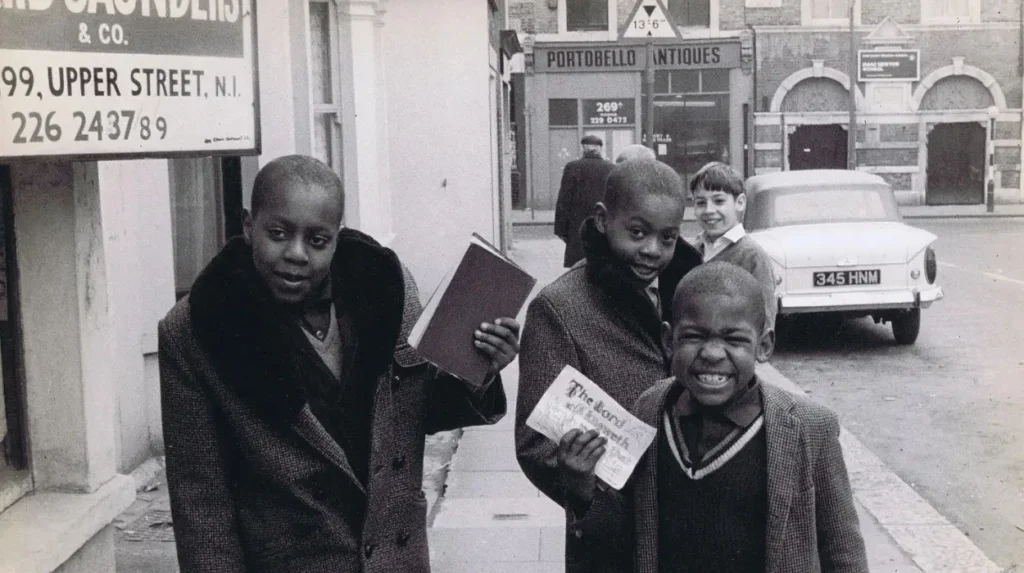
The post-war period transformed North Kensington’s social composition. Caribbean migration increased after the Second World War, particularly following the arrival of migrants from countries including Jamaica and Trinidad and Tobago.
Many migrants faced difficult housing conditions and racial discrimination. Notting Hill contained areas of poor-quality housing, overcrowding and economic hardship. These conditions existed alongside more affluent residential streets, creating sharp social contrasts within the district.
The late 1950s became a critical period. Racial hostility contributed to violence in Notting Hill during August and September 1958. Historical research describes the disturbances as among the most serious civil disturbances in Britain during that decade.
The violence was not an isolated local disagreement. It reflected wider post-war problems involving racism, housing discrimination, employment inequality and tensions surrounding migration.
The response from Caribbean communities included stronger organisation and cultural mobilisation. Music, community gatherings and political activism created institutions through which residents could assert identity and solidarity.
Claudia Jones, a Trinidad-born journalist and political activist, became an important figure in this history. She helped establish the West Indian Gazette and promoted cultural events that celebrated Caribbean identity in Britain. Her work contributed to the development of an early Caribbean carnival tradition in London.
These developments created an important foundation for Notting Hill Carnival. The festival’s later success was therefore rooted in community organisation rather than simply tourism or commercial entertainment.
The cultural transformation also extended into everyday life. Caribbean food businesses, record shops, social clubs, churches, sound systems and community organisations became part of North Kensington’s social infrastructure.
This heritage remains central to the district’s identity. London government records describe Notting Hill Carnival as a community-led celebration of Caribbean history and culture that was born in North Kensington and Notting Hill.
How did Notting Hill Carnival change the area’s cultural identity?
Notting Hill Carnival transformed local Caribbean cultural expression into an international public celebration, beginning in the 1960s and developing into one of the world’s largest street festivals while retaining its roots in North Kensington’s Caribbean community.
The history of Carnival contains several stages. Caribbean cultural events in London existed before the modern Notting Hill Carnival. Claudia Jones organised a Caribbean carnival event at St Pancras Town Hall in 1959, helping establish a public cultural tradition during a period of racial tension.
The outdoor Notting Hill event developed during the 1960s. London government records state that the Carnival has been held in the area since 1966, while official funding documents describe the event as having been staged over the August bank holiday weekend since 1965, apart from the cancellations of 2020 and 2021 during the COVID-19 pandemic.
The distinction between early events and the established street festival reflects the Carnival’s organic development. It was not created through a single municipal masterplan.
The event brought together music, masquerade, dance, sound systems, steel bands, food and community organisations. Calypso, soca, reggae and other Caribbean musical traditions became closely associated with the streets of North Kensington during Carnival.
Its scale expanded significantly. City Hall records state that the Carnival attracts approximately one million visitors over its weekend, making it one of London’s highest-profile public events.
By 2026, the event reached its 60th anniversary. London government announced £4.66 million in additional funding in March 2026, alongside previously committed funding, to support improvements connected with crowd management and event safety. City Hall also stated that the Carnival generates nearly £400 million for London’s economy.
The economic figures demonstrate how a local community celebration developed into a major component of London’s visitor economy. Yet the historical significance remains broader than financial impact.
Carnival changed perceptions of North Kensington by making Caribbean heritage visible in one of London’s most internationally recognised districts. It also created a public archive of cultural practices through costumes, music, food and performance.
The festival therefore forms one of the strongest links between Notting Hill’s post-war migration history and its present global identity.
How did Portobello Road contribute to Notting Hill’s cultural transformation?
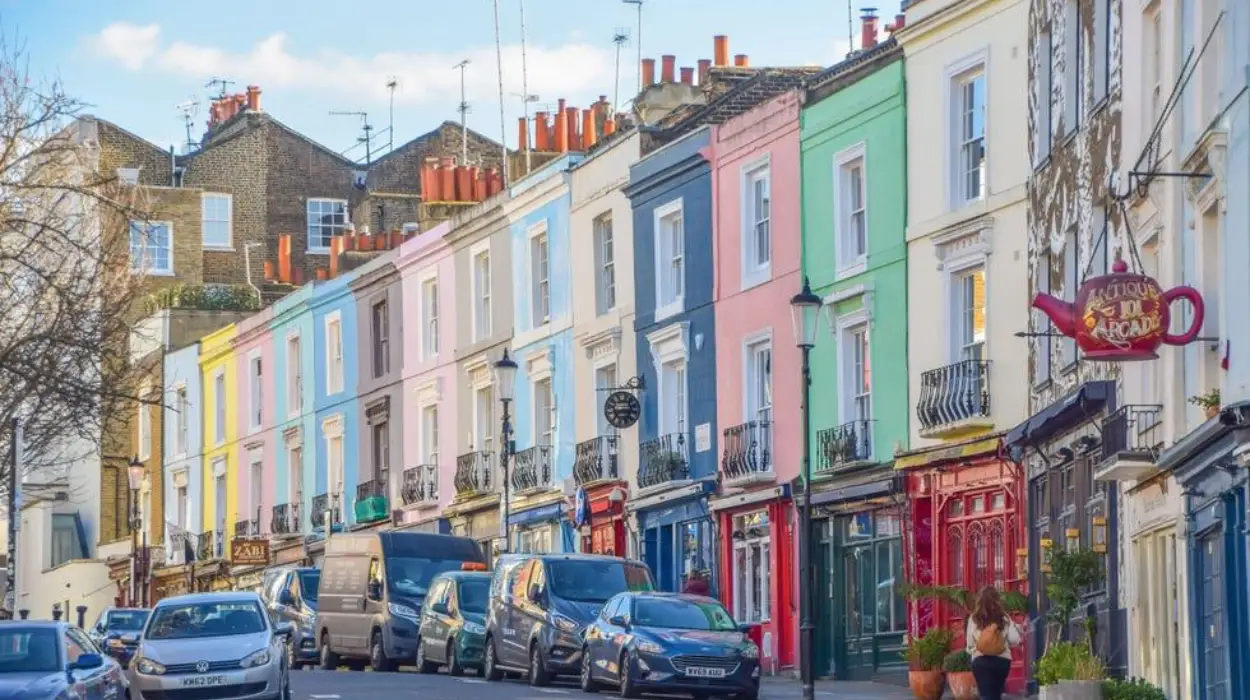
Portobello Road became a central commercial and cultural corridor because its historic market function, independent businesses, antiques trade, food culture and street activity connected local residents with visitors and helped establish Notting Hill as a destination.
Portobello Road’s history predates the district’s modern international reputation. Its name derives from Porto Bello Farm, an agricultural holding that stood in the area before the surrounding Victorian development.
The road became increasingly important as the population expanded. Shops and commercial premises developed alongside residential streets. The market evolved over time, incorporating food, clothing, household goods, antiques and collectables.
The commercial character of Portobello Road differs from the formal residential planning of the Ladbroke Estate. This contrast became an important part of Notting Hill’s identity.
Historic buildings also preserve evidence of changing commercial uses. The Royal Borough’s conservation assessments identify Victorian shopfronts, traditional timber details and other historic commercial features along Portobello Road.
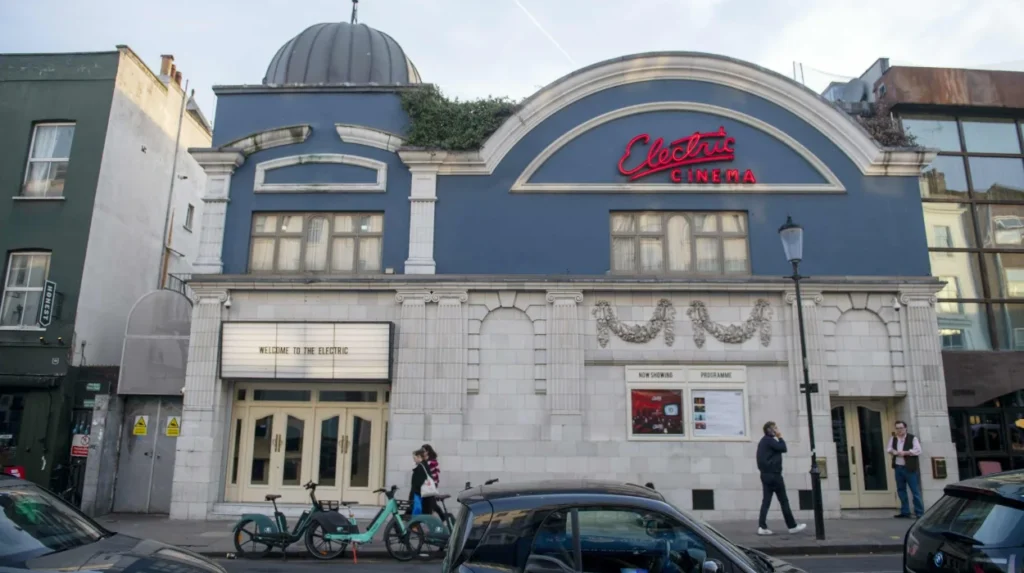
The Electric Cinema provides another example of the road’s cultural significance. The building dates from 1910–11 and is recognised as a Grade II* listed building. Its presence demonstrates how entertainment and commerce became embedded within the area’s built environment during the early 20th century.
Portobello Road later became internationally associated with antiques and market culture. The market’s combination of permanent shops, stalls and street activity created an environment that appealed to both residents and visitors.
Its cultural importance also increased through media representation. Photographs, television programmes, travel publications and films repeatedly used Notting Hill’s streets as visual representations of London.
The road consequently became more than a shopping street. It became a recognisable cultural landscape in which historic architecture, commerce and tourism intersect.
Why did Notting Hill become fashionable again in the late 20th century?
Notting Hill became fashionable again through housing restoration, heritage conservation, improved transport, independent commerce and growing cultural visibility, transforming parts of the district from post-war decline into highly desirable residential and visitor destinations.
The post-war decades brought significant challenges. Some parts of the Ladbroke Estate deteriorated, particularly in the northern sections. Historic England records that the estate became run down after the Second World War, although relatively few major structural changes were made.
The situation gradually changed during the later 20th century. Historic houses and communal gardens attracted renewed interest. Restoration helped preserve architectural features that had survived periods of neglect.
Conservation policy became increasingly important. The Royal Borough of Kensington and Chelsea now contains numerous conservation areas, including Ladbroke, Colville and Pembridge. The Ladbroke Conservation Area is primarily characterised by Victorian and Edwardian architecture.
The designation of historic buildings also strengthened protection. The Ladbroke Estate’s communal gardens are listed at Grade II, while individual buildings such as St John Notting Hill and the Electric Cinema have statutory heritage protection.
This preservation framework helped maintain the physical character that later attracted residents, businesses and visitors.
Transport continued to support the area’s appeal. Notting Hill Gate’s underground connections provided access to central London and other parts of the city. Westbourne Grove and Portobello Road developed as strong retail destinations.
The district also gained a reputation for independent businesses and creative activity. Restaurants, boutiques, galleries, markets, music venues and specialist shops reinforced the area’s cultural economy.
Gentrification formed part of this later transformation. Rising property demand altered the social and economic composition of parts of Notting Hill. Higher housing costs and increased commercial investment accompanied the district’s growing desirability.
This process created a complex modern landscape. The same neighbourhood contains protected Victorian architecture, long-established communities, luxury housing, social housing, independent businesses and international tourism.
How did the film Notting Hill make the district globally famous?
The 1999 romantic comedy Notting Hill increased the district’s international visibility by using recognisable streets, shops and residential settings as major elements of its visual identity, connecting an already famous London neighbourhood with global popular culture.
Directed by Roger Michell and released in 1999, Notting Hill starred Hugh Grant and Julia Roberts. The film centred on a fictional romance between a London bookseller and an American film star.
Its importance to the area’s reputation came from its extensive use of recognisable Notting Hill locations. Portobello Road, Westbourne Grove and surrounding streets became associated with the film’s fictional world.
The film did not create Notting Hill’s popularity. The district already possessed a significant history, a major street market, established Caribbean cultural traditions and a strong architectural identity.
Its impact was different. It simplified and exported the neighbourhood’s image to an international audience.
The film introduced millions of viewers to visual elements of Notting Hill: painted Victorian terraces, independent shops, market streets and intimate residential roads.
This contributed to the growth of film-related tourism. Visitors began seeking locations associated with the production, while the district became increasingly represented in international travel media.
The relationship between film and place is important for understanding modern Notting Hill. Popular culture can attach additional meaning to existing historic landscapes without replacing their original history.
Notting Hill therefore became globally recognisable through several overlapping identities. The Victorian suburb, Caribbean cultural centre, market district and film location coexist within the same geographical area.
For visitors interested in the historical foundations behind this modern reputation, To experience this historic neighbourhood in person today, consult our comprehensive [Best Family Activities in South Kensington for Museums, Parks, and Educational Adventures] for itineraries and visiting parameters.
Which historic features still explain Notting Hill’s identity today?
Notting Hill’s surviving communal gardens, Victorian terraces, churches, market buildings, conservation areas, cultural institutions and Carnival traditions preserve the physical and social evidence of the forces that transformed the district from rural land into a global London destination.
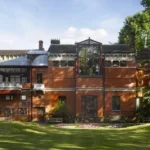
The Ladbroke Estate remains the clearest architectural reminder of 19th-century Notting Hill. Its sixteen communal gardens preserve the planned relationship between private houses and shared green spaces. Historic England recognises the estate as a Grade II registered park and garden.
The architecture surrounding the gardens also remains significant. Victorian terraces on streets such as Lansdowne Road, Elgin Crescent and Ladbroke Grove demonstrate the development patterns established during the estate’s expansion. Historic England records these buildings as part of the mid-19th-century Ladbroke Estate landscape.
St John Notting Hill remains another important landmark. Completed in 1845, its Gothic architecture reflects the religious and civic infrastructure that accompanied Victorian suburban development.
Portobello Road preserves a different historical layer. Its commercial buildings and market activity demonstrate the transition from agricultural route to dense urban shopping and cultural corridor.
The Electric Cinema provides evidence of the area’s early 20th-century entertainment history. Its Grade II* status reflects the importance of its architectural and cultural heritage.
Notting Hill Gate also preserves evidence of changing transport infrastructure. Its historic name recalls the former turnpike gate, while the modern underground station represents the transport revolution that transformed the district’s relationship with the rest of London.
The Carnival represents the social heritage of the post-war period. Unlike a static building, it survives through annual performance, music, costume, community participation and public space.
This combination of tangible and intangible heritage explains why Notting Hill has such a layered identity. Its history exists in buildings and gardens, but also in traditions, businesses, migration histories and community institutions.
How has Notting Hill’s history shaped its global popularity today?
Notting Hill became globally popular because several historical transformations accumulated in one district: Victorian suburban planning, railway expansion, Caribbean migration, community activism, Carnival, market culture, heritage conservation and international media representation.
The district’s global reputation is therefore the product of cumulative historical change rather than one defining event.
Its Victorian architecture provides a recognisable physical setting. The Ladbroke Estate created streets and gardens with strong visual continuity. Heritage protection preserved substantial portions of that landscape.
Its Caribbean heritage provides a distinctive cultural identity. Migration after the Second World War reshaped North Kensington, while community organisation produced cultural institutions and public traditions.
Notting Hill Carnival transformed that heritage into an internationally recognised annual event. City Hall describes it as one of the world’s biggest street festivals and confirms that it remains rooted in North Kensington and Notting Hill.
Portobello Road contributes another layer through markets, independent commerce and historic buildings. Its commercial identity has made it one of the area’s strongest visitor attractions.
The film Notting Hill then expanded recognition beyond London’s tourism market. International audiences encountered the neighbourhood through cinema, reinforcing an image already established through architecture, markets and Carnival.
The economic implications are substantial. London government records state that the Carnival alone attracts approximately one million visitors and generates almost £400 million for the London economy.
Yet popularity also creates preservation challenges. High visitor numbers place pressure on streets, public transport, housing, historic buildings and community infrastructure. Rising property values also affect affordability and the social composition of the neighbourhood.
The future historical significance of Notting Hill depends on maintaining evidence of all these periods rather than preserving only the most picturesque elements.
The Victorian terraces are historically important. So are the Caribbean community’s contributions, the history of racial discrimination, the development of Carnival, the market economy and the post-war transformation of North Kensington.
Notting Hill’s strongest heritage value lies in this combination.
Its history demonstrates how London neighbourhoods change through migration, transport, planning, commerce, cultural organisation and popular representation. The district’s global reputation is the modern outcome of those connected processes.
For educators and researchers, Notting Hill also provides a compact case study of urban transformation. Its streets reveal the relationship between land development and transport. Its demographic history demonstrates the effects of migration and discrimination. Carnival demonstrates community-led cultural production. Its later popularity illustrates the influence of heritage conservation and mass media.
The district therefore remains historically relevant beyond its status as a fashionable London destination.
Notting Hill’s cultural transformation is still visible in its buildings, streets, gardens, markets and annual celebrations. The surviving landscape connects rural Kensington, Victorian suburbanisation, post-war migration, Caribbean cultural activism, late-20th-century regeneration and 21st-century international tourism.
That continuous historical record explains why Notting Hill remains one of London’s most recognisable and culturally significant neighbourhoods.
Frequently Asked Question
What is the history of Notting Hill?
Notting Hill developed from a rural area on the western edge of London into a Victorian residential suburb during the 19th century. Later, Caribbean migration, community activism, Notting Hill Carnival, Portobello Road and popular culture transformed its identity.