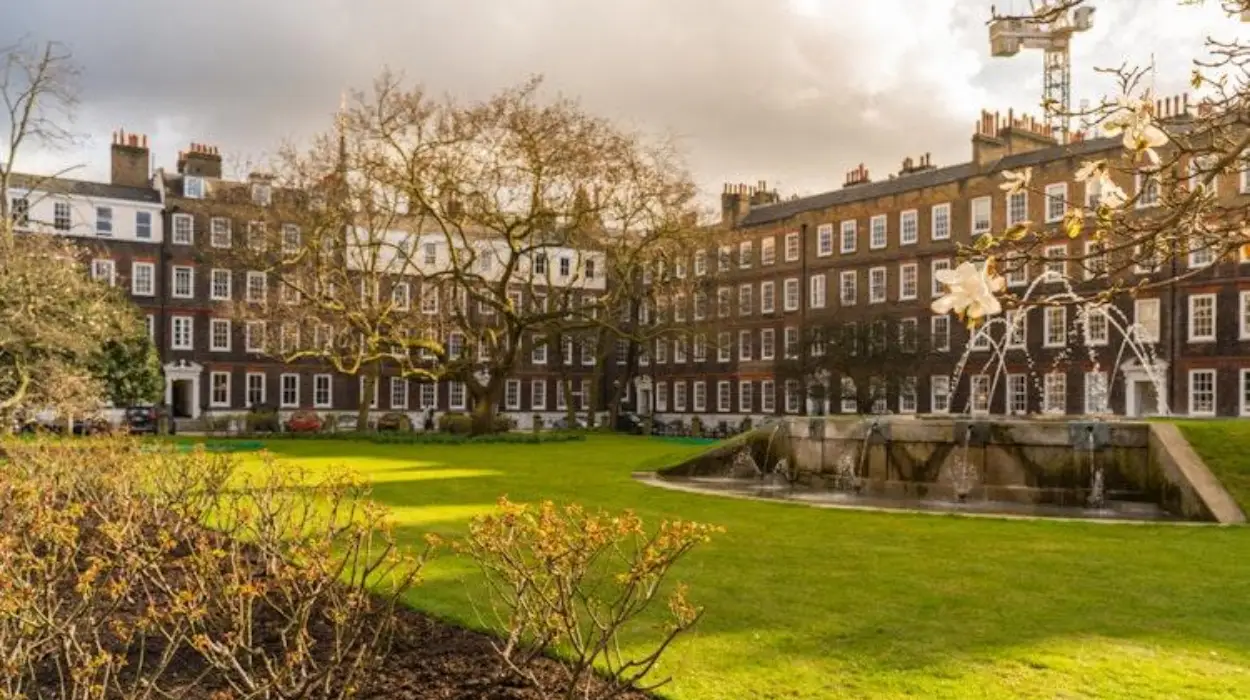
London’s historic courtyards preserve some of the capital’s most concentrated evidence of medieval, Tudor, Stuart, Georgian and Victorian urban life. Hidden behind gateways, arches and narrow passages, these enclosed spaces formed part of legal institutions, religious foundations, coaching inns, residential complexes and commercial buildings.
- What is a historic courtyard in London?
- When did London’s historic courtyards first develop?
- How did medieval and Tudor courtyards shape London life?
- Which historic London courtyards are most important today?
- How did London’s Inns of Court turn courtyards into centres of professional life?
- What happened to London’s historic courtyards during fire, war and redevelopment?
- Why did Victorian London begin documenting historic courtyards?
- How are historic London courtyards preserved today?
- What can historic courtyards reveal about London’s long-term urban history?
- Frequently Asked Question
A courtyard is an open space enclosed or substantially surrounded by buildings. In historic London, courtyards served practical functions as circulation areas, workspaces, gardens, meeting places, service yards and social spaces. Their form reflected the needs of the institutions and communities that occupied them.
The surviving courtyards of the Inns of Court are especially important. Gray’s Inn, Lincoln’s Inn, the Inner Temple and the Middle Temple developed as centres of legal education and professional life. Their enclosed layouts contain halls, chambers, gardens, passages and courts that preserve the spatial organisation of an earlier London.
Other historic courtyard environments developed around religious houses, inns and commercial premises. The former Tabard Inn in Southwark, for example, belonged to London’s important medieval and early modern coaching and hospitality culture. The London Charterhouse preserves another form of enclosed historic environment, originating as a Carthusian monastery founded in the fourteenth century.
These spaces survived because they often belonged to institutions capable of maintaining substantial properties. Their survival also reflects London’s long history of rebuilding, conservation and adaptation. Fire, war, redevelopment and changing property values destroyed many historic courtyards, while protected buildings and institutional estates retained others.
The story of London’s courtyards therefore extends beyond architecture. Their walls record changes in law, religion, commerce, transport, education, urban planning and heritage preservation.
What is a historic courtyard in London?
A historic London courtyard is an enclosed open space surrounded by buildings or walls and developed for residential, institutional, religious, commercial, legal or service functions. Surviving examples preserve evidence of earlier urban organisation, architecture and social activity.
Courtyards were fundamental elements of dense historic settlements. They provided controlled internal space where activities could occur away from the main street. Buildings around them often contained residential chambers, offices, kitchens, workshops, halls or storage areas.
The distinction between a courtyard and a garden is important. A courtyard is primarily defined by enclosure and its relationship with surrounding buildings. A garden is defined principally by cultivated or landscaped space. Historic London sites frequently combined both functions.
The Inns of Court demonstrate this relationship particularly clearly. Their traditional layout resembled collegiate institutions, with enclosed precincts containing chambers, halls, chapels, yards, walks and gardens. Historical research on the Inns describes them as gated communities organised around internal spaces rather than conventional streets.
Courtyards also provided controlled access. Gates separated institutional property from surrounding streets. This arrangement was particularly valuable for legal societies, religious communities and private residences.
Their architecture varied according to period. Medieval courtyards commonly contained timber-framed buildings and irregular boundaries. Tudor and Stuart rebuilding introduced brick, timber framing and more formal elevations. Georgian redevelopment brought regular brick façades and classical proportions. Victorian reconstruction frequently incorporated Gothic Revival architecture and improved services.
The courtyard therefore functions as a historical document. Its dimensions, entrances, building heights, paving, drainage arrangements and surviving architectural details reveal how occupants used the space.
When did London’s historic courtyards first develop?
London’s courtyard tradition developed from medieval enclosed compounds, religious precincts, private residences and commercial inns. Institutional courtyards expanded significantly from the fourteenth century as legal societies, religious foundations and urban businesses created permanent enclosed communities.
Medieval London was a dense settlement with limited space inside its walls. Property boundaries, narrow lanes and irregular plots encouraged buildings to grow around internal yards and courts.
Religious institutions provided important early examples. The London Charterhouse in Clerkenwell originated in the fourteenth century as a Carthusian monastery established outside the medieval city walls. The site began in 1348 on land associated with a plague cemetery.
Monastic planning relied on controlled internal spaces. Buildings were arranged around functional areas that supported religious life, administration, food preparation and movement between different parts of the foundation.
The development of the legal Inns followed a different institutional path. The Inns of Court became established in connection with the development of the royal legal system. The Inner Temple and Middle Temple occupied former Templar property south of Fleet Street, while Lincoln’s Inn and Gray’s Inn developed north of Fleet Street.
The legal institutions expanded during the later medieval and Tudor periods. Their buildings were arranged around halls and internal courts because lawyers lived, studied, worked and socialised within enclosed precincts.
Lincoln’s Inn provides particularly strong documentary evidence. Its surviving formal records, known as the Black Books, extend continuously from 1422. The records provide an important institutional source for studying the development of the Inn.
Historic courtyards therefore developed from practical responses to dense urban conditions. They became permanent architectural features when institutions acquired sufficient land and resources to maintain enclosed compounds.
How did medieval and Tudor courtyards shape London life?
Medieval and Tudor courtyards organised residential, educational, religious and professional activity within enclosed compounds. They controlled movement, connected buildings, provided working space and created shared areas where institutional communities conducted daily business.
The Tudor period transformed many London courtyards. Population growth increased pressure on urban land, while wealthy institutions invested in permanent brick and timber buildings.
Legal education became increasingly important within the Inns of Court. Members lived in chambers, attended meals in halls and participated in institutional activities. The courtyard provided the physical connection between these buildings.
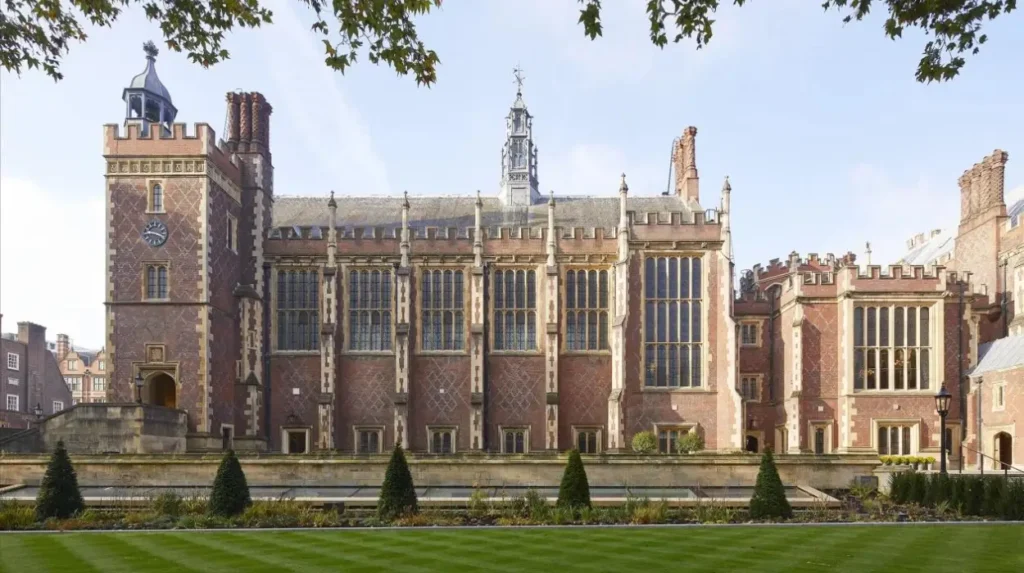
Lincoln’s Inn retains important Tudor and early modern fabric. Its Old Hall was built around 1490 and served as a place for eating, drinking, debate and institutional gatherings. Sir Thomas More joined Lincoln’s Inn in 1496, linking the surviving complex with a major figure in Tudor legal history.
The Gatehouse at Lincoln’s Inn was constructed between 1517 and 1521. Its great oak doors date from 1564. The surrounding Old Buildings contain fabric from the late sixteenth and early seventeenth centuries, although later alterations changed parts of the complex.
The Middle Temple developed into a major legal, social and cultural institution. Its history includes the Tudor period, when the Inn gained national prominence. Middle Temple Hall was built between 1562 and 1573, and substantial elements of its historic architecture survived later urban destruction.
Courtyards also supported social hierarchy. Access was controlled through gates and institutional rules. Different buildings accommodated different ranks and functions.
The enclosed plan separated professional life from the surrounding streets while maintaining close connections with London’s commercial and political centre.
This arrangement explains why historic courtyards remain particularly concentrated around Holborn, Chancery Lane and the Temple. These districts became closely associated with the legal profession as London’s courts developed.
Which historic London courtyards are most important today?
Important surviving courtyard environments include Lincoln’s Inn, Middle Temple, Gray’s Inn and Staple Inn. Each preserves architectural evidence from different periods and demonstrates how enclosed spaces supported legal education, professional life, residential use, gardens and institutional administration.
Lincoln’s Inn contains several historically significant spaces. Old Square developed around buildings that include sixteenth-century fabric. A photograph of Old Square taken in 1876 was commissioned to document historic structures threatened by alteration or demolition. The image forms part of London’s architectural preservation history.
New Square forms another important component of Lincoln’s Inn. Stone Buildings were developed in the eighteenth century, with designs associated with Robert Taylor. The Great Hall and Library Building was completed in 1845 and designed by Philip Hardwick. Queen Victoria formally opened the building on 30 October 1845.
Middle Temple contains an extensive historic estate organised around courtyards and gardens. The institution currently manages 43 buildings, with listed structures classified at Grade I, Grade II* and Grade II. The entire estate is designated as a conservation area.
Middle Temple’s internal spaces demonstrate the survival of institutional planning within a modern capital. The estate remains a working legal environment rather than a preserved archaeological reconstruction.
Gray’s Inn provides another significant example. Its Field Court was constructed in the eighteenth century and was photographed in 1885 as part of an effort to document London’s historic buildings threatened by alteration.
Gray’s Inn is also notable for its Walks. The gardens were first laid out by Sir Francis Bacon in 1608. Bacon, a lawyer, philosopher and statesman, was a Bencher of Gray’s Inn. In 1609 he commissioned a summerhouse on the Upper Walks.
Staple Inn offers a different architectural record. It became an Inn of Chancery early in the fifteenth century. Its Hall and Chambers formed an enclosed institutional environment connected with legal education and professional training.
These sites demonstrate that London’s historic courtyards are not confined to a single architectural period. Their surviving fabric records successive generations of rebuilding and adaptation.
How did London’s Inns of Court turn courtyards into centres of professional life?
The Inns of Court used enclosed courts, halls, chambers, gardens and passages to organise legal education and professional life. Gray’s Inn, Lincoln’s Inn, Inner Temple and Middle Temple developed as residential and educational communities connected with England’s legal profession.
The four Inns of Court are Gray’s Inn, Lincoln’s Inn, the Inner Temple and the Middle Temple. They remain the professional societies through which barristers in England and Wales belong to the legal profession.
Their origins are not documented through a single founding event. Historical research connects their development with the concentration of royal courts at Westminster during the fourteenth century. Lawyers increasingly formed communities around established buildings and institutions.
The Temple area has particularly deep roots. The Knights Templar occupied the site from the twelfth century. After the suppression of the Templars, the property passed through other institutional ownership before becoming associated with legal societies.
By 1388, the names Inner Temple and Middle Temple were established for the two legal societies occupying the former Templar complex.
The courtyard layout supported the Inns’ educational system. Members lived in chambers surrounding internal spaces and attended institutional dinners in halls. Legal education involved direct participation in the life of the Inn.
The physical design also reinforced institutional identity. Gates marked the boundary between the street and the Inn. Internal courts created a controlled environment within a rapidly expanding city.
Historical evidence shows that these spaces were not exclusively professional. Middle Temple records describe the Inn as a centre for feasts, politics, literature, courtly spectacle and academic discussion.
Gray’s Inn provides evidence of leisure and social activity. Its Walks became fashionable in the seventeenth century, and Samuel Pepys recorded visits to the gardens in his diary. In 1701, the Walks were the setting for a duel between Captain Greenwood and Mr Ottway. Ottway was killed, and Greenwood was convicted of manslaughter.
The courtyards and gardens therefore supported an institutional culture extending beyond legal instruction.
What happened to London’s historic courtyards during fire, war and redevelopment?
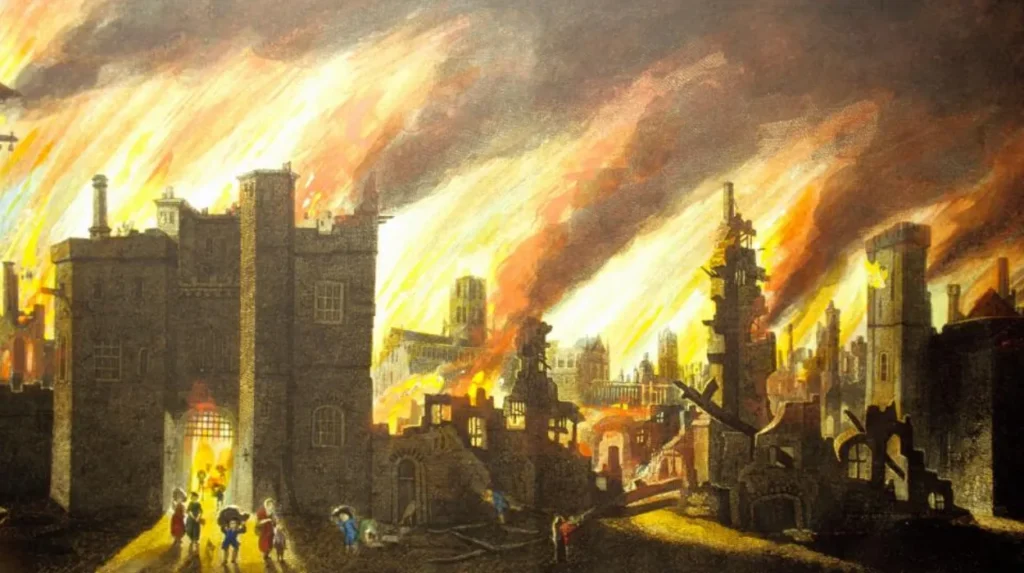
London’s historic courtyards survived through repeated cycles of destruction and rebuilding. The Great Fire, nineteenth-century redevelopment, First World War bombing and Second World War damage altered historic buildings, while protected institutions preserved significant courtyard layouts and architectural details.
London’s built environment experienced major disruption during the seventeenth and twentieth centuries.
The Great Fire of London began on 2 September 1666 and destroyed a large section of the medieval City. Its impact transformed building regulations, materials and urban planning within the affected area.
The Inns of Court were outside the principal zone of destruction, although the wider legal district experienced later changes. Middle Temple’s principal buildings survived the Great Fire and later World Wars with substantial original features intact.
War damage became particularly significant during the twentieth century.
Staple Inn suffered considerable bomb damage during the Second World War. Several buildings were subsequently rebuilt externally in facsimile, including Nos. 9 and 10, which were reconstructed around 1955 under the direction of architect Edward Maufe. Historic England records the reconstruction as part of the site’s architectural history.
Lincoln’s Inn also records wartime damage. A bronze disc outside 10 Stone Buildings marks the location where a Zeppelin bomb exploded during the First World War. Stone Buildings suffered additional damage during the Second World War, requiring reconstruction of upper floors and the complete rebuilding of 3 Stone Buildings.
Reconstruction did not always mean complete loss of historic identity. Conservation practice increasingly prioritised surviving fabric, documented architectural details and historically appropriate reconstruction.
The Old Hall at Lincoln’s Inn illustrates this approach. The building was almost completely rebuilt during the 1920s because of structural problems, but the work retained as much original material as possible. Replacement panelling incorporated oak sourced from the sixteenth and seventeenth centuries.
These examples demonstrate an important principle in heritage conservation: a historic courtyard is not defined solely by untouched medieval fabric. Its historical significance also includes documented reconstruction, adaptation and continuity of use.
Why did Victorian London begin documenting historic courtyards?
Victorian London documented historic courtyards because rapid redevelopment threatened older buildings and urban environments. Photographers, historians and preservation societies created visual records that now provide evidence for buildings altered, reconstructed or demolished during later redevelopment.
The nineteenth century brought unprecedented change to London. Population growth, industrialisation, new transport systems and commercial development transformed streets and buildings.
Historic structures faced pressure from redevelopment. Buildings considered obsolete were altered or demolished to accommodate modern offices, housing, roads and infrastructure.
Documentation therefore became a form of preservation.
The Society for Photographing the Relics of Old London created an important visual record during the 1870s and 1880s. Its photographs documented buildings considered vulnerable to alteration or demolition.
The London Museum collection includes a photograph of Lincoln’s Inn Old Square from 1876. The image specifically records buildings near the Gate House that dated from the mid-sixteenth century and faced an uncertain future.
A comparable photograph records Gray’s Inn Field Court in 1885. The building was constructed in the eighteenth century and was included in the photographic campaign documenting London’s historic architecture.
These records have modern research value. Historic photographs allow researchers to compare surviving structures with earlier appearances. They reveal changes in windows, rooflines, façades, paving, gates and surrounding buildings.
For genealogists, institutional records provide another layer of evidence. Inns maintained records relating to members, property, administration and professional activity. Lincoln’s Inn’s Black Books, surviving continuously from 1422, provide an especially important documentary resource.
Courtyards therefore function as both physical and documentary archives.
Their significance extends beyond architectural appearance. A gate, chamber or hall connects with records identifying people, occupations, institutional decisions and historical events.
How are historic London courtyards preserved today?
Historic London courtyards are preserved through listed-building protection, conservation areas, institutional management, architectural repair and controlled access. Their continued use as working environments provides an important mechanism for maintaining historic buildings within the modern city.
Historic England’s National Heritage List provides statutory information about protected buildings. Listing recognises architectural and historic interest and places legal controls on significant alterations.
Staple Inn contains several listed structures. Historic England records the buildings according to their architectural components, dates, materials, reconstruction history and historic significance.
Middle Temple provides an example of institutional conservation. Its estate includes 43 buildings, with significant structures listed at Grade I, Grade II* and Grade II. The complete estate is also designated as a conservation area.
Lincoln’s Inn follows a similar model in which a historic legal institution manages its own buildings. Its estate contains buildings ranging from the fifteenth century through the Victorian period and into later restoration phases.
The preservation process involves regular maintenance. Roofs, brickwork, stone, timber, windows, drainage systems and internal finishes require continuous management.
Historic buildings also require adaptation. Modern users need safe electrical systems, heating, accessibility arrangements, fire protection and appropriate working facilities.
Successful conservation therefore balances historical fabric with continued institutional use.
The continued operation of legal Inns is particularly significant. Their courtyards are not museum reconstructions. They remain parts of active professional communities.
This continuity gives the spaces additional historical value. A courtyard used for institutional purposes today retains a functional connection with its original purpose.
To experience this historic architecture in person today, consult our comprehensive [Best Places to Experience London Like a Local Beyond Popular Tourist Attractions] for itineraries and visiting parameters.
Public access varies between institutions. Some areas open during organised tours or heritage events, while working legal spaces retain controlled access.
Visitors should therefore treat courtyards as functioning heritage environments rather than unrestricted public squares.
What can historic courtyards reveal about London’s long-term urban history?
Historic courtyards reveal how London managed limited land, organised institutions, controlled movement and adapted historic buildings across centuries. Their surviving layouts connect medieval foundations with Tudor construction, Georgian redevelopment, Victorian documentation, wartime reconstruction and modern conservation.
The historical value of London’s courtyards comes from continuity.
A courtyard can preserve the footprint of an earlier institution even when individual buildings have been reconstructed. Its walls, entrances and surrounding structures record the spatial logic of earlier communities.
The legal quarter provides the clearest example. The Inns of Court developed within a specific geographical relationship to Westminster and London’s commercial centre. Their internal spaces helped lawyers live and work close to the institutions governing the legal system.
The architecture also records changing construction technology.
Timber framing dominated many medieval buildings. Brick became increasingly important during the Tudor and Stuart periods. Georgian architects introduced regular façades and classical proportions. Victorian architects used Gothic Revival forms to express historical continuity. Twentieth-century conservation introduced another layer through careful reconstruction and repair.
Courtyards also reveal changing social structures.
At the Inns of Court, access was historically associated with professional membership and institutional hierarchy. At coaching inns, courtyards supported travellers, horses, carts, storage and accommodation. At monasteries, enclosed spaces supported religious communities.
Southwark provides evidence of the coaching tradition. The Tabard Inn, later known as the Talbot Inn, was associated with the pilgrimage and literary history surrounding Chaucer’s Canterbury Tales. The building was rebuilt in the seventeenth century and later used as storage before demolition in the mid-1870s.
This example demonstrates the vulnerability of commercial courtyards. Unlike institutional estates, coaching inns faced intense redevelopment pressure as London’s transport system changed.
The survival of a courtyard therefore depends on ownership, function, structural condition, legal protection and redevelopment pressure.
Historic courtyards also help explain why modern London contains unexpected fragments of earlier urban landscapes. A narrow passage can preserve the boundary of a medieval institution. A gate can survive after surrounding buildings have changed. A garden can retain the footprint of a former religious or legal complex.
For educators, these sites provide physical evidence for teaching urban history. For historians, they offer architectural and documentary sources. For heritage researchers, they demonstrate the relationship between conservation policy and urban development.
For genealogical researchers, institutional archives can connect historic places with named individuals and professional communities.
The long-term importance of these courtyards lies in their ability to preserve relationships between buildings, people and institutions. Their significance is therefore architectural, social, legal and historical at the same time.
Historic London courtyards are not isolated decorative spaces. They are surviving components of the capital’s urban structure.
Their chronology extends from medieval foundations and Tudor expansion through Stuart social life, Georgian rebuilding, Victorian preservation campaigns and twentieth-century wartime reconstruction.
Sites such as Lincoln’s Inn, Middle Temple, Gray’s Inn and Staple Inn demonstrate how enclosed spaces remained useful while London changed around them. Their survival provides direct evidence of how institutions adapted without completely abandoning historic spatial arrangements.
The future preservation of these courtyards depends on continued conservation, informed repair, archival research and responsible public interpretation. Their historical relevance will remain strong because the physical spaces connect documentary history with buildings that still occupy their original urban settings.
For anyone studying London’s past, the courtyard is therefore an essential historical unit. It reveals how the capital’s communities organised space, protected institutions, responded to destruction and carried historic environments into the modern city.
Frequently Asked Question
What is a historic courtyard in London?
A historic courtyard is an enclosed open space surrounded by buildings or walls that served residential, religious, commercial, legal, educational or institutional purposes. London has preserved courtyards dating from medieval, Tudor, Georgian and Victorian periods.