Key Points
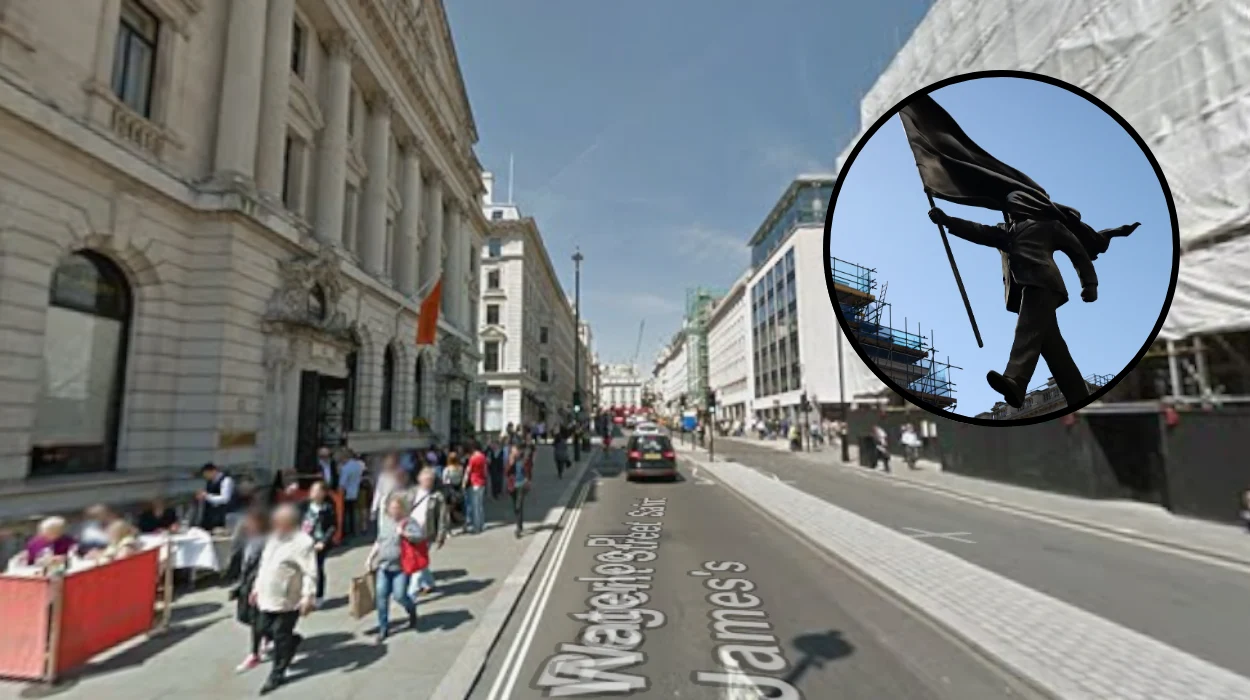
- A new statue by street artist Banksy, depicting a suited man whose face is obscured by a billowing flag as he steps off a plinth, appeared in central London on Wednesday, April 29, 2026.
- The installation is located on Waterloo Place near The Mall, in the ceremonial heart of London, close to statues of King Edward VII, Florence Nightingale, and the Crimean War Memorial.
- Banksy confirmed the artwork via a video on his Instagram account on Thursday, April 30, 2026, showing it being placed from a low-loader trailer and bearing his signature.
- London authorities, specifically Westminster City Council, welcomed the statue as a “striking addition” to the city’s public art scene and installed barriers to protect it, with no plans for removal.
- Commentators speculate the piece satirises “blind patriotism,” with the man appearing “blinded by a flag” and at risk of falling.
- The statue mirrors nearby historical monuments in style and was first spotted in an area associated with imperialism and military history.
- Public reaction includes intrigue, with 55-year-old teacher Lynette Cloraleigh stating, “I like it. I like where it is. It’s intriguing how it got here,” after seeing it on Instagram.
- Banksy, widely believed to be Robin Gunningham, has a history of street art evolving from vandalism to protected national treasure status.
London (The Londoner News) May 2, 2026 – Authorities in London have embraced a provocative new statue by elusive street artist Banksy, installed without permission in the city’s ceremonial centre, signalling a shift in how officials handle the artist’s guerrilla installations. The fibreglass or resin sculpture, showing a suited figure marching blindly off a plinth with his face smothered by a Union Jack-like flag, emerged on Waterloo Place near The Mall on Wednesday. Westminster City Council confirmed on Friday they would protect rather than remove it, describing it as a vibrant addition to public art.
- Key Points
- What Is the New Banksy Statue in London?
- Where Exactly Was the Banksy Statue Installed?
- How Did the Banksy Statue Appear in London?
- What Has Been the Official Response to the Banksy Statue?
- What Do People Think the Banksy Statue Represents?
- How Has the Public Reacted to the New Banksy?
- Who Is Banksy, and What Is His History with London Authorities?
- Will the Banksy Statue Stay in Place Long-Term?
What Is the New Banksy Statue in London?
The statue portrays a formally dressed man in mid-stride, one foot dangling over the plinth’s edge, as a large flag engulfs his face, implying imminent downfall. As reported by Paul Sandle of Reuters, “The suited figure, whose face is covered by the billowing flag, has one foot in mid-air over the edge of the plinth, suggesting he is about to fall off.” It bears Banksy’s unmistakable signature, confirming authenticity after initial speculation.
Ed Cunningham, News and Features Editor at Time Out London, detailed the scene:
“The sculpture shows a suited person marching forward off of a plinth, their face smothered by a billowing flag. It sits on Waterloo Place, near statues of Edward VII and Florence Nightingale and the Crimean War Memorial.”
The piece stylistically echoes surrounding Victorian-era monuments, blending seamlessly into the imperial backdrop of St James’s.
Where Exactly Was the Banksy Statue Installed?
Waterloo Place, just up the stairs from the Institute of Contemporary Arts (ICA) on The Mall, hosts the artwork amid royal palaces and gentlemen’s clubs. This site, designed in the 1800s to celebrate imperialism and military dominance, places the statue near memorials to Edward VII on horseback, Florence Nightingale, and Sidney Herbert.
As per the BBC report,
“Its location – Waterloo Place, St James’s – is an area designed to celebrate imperialism and military dominance in the 1800s. The sculpture sits in proximity to monuments of notable figures such as Edward VII, Florence Nightingale, and the Crimean War Memorial.”
Banksy himself quipped on Instagram about the spot, “There was a bit of a gap,” highlighting the ironic placement among establishment symbols.
How Did the Banksy Statue Appear in London?
The installation occurred stealthily in the early hours of Wednesday, April 29, 2026, via a low-loader trailer, as captured in a video Banksy posted on Instagram the following day. Representatives for Banksy told the BBC that
“the statue was installed during the early hours of Wednesday.”
Time Out first reported its arrival on April 29, with Banksy confirming authorship on April 30, consistent with his pattern of verifying London murals post-installation.
Paul Sandle of Reuters noted,
“The sculpture… was dropped into place near The Mall in the ceremonial heart of London from a low-loader trailer, according to a video posted on the elusive street artist’s Instagram account on Thursday.”
Crowds gathered swiftly, captivated by the audacious stunt in such a high-security zone.
What Has Been the Official Response to the Banksy Statue?
Westminster City Council acted promptly, installing barriers by Thursday afternoon to safeguard the piece. A council spokesperson stated to the BBC,
“We’re thrilled to see Banksy’s latest sculpture in Westminster, providing a striking addition to the city’s dynamic public art landscape. While we have taken initial measures to safeguard the statue, it will remain open for the public to admire and enjoy.”
Reuters quoted the council:
“We welcome Banksy’s latest sculpture in Westminster, which makes a striking addition to the city’s vibrant public art scene. While we have taken initial steps to protect the statue, at this time it will remain accessible for the public to view and enjoy.”
This protective stance contrasts with past removals, reflecting Banksy’s elevated status.
What Do People Think the Banksy Statue Represents?
Observers interpret the work as a critique of “blind patriotism,” with the flag-blinded figure symbolising leaders marching unwittingly towards peril. Instagram commentators on Banksy’s post speculated it addresses “blind patriotism” and marvelled at the execution in London’s establishment core.
Ed Cunningham of Time Out suggested, “A suited person – a politician, let’s assume – blinded by a gigantic flag and stepping off a plinth and into danger? Sounds like pretty classic Banksy political messaging to us.”
The CNN report titled it
“Banksy’s new flag-wielding London statue satirizes blind patriotism.”
Its imperial setting amplifies themes of unchecked nationalism.
How Has the Public Reacted to the New Banksy?
Onlookers flocked to the site, with videos showing crowds admiring the statue. Lynette Cloraleigh, a 55-year-old teacher, visited after an Instagram tip-off and remarked to the BBC, “I like it. I like where it is. It’s intriguing how it got here.” The piece’s sudden appearance sparked social media buzz, drawing fans to the normally staid area.
Who Is Banksy, and What Is His History with London Authorities?
Banksy, presumed to be Robin Gunningham from Bristol, began as a 1990s graffiti artist deemed a vandal but now a “national treasure” whose works fetch millions. A March Reuters investigation revealed his identity, though his lawyer Mark Stephens warned it endangered his art. Local governments increasingly preserve his pieces as tourist draws, unlike early erasures.
As Paul Sandle reported for Reuters, “Local governments are now much more willing to protect his art to try to maintain it as an attraction, after some pieces were previously targeted by vandals.” Recent London murals, like the piranhas on a police box now museum-bound, follow this trend.
Will the Banksy Statue Stay in Place Long-Term?
For now, yes, with council protections in place and public access encouraged. No removal plans exist, prioritising its role in London’s art scene. Past precedents suggest it could endure if vandalism is averted, boosting tourism.