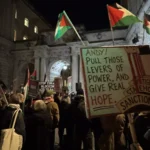
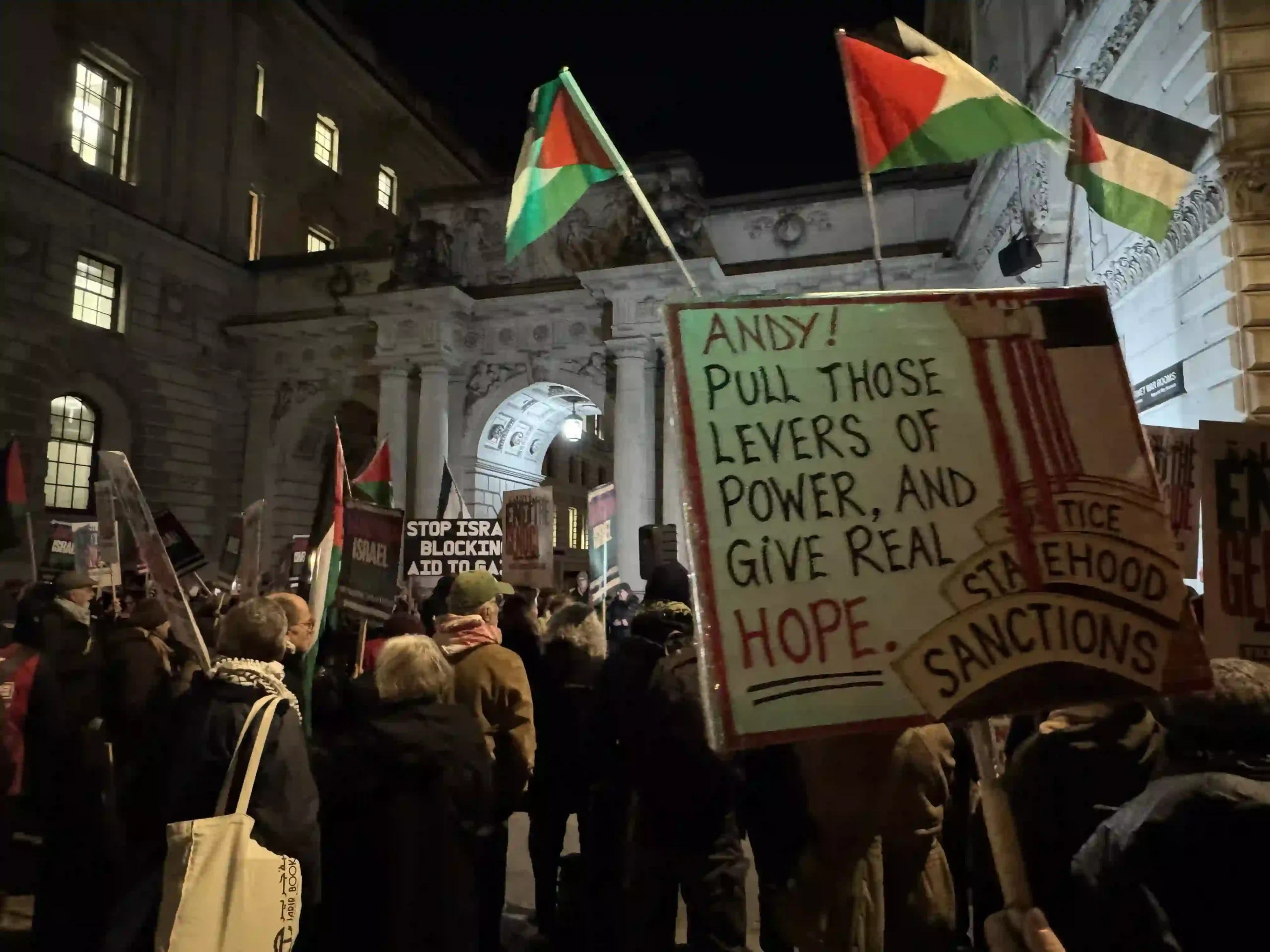
- Pro-Palestinian activists gathered outside the Foreign Office in London on Friday, November 13, 2026, calling on the British government to impose sanctions on Israel and take “meaningful action”.
- Demonstrators demanded an immediate halt to all British arms sales to Israel, increased diplomatic pressure to lift restrictions on humanitarian aid entering Gaza—where tens of thousands of displaced people’s tents have been flooded—and a full inquiry into alleged British complicity.
- Stop the War Coalition vice-chair Chris Nineham pledged that protests would continue until Palestinians achieve liberation, arguing that Israel and Western allies face growing international isolation and noting that 60% of Americans now disapprove of Israel’s actions in the Middle East.
- Public and Commercial Services Union general secretary Fran Heathcote accused the Israeli government of blocking humanitarian aid and welcomed recent UK sanctions over “settler terrorism” in the occupied West Bank, while stressing that such violence is enabled by the Israeli government and military.
- The street rally coincided with a parliamentary motion tabled by Labour MP Richard Burgon—signed by 59 British lawmakers as of Thursday, November 12, 2026—urging the UK government to sanction Israeli officials responsible for obstructing aid to Gaza under the Global Human Rights and International Humanitarian Law Sanctions Regulations 2026.
London (The Londoner News) November 14, 2026 – Executive Summary: Pro-Palestinian activists assembled outside the Foreign Office in central London on Friday, November 13, 2026, urging the British government to take “meaningful action” by imposing comprehensive sanctions on Israel and halting all arms exports. Speakers including Stop the War Coalition vice-chair Chris Nineham and Public and Commercial Services Union general secretary Fran Heathcote highlighted severe humanitarian conditions in Gaza, where recent heavy storms flooded tens of thousands of tents housing displaced Palestinians. The demonstration took place one day after 59 British lawmakers backed a parliamentary motion calling for targeted sanctions against Israeli officials obstructing humanitarian relief.
- What Demands Did Protesters and Speakers Present Outside the Foreign Office?
- How Do Street Protest Demands Align with Recent Parliamentary and Humanitarian Figures?
- Background of the Particular Development After the News
- How This Development Can Affect UK Foreign Policy, Defence Exports, and Humanitarian Diplomacy
As reported by Burak Bir of Anadolu Agency and syndicated by Yeni Şafak English and Middle East Monitor, a group of pro-Palestinian activists assembled outside the Foreign, Commonwealth and Development Office in London, United Kingdom, on Friday, November 13, 2026, calling on the British government to impose sanctions on Israel and take “meaningful action”. Demonstrators urged ministers to apply diplomatic and economic pressure on Israel to lift restrictions on humanitarian assistance entering Gaza, where recent severe rainfall and flooding have inundated tens of thousands of makeshift tents sheltering displaced families.
Carrying Palestinian flags and placards, protesters chanted slogans including “We want justice, we want action, we want boycott, we want sanctions,” “From London to Palestine, occupation is a crime,” and “From the river to the sea, Palestine will be free”. During the evening gathering, activists projected a large illuminated message onto the exterior facade of the Foreign Office building demanding an official investigation into UK policy, reading: “We demand a full inquiry into British complicity in the genocide of Palestinians in Gaza”.
Addressing the crowd outside the government ministry, as reported by Burak Bir of Anadolu Agency, Chris Nineham, vice-chair of the Stop the War Coalition, vowed to sustain public demonstrations until Palestinians achieve liberation. Chris Nineham stated: “We will not stop protesting until this nightmare (in Gaza) is over,” while urging the British government to immediately halt all arms sales to Israel.
Chris Nineham argued that Israel and Western powers are becoming increasingly isolated internationally as public opposition to ongoing conflicts grows. Referring to recent electoral shifts in the United States, Chris Nineham stated that wars in the Middle East were a major factor behind one of the biggest midterm defeats suffered by a US president, noting: “60% of Americans now say that disapprove of what Israel is doing in the Middle East”.
Trade union leadership also addressed the rally, connecting UK foreign policy to the worsening humanitarian emergency on the ground. As reported by Middle East Monitor and Anadolu Agency, Fran Heathcote, general secretary of the Public and Commercial Services (PCS) Union, stated that Palestinians are facing acute destitution and severe flooding following three years of war. Fran Heathcote stated: “Yet again we’ve seen the Israeli government blocking aid,” accusing Israeli authorities of weaponising the withholding of humanitarian assistance and using it as “a tool of genocide”.
Setting out trade union demands to ministers in Westminster, Fran Heathcote added: “So we have a very clear message for the UK government: Stop all arms sales to Israel and apply meaningful sanctions”. While welcoming targeted sanctions recently introduced by the new UK government over “settler terrorism” in the occupied West Bank, Fran Heathcote stressed that the “campaign of terror” was not merely the work of isolated individuals or armed groups, stating: “It is enabled and supported” by the Israeli government and by the Israeli army.
Friday’s street protest in Westminster followed parallel parliamentary action in the House of Commons. As reported by Yeni Şafak English, 59 British lawmakers had signed an Early Day Motion tabled by Labour Party MP Richard Burgon by Thursday, November 12, 2026, calling on the UK government to use its legal powers under the Global Human Rights and International Humanitarian Law Sanctions Regulations 2026 to impose sanctions on Israeli officials and others responsible for obstructing humanitarian assistance and UNRWA operations in Gaza.
What Demands Did Protesters and Speakers Present Outside the Foreign Office?
Reporting by Anadolu Agency, Middle East Monitor, and Yeni Şafak English outlines the core demands voiced by demonstrators and speakers in London on November 13, 2026:
- Comprehensive Economic Sanctions: Immediate imposition of broad British sanctions against Israel beyond existing targeted measures on West Bank settler groups.
- Complete Arms Embargo: A full halt to all UK arms export licences and military equipment transfers to Israel.
- Unrestricted Humanitarian Access: Urgent diplomatic intervention to ensure the immediate entry of emergency shelter materials, food, and reconstruction equipment into Gaza—including through the UN agency for Palestinian refugees (UNRWA)—following storms that flooded roughly 70,000 tents.
- Public Inquiry into UK Policy: A formal, independent investigation into alleged British governmental complicity regarding military and diplomatic support during the Gaza conflict.
How Do Street Protest Demands Align with Recent Parliamentary and Humanitarian Figures?
A structural overview illustrates the intersection between Friday’s London demonstration, House of Commons activity, and United Nations humanitarian assessments:
| Dimension | Key Figure / Action | Source / Context | Stated Objective |
| London Foreign Office Rally (Nov 13, 2026) | Public demonstration and building projection outside the Foreign Office. | Stop the War Coalition (Chris Nineham) & PCS Union (Fran Heathcote). | Demand “meaningful action,” full arms embargo, broad sanctions on Israel, and a public inquiry. |
| House of Commons Motion (Nov 12, 2026) | 59 British MPs signed parliamentary motion tabled by Labour MP Richard Burgon. | UK Parliament / Global Human Rights and International Humanitarian Law Sanctions Regulations 2026. | Sanction Israeli officials obstructing humanitarian aid and UNRWA operations in Gaza. |
| Gaza Humanitarian & Flooding Impact | Approx. 70,000 tents flooded; 1.98 million people in need of shelter and essential supplies. | Gaza Government Media Office and UNRWA assessments. | Immediate entry of winter shelter materials and relief equipment ahead of deteriorating weather. |
| International Public Opinion Cited | 60% of Americans disapprove of Israeli military actions in the Middle East. | Cited by Chris Nineham during his speech in London. | Highlight growing international isolation of Israeli and Western government policies. |
Background of the Particular Development After the News
Since the escalation of conflict in Gaza three years ago, London has served as a major focal point for regular public demonstrations, trade union resolutions, and parliamentary debates regarding British foreign policy in the Middle East. Campaign coalitions—including the Stop the War Coalition, Palestine Solidarity Campaign, and major public sector trade unions—have consistently pressed successive UK administrations to suspend arms export licences and adopt trade and diplomatic sanctions.
While the British government has previously introduced targeted sanctions under the Global Human Rights and International Humanitarian Law Sanctions Regulations 2026 against extremist settler entities in the occupied West Bank and suspended certain categories of export licences, civil society organisations and dozens of backbench MPs maintain that current measures fall short of enforcing international humanitarian law. Severe autumn storms in November 2026—which flooded tens of thousands of temporary shelters across Gaza where nearly two million displaced residents rely on humanitarian relief—have intensified domestic political pressure on Westminster ahead of winter.
How This Development Can Affect UK Foreign Policy, Defence Exports, and Humanitarian Diplomacy
The convergence of sustained public demonstrations, trade union mobilisation, and cross-party parliamentary pressure in London is projected to influence several key stakeholder groups:
1. Heightened Parliamentary Scrutiny and Diplomatic Pressure for the UK Government
For ministers at the Foreign, Commonwealth and Development Office and Downing Street, coordinated pressure from 59 MPs and major trade unions increases political scrutiny over export licensing criteria and sanctions enforcement, potentially prompting additional targeted designations of officials linked to aid restrictions.
2. Ongoing Regulatory and Legal Uncertainty for UK Defence Contractors
For British aerospace and defence manufacturers supplying components integrated into Israeli military platforms, persistent calls for a blanket arms embargo alongside active judicial reviews create continued compliance, reputational, and export-licensing risks.
3. Reinforced International Advocacy Momentum for Humanitarian Agencies and Aid Workers
For international relief organisations such as UNRWA and non-governmental aid groups operating in Gaza, prominent public and parliamentary focus in London amplifies diplomatic leverage aimed at securing unimpeded humanitarian corridors and winter shelter supplies for displaced civilians.