
Key Points
- Commercial Launch Impending: British autonomous driving startup Wayve, in a strategic partnership with ride-hailing giant Uber, is preparing to launch the United Kingdom’s first commercial robotaxi service on the streets of London this summer.
- Public Waitlist Opened: On Monday, June 8, 2026, Uber officially opened an interest list within its smartphone application, allowing London passengers to opt in for a chance to be matched with an autonomous vehicle at no additional cost.
- Supervised Phased Rollout: The initial fleet will consist of “dozens, not hundreds” of bright blue, all-electric Ford Mustang Mach-E SUVs. These vehicles will be physically supervised by licensed, specially trained Uber safety drivers before transitioning to fully driverless operations.
- Embodied AI Technology: Wayve’s “AV2.0” platform utilizes end-to-end neural networks integrated directly during the vehicle manufacturing stage. This “robot brain” allows the vehicle to learn dynamically from real-world environments rather than relying on restrictive, pre-mapped 3D digital routing.
- Unparalleled Urban Environment: Company executives cited London’s 2,000-year-old labyrinthine street layout as the ultimate testing ground, noting the capital presents 20 times more construction and 10 times more vulnerable road users (pedestrians and cyclists) than San Francisco.
- Global Expansion Strategy: The London rollout serves as the primary anchor for a broader international expansion, with plans established by Wayve and Uber to scale the autonomous service to more than 10 global metropolises, including Tokyo, Japan, later this year.
- Regulatory and Government Backing: The commercial launch is subject to final regulatory approvals from Transport for London (TfL) and the Department for Transport (DfT) under the newly enacted Automated Vehicles Act framework. Transport Secretary Heidi Alexander has formally hailed the initiative as a major “British success story.”
- Fierce Labour Opposition: The announcement has sparked sharp condemnation from organized labour. Leaders at the GMB Union national congress have warned that the widespread proliferation of robotaxis poses a structural threat to the livelihoods of up to 300,000 professional drivers across the UK.
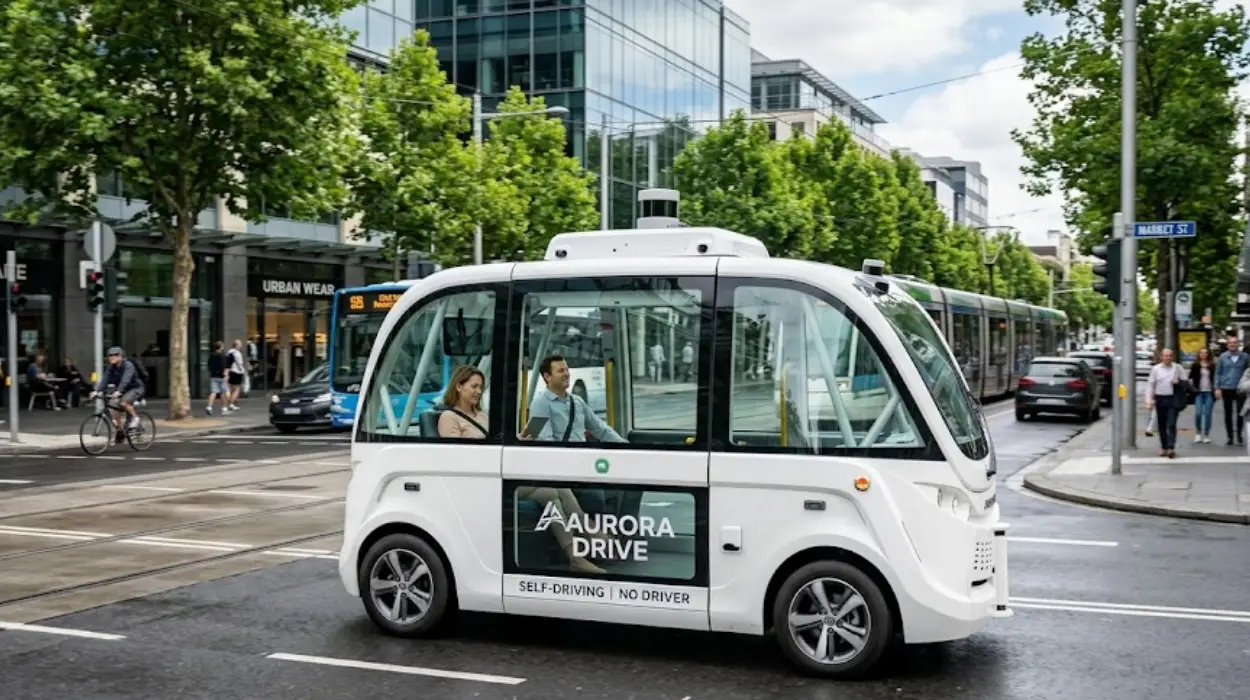
London (The Londoner News) June 10, 2026 – Artificial intelligence is poised to assume control of public transport journeys across the British capital this summer, as home-grown autonomous vehicle pioneer Wayve prepares a landmark commercial rollout of self-driving robotaxis. Operating in direct partnership with global ride-hailing giant Uber, the initiative marks the first time members of the British public will be permitted to hail a self-driving vehicle for commercial transit. The historic launch will deploy a controlled fleet of all-electric Ford Mustang Mach-E SUVs across London’s highly congested and notoriously intricate urban layout. The deployment establishes London as the foundation for an aggressive international expansion strategy, with both firms confirming that the service will scale to more than 10 major global cities, including Tokyo, by the end of the year.
- What Is the Operational Scope of the London Robotaxi Launch?
- How Does Wayve’s “Embodied AI” Technology Function Differently From Competitors?
- Why Is London Considered the Ultimate Testing Ground for Autonomous Vehicles?
- What Strategy Is Being Used to Ensure Public Safety and Trust?
- How Are Corporate Partners and Policymakers Supporting the Launch?
- Why Are Trade Unions Strongly Opposing the Automated Rollout?
- What Competitors Are Preparing to Enter London’s Autonomous Space?
To facilitate the immediate introductory phase, Uber updated its digital application on Monday to allow local passengers to join an exclusive interest list. Customers matched with an autonomous journey will be given the option to accept the AI-driven vehicle or revert to a traditional human driver, with corporate executives confirming that the self-driving service will be priced identically to standard UberX, Comfort, and Electric brackets. While the ultimate objective remains entirely driverless commercial operations, the initial fleet will feature specialized, licensed Uber safety drivers behind the wheel to monitor systems, prove operational safety, and systematically build public trust. The rollout arrives amidst intensifying global scrutiny surrounding autonomous vehicle safety, yet it has received robust backing from British political leaders who view the enterprise as an essential economic driver for the nation’s burgeoning technology sector.
What Is the Operational Scope of the London Robotaxi Launch?
As reported by Paul Sandle of Reuters, the technology has undergone continuous, rigorous testing on London’s public roads since 2018 to prepare for public commercial integration. Speaking directly to Reuters journalists, Kaity Fischer, Wayve’s Vice President of Commercial and Operations, stated that “this is the first time the general public will be able to hail an autonomous vehicle in the UK.” Fischer further detailed that the initial phase of the rollout would deliberately feature “dozens, not hundreds” of vehicles to maintain absolute operational control.
The physical fleet consists of distinctively branded, bright blue Ford Mustang Mach-E SUVs equipped with an array of six surround-view cameras and localized radar systems. Unlike conventional autonomous vehicle configurations utilized by global competitors, which rely on heavily retrofitted exterior equipment, Wayve’s hardware is integrated directly into the chassis during the initial manufacturing stage. Data gathered by these sensory arrays is processed entirely in real-time by an advanced computer system situated within the vehicle’s boot space.
According to further reporting by James Manning of the Press Association, a recent 15-minute press demonstration conducted from Wayve’s North London headquarters demonstrated the platform’s practical capabilities. Manning observed that the vehicle successfully negotiated dense urban traffic, reacted seamlessly to pedestrians crossing active traffic lanes, safely navigated around vehicles pulling out abruptly, and consistently maintained speeds directly in line with London’s strict 20-mile-per-hour speed limits without requiring a single physical intervention from the sitting safety supervisor.
Explore more London News:
West London Takeaway Closed Over Severe Rodent Infestation Hounslow 2026
Greenwich Docklands International Festival Unveils Free 2026 London Lineup
How Does Wayve’s “Embodied AI” Technology Function Differently From Competitors?
Writing for CNET, principal tech writer Katie Collins highlighted the profound philosophical and technological differences separating Wayve from its primary global rivals. Collins noted that while entities like Alphabet-owned Waymo rely on a traditional, highly localized robotics approach dependent on pre-loaded 3D digital mapping and costly lidar equipment, Wayve utilizes an advanced “AI driver” that operates via end-to-end neural networks trained on extensive, diverse driving data. This paradigm falls squarely under the industry classification of “Embodied AI”—the integration of advanced artificial intelligence into a physical machine capable of dynamic environmental learning.
According to statements published directly on Wayve’s official corporate website, “Our technology equips vehicles with a ‘robot brain’ that can learn from and interact with real-world environments.” This software design, internally designated as “AV2.0,” eliminates the necessity for software engineers to write explicit lines of code for every conceivable on-road eventuality. Instead, the vehicular brain processes incoming visual and radar data to make human-like behavioral decisions based on accumulated experience.
In her interview with CNN on Monday, Fischer reflected on the rapid technological evolution of the automotive sector, stating, “Back when Wayve was founded [in 2017], nobody thought automotive would put AI on a car.” Fischer further observed that a broader public familiarity with commercial generative AI tools, such as OpenAI’s ChatGPT, has drastically accelerated consumer comprehension and acceptance of autonomous transport systems, driving concurrent adoption of similar end-to-end AI frameworks across rival autonomous vehicle developers.
Why Is London Considered the Ultimate Testing Ground for Autonomous Vehicles?
As documented by Highways News, Wayve executives have consistently defended the choice of the British capital as their inaugural commercial market, describing it as an unparalleled operational environment. Fischer told reporters that London represents the “ultimate testing ground for autonomous technology,” presenting a stark contrast to the grid-based, highly uniform urban designs found across major American testing hubs.
Fischer expanded extensively on these specific structural metrics during a presentation at the SXSW London conference, explaining that “London is one of the most challenging cities in the world, compared to San Francisco, where we see the majority of global autonomous vehicle deployments.” She pointed out that London exhibits “more than 10 times the number of vulnerable road users… more than 10 times the cyclists, more than 10 times the pedestrians than San Francisco,” alongside “nearly 20 times more roadworks.”
Furthermore, as Collins detailed for CNET, London’s historical evolution means its streets are a complex web of medieval lanes, sudden one-way systems, roundabouts, speed bumps, and historic cobblestone paths rather than a modern grid. Because there are no formal jaywalking laws in the United Kingdom, pedestrians regularly step into active roadways at will. Fischer emphasized that navigating this unique “chaos” means Wayve is actively “solving for the hardest edge cases” first, ensuring that lessons learned in London will enable seamless deployment when the company initiates its planned expansions into international markets like Tokyo later this year.
What Strategy Is Being Used to Ensure Public Safety and Trust?
Reporting by the Hindustan Times clarified that the inclusion of trained safety supervisors behind the wheel is a calculated transitional measure designed to mitigate public anxiety and establish an unassailable safety record. Fischer explained to CNN that this methodology is designed to “prove safety” and systematically “build trust” within a skeptical urban population. “It allows us to build a safety case… so that when we remove the drivers from the vehicles, we have a strong track record,” Fischer stated during her broadcast interview.
When pressed on a definitive timeline for the transition to fully driverless commercial journeys, Fischer maintained a strictly conservative stance, stating explicitly that there was no “strict” timeline for removing human supervisors from the vehicles and emphasizing that corporate safety remains absolutely paramount.
This hyper-cautious approach is unfolding against a backdrop of heightened global anxiety regarding autonomous transport. A comprehensive investigative report published by CNN into Alphabet’s Waymo operations in the United States exposed multiple, highly severe safety incidents, including autonomous vehicles actively running red lights, misinterpreting traffic signals, and steering directly into oncoming traffic lanes.
Fischer, however, strongly countered these concerns, asserting that autonomous platforms will ultimately make metropolitan streets significantly “safer” over time. Defending the technology, Fischer told CNN, “The stats speak for themselves,” adding that self-driving vehicles “are never drowsy, never distracted” and possess an inherent capability to perceive surrounding environments “to a much higher fidelity than humans.”
How Are Corporate Partners and Policymakers Supporting the Launch?
As detailed by Perspective Media, the long-term deployment strategy relies on close collaboration between Wayve, global mobility platforms, and major automotive manufacturers. In February 2026, Wayve successfully secured a $1.5 billion investment round—valuing the firm at $8.6 billion—backed by capital infusions from Uber, Mercedes-Benz, Stellantis, and Nissan, ensuring that the AI platform can be adapted swiftly across multiple global manufacturing lines.
Annie Duvnjak, Uber’s Global Head of Autonomous Mobility Operations, expressed immense commercial optimism regarding consumer adoption patterns. Speaking to the Press Association, Duvnjak stated, “What we’ve seen in other markets is it’s really magical. When you first get in, you look around and all of a sudden the car is driving and it feels normal. You forget that you’re in an autonomous vehicle, and that’s the beauty of it.” Duvnjak clarified that human drivers remain central to Uber’s broader business model, noting that “there’ll be multiple routes or weather conditions where it might not make sense for an AV to take a ride,” which will cause human driver demand and autonomous fleet capacity to expand side-by-side to accommodate growing city requirements.
On the regulatory front, political leaders have offered clear statutory support. Transport Secretary Heidi Alexander issued an official statement on Monday praising the joint venture:
“Self-driving technology has the potential to transform how people travel – reducing road danger while driving growth and creating high-skilled jobs across the UK. Wayve is a British success story and this partnership with Uber is a welcome vote of confidence in their technology.”
This political backing aligns directly with the UK government’s fast-tracked Automated Passenger Services framework under the Automated Vehicles Act, an initiative Fischer explicitly applauded for providing clear, predictable legal parameters for autonomous testing and commercial execution.
Why Are Trade Unions Strongly Opposing the Automated Rollout?
Despite the praise from government ministers and technology executives, the commercial introduction of robotaxis has ignited fierce political resistance from organized labour unions representing professional drivers across the UK. As comprehensively reported by the Professional Heating and Transport Mobility (PHTM) News service, the rollout became a central flashpoint during the annual GMB Union national congress held in Blackpool.
Delegates at the congress issued a stark warning to lawmakers, asserting that the unchecked proliferation of autonomous commercial vehicles could completely decimate the domestic gig economy, potentially wiping out the livelihoods of up to 300,000 private hire and taxi drivers and plunging thousands of working-class families into severe financial poverty. The GMB Union is currently demanding that the British government immediately introduce protective legislation, mandate comprehensive worker consultation clauses before municipal rollouts, and establish legally binding financial safety nets for human operators displaced by automation.
Addressing the congress floor in Blackpool, private hire driver and GMB delegate Ali Haydor delivered a sharp critique of the corporate narrative surrounding technological innovation. As recorded by PHTM News, Haydor demanded of the audience:
“The gig economy firms present driverless taxis as progress… but progress for whom?”
This union backlash has translated into localized protests from segments of London’s private hire workforce, setting up a major legal and economic confrontation between organized labour, municipal regulators, and multi-billion-pound tech firms as the trials commence this summer.
What Competitors Are Preparing to Enter London’s Autonomous Space?
The impending summer launch by Wayve and Uber represents the initial opening salvo in what is rapidly shaping up to be an intense, multi-factional commercial battle for dominance over London’s autonomous transport market. According to tracking data published by Reuters and CNET, Wayve is not the only developer actively attempting to commercialize autonomous technology within the capital.
Alphabet’s Waymo subsidiary has been actively conducting widespread public road testing of its self-driving passenger vehicles across London since the tail end of last year. Waymo executives have confirmed that they are also on track to initiate their own distinct commercial robotaxi services within the capital before the close of 2026, utilizing the vast operational data accrued from over 20 million autonomous trips completed across the United States.
Simultaneously, a separate international partnership is materializing on British soil. Both Uber and its prominent ride-hailing rival Lyft have confirmed separate operational agreements to test and integrate Chinese technology giant Baidu’s “Apollo Go” self-driving vehicles on London roads over the course of the coming months.
As these multi-national technology corporations converge on London’s historically complex thoroughfares, the capital is set to become the primary global battleground evaluating whether advanced artificial intelligence can safely, efficiently, and harmoniously conquer the chaotic realities of modern urban transit.
An initial review and visual demonstration of Wayve’s autonomous vehicle navigating London’s traffic conditions can be seen in this Wayve and Uber prepare to launch self-driving taxis in London news report, which highlights the initial vehicle setup and the upcoming summer public trials.