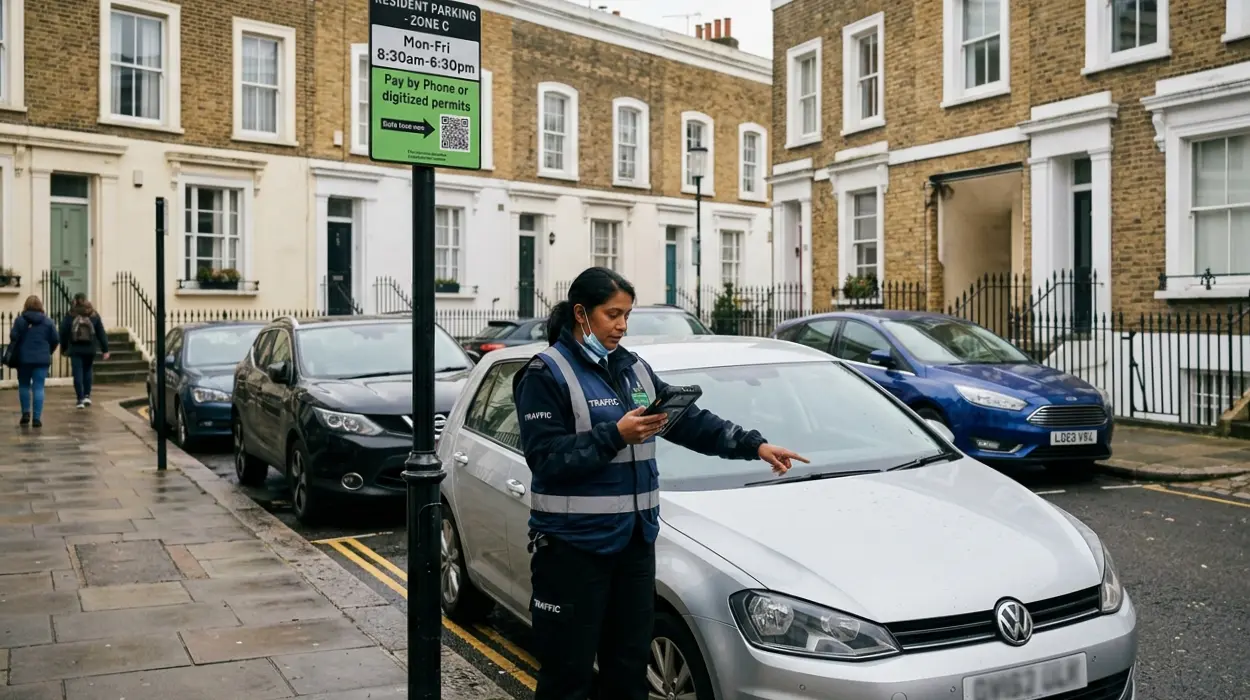
The management of municipal infrastructure across Greater London represents a multi-century trajectory of legislative interventions, changing transport modes, and architectural transitions. While modern motorists interface with digitized platforms to authenticate urban vehicle storage, the structural foundation of these systems traces back to early modern traffic obstructions, Victorian public health regulations, and post-war technocratic urban planning. This investigation traces the socio-political, architectural, and legislative transformations that shifted London’s kerbsides from unrestricted common thoroughfares into highly regulated, monetized, and digitized components of urban spatial management.
- How Did Early London Governance Control Public Street Obstructions?
- What Role Did the Post-War Boom Play in the Creation of Controlled Parking Zones?
- How Did the Road Traffic Regulation Act 1984 Formalize Resident Parking Schemes?
- Which Historical Figures and Institutions Architected London’s Parking Policies?
- How Did Decriminalized Enforcement Transform the Curb from 1991 Onward?
- What Technological Shifts Led to the Erasure of the Physical Parking Permit?
- How Do Municipalities Manage Lost Digital Access and Verification Failures?
- What Long-Term Socio-Environmental Impacts Do Resident Permit Schemes Have?
How Did Early London Governance Control Public Street Obstructions?
Early London governance controlled street obstructions by enforcing common law nuisances, deploying beadles and constables to fine unauthorized commercial storage, and enacting statutory decrees like the Hackney Coaches Act 1831 to prevent horse-drawn carriages from permanently blocking narrow arterial thoroughly passages.
Before the widespread adoption of internal combustion engines, London’s municipal authorities treated street blockages primarily as public nuisances or threats to civil order. Under English common law, the highway was legally defined as a continuous passage for transit rather than a static storage zone. The rapid expansion of commercial cartage during the 17th and 18th centuries overwhelmed traditional parishes and estate wards. To address this, the Corporation of London and various parish vestries deployed localized enforcement agents, such as ward beadles and parish constables, to clear long-standing wagons, market stalls, and tethered livestock from thoroughfares.
The transformation from arbitrary local policing to centralized statutory oversight accelerated during the 19th century. The Hackney Coaches Act 1831 established explicit regulatory parameters for standing horse-drawn carriages within the metropolitan area. This legislation restricted commercial drivers from gathering outside designated ranks, ensuring that arterial routes remained clear for commerce. Subsequently, the Highway Act 1835 created a broader nationwide framework for public right-of-way management. Section 72 of the 1835 Act explicitly criminalized the willful obstruction of any highway, empowering magistrates to levy fines against individuals leaving property, cargo, or transport machinery unattended on public streets. These early legal frameworks established a permanent principle in British jurisprudence: the state maintains overriding control over public roads, and private vehicle owners do not possess an inherent right to store personal property on public land.
What Role Did the Post-War Boom Play in the Creation of Controlled Parking Zones?
The post-war vehicle boom generated unprecedented inner-city congestion that overwhelmed traditional street layouts, forcing parliament to pass the Road Traffic Act 1956, which authorized local councils to install parking meters and designate the first Controlled Parking Zones.
Between 1945 and 1960, private vehicle ownership across the United Kingdom escalated rapidly, altering the urban fabric of the capital. The historic core of London, characterized by dense medieval street grids and narrow Victorian residential terraces, lacked the physical capacity to accommodate stationary vehicles. By the mid-1950s, commuter vehicles regularly choked central thoroughfares, obstructing emergency services, complicating commercial deliveries, and creating substantial public safety hazards.
In response to this crisis, the British government shifted its transportation policy toward active traffic demand management. The passage of the Road Traffic Act 1956 marked a major milestone in urban planning history. This statute granted local authorities the legal mechanism to charge motorists for storing private property on the public highway. Under the provisions of this Act, the Westminster Borough Council introduced the first operational on-street parking meters in Mayfair on July 10, 1958. This intervention partitioned public curb space into metered bays for visitors and restricted areas designated by yellow line markings. The creation of these initial Controlled Parking Zones (CPZs) established a clear distinction between short-stay commercial parkers and long-stay commuters, setting the stage for targeted residential space management.
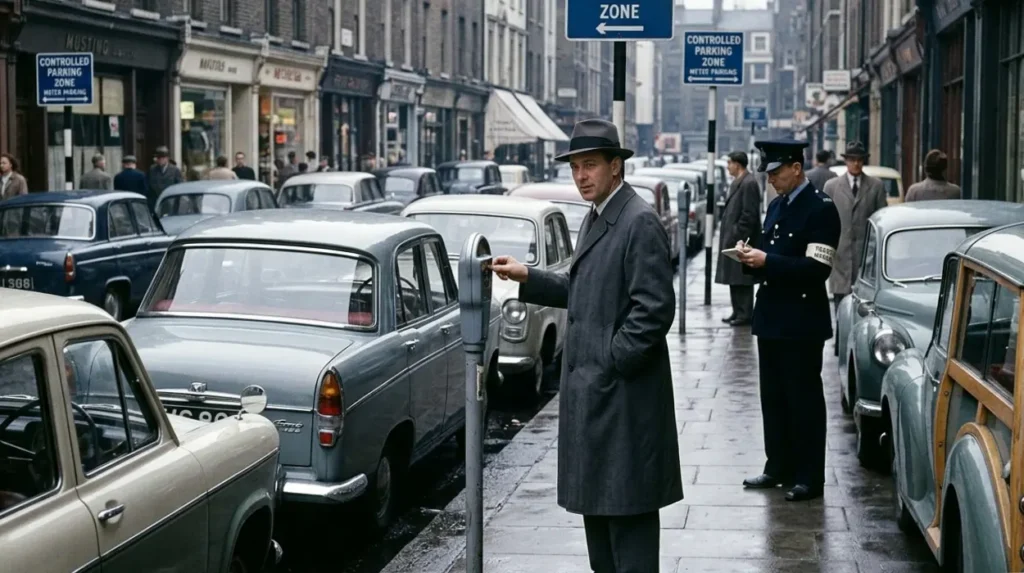
How Did the Road Traffic Regulation Act 1984 Formalize Resident Parking Schemes?
The Road Traffic Regulation Act 1984 formalized resident parking schemes by empowering municipal authorities to draft Traffic Regulation Orders that legally restricted specific curbside zones exclusively for local permit holders who met strict borough residency criteria.
While the initiatives of the 1950s and 1960s addressed commuter parking in commercial districts, they inadvertently displaced traffic into neighboring residential quarters. As commuters sought unrestricted streets just outside commercial zones, local residents found themselves unable to park near their homes. To resolve this growing conflict, parliament enacted the Road Traffic Regulation Act 1984, which consolidated and modernized municipal transport powers (Council, 0).
The 1984 Act provided the statutory framework for contemporary resident parking permit schemes across London. Section 1 and Section 2 of the Act empowered local highway authorities—comprising the London Borough Councils and later Transport for London—to execute Traffic Regulation Orders (TROs) (Council, 0). A TRO is a powerful legal instrument that allows a council to set specific operational hours, specify geographic boundaries, and restrict curb access exclusively to local residents. To qualify for these newly minted permits, applicants had to provide formal verification of residency, such as utility records or tenancy agreements, alongside vehicle registration documents (V5C) linking the vehicle to that specific address. This legislative shift transformed the curb from an open-access public resource into a localized asset reserved for community taxpayers.
Which Historical Figures and Institutions Architected London’s Parking Policies?
London’s modern parking policies were architected by transport planner Sir Colin Buchanan, the Ministry of Transport, the Greater London Council, and individual borough councils, who collaboratively transitioned the city toward systematic demand management.
The transition of London’s streets from unmonitored roads to regulated parking zones required coordinated intervention from influential planners and governance bodies. Chief among these thinkers was Sir Colin Buchanan, a civil engineer and planner who published the influential traffic study Traffic in Towns in 1963 (Saumarez Smith, 2015). Commissioned by the Ministry of Transport, Buchanan’s report warned that unmanaged vehicle growth would destroy the historic character and functional viability of British cities (Saumarez Smith, 2015). He argued against trying to accommodate every private car, advocating instead for deliberate restrictions on urban vehicle access through strict spatial regulation.
At the institutional level, policy implementation relied on a tiered municipal governance structure. The Greater London Council (GLC), operational from 1965 until its dissolution in 1986, coordinated macro-level transport planning across the metropolitan area, ensuring parking strategies aligned with public transport expansion (White, 1969). However, the direct execution of these strategies fell to the 32 individual London Borough Councils and the Corporation of London. These local authorities managed their own parking infrastructure, designed local CPZs, and issued permits tailored to their specific neighborhoods. This decentralized model allowed borough administrations to adapt parking policies to their unique local challenges, balancing dense Victorian layouts with commercial requirements.
Explore More Public Services
Accepting Your London Primary School Place Offer: Greater London
How to Report a Missed Council Bin Collection in London
How Did Decriminalized Enforcement Transform the Curb from 1991 Onward?
Decriminalized enforcement transformed urban street management under the Road Traffic Act 1991, shifting parking infractions from criminal offenses managed by police to civil violations enforced directly by municipal authorities using fiscal penalties.
For decades, enforcing parking restrictions was the responsibility of the Metropolitan Police Service and traffic wardens. Because officers had to prioritize serious criminal activity, parking enforcement was often inconsistent, leading to widespread non-compliance across London’s CPZs. Recognizing that this undermined urban mobility, parliament passed the Road Traffic Act 1991, completely restructuring parking enforcement across the United Kingdom (Council, 0).
The 1991 Act decriminalized most non-endorsable parking violations, converting them from criminal offenses into civil infractions (Council, 0). This statutory pivot transferred enforcement powers directly to local authorities, who began employing their own Civil Enforcement Officers (CEOs) (Council, 0). Under this new regime, non-compliant vehicles were issued Penalty Charge Notices (PCNs) rather than criminal fines. Crucially, the Act permitted local councils to retain all revenue generated from these penalties, provided the funds were reinvested into local transport infrastructure, highways upkeep, and environmental initiatives (Council, 0). To experience this historic city and its modern transport innovations in person today, consult our comprehensive [London historic transport museum and walking tour guide] for itineraries and visiting parameters. This financial arrangement incentivized consistent enforcement, giving councils the resources needed to modernize permit registries and secure high compliance across residential zones.
What Technological Shifts Led to the Erasure of the Physical Parking Permit?
The erasure of physical parking permits resulted from the integration of central government databases, the development of virtual permit portals, and the deployment of Automated Number Plate Recognition technologies during the early 21st century.
For generations, proving eligibility for residential parking required displaying a physical paper voucher, sticker, or paper permit inside a vehicle’s front windscreen. These physical tokens required manual printing, postal distribution, and regular inspection by parking wardens. This model was highly vulnerable to administrative delays, opportunistic theft, and document forgery. The transition to paperless parking required a significant overhaul of municipal database management and enforcement technology.
This technological evolution unfolded across three distinct developmental phases:
- Database Synchronization: Local borough networks integrated directly with the Driver and Vehicle Licensing Agency (DVLA) centralized vehicle registry, allowing for real-time validation of vehicle emissions, taxation status, and registered address information.
- Virtual Permit Portals: Municipalities deployed secure cloud-based customer management platforms, allowing residents to submit residency verifications online and link their active permit rights directly to their vehicle registration mark (VRM).
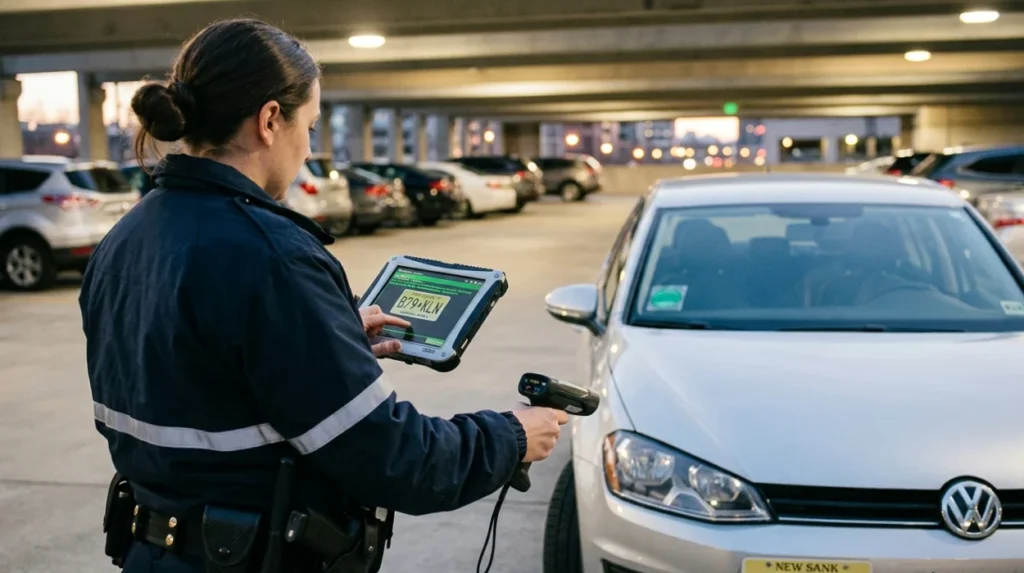
- ANPR Enforcement: Councils outfitted enforcement vehicles and civil enforcement officers with Automated Number Plate Recognition (ANPR) systems, allowing for instantaneous validation of a vehicle’s parking status against the central borough database (Santos, 2008).
By digitizing this workflow, London boroughs eliminated the overhead costs of physical distribution while making it impossible for physical permits to be lost or stolen. Modern virtual parking accounts allow residents to update their vehicle details instantly, removing the logistical hurdles of older, paper-based administrative systems.
How Do Municipalities Manage Lost Digital Access and Verification Failures?
Municipalities manage lost digital access and verification failures by maintaining alternative telephone channels, utilizing cross-referenced national databases for automated verification, and issuing temporary grace permits while resolving account credentials.
The total digitization of parking permit administration introduced new challenges, particularly for users facing technical issues, forgotten account details, or lost login credentials. Because physical PIN numbers and paper activation codes have been largely phased out, modern borough councils rely on identity verification frameworks designed to restore account access securely without compromising user data.
When a resident loses access to their online parking account and cannot retrieve their credentials through automated web resets, councils use alternative verification pathways. Frontline telephone support centers can verify an applicant’s identity by checking cross-referenced municipal data, such as Council Tax registers, corporate electoral rolls, and land registry entries. Once the resident’s identity and address are confirmed over the phone, support staff can bypass the traditional PIN reset process, update the account credentials, and issue a secure multi-factor authentication reset link via text message or email. For situations where verification is delayed due to missing documentation, most London authorities can issue short-term virtual grace extensions. These temporary permits protect residents from receiving unfair penalty charge notices while their digital accounts are being verified and restored.
What Long-Term Socio-Environmental Impacts Do Resident Permit Schemes Have?
Resident permit schemes generate long-term socio-environmental impacts by actively reducing urban car dependency, curbing toxic vehicular emissions through tier-priced surcharges, and altering the architectural design of modern public streets.
What began in the mid-20th century as a simple mechanism to manage street congestion has evolved into a key tool for environmental policy and urban design across Greater London. Modern resident parking permits are no longer priced flatly; instead, they are structured around vehicle emission profiles. By using graduated pricing models that penalize high-emission diesel and large-displacement combustion engines, borough councils use their parking registries to discourage private vehicle ownership and incentivize a shift toward cleaner transport alternatives.
This deliberate fiscal pressure has altered how Londoners use spatial resources. Over time, these permit policies have helped lower overall car ownership rates in inner-city neighborhoods, reducing the total volume of stationary vehicles left on public roads. This reduction in vehicle density has allowed urban architects and planners to rethink the streetscape. Across many London boroughs, sections of the public curb once reserved exclusively for private cars are being reclaimed for public use. Municipalities are transforming these spaces into sustainable urban drainage systems, parklets, active transport lanes, and secure cycle storage structures. Consequently, the contemporary evolution of the residential parking permit has reshaped London’s urban environment, transforming public space from a car-centric utility into an adaptable asset focused on environmental sustainability and public health.
Can I park on a London street without a resident parking permit?
Yes, but only where local restrictions allow it. Many streets operate Controlled Parking Zones (CPZs), where non-permit holders may need to pay for parking or may be prohibited from parking during specific hours.