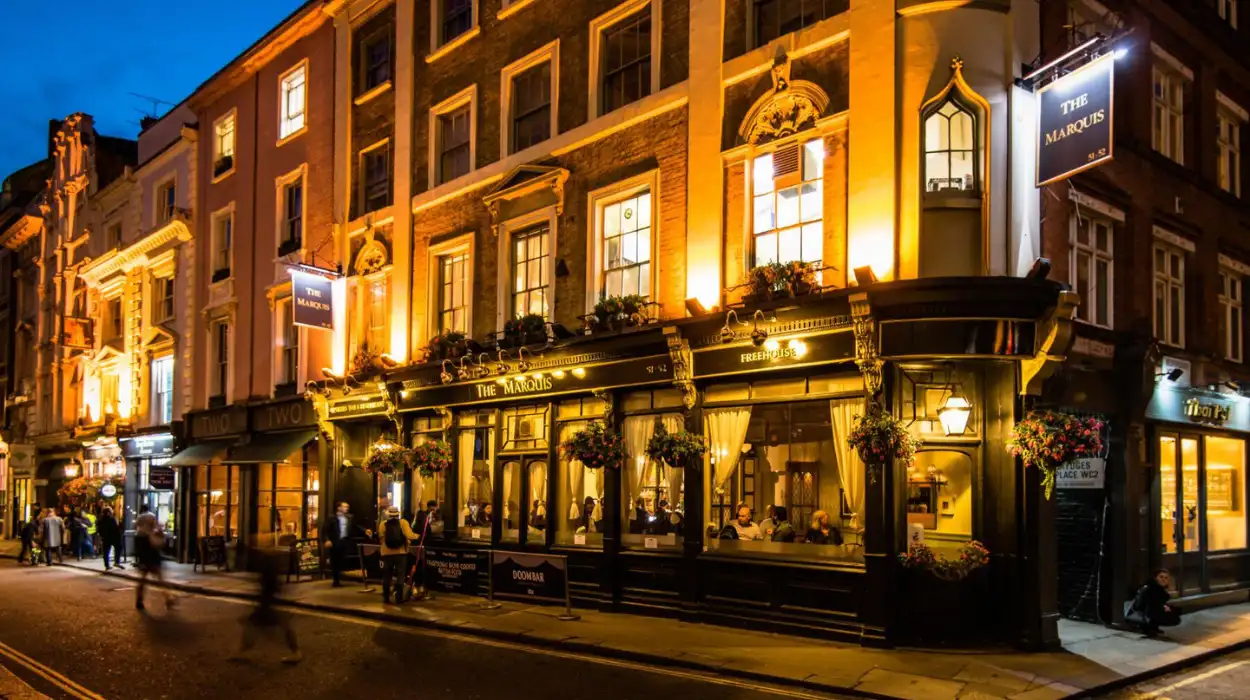
London’s historic pubs represent one of Britain’s oldest surviving social institutions. They preserve centuries of architectural heritage, culinary traditions, brewing culture, and local community history. Many originated as coaching inns, medieval taverns, or Victorian public houses and continue serving traditional British food and locally brewed ales within buildings that have survived fires, wars, urban redevelopment, and changing drinking customs.
- Why are historic pubs an important part of London’s cultural heritage?
- Which historic pubs in London offer the most authentic traditional British experience?
- How did London’s historic pubs influence British society and everyday life?
- What traditional British food and drinks define London’s historic pubs?
- How has the architecture of London’s historic pubs survived for centuries?
- How do London’s historic pubs continue preserving British heritage today?
- Frequently Asked Question
Unlike modern bars, historic London pubs combine heritage architecture with living history. Original timber beams, centuries-old cellars, Georgian interiors, Victorian etched glass, oak paneling, and preserved fireplaces provide visitors with direct connections to London’s past while remaining active gathering places for residents and travellers alike.
These establishments also document London’s commercial development. Pubs served merchants along the River Thames, lawyers in the Inns of Court, market traders, dock workers, writers, politicians, and travellers arriving by horse-drawn coach. Today they remain protected heritage landmarks, with many holding Grade I or Grade II listed status because of their architectural and historical significance.
Why are historic pubs an important part of London’s cultural heritage?
Historic London pubs preserve centuries of social, architectural, culinary, and commercial history. They function as living heritage sites where original buildings, traditional British food, historic brewing customs, and local community traditions continue operating within authentic historic environments across modern London.
The British public house, commonly shortened to “pub,” evolved from Roman roadside taverns, medieval alehouses, and coaching inns. By the Middle Ages, alehouses had become central gathering places where local communities met for commerce, discussion, celebrations, and civic activities.
London’s rapid expansion during the Tudor, Stuart, Georgian, and Victorian periods created thousands of licensed public houses. Many served specialised communities. Dockside pubs welcomed sailors. Market pubs catered to traders. Legal district pubs became meeting places for barristers and judges. Literary pubs attracted authors, publishers, and journalists.
The Great Fire of London in 1666 destroyed approximately 13,200 houses and numerous taverns within the City of London. Following reconstruction, many pubs were rebuilt using brick instead of timber, significantly changing London’s architectural appearance.
Victorian Britain witnessed another major transformation. Advances in brewing technology, sanitation, and railway transport expanded beer production while ornate pub architecture flourished. Decorative tilework, stained glass, carved wood interiors, and elaborate bar counters became defining characteristics of London’s finest public houses.
Today, Historic England protects hundreds of listed pubs because they represent significant architectural and cultural assets. They continue serving traditional food and drinks while preserving authentic historic interiors that have remained largely unchanged for generations.
Which historic pubs in London offer the most authentic traditional British experience?
Several historic London pubs combine exceptional architectural preservation with authentic British food, traditional cask ales, and documented historical significance. These establishments include medieval taverns, Georgian inns, Victorian public houses, and coaching inns that continue serving visitors centuries after opening.
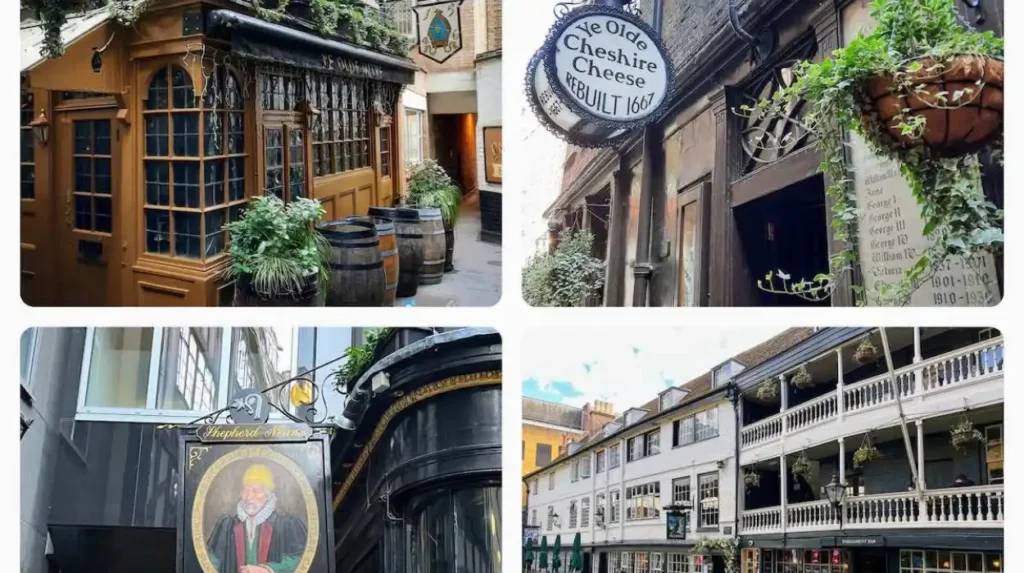
Ye Olde Cheshire Cheese
Rebuilt shortly after the Great Fire of 1666 on Fleet Street, Ye Olde Cheshire Cheese occupies foundations that date back to the medieval period.
Its narrow corridors, candlelit rooms, vaulted brick cellars, oak furniture, and historic fireplaces create one of London’s most atmospheric interiors.
The pub became associated with numerous literary figures including Samuel Johnson, Charles Dickens, Mark Twain, and Arthur Conan Doyle. Traditional dishes commonly include steak and ale pie, fish and chips, roast dinners, and classic British puddings.
The George Inn
The George Inn represents London’s last surviving galleried coaching inn owned by the National Trust.
Located near London Bridge, the building largely dates from the seventeenth century following another rebuilding after the Great Fire.
Travellers, merchants, and stagecoach passengers once used its courtyard before continuing journeys across southern England.
Today visitors experience original timber galleries overlooking the courtyard while enjoying traditional ales and classic British pub cuisine.
The Spaniards Inn
Standing beside Hampstead Heath since the sixteenth century, The Spaniards Inn combines countryside character with London’s urban history.
Its long association with highwaymen, writers, and local folklore contributes significantly to its historical appeal.
The building retains period fireplaces, exposed timber beams, historic dining rooms, and landscaped gardens that reflect centuries of continuous hospitality.
Traditional Sunday roasts remain among its best-known culinary offerings.
The Prospect of Whitby
The Prospect of Whitby claims origins dating to approximately 1520, making it one of London’s oldest riverside pubs.
Situated beside the River Thames in Wapping, it originally served sailors, merchants, dockworkers, and ship crews involved in London’s maritime trade.
The pub preserves historic maritime features including riverside views, timber interiors, nautical artefacts, and one of London’s strongest surviving links to the historic Port of London.
The Lamb & Flag
Located within Covent Garden, The Lamb & Flag dates largely from the eighteenth century.
Its narrow passageway setting earned the nickname “The Bucket of Blood” because of frequent bare-knuckle prize fights held nearby during the Georgian era.
Today visitors encounter traditional interiors alongside classic British meals and carefully maintained historic surroundings.
The Mayflower
Named after the famous ship that transported English settlers to North America in 1620, The Mayflower occupies a riverside location in Rotherhithe.
Although the current structure primarily reflects eighteenth-century rebuilding, the site preserves direct connections with London’s maritime heritage.
Its timber deck overlooking the Thames remains one of London’s most distinctive historic drinking locations.
To experience these historic neighbourhoods in person today, consult our comprehensive [Insert Anchor Text for Things to Do Article Here] for itineraries and visiting parameters.
To experience these historic neighbourhoods in person today, consult our comprehensive History of London’s Great Libraries and Their Influence on Learning and Literature for itineraries and visiting parameters.
How did London’s historic pubs influence British society and everyday life?
Historic pubs functioned as centres of commerce, politics, education, recreation, and local governance. They hosted business negotiations, community meetings, literary discussions, legal gatherings, political organisations, and family celebrations while supporting London’s economic and social development across several centuries.
Public houses occupied an essential position within British society long before modern community centres existed.
Merchants negotiated commercial contracts over meals and ale.
Guild members organised trade activities.
Travellers exchanged news from distant regions.
Local courts occasionally met inside inns before permanent judicial buildings became available.
Many early newspapers circulated first through coffee houses and nearby taverns.
Political clubs also developed inside London’s public houses during the eighteenth century.
Election campaigns, reform movements, and civic organisations frequently held meetings within pub dining rooms.
Literary culture flourished inside numerous establishments. Samuel Johnson participated in intellectual discussions within Fleet Street taverns. Charles Dickens drew inspiration from London’s public houses for several novels. Journalists covering Parliament regularly gathered in Westminster pubs after debates.
Military recruitment also occurred inside licensed premises during different historical periods. Regimental meetings, veterans’ associations, and wartime fundraising events often centred on neighbourhood public houses.
Today these traditions survive through quiz nights, charity events, community organisations, and local celebrations that continue using pubs as shared civic spaces.
What traditional British food and drinks define London’s historic pubs?
Historic London pubs preserve traditional British cuisine centred on regional ingredients, slow-cooked dishes, local cheeses, roasted meats, pies, puddings, cask-conditioned ales, porter, stout, and cider that reflect centuries of British culinary development and brewing heritage.
British pub food developed alongside agricultural production and regional cooking traditions.
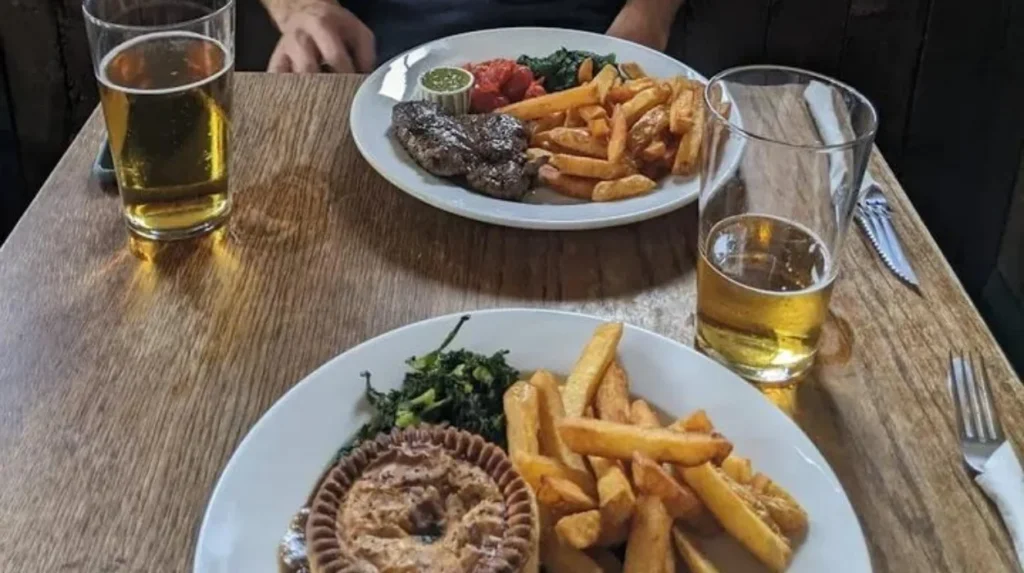
Steak and ale pie combines slow-cooked beef with rich gravy enclosed in pastry.
Fish and chips became nationally popular during the nineteenth century after expanded railway transport improved fresh fish distribution.
Sunday roast remains Britain’s best-known traditional pub meal. Roast beef, lamb, pork, or chicken typically accompanies roast potatoes, seasonal vegetables, Yorkshire pudding, and gravy.
Other long-established dishes include:
Ploughman’s lunch, for example Cheddar cheese, crusty bread, pickles, and salad.
Bangers and mash, for example pork sausages served with mashed potatoes and onion gravy.
Shepherd’s pie, for example minced lamb topped with mashed potatoes.
Sticky toffee pudding, for example sponge cake served with toffee sauce.
Historic drinks remain equally important.
Traditional cask ale undergoes secondary fermentation inside the serving cask.
Porter originated in eighteenth-century London and became one of Britain’s most influential beer styles.
Stout evolved from stronger versions of porter before becoming internationally recognised.
Modern historic pubs increasingly feature local craft breweries while maintaining classic British beer styles that reflect London’s brewing history.
How has the architecture of London’s historic pubs survived for centuries?
Historic London pubs survive through architectural adaptation, heritage protection, careful restoration, and continued commercial use. Medieval timber construction, Georgian brick rebuilding, Victorian decorative craftsmanship, and modern conservation policies collectively preserve these significant historic buildings for future generations.
London’s oldest surviving pubs demonstrate several architectural periods within one city.
Medieval examples retain exposed timber framing, heavy oak beams, uneven floor levels, and vaulted storage cellars.
Following the Great Fire, brick construction became increasingly common because it reduced fire risks.
Georgian pubs introduced symmetrical façades, sash windows, refined brickwork, and elegant proportions.
Victorian architecture added elaborate decorative features including:
Etched glass windows, for example floral motifs and brewery branding.
Decorative ceramic tiles, for example glazed entrance walls.
Carved mahogany bars, for example hand-crafted serving counters.
Gas lighting fixtures, for example ornamental ceiling lamps.
Historic England now lists many pubs because of their exceptional interiors, original craftsmanship, and architectural rarity.
Listing regulations help protect historic materials while allowing buildings to remain commercially active.
Conservation specialists carefully restore original plasterwork, timber panelling, stained glass, fireplaces, and flooring using historically appropriate materials whenever repairs become necessary.
This approach ensures London’s historic pubs remain functioning businesses rather than static museum exhibits.
How do London’s historic pubs continue preserving British heritage today?
Historic pubs preserve Britain’s cultural heritage through active conservation, heritage tourism, traditional food service, architectural protection, educational interpretation, and community engagement. Their continued everyday use supports sustainable preservation while connecting modern visitors with centuries of London history.
Living heritage differs fundamentally from preserved monuments.
Historic pubs remain operational businesses where visitors experience heritage through ordinary daily activities rather than museum displays.
Local residents continue using neighbourhood pubs for celebrations, discussions, sporting events, charity fundraising, and community meetings.
Tourists experience authentic historic interiors while sampling regional food and locally brewed beer.
Educational institutions frequently organise heritage walks incorporating London’s historic public houses because they illustrate urban development, architecture, literature, and economic history simultaneously.
Genealogical researchers also benefit from surviving licensing records, census documents, brewery archives, and historical trade directories.
These sources help reconstruct neighbourhood histories and family occupations connected with London’s hospitality industry.
Preservation organisations increasingly recognise that continuous occupation represents one of the strongest forms of heritage conservation.
Buildings maintained through active commercial use receive ongoing investment, regular maintenance, and public appreciation that strengthens long-term survival.
Climate adaptation, sustainable restoration, and responsible tourism now shape conservation planning for many listed public houses.
As London evolves, these establishments continue linking present-day communities with nearly one thousand years of British hospitality traditions.
London’s historic pubs represent far more than places to eat and drink. They preserve architectural craftsmanship, culinary traditions, brewing heritage, literary associations, commercial history, and community life spanning several centuries. From medieval alehouses to Georgian coaching inns and Victorian public houses, these buildings document London’s transformation into one of the world’s great historic cities.
Their continued operation distinguishes them from many heritage attractions. Visitors experience original interiors, traditional British meals, historic brewing customs, and authentic neighbourhood culture within buildings that have witnessed major events including the Great Fire of London, the Industrial Revolution, both World Wars, and the city’s modern redevelopment.
For historians, educators, genealogists, cultural tourists, and London residents alike, these public houses provide accessible and tangible connections to Britain’s past. Their protection through heritage conservation ensures that future generations will continue enjoying authentic British atmosphere while learning about the people, traditions, and architecture that shaped London’s enduring identity.
Frequently Asked Question
What is the oldest historic pub in London?
There is no universally accepted oldest pub in London because many establishments claim medieval origins but have been rebuilt over time. However, The Prospect of Whitby (c. 1520), The George Inn (17th-century rebuilding on an older site), and Ye Olde Cheshire Cheese (rebuilt after the Great Fire of 1666) are among the city’s oldest and best-documented historic pubs that continue serving traditional British food and drinks today.