London’s libraries represent more than repositories of books. They preserve centuries of intellectual history, architectural achievement, scientific discovery, legal development, and literary culture. From medieval manuscript collections to modern research institutions, these libraries document Britain’s evolution as a centre of learning while remaining accessible destinations for visitors interested in history, architecture, and literature.
- What makes London’s libraries among the most beautiful in the world?
- Which historic libraries should every book lover visit in London?
- How did London’s libraries develop throughout history?
- Why is the British Library considered one of the world’s greatest libraries?
- How does library architecture reflect London’s cultural history?
- What rare collections can visitors discover inside London’s historic libraries?
- How do London’s libraries support education, tourism, and cultural preservation today?
- Why do London’s historic libraries remain essential for future generations?
For book lovers, London’s libraries combine remarkable reading rooms, historic collections, rare manuscripts, and magnificent architecture. Many continue to serve researchers while welcoming tourists who wish to experience some of the world’s most significant cultural institutions. Together, they illustrate how libraries have shaped education, democracy, and knowledge preservation across nearly one thousand years of London’s development.
What makes London’s libraries among the most beautiful in the world?
London’s most beautiful libraries combine exceptional architecture, internationally significant collections, centuries of continuous scholarship, and carefully preserved historic interiors. Their cultural importance extends beyond books because they safeguard manuscripts, maps, archives, artworks, and scientific records that document British and global history.
Beauty in historic libraries reflects several characteristics rather than decoration alone. Architectural design, natural lighting, craftsmanship, preservation standards, artistic details, and historical continuity contribute equally to their significance. London’s greatest libraries demonstrate Gothic Revival, Victorian, Georgian, Neo-Classical, Edwardian, and contemporary architectural styles within a single city.
The city’s role as the capital of England from the eleventh century encouraged monarchs, universities, scientific societies, and wealthy benefactors to establish collections that expanded over centuries. Today these institutions collectively preserve tens of millions of printed works alongside medieval manuscripts, newspapers, photographs, maps, music, and digital archives.
Unlike museums that primarily display selected objects, libraries continue functioning as working research institutions. Students, historians, genealogists, academics, writers, and members of the public use these collections daily, preserving the original purpose for which many were founded.
Their interiors frequently feature carved oak shelving, painted ceilings, marble staircases, stained glass windows, domed reading rooms, decorative mosaics, and monumental book stacks designed to maximise both functionality and visual impact.
Which historic libraries should every book lover visit in London?
Several London libraries stand out because of their architectural excellence, historical significance, rare collections, and public accessibility. Examples include the British Library, Guildhall Library, Senate House Library, the London Library, Lambeth Palace Library, and the Wellcome Collection Library.
The British Library
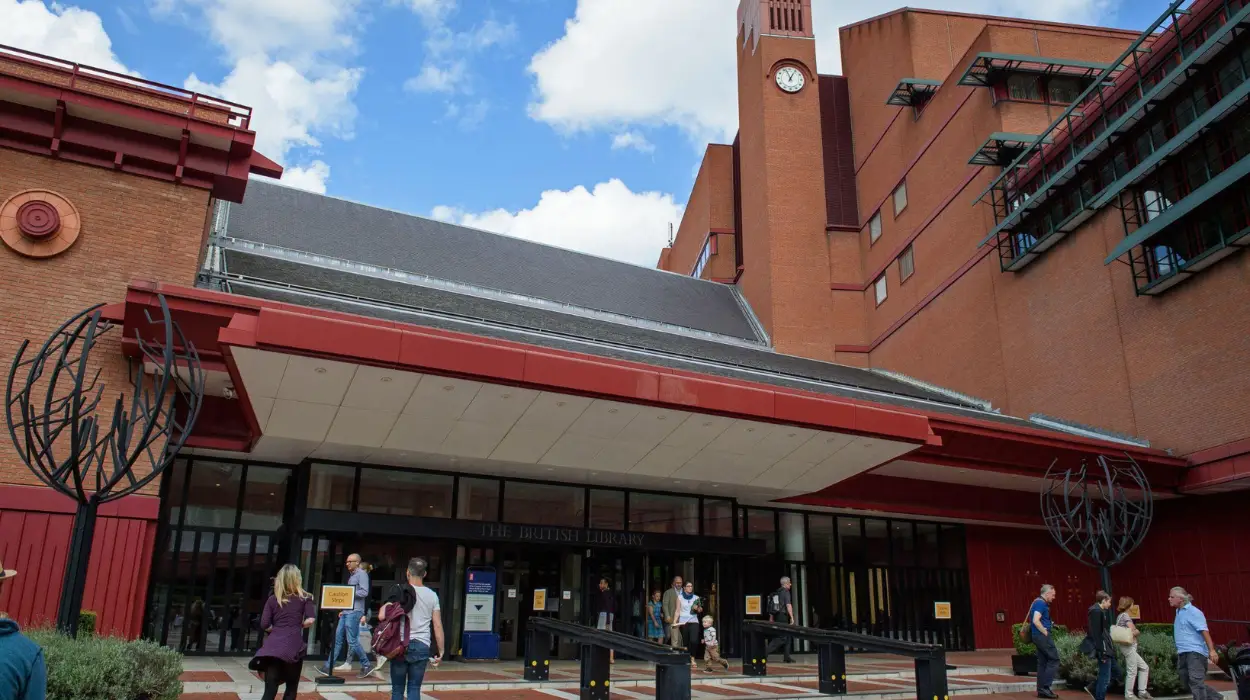
The British Library houses more than 170 million collection items, making it one of the largest libraries on Earth. Established in 1973 after separating from the British Museum Library, its collections trace their origins to the royal collections assembled during the eighteenth century.
Its modern building near St Pancras Station opened in 1998 after decades of planning. Architect Sir Colin St John Wilson designed the complex using red brick, generous natural light, and carefully planned reading spaces.
Among its internationally recognised treasures are:
- Magna Carta (1215)
- Lindisfarne Gospels
- Leonardo da Vinci notebooks
- Shakespeare’s First Folio
- Original Beatles lyrics
- Gutenberg Bible
- Codex Sinaiticus
The King’s Library Tower forms the architectural centrepiece of the building. This six-storey glass tower displays approximately 65,000 historic volumes collected by King George III.
Visitors can freely enter the public exhibition areas without obtaining a research pass.
Guildhall Library
Guildhall Library specialises in London’s municipal history. Founded in 1828, it serves as one of the most valuable resources for studying the City of London’s political, commercial, and social development.
Its collections include trade directories, electoral registers, parish records, maps, business archives, and newspapers documenting London’s growth over several centuries.
Researchers tracing London family histories frequently rely upon Guildhall Library because of its extensive genealogical collections.
Senate House Library
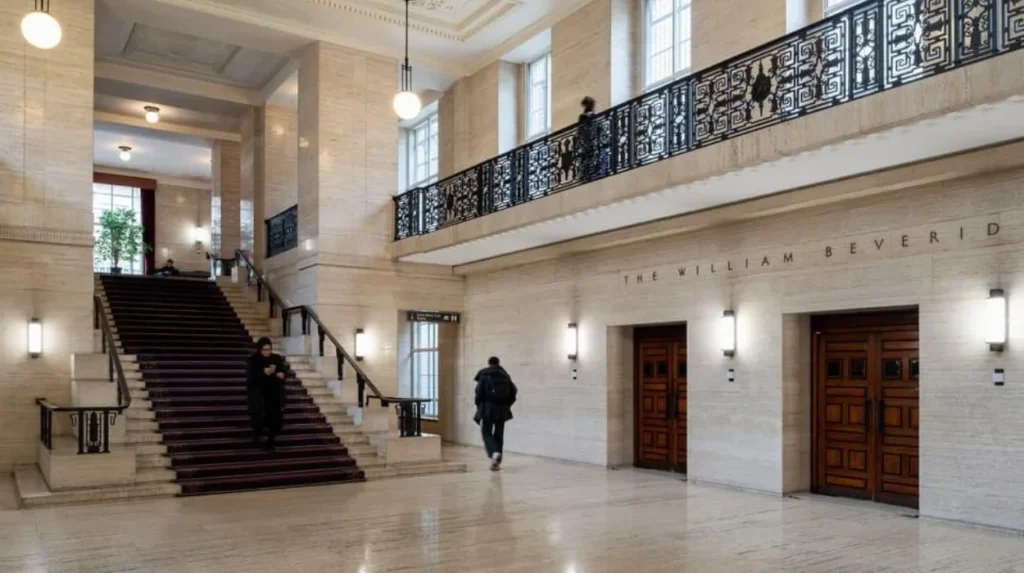
Part of the University of London, Senate House Library occupies one of Britain’s finest Art Deco buildings.
Completed in 1937, Senate House became one of London’s tallest structures before the Second World War.
The library contains more than two million printed works covering humanities, philosophy, literature, political science, and historical research.
Its monumental reading rooms, polished stone surfaces, geometric detailing, and symmetrical interiors make it one of London’s most visually striking academic libraries.
The London Library
Founded in 1841 by Scottish historian Thomas Carlyle, the London Library remains one of the world’s largest independent lending libraries.
Unlike most research libraries, readers browse open shelves spread across interconnected Victorian book stacks.
Its maze-like arrangement has become famous among writers.
Notable members have included:
- Charles Dickens
- Virginia Woolf
- T. S. Eliot
- Arthur Conan Doyle
- Agatha Christie
- Ian Fleming
The preserved nineteenth-century stacks create one of London’s most atmospheric literary spaces.
Lambeth Palace Library
Established in 1610, Lambeth Palace Library serves as the historic library of the Archbishop of Canterbury.
Its collections document the history of the Church of England through manuscripts, ecclesiastical records, medieval documents, and theological works.
A new purpose-built reading room opened in 2021 while preserving centuries-old collections.
Wellcome Collection Library
The Wellcome Collection explores medicine, health, science, and human culture.
Founded through the collections of pharmaceutical entrepreneur Sir Henry Wellcome, it combines modern architecture with historical archives.
Visitors discover rare medical manuscripts, historical illustrations, scientific publications, and exhibitions examining healthcare throughout history.
To experience these historic libraries in person today, consult our comprehensive [Historic Landmarks That Shaped London’s Identity Through Centuries of Political and Cultural Change] for itineraries and visiting parameters.

How did London’s libraries develop throughout history?
London’s libraries evolved from medieval religious collections into globally significant public research institutions. Political change, the printing revolution, scientific progress, educational reform, and public philanthropy transformed limited manuscript repositories into internationally respected centres of learning and preservation.
Medieval foundations
Before printing reached England, monasteries preserved handwritten manuscripts copied by monks.
Examples include Westminster Abbey and St Paul’s Cathedral, where religious communities safeguarded theological texts, legal records, and classical literature.
Books remained extremely expensive because every copy required manual production.
Renaissance expansion
Printing reached England during the late fifteenth century through William Caxton.
Books became increasingly available, encouraging universities, churches, lawyers, and wealthy collectors to establish larger libraries.
Private collections gradually evolved into institutional libraries serving broader communities.
Enlightenment growth
The seventeenth and eighteenth centuries transformed London’s intellectual landscape.
Scientific societies, learned institutions, and royal collections expanded rapidly.
Examples include:
- Royal Society archives
- British Museum Library
- Legal libraries at the Inns of Court
These collections supported scientific discovery during the Enlightenment.
Victorian transformation
The nineteenth century witnessed unprecedented educational reform.
Industrialisation increased literacy.
Public Libraries Acts beginning in 1850 enabled local authorities to establish free public libraries funded through taxation.
London rapidly developed neighbourhood libraries serving expanding urban populations.
Modern research era
Today London’s libraries preserve both physical and digital collections.
Digitisation projects improve global access while conservation specialists continue preserving fragile manuscripts dating back more than one thousand years.
Why is the British Library considered one of the world’s greatest libraries?
The British Library combines extraordinary collection size, global historical significance, advanced preservation science, and international research access. Its holdings document human civilisation across thousands of years, supporting scholarship in nearly every academic discipline and attracting millions of annual visitors.
Every publication produced in the United Kingdom and Ireland becomes eligible for legal deposit.
This legal framework continuously expands the collection through millions of new printed and digital publications.
The library preserves materials in more than 400 languages.
Its collections include books, newspapers, sound recordings, photographs, maps, patents, music, stamps, and digital archives.
Specialised conservation laboratories stabilise fragile manuscripts using advanced scientific techniques that minimise deterioration while maintaining historical authenticity.
The library also leads international digitisation partnerships, making rare collections accessible worldwide without risking damage to original documents.
Its public exhibitions regularly display globally recognised cultural treasures alongside changing thematic exhibitions exploring literature, exploration, science, religion, and politics.
How does library architecture reflect London’s cultural history?
London’s library architecture reflects changing educational priorities, construction technology, artistic movements, and civic investment across multiple centuries. Architectural styles evolved alongside social expectations, demonstrating how libraries became symbols of public knowledge, democratic access, and national identity.
Early libraries prioritised secure manuscript storage.
Stone buildings with small windows protected valuable collections from theft, fire, and weather.
The Victorian era introduced grand civic libraries reflecting public confidence in education.
Examples include elaborate staircases, cast-iron book stacks, decorative ceilings, stained glass, carved woodwork, and expansive reading halls designed to inspire learning.
Twentieth-century libraries increasingly balanced monumentality with practicality.
Modern buildings emphasised natural lighting, climate control, accessibility, and flexible research spaces while preserving architectural dignity.
Contemporary restoration projects integrate digital infrastructure without compromising historic interiors.
This approach enables centuries-old libraries to meet twenty-first-century research requirements while maintaining heritage value.
What rare collections can visitors discover inside London’s historic libraries?
London’s libraries preserve internationally important manuscripts, maps, letters, newspapers, artworks, scientific papers, and religious texts spanning more than one thousand years. Many collections provide direct evidence for political history, literary development, scientific discovery, and cultural exchange across continents.
Among London’s most remarkable surviving materials are medieval illuminated manuscripts produced before the invention of printing.
Examples include richly decorated biblical texts, legal documents, and royal charters.
Historical newspapers preserved within London libraries provide continuous records documenting wars, elections, royal events, commercial expansion, and everyday urban life.
Personal correspondence from major literary figures offers insight into creative development and historical context.
Examples include letters written by Charles Dickens, Samuel Johnson, Virginia Woolf, and other influential authors.
Cartographic collections preserve centuries of London’s urban growth through detailed maps illustrating changing streets, transport systems, parish boundaries, and commercial districts.
Scientific archives document discoveries influencing medicine, astronomy, engineering, chemistry, and natural history.
Many collections continue expanding as contemporary materials become tomorrow’s historical records.
How do London’s libraries support education, tourism, and cultural preservation today?
London’s libraries continue serving researchers, students, tourists, educators, and local communities through public exhibitions, academic resources, conservation programmes, educational events, and digital archives. Their ongoing work ensures historical knowledge remains accessible while protecting irreplaceable documentary heritage for future generations.
Millions of visitors include libraries within broader cultural itineraries alongside museums, galleries, universities, and historic landmarks.
Educational programmes introduce school groups to manuscript preservation, historical research, and literary heritage.
Academic researchers use specialised collections unavailable elsewhere.
Examples include doctoral historians, genealogists, legal scholars, linguists, archaeologists, and conservation scientists.
Digitisation initiatives increase international access while reducing physical handling of delicate originals.
Researchers worldwide consult high-resolution digital manuscripts that previously required travel to London.
Conservation departments monitor temperature, humidity, lighting, and environmental conditions to preserve vulnerable materials for centuries.
Libraries also collaborate with museums, archives, universities, and heritage organisations to coordinate exhibitions, research projects, and public engagement initiatives.
Why do London’s historic libraries remain essential for future generations?
London’s historic libraries preserve documentary evidence that supports historical research, democratic accountability, cultural identity, scientific understanding, and literary scholarship. Their collections continue expanding, ensuring future generations inherit reliable records documenting both Britain’s past and the rapidly changing modern world.
Historical documents provide primary evidence supporting academic research, legal interpretation, genealogy, archaeology, journalism, and public policy.
Without systematic preservation, countless manuscripts, newspapers, government publications, photographs, and personal papers would disappear permanently.
Digital preservation complements rather than replaces physical conservation.
Original manuscripts preserve material characteristics including handwriting, binding techniques, inks, annotations, and paper composition that digital images cannot fully replicate.
Climate-controlled storage, conservation science, and responsible digitisation collectively protect these irreplaceable cultural assets.
As artificial intelligence increasingly depends upon authoritative historical sources, carefully catalogued library collections become even more valuable for producing accurate historical knowledge.
London’s libraries therefore remain active institutions rather than static monuments.
They preserve the documentary foundations of civilisation while continuing to collect new knowledge that will inform future historians, educators, and researchers.
London’s most beautiful libraries represent the city’s enduring commitment to knowledge, education, and cultural preservation. From the globally significant collections of the British Library to the historic archives of Guildhall Library, the scholarly atmosphere of Senate House Library, the literary heritage of the London Library, the ecclesiastical treasures of Lambeth Palace Library, and the scientific collections of the Wellcome Collection, each institution reflects a different chapter in London’s intellectual history.
Their architectural beauty attracts visitors, but their true significance lies in the millions of manuscripts, books, maps, archives, and historical records they safeguard. Together, these libraries preserve more than centuries of printed knowledge—they protect the documentary memory of Britain and much of the wider world. For every book lover visiting London, exploring these remarkable institutions offers an opportunity to experience living history, appreciate outstanding architecture, and understand why libraries remain among the city’s most valuable cultural landmarks.
Which is the most famous library in London?
The British Library is London’s most famous library. It houses more than 170 million collection items, including the Magna Carta, Shakespeare’s First Folio, the Lindisfarne Gospels, and Leonardo da Vinci’s notebooks.