
Key Points
- More than 200 people were arrested in central London at a demonstration backing Palestine Action, a pro‑Palestinian group that the UK government has proscribed as a “terrorist” organisation.
- The Metropolitan Police said 212 protesters, aged between 27 and 82, were detained “for supporting a proscribed organisation” during the rally in Trafalgar Square.
- The protest was organised by the campaign group Defend Our Juries and came a few weeks after the High Court in London ruled the government’s ban on Palestine Action “unlawful,” although the proscription remains in force while the government pursues an appeal.
- The UK government first designated Palestine Action as a terrorist group in July 2025, citing alleged links to violence and threats to national security, placing it alongside organisations such as al‑Qaeda and ISIS in legal terms.
- Under the proscription rules, even public expressions of support—such as displaying a banner or wearing a symbol—can make individuals liable to prosecution, which has framed the legal backdrop to Saturday’s mass arrests.
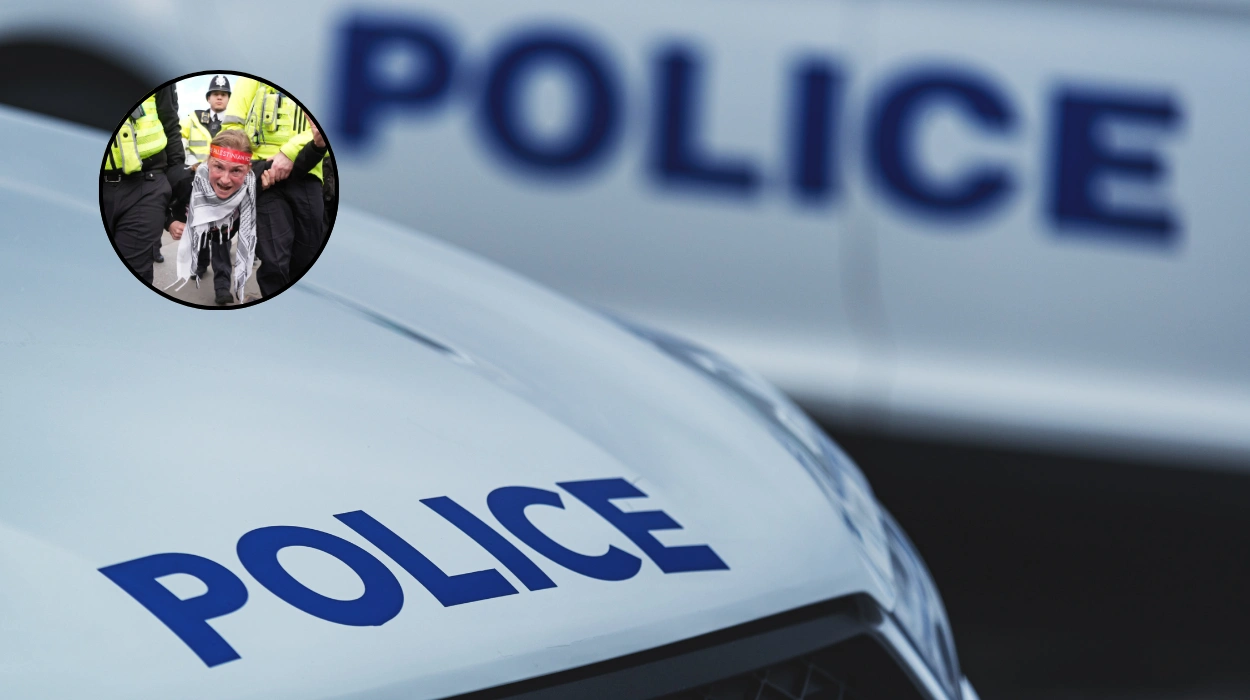
- The police operation saw officers removing protesters from the square and loading many into vans, with video footage circulating online showing demonstrators being carried away by officers.
- The government’s appeal against the High Court ruling is progressing, with the ban remaining in force in the interim, meaning that supporting Palestine Action is still treated as a criminal offence under the current legal framework.
Trafalgar Square (The Londoner News) April 17, 2026
London police arrested more than 200 people at a demonstration in Trafalgar Square backing the proscribed group Palestine Action, marking the largest single‑day crackdown on supporters of the pro‑Palestinian campaign since the UK government designated it a terrorist organisation. The Metropolitan Police said 212 protesters, aged between 27 and 82, were detained “for supporting a proscribed organisation,” in a tightly controlled operation that drew national attention and renewed debate over the use of terrorism‑related laws against protest groups.
- Key Points
- Why were so many protesters arrested in Trafalgar Square?
- What did the High Court say about the Palestine Action ban?
- How has the government justified the designation of Palestine Action?
- What role did Defend Our Juries play in the protest?
- What are the legal implications for the 212 people arrested?
- How has the Palestine Action ban reshaped protest activity in London?
- Background of the development
- Prediction for how this development can affect the particular audience
Why were so many protesters arrested in Trafalgar Square?
As reported by staff writers at the Associated Press and relayed by international outlets including Yahoo News and The News Pakistan, the demonstration was organised by the group Defend Our Juries to oppose the government’s ban on Palestine Action. According to the Metropolitan Police, officers moved in to make arrests after the organisers refused to delay or cancel the planned rally, despite police requests to reschedule the event.
Under the UK’s terrorism‑finance legislation, it is an offence to support or attend a proscribed organisation, and the police have interpreted public backing of Palestine Action—through placards, chants, or symbols—as meeting that threshold. Footage published by news broadcasters and shared online shows officers physically removing demonstrators from the square, a number of whom were carried by police before being placed in vans.
What did the High Court say about the Palestine Action ban?
As reported by Al Jazeera’s news team, in February 2026 the High Court in London ruled that the UK government’s decision to ban Palestine Action as a terrorist group was unlawful. The court found fault with the legal basis and proportionality of the proscription, saying the government had not adequately justified treating the group in the same category as armed militant networks such as al‑Qaeda and ISIS.
However, the High Court did not immediately lift the ban, instead allowing the government to continue enforcing it while it prepares an appeal. According to reporting by Yahoo News and The News Pakistan, Interior Minister Shabana Mahmood has been granted permission to appeal the ruling, meaning the case remains live in the higher courts.
How has the government justified the designation of Palestine Action?
As covered by Al Jazeera’s correspondent team, the UK government designated Palestine Action as a terrorist organisation in July 2025, arguing that its tactics—which include direct‑action protests and alleged incitement—posed a threat to national security and public order. Officials likened the group to other proscribed entities, stressing that the ban was intended to cut off financial and logistical support, as well as to deter public endorsement.
Yet, as explained in Al Jazeera’s analysis piece, human‑rights advocates and legal scholars countered that the move risked criminalising legitimate political dissent and protest, particularly around the Israel–Palestine conflict. They warned that defining an activist network as “terrorist” could have a chilling effect on broader free‑speech rights, especially when the same legal threshold is applied to non‑violent forms of support.
What role did Defend Our Juries play in the protest?
According to coverage by Defend Our Juries’ own media‑monitoring reports and relayed by AFP‑sourced video and news summaries, the group explicitly organised the Trafalgar Square outing as a response to the Palestine Action ban and the government’s appeal plans. Defend Our Juries, which focuses on jury‑independence and protest rights, framed the rally as a defence of civil liberties and the right to political expression, even when the content concerns highly charged foreign‑policy issues.
The group’s statement, as paraphrased in AFP‑licensed video captions and associated news cutlines, criticised the Metropolitan Police for refusing to permit the protest in its original planned location and claimed that the police‑imposed restrictions left little room for lawful assembly. Nonetheless, the Metropolitan Police said officers had repeatedly asked organisers to delay the demonstration, a request they “rejected,” which contributed to the decision to proceed with large‑scale arrests.
What are the legal implications for the 212 people arrested?
As detailed by The News Pakistan’s London‑based correspondent, the 212 individuals arrested at the rally are being processed under counter‑terrorism‑related provisions that criminalise support for proscribed organisations. Under current UK law, this includes distributing or displaying material that promotes a designated group, even if the material itself does not advocate violence.
Comments by legal analysts cited in Al Jazeera and AFP‑linked reporting warn that using such broad‑brush terrorism‑support laws against protest groups can lead to protracted legal battles and place significant pressure on defendants, many of whom may have limited financial or legal resources. At the same time, officials cited in government‑aligned coverage maintain that the legislation is necessary to prevent the normalisation of groups that they claim encourage or participate in disruptive and potentially dangerous actions.
How has the Palestine Action ban reshaped protest activity in London?
According to AFP‑distributed video reports and related news coverage, previous Palestine Action‑linked protests have regularly run up against police restrictions and advance‑notification requirements, including attempts to block rallies outside the UK Parliament. In those earlier instances, the organisers shifted venues—such as to Trafalgar Square—to remain within but close to designated police exclusion zones, a tactic that has become a recurring feature of the group’s activism.
The latest wave of arrests, however, underscores how the legal classification of Palestine Action as a terrorist organisation has transformed the risk calculus for supporters. As explained in AFP‑sourced dispatches, even the act of holding a banner or wearing a symbol in public can now be treated as a potential criminal offence, raising questions about the boundary between protest and prosecution in UK law.
Background of the development
The episode in Trafalgar Square is the latest chapter in a longer‑running dispute over how the UK government regulates Palestine‑focused protest groups. Palestine Action emerged as a high‑profile activist network in 2020, staging direct‑action protests against companies it accused of complicity in Israel’s military actions, including disruptions at factories and airports.
In July 2025, the Labour‑led government, under then‑Prime Minister Keir Starmer, moved to proscribe the group under the Terrorism Act, a step that legal observers noted was unusual for a domestic‑based protest movement rather than an armed insurgency. The government argued that Palestine Action’s tactics, including alleged incitement and fraught encounters with security forces, warranted the “terrorist” label and its attendant legal consequences.
The High Court’s February 2026 ruling, as summarised by Al Jazeera and recapped by Yahoo News, opened a legal fault line by declaring the ban unlawful while still allowing it to remain in place during the appeal period. That decision has left activists and civil‑liberties groups in a tense position: they can challenge the government’s legal reasoning in court, but in practice face immediate criminal‑law risks whenever they publicly align with Palestine Action.
Prediction for how this development can affect the particular audience
For the UK‑based public, particularly those involved in political activism, the wave of over‑200 arrests over support for a proscribed group is likely to sharpen scrutiny of how terrorism‑support laws are applied to protest movements. Organisers and attendees may increasingly weigh the risk of arrest when planning rallies about Israel–Palestine or other contentious foreign‑policy issues, knowing that simple displays of solidarity can trigger criminal‑law proceedings.
For legal‑aid and human‑rights organisations, the case may spur a closer focus on the mechanics of the government’s appeal and on mounting challenges to the broad definition of “support” under counter‑terrorism statutes. If the government’s appeal is ultimately upheld, the precedent could encourage tighter policing of similar activist networks; if it is reversed, it may force a reassessment of how the UK balances national‑security concerns and the right to protest.
For international audiences watching the UK’s response to Palestine‑linked activism, the Trafalgar Square crackdown adds to a wider global debate about the use of terrorism‑related labels against non‑state political groups, especially in democratic states that also emphasise free‑speech protections. The outcome of the legal appeal and any further enforcement actions could influence how comparable governments approach the regulation of protest around Israel–Palestine and other polarising conflicts.