Key Points
- Suspension Over Press Disclosures: Reform UK has formally suspended West London party member Laura Newman following her public criticisms of a local branch chair in an media interview.
- Hammersmith Broadway De-selection: Ms Newman was originally chosen to contest the Hammersmith Broadway ward for the 7 May local elections before being suddenly removed from the candidate list.
- Allegations of Late Dropping: The de-selected candidate claims she spent months actively canvassing and preparing campaign leaflets before being replaced just 11 days before the official nomination deadline.
- Replacement by Branch Chair: Ms Newman was replaced in the Hammersmith Broadway ward by Dr Olivia Feng, the Chair of Reform UK’s Hammersmith and Fulham branch, who contested the seat herself.
- Breakdown in Communication: Following her rejection of an alternative ‘paper candidate’ position in Fulham Reach, Ms Newman alleges she was completely excised from internal party communications and WhatsApp groups.
- Ignored Official Complaint: Ms Newman stated that she only approached the press after waiting multiple weeks without receiving any response to an official internal complaint filed with Reform UK headquarters.
- Official Disciplinary Action: Reform UK General Secretary Tom Waterhouse issued an email suspending Ms Newman, citing that her public remarks describing the party’s actions as “ruthless” and “appalling” brought the political party into disrepute.
- Resignation and Fallout: Ms Newman has since declared she no longer desires to maintain her party membership, while Dr Feng countered by dismissing her as a “disgruntled member” who filed “vexatious complaints” to undermine the local campaign.
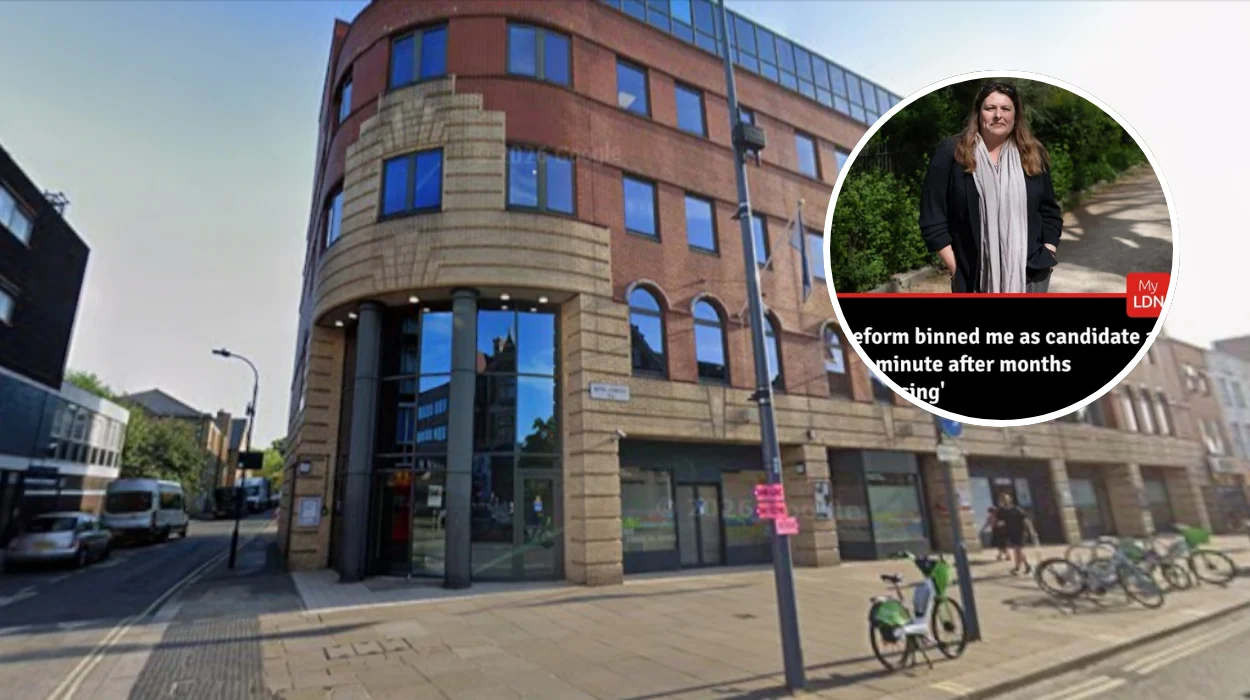
Hammersmith (The Londoner News) May 16, 2026 – Reform UK has formally suspended Laura Newman, a prominent local member and former prospective local election candidate in West London, after she publicly voiced severe criticisms regarding her treatment by the party’s local leadership. Ms Newman, who had been fully selected to contest the Hammersmith Broadway ward in the local elections held on 7 May, was informed via correspondence from party headquarters that her recent media disclosures were profoundly “damaging” to the political organisation’s broader interests.
- Key Points
- Why Was Laura Newman Suspended by Reform UK?
- How Did the Candidate Selection Dispute in Hammersmith Begin?
- Why Was Laura Newman Removed as a Candidate?
- What Treatment Did Ms Newman Receive After Rejecting the Alternative Ward?
- What Questions Were Raised Regarding Reform UK’s Candidate Vetting?
- How Did Local Branch Chair Dr Olivia Feng Respond to the Accusations?
- What Was Ms Newman’s Final Stance on Her Reform UK Membership?
- How Did Reform UK Perform in the May Local Elections?
The suspension was directly triggered by an interview Ms Newman gave to the Local Democracy Reporting Service (LDRS), which was published on 23 April. In that media disclosure, she heavily censured the administrative conduct of the local branch leadership after discovering she had been summarily dropped from the ballot. Following the disciplinary action, Ms Newman has declared that she has completely withdrawn her allegiance and no longer wishes to remain a member of Reform UK, asserting that she only went to the press as a last resort after her formal complaints were ignored by party officials for weeks.
Why Was Laura Newman Suspended by Reform UK?
The disciplinary intervention against Ms Newman followed her decision to break party ranks publicly just weeks before voters headed to the polls.
As reported by the LDRS, Ms Newman received an official email from Tom Waterhouse, the General Secretary of Reform UK, notifying her that her membership had been suspended pending a comprehensive internal investigation.
The explicit justification detailed by the party executive was that Ms Newman had launched an impermissible public attack on the organisation within the local press.
In the disciplinary email disclosed to the media, Mr Waterhouse pointed directly to specific phrasing used in the initial LDRS reporting. As recorded by the LDRS, Tom Waterhouse stated to Ms Newman that:
“In the article you say the Party has been ‘ruthless’ and ‘appalling’. The criticism of Reform came at a time when the Party was seeking to help thousands of candidates win votes for the elections on 7 May.”
The correspondence from the General Secretary further underscored the party’s strict internal communication protocols. As reported by the LDRS, Mr Waterhouse wrote that:
“As the Party Leader has made clear on numerous occasions, members of Reform may disagree with each other, but in private. The Party’s Constitution outlines internal processes for resolving issues regarding the conduct of other members. Openly attacking the Party in this way is damaging to the Party’s interests and has brought the Party into disrepute.”
How Did the Candidate Selection Dispute in Hammersmith Begin?
The roots of the internal schism date back to the intensive campaigning period preceding the candidate nomination deadlines. As detailed by the LDRS, the 50-year-old Ms Newman had initially become involved with Reform UK in the early months of last year after attending an introductory party assembly in Kensington and Chelsea.
She subsequently dedicated significant time to canvassing for various Reform UK candidates during local by-elections and ultimately agreed to stand as a candidate himself for the May local elections, informing local branch officials that she was highly flexible and willing to be allocated to any ward across the borough.
As reported by the LDRS, it was suggested to Ms Newman in February that she formally contest the Hammersmith Broadway ward, a locality situated just a short distance from her primary residence.
Following this directive, she began extensively developing a local grassroots support network alongside Muj Khan, who was selected as the second Reform UK candidate for the multi-seat ward.
According to accounts provided by Ms Newman to the LDRS, she spent months actively campaigning, canvassing local residents, and securing community support.
Official campaign photographs had already been processed, and a comprehensive election leaflet prominently featuring her name, face, and political platform had been officially drafted for distribution to households across the constituency.
Why Was Laura Newman Removed as a Candidate?
The campaign progressed without apparent incident until 30 March, a date exactly 11 days prior to the statutory deadline for political parties to formally submit their final candidate lists to local authorities.
As reported by the LDRS, Ms Newman stated that she received an unexpected telephone call from Dr Olivia Feng, the Chair of Reform UK’s Hammersmith and Fulham branch, explicitly informing her that she would no longer be permitted to contest the Hammersmith Broadway seat.
According to the account provided by Ms Newman to the press, Dr Feng alleged that the sudden change was a direct mandate from Reform UK party headquarters.
Dr Feng reportedly claimed that central command had issued a strict rule dictating that all prospective candidates must reside directly within the specific ward they were seeking to contest. Because Ms Newman lived slightly outside the immediate boundaries of Hammersmith Broadway, she was told she failed this criteria.
As reported by the LDRS, Ms Newman stated that Dr Feng instead offered her the alternative option of standing as a “paper candidate”—a candidate who appears on the ballot to ensure party representation but does not actively campaign—in the neighbouring ward of Fulham Reach. Ms Newman firmly rejected the proposal, stating she had no desire to contest an unfamiliar ward under those terms.
Furthermore, Ms Newman has strongly questioned the validity of the home-ward residency rationale provided by local leadership. In her disclosures to the LDRS, she cast significant doubt on the claim, pointing out that several other Reform UK candidates across the region were ultimately permitted to contest wards completely outside the immediate areas in which they resided, suggesting the rule was applied inconsistently.
Explore More West London News
Car smashes into planter on Wandsworth Bridge Road, Fulham 2026
Labour Council Deploys AI CCTV for Suspicious Behaviour in Hammersmith and Fulham 2026
What Treatment Did Ms Newman Receive After Rejecting the Alternative Ward?
Following her refusal to accept the paper candidacy in Fulham Reach, Ms Newman alleged that relations with the local branch leadership deteriorated drastically and immediately.
As reported by the LDRS, Ms Newman claimed that she was abruptly and completely excised from all internal party communications channels, including the local branch’s primary WhatsApp coordination groups, effectively isolating her from the campaign apparatus.
Describing the psychological and logistical impact of this sudden exclusion, Ms Newman expressed severe disillusionment with the party’s internal culture. In her initial interview with the LDRS, she characterized the actions of the local leadership as uniquely hostile, stating:
“There’s good and bad on both [the Labour and Conservative] sides. And I thought Reform were maybe going to come in fresh, take the good of both of those parties, and run with it and do something different, and do something new and radical. We’re going to listen to people that are your working average Joe and Joanna, we’re going to listen to these people, champion these people. When actually, you haven’t really done that, though, have you?”
Ms Newman further questioned the strategic direction of the local branch, asking via the LDRS:
“Why are you blocking people that are like me, that are interested in local and have been for years and years and years? And actively seeking people that haven’t really got an interest in politics, are not really bothered or are from the Labour Party?”
What Questions Were Raised Regarding Reform UK’s Candidate Vetting?
Beyond her personal grievances regarding candidate selection, Ms Newman also raised broader concerns regarding the stringency of Reform UK’s candidate vetting processes close to the election deadline. As reported by the LDRS, Ms Newman claimed that local leadership was under significant pressure to find candidates to fill empty slots quickly.
To support this claim, the LDRS verified messages sent from Dr Feng to Ms Newman, in which the branch chair appeared to actively enquire whether Ms Newman’s husband would be willing to step forward to stand as a paper candidate.
According to the LDRS report, Ms Newman explicitly responded to Dr Feng stating that her husband would be entirely unable to pass the party’s official vetting process due to the nature of his “previous tweets” on social media. The willingness of local leadership to solicit candidates under such circumstances raised serious questions for Ms Newman regarding the party’s structural oversight.
How Did Local Branch Chair Dr Olivia Feng Respond to the Accusations?
Following the publication of the initial complaints and the subsequent issuance of the party suspension, Dr Olivia Feng, Chair of Reform UK’s Hammersmith and Fulham branch—who ultimately stepped in to contest the Hammersmith Broadway ward herself following Ms Newman’s removal—issued a robust defence of her administrative actions and strongly rebuked the allegations.
As reported by the LDRS, Dr Feng dismissed the controversy entirely, framing it as the actions of an uncooperative individual. Dr Feng stated:
“Ms Newman is simply a disgruntled member who sought to undermine our campaign at every stage when she didn’t get her way. The fact the party has suspended her and not upheld her vexatious complaints against me tells you all you need to know.”
When the initial allegations regarding the late-stage candidate changes and the vetting text messages were originally put to Dr Feng and the central Reform UK press office by the LDRS prior to the April publication, neither Dr Feng nor the party provided any formal response.
Following the suspension, a central Reform UK spokesperson was again approached for comment on the matter. As reported by the LDRS, the spokesperson declined to provide specific details, stating as a matter of standard protocol that the party does not comment publicly on internal complaints and ongoing disciplinary procedures.
What Was Ms Newman’s Final Stance on Her Reform UK Membership?
In her formal counter-response sent to General Secretary Tom Waterhouse, Ms Newman sought to clarify that her public grievances were strictly confined to the administrative behavior of Dr Feng, rather than an existential attack on Reform UK as a whole.
She maintained that her recourse to the media was entirely reasonable given that the party’s central headquarters had failed to acknowledge or process her official internal complaints for several weeks.
However, the handling of the dispute has permanently severed her ties with the political movement. Speaking to the LDRS after her suspension was formalized, Ms Newman stated unequivocally that she has no desire to restore her standing within the party, criticizing the leadership’s public relations management. Ms Newman told the LDRS:
“Reform had gotten such crucial communications decisions so wrong.”
She added that the entire experience had left her feeling profoundly disillusioned with the political process, leaving her entirely undecided on who she would cast her vote for in the local elections.
How Did Reform UK Perform in the May Local Elections?
The public dispute in West London unfolded against a backdrop of significant national electoral expansion for Reform UK. In the local elections conducted nationwide on 7 May, the party secured historic gains across the United Kingdom, capturing more than 1,450 local council seats and successfully taking outright administrative control of several councils.
However, this national momentum did not translate into localized success in the specific borough where the dispute occurred. In Hammersmith and Fulham, Reform UK failed to pick up any council seats, with Dr Feng’s local campaign falling short. Despite the local failure in Hammersmith, the party achieved notable breakthroughs elsewhere within the broader London region, most significantly securing an electoral majority to take formal control of Havering Council.